

What Documents Are Required for DQ, IQ, OQ, and PQ of a Pharmaceutical Homogenizer?
A supplier’s ‘validation package’ may contain useful drawings and factory test sheets while leaving the site’s most important questions unanswered. Does the installed machine match the ordered design? Can it operate across the intended range? Does the real formulation meet its quality requirements? DQ, IQ, OQ and PQ organize the evidence for these different questions, so their files should not be four copies of the same checklist.
Design qualification (DQ) assesses whether the proposed design suits the intended use. Installation qualification (IQ) records and checks what was installed. Operational qualification (OQ) tests the required operation, while performance qualification (PQ) evaluates performance with production materials or justified equivalents. EU GMP Annex 15 provides this framework. Begin with the user requirements specification, then link each critical requirement to the document or test that will show whether it has been met.
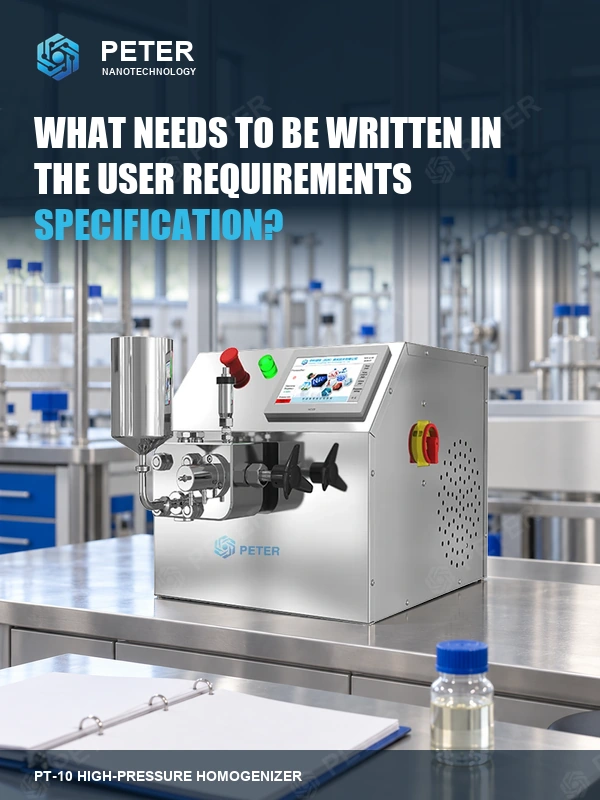
What needs to be written in the user requirements specification?
The user requirements specification, or URS, should explain the intended duty: feed properties, required output, product quality, temperature limits, cleaning, utilities and records. Distinguish essential requirements from preferences. A requirement that affects product quality needs a clear way to assess whether the equipment meets it.
For a development instrument, the intended use may differ from that of a machine in pharmaceutical manufacture. EU GMP Annex 15, section 3, makes the URS a reference throughout the qualification lifecycle. It is more useful to define the actual task than to ask broadly for a ‘GMP machine’ without stating what the process needs.
A traceability matrix links each critical requirement to its design response, verification method and accepted result. This prevents a requirement from being lost between purchasing, engineering and validation. It also exposes missing tests before execution, when there is still time to plan them properly.
Which design documents belong in DQ?
DQ reviews whether the proposed design meets the intended purpose and relevant GMP requirements. Useful documents include the URS, functional specification, process and instrumentation drawings, product-contact material information, utility schedule, cleaning concept and risk assessment. The review should identify unresolved assumptions while the design can still be changed.
For a homogenizer, ask how the product will reach the inlet, where pressure and temperature will be measured, which operating limits the equipment can support, and how contact parts will be cleaned. The supplier’s actual design must answer these questions. A catalogue description is not a substitute for a drawing or specification that identifies the ordered configuration.
The DQ, IQ, OQ and PQ documents can refer to one another, but each stage has a different purpose. The table below separates those purposes so a design review is not mistaken for proof of installed or product performance.
| Stage | Question being answered | Typical controlled evidence |
|---|---|---|
| DQ | Is the design suitable for intended use? | URS, design review, risk assessment and drawings |
| IQ | Was the specified configuration installed? | Identity, utility checks, calibration and material records |
| OQ | Does it operate across justified conditions? | Approved functional challenges and recorded results |
| PQ | Does it perform suitably in intended use? | Representative-material runs and quality evidence |
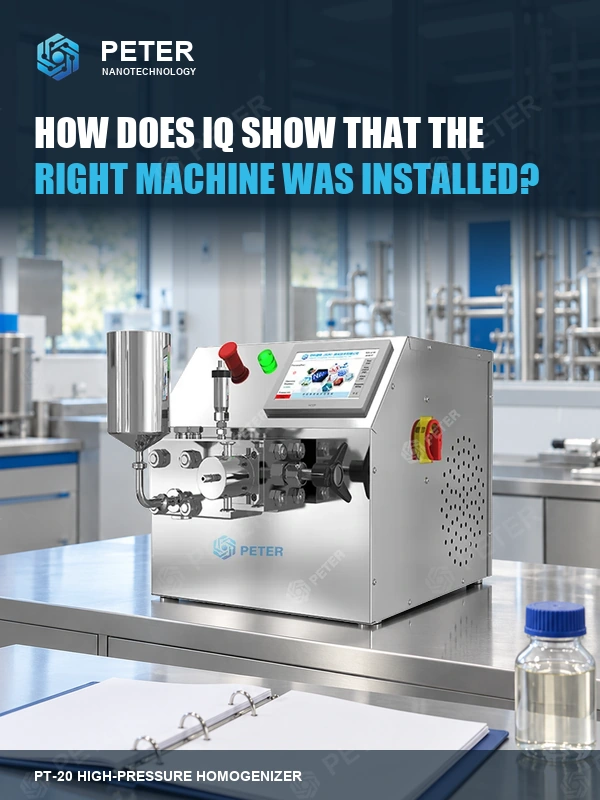
How does IQ show that the right machine was installed?
IQ records the equipment identity, configuration and location, then compares the installation with the approved specifications and drawings. Check utility connections, supplied instruments and calibration status. Collect relevant construction-material records, manuals and maintenance instructions. Record differences from the ordered design and resolve them through the site’s deviation or change procedures.
Annex 15 section 3.9 identifies installation verification, supplier instructions, calibration and construction-material checks among IQ considerations. Where material evidence is required, it should be traceable to the supplied component or assembly. A certificate naming a material without that link leaves the installation question unresolved.
Record software and configuration versions when they affect operation or data. Assess computerized-system requirements under the site’s quality system. The presence of a touchscreen alone does not establish which electronic-record controls apply.
What does OQ need to test beyond a successful start-up?
A start-up run at one convenient setting shows less than operation across the intended range. OQ tests the functions and conditions selected through the risk assessment. Depending on the supplied equipment, this may include pressure control, flow behavior, temperature measurement, alarms and responses to loss of a required utility.
Write the expected response and acceptance criterion before each test. Use calibrated measurements and suitable test materials, and record the conditions under which the test was performed. Challenge only functions actually supplied, using approved safe methods; qualification is not a reason to bypass guards or exceed working limits.
The FDA’s January 2011 Process Validation guidance describes a lifecycle approach in the US context. It supports a broader understanding of qualification and process validation, but should not be cited as a rule requiring these exact four document titles for every project.
Why does PQ need representative material rather than only water?
Water can demonstrate some equipment functions without behaving like a viscous formulation, fragile emulsion or biological material. PQ examines performance in the intended use, using production materials or substitutes with justified equivalent behavior. Its sampling and quality measurements need to answer the actual process question.
Consider relevant batch sizes, feed variation, settings and sampling frequency. A satisfactory pressure reading does not show that the product reached its required size distribution or retained its function. Likewise, satisfactory particle size does not establish acceptable cleaning or microbiological control. These activities can share information while retaining their own scope.
Choose the number of runs and challenge conditions through the applicable validation strategy and documented rationale. There is no universal rule that every DQ, IQ, OQ and PQ stage requires three batches. The study needs enough evidence for the intended use, with its acceptance approach agreed before results are available.
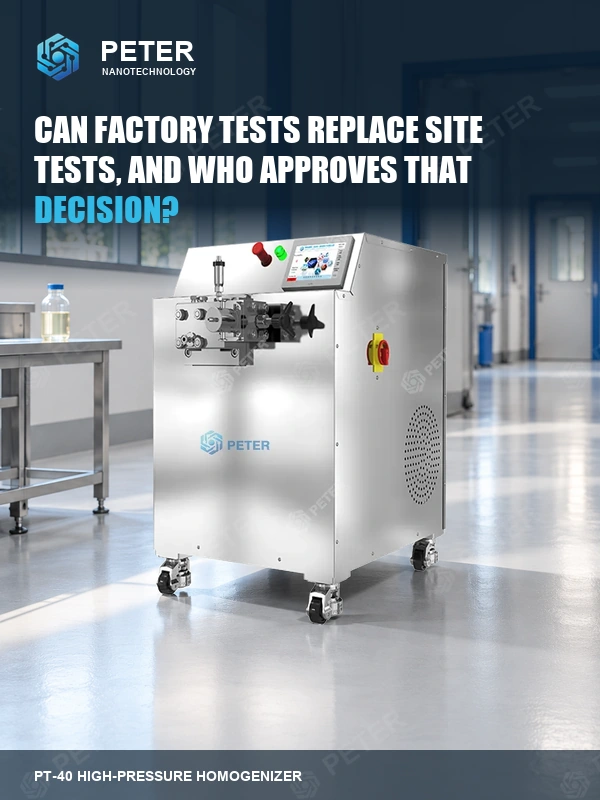
Can factory tests replace site tests, and who approves that decision?
A factory acceptance test (FAT) can provide useful evidence. Annex 15 allows justified reuse where the result remains relevant and is unaffected by transport or installation. Show which requirement the test supports, review its conditions and deviations, and identify what must still be checked at the site. A vendor’s completed form should not be accepted merely because it carries the right heading.
Assign each deliverable to a named function in the project plan. The supplier contributes agreed design and test records; site engineering checks installation and utilities; operations supports procedures and execution; the site’s validation and quality arrangements govern review and release. Open items need an impact assessment and authorized conditions for proceeding.
| Deliverable | Supplier contribution | Site decision |
|---|---|---|
| Design and material file | Configuration-specific records | Suitability and traceability review |
| FAT evidence | Executed tests and deviations | Justification for reuse after installation |
| IQ and OQ protocol | Available technical inputs or templates | Approval, supplementation and execution scope |
| PQ evidence | Equipment support as agreed | Product, sampling and acceptance strategy |
| Release | Closure of assigned technical items | Authorized quality-system decision |
When evaluating a laboratory high-pressure homogenizer such as the CAS PETER PT-20, request a list of available drawings, materials information and factory records. For a production high-pressure homogenizer, specify the installation and test documents needed for the larger process. Confirm availability and scope before purchase.
The experimental equipment category can help distinguish a development requirement from a manufacturing installation. These are equipment references on CAS PETER’s supplier-operated site; their listings do not establish completed qualification for a purchaser’s pharmaceutical process.
Frequently asked questions
What is DQ for a pharmaceutical homogenizer?
DQ assesses and documents whether the proposed design suits the intended purpose and relevant GMP requirements. It uses the URS, design information and risk assessment to identify whether important requirements have been addressed.
What documents are needed for IQ of a homogenizer?
Include identity and configuration records, installation drawings, utility checks, relevant calibration and material records, and supplier instructions. The records should describe the equipment actually delivered and installed, including resolved differences from the specification.
What should OQ test on a homogenizer?
Test the functions and ranges identified in the approved risk assessment. These may include control, measurement, alarms and supplied protective responses. Use predefined criteria and safe challenge methods appropriate to the installed design.
How is PQ different from OQ for a homogenizer?
OQ checks whether the equipment operates as required. PQ examines performance in the intended use with representative material and relevant quality measurements. Water tests can support some functions without proving formulation performance.
Which supplier documents should support DQ, IQ, OQ, and PQ?
Request design and connection drawings, configuration and material records, manuals, relevant calibration records and executed factory tests. Include test conditions, deviations and document versions so the site can decide which evidence is reusable.
Who is responsible for each qualification stage?
Assign responsibilities in the project plan and purchase scope. The supplier provides agreed technical records, while the pharmaceutical manufacturer defines its requirements and controls acceptance and release through its quality system.
References
- European Commission, EU GMP Annex 15: Qualification and Validation, 2015, sections 1–3
- FDA, Process Validation: General Principles and Practices, January 2011
- CAS PETER, PT-20 product page and original photograph, accessed 16 October 2026
Conclusion
A reviewer should be able to start with a critical requirement, find how the design addresses it, and see the accepted installation or test result. That is more useful than a large document package with unresolved gaps. Reuse supplier evidence where its relevance is clear, perform the remaining site tests, and keep product performance separate from a demonstration that the machine runs. The site’s authorized quality procedures determine when the evidence is sufficient to proceed.