

Batch vs Recirculation vs Continuous Homogenization: Which Process Is Better?
If a homogenizer processes 500 L/h, how much finished product can the line make? The answer changes if the batch needs two passes, returns to a mixed tank, or loses material during start-up and recovery. Comparing those arrangements by machine flow alone can make a workable process look slower than it is, or make an undersized line appear adequate.
Batch describes a defined lot, recirculation describes a return path, and continuous operation describes ongoing feed and product flow. They are not three mutually exclusive machine types. A batch can use separate passes or recirculation. Choose the arrangement by the treatment each portion needs, temperature control, recovered output and cleaning work. In a mixed recirculation tank, average turnovers do not mean every portion has received the same number of passes.
Can a batch process also use recirculation?
Yes. A batch is a defined quantity of material, while recirculation sends product back to a holding volume. A pressure homogenizer may transfer a batch into a separate receiver, process it through several segregated transfers, or return it to the original tank. These arrangements give the material different treatment histories even when the machine and pressure setting are unchanged.
Continuous operation feeds and removes material during steady production. It may still need upstream batch preparation, buffer tanks and start-up diversion. Tetra Pak’s homogenizers chapter places pressure homogenization within a processing line, which helps explain why the machine’s flow is only one part of plant output.
Describe the flow path before comparing equipment. A supplier can assess the proposed inlet and discharge conditions much more usefully from that description than from a request for a ‘batch machine’ with no explanation of where the treated material goes.
| Arrangement | How treatment is organized | Question to verify |
|---|---|---|
| Batch, one transfer | A defined lot moves to a separate receiver | Does one pass meet the endpoint? |
| Batch, discrete passes | Material is segregated between transfers | Are all required passes and hold-up controlled? |
| Batch with recirculation | Treated material returns to a holding tank | Is the exposure distribution acceptable? |
| Continuous | Feed and product move during steady operation | How are start-up, diversion and transitions controlled? |
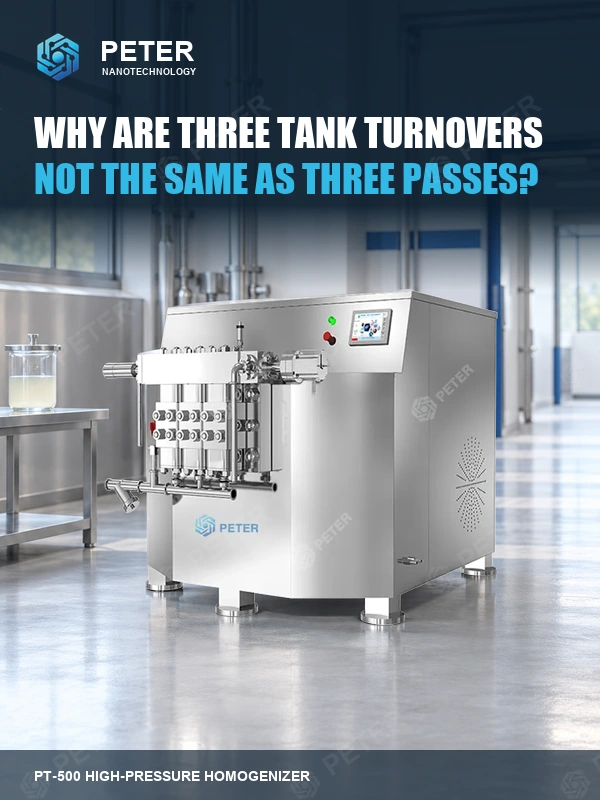
Why are three tank turnovers not the same as three passes?
During recirculation homogenization, returning material mixes with material that has received less treatment. Some liquid can re-enter the machine repeatedly before other liquid reaches it once. The ratio n = Q × t ÷ V gives average turnovers for flow Q, elapsed time t and working volume V. It does not assign that number of passes to every portion.
An ideal-mixing calculation illustrates the difference. Assume instantaneous perfect tank mixing, constant flow and volume, no dead zones and negligible external loop volume. Under those assumptions, the fraction that has not entered the treatment loop is exp(−n). After three average turnovers, exp(−3) is about 5%. This is a mathematical illustration, not measured behavior for a factory tank.
If every portion needs a defined minimum number of passes, segregated source and receiving tanks may provide clearer treatment boundaries. Hold-up and mixing at transfer boundaries still need assessment. Where the distribution matters to quality, a suitable tracer or residence-time study can test the actual arrangement.
When does a continuous single pass make more sense?
A single pass can be attractive when it reaches the required quality and the upstream feed remains consistent. It avoids repeatedly blending treated and untreated product in a holding tank. The line still needs sufficient downstream capacity and a way to handle start-up material or interruptions.
Separate passes can be easier to sample and cool between transfers when repeated treatment is required. Recirculation may be convenient in development when the exposure distribution is acceptable and samples show useful progress. Neither convenience nor a continuous label establishes which arrangement is best for the formulation.
Tetra Pak’s tanks chapter describes mixing, buffering and balance-tank functions. Do not assume a storage tank performs all of them adequately. The tank and its return arrangement need to suit the job assigned to them.
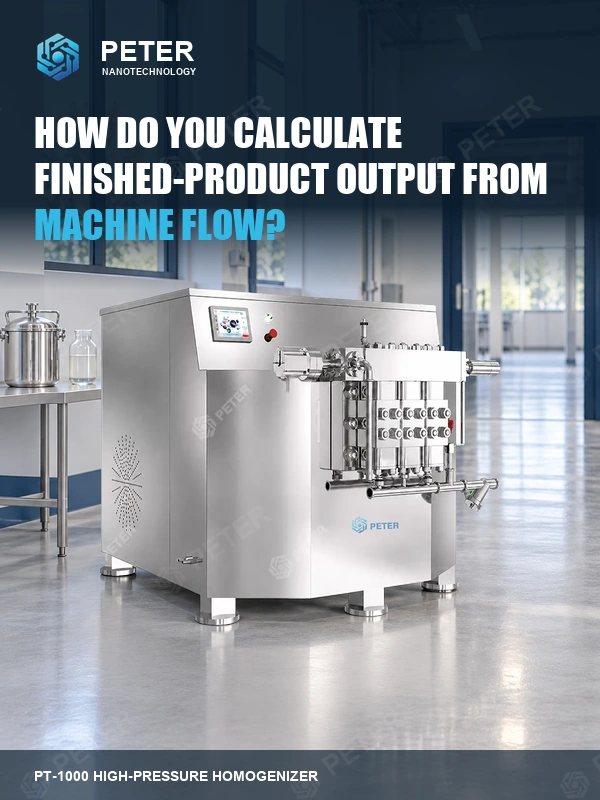
How do you calculate finished-product output from machine flow?
For separate passes, calculate treatment time for each transfer, then add preparation, cooling, recovery and cleaning. An illustrative 500 L batch processed twice at 500 L/h needs two hours for treatment alone. That gives 250 L/h of finished batch before any other time or losses. It is arithmetic for the stated assumptions, not a model performance claim.
For recirculation, report loop flow and batch completion time separately. Circulating the same liquid several times does not create more finished product. Use accepted recovered volume divided by the full cycle time when estimating output. For a continuous line, use accepted output over a consistent campaign period, including the relevant start-up, interruptions and changeover.
Small or valuable batches also make hold-up important. Record what remains in the machine, cooler and lines and how it can be recovered. Comparing only hourly flow can miss a material loss that matters more than a modest difference in processing time.
| Capacity measure | What belongs in it | Misleading comparison to avoid |
|---|---|---|
| Machine flow | Actual volume through the device per time | Treating loop flow as finished output |
| Batch output | Accepted recovered batch divided by cycle time | Ignoring additional passes and cooling |
| Campaign output | Accepted product divided by relevant campaign time | Excluding start-up and changeover from only one option |
| Recovery | Saleable output relative to charged material | Ignoring cooler and line hold-up |
What changes in cooling and cleaning when you add a return loop?
A return loop adds product-contact surfaces and may bring a tank, cooler and additional connections into the cleaning boundary. A short single-pass route may have less hold-up, while a continuous line may need more attention to transitions and segregation. Compare the installed system rather than assume one mode is always easier to clean.
Follow product temperature at the treatment outlet and at the next inlet exposure. Warm liquid returned to the tank changes the starting condition for later treatment. Cooling may keep the bulk tank temperature low without showing the brief hotter exposure before the exchanger.
For medicinal-product applications, EU GMP Annex 15 provides the qualification and validation framework. Include the relevant connected system in that work. Cleaning or qualification evidence for the stand-alone machine does not automatically cover a newly added return line and tank.
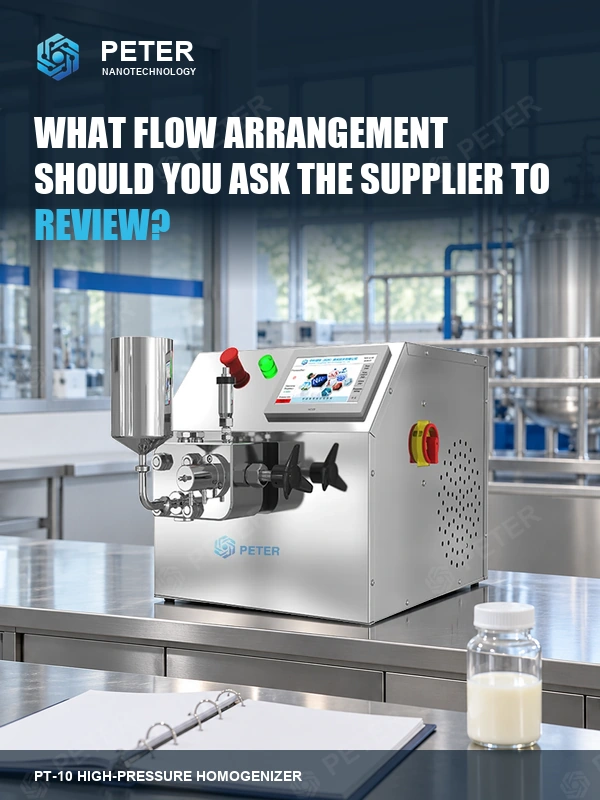
What flow arrangement should you ask the supplier to review?
For a production high-pressure homogenizer such as the CAS PETER PT-1000, state the working volume, required treatment, proposed return or receiving arrangement and accepted output target. Ask for pressure and actual flow together, supported feed conditions, cooling duties and product hold-up for the quotation.
A pilot high-pressure homogenizer trial can help establish how much treatment the product needs before the production layout is fixed. Record feed preparation, flow, pressure, temperature, sampling point and recovered product. These details allow the supplier and site team to check whether the proposed larger arrangement is comparable.
This comparison was reviewed on 16 October 2026 using the cited sources and the explicitly hypothetical calculations above. It compares process arrangements, not measured brand performance. CAS PETER operates this site; its model links are equipment references for a supplier discussion.
Frequently asked questions
What is the difference between batch and continuous homogenization?
Batch processing handles a defined lot. Continuous operation feeds and removes material during steady production. A batch can still flow through a pressure homogenizer, so the terms do not identify different homogenizing mechanisms.
When is recirculation better than single-pass processing?
Use it when repeated treatment is useful and the resulting exposure distribution and temperature history are acceptable. Track the batch’s quality over time rather than treating average turnovers as guaranteed passes.
How does residence time change between batch and continuous systems?
Liquid in a mixed recirculation tank can pass through the machine different numbers of times. Separate transfers give clearer pass boundaries, subject to hold-up and transfer mixing. Assess the actual exposure where quality depends on it.
Which process mode is easier to clean and validate?
The installed contact path determines cleaning work. A return loop adds surfaces, while a continuous line may add transition and segregation requirements. Compare the actual layouts rather than the mode names.
How should capacity be compared across batch and continuous homogenizers?
Divide accepted recovered product by a consistent full cycle or campaign time. Include required passes, preparation, cooling, recovery and changeover. Keep loop flow separate from finished output.
What data should be recorded during a recirculation trial?
Record working volume, loop flow, pressure, temperature over time, elapsed time and sampling location. Include preparation and recovered output, and distinguish average turnovers from separate passes.
References
- Tetra Pak, Dairy Processing Handbook, chapter 7.3: Homogenizers, accessed 16 October 2026
- Tetra Pak, Dairy Processing Handbook, chapter 7.10: Tanks, accessed 16 October 2026
- European Commission, EU GMP Annex 15: Qualification and Validation, 2015
- CAS PETER, PT-1000 product page and original photograph, accessed 16 October 2026
Conclusion
Choose the simplest arrangement that gives the required quality with an understood treatment history. One pass, separate repeated passes and mixed-tank recirculation answer different needs. Compare them using accepted recovered output over the same operating period, with cooling and cleaning included. This avoids paying for a high loop-flow figure that does not translate into useful production, or choosing an apparently faster arrangement that cannot treat the batch consistently.