

Enzyme Activity After High-Pressure Cell Disruption: A Recovery Guide
High-pressure cell disruption should be optimized for recovered enzyme activity, rather than the amount of protein released. A useful trial measures activity and protein in matched feed, whole lysate, clarified extract and retained solids, while recording temperature, residence time and sample handling. More pressure or another pass can improve release yet reduce the active material available for the next step. The best operating condition therefore depends on the target enzyme, the assay and downstream recovery. This guide explains how to separate those effects before choosing a cell-disruption configuration or transferring a laboratory result to a larger batch.
Separate release, activity and recovery
A cloudy lysate or a higher soluble-protein concentration does not identify how much active target enzyme has been recovered. Cell disruption releases many components together. The target may remain associated with debris, enter the liquid fraction, aggregate, or lose activity during processing and subsequent holding. Begin by identifying the fraction that the next production step will actually use.
Record three different questions in the trial brief. How much target material was released? How much catalytic activity remains under the specified assay conditions? How much of that activity survives clarification and transfer? Keeping these questions separate makes the investigation actionable when the numbers move in different directions.
The study on protease extraction from brewer’s spent yeast compared disruption routes using protein and activity measurements. Its results illustrate why cell breakdown and useful enzyme recovery need separate endpoints; they do not establish a universal ranking for every organism or enzyme. Treat the paper as evidence for the measurement distinction, rather than a recipe for a different feed.
Establish an assay before varying pressure
Agree the substrate, assay temperature, pH, reaction interval, detection method and activity-unit definition before testing the homogenizer. Use a range in which the analytical response can be interpreted reliably. If the assay becomes nonlinear at high extract concentration, dilution must follow a documented method rather than an improvised adjustment for each sample.
Include a reagent blank and an appropriate sample blank where the lysate contributes color, turbidity or background signal. Compare sample dilution behavior and assess whether the matrix interferes with the readout. A high-pressure treatment can change the sample matrix, so matching dilution factors alone does not guarantee matching analytical conditions.
Use the same reference preparation across a comparison series where practicable. Record the time between collection and assay, storage temperature and any freeze-thaw event. A sample tested immediately after processing should not be compared without qualification against another sample that spent several hours awaiting analysis.
Build a fraction-by-fraction sampling map
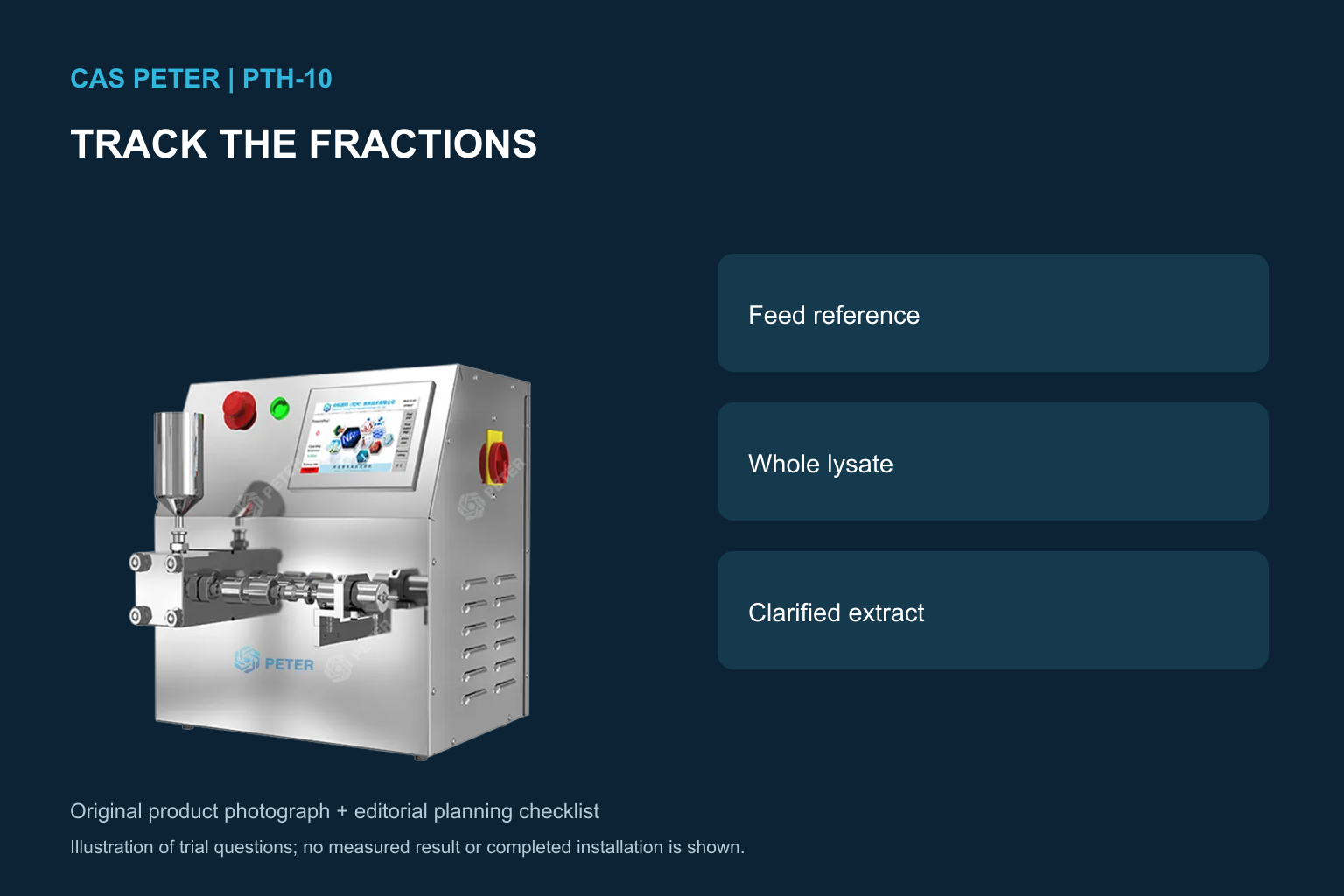
Collect representative feed before processing, whole lysate after each planned treatment, the clarified liquid and the retained solids. Define the separation procedure, including the equipment setting and elapsed time. Retain an aliquot of the unprocessed reference under matched holding conditions to distinguish processing effects from ordinary time-dependent changes.
Where the target is expected in the soluble fraction, clarified-extract activity is usually the practical decision endpoint. Where activity is intentionally associated with a particulate fraction, the collection and assay method must reflect that objective. Do not discard the retained solids automatically and then describe the remaining activity as complete recovery.
| Sample or record | Question it answers | Practical comparison |
|---|---|---|
| Matched unprocessed reference | Did holding alone change activity? | Same storage and assay schedule |
| Whole lysate | What did disruption release into the mixture? | Activity and protein on the same basis |
| Clarified extract | What reaches the next liquid-phase step? | Total units and extract volume |
| Retained solids | Is useful target still outside the extract? | Suitable recovery or activity test |
| Time and temperature history | Could exposure explain a change? | Feed, outlet, cooling and hold records |
This is a planning matrix, not a standardized assay. The selection of fractions follows the recovery question, and the analytical method must be qualified for the actual enzyme and sample matrix.
Report total activity alongside specific activity
Activity concentration, total activity and specific activity describe different things. Total activity equals activity concentration multiplied by the recovered volume, provided the units are consistent. Specific activity divides total activity by the amount of measured protein. An extract can have higher specific activity while containing fewer total active units because some non-target protein, target enzyme or both have been removed.
For a hypothetical example, an extract containing 20 units per milliliter in 80 milliliters contains 1,600 units. A second condition producing 25 units per milliliter in 50 milliliters contains 1,250 units. The second extract is more concentrated but does not contain more total activity. These numbers explain the calculation only; they are not CAS PETER test results.
Any percentage recovery needs a defensible denominator. An intact-cell feed assay may not access intracellular enzyme completely. If total recoverable activity has not been established using a suitable reference extraction, label the comparison as relative extract activity rather than absolute recovery. Preserve raw volumes and dilution calculations so another analyst can reproduce the result.
Use temperature as an experimental variable
Measure feed and discharge temperatures and record the cooling arrangement and delay before collection. A single final tank temperature can hide short exposure at the outlet and longer exposure during recirculation. Identify where each sensor sits and whether its response is suitable for the observation being made.
Published work on glucose oxidase after high-pressure homogenization found that the observed activity response depended on assay pH and that improved activity under one condition did not mean improved thermal tolerance. That distinction is useful when reviewing trial data: activity measured under a selected analytical condition is not a complete stability profile.
Do not infer that a process described as nonthermal has no temperature consequences. Specify an acceptable exposure window for the target and verify the actual configuration. Where cooling is required, include coolant supply and heat-exchanger performance in the trial record rather than assuming that the equipment name describes the installed cooling package.
Increase processing only when the next measurement justifies it
Start from a documented, manufacturer-approved operating window for the actual suspension. Keep biomass concentration, buffer composition, feed preparation and starting temperature controlled while screening pressure or pass count. Changing all of them simultaneously can produce a result that cannot be attributed to any one factor.
Collect at selected intermediate points instead of testing only the initial and final samples. Stop expanding a condition when the active recovery no longer improves meaningfully, the target is already met, or a temperature or equipment limit is approached. More complete disruption can increase the burden on clarification without increasing the usable enzyme fraction.
A pressure benefit observed with an isolated enzyme preparation cannot predict the release behavior of an intracellular enzyme in a different organism. Establish the actual relationship using representative feed, a controlled assay and matched sampling. Keep the analytical conclusion distinct from any proposed mechanism until additional evidence supports that mechanism.
Diagnose a mismatch between protein and activity
If soluble protein increases while active units decline, first verify assay interference and sampling consistency. Then review temperature, holding time and the fractionation procedure. Compare the retained solids and extract before concluding that the target was irreversibly damaged. A separation change can redistribute measured activity even when total recovered target changes little.
If whole-lysate activity is acceptable but clarified-extract activity falls, examine losses at the separation and transfer stages. Record the volumes left in containers, removed as samples and retained with debris. A stronger disruption condition can change the physical behavior of the lysate, so the same clarification setting may not have the same recovery effect.
When the activity result rises unexpectedly, repeat the assay with suitable controls and an independent preparation. A change in accessibility or assay inhibition can alter the measured response. Describe the finding at the level supported by the evidence; do not convert an unexplained analytical increase into a claim of improved enzyme structure or commercial yield.
Prepare the equipment and scale-up discussion
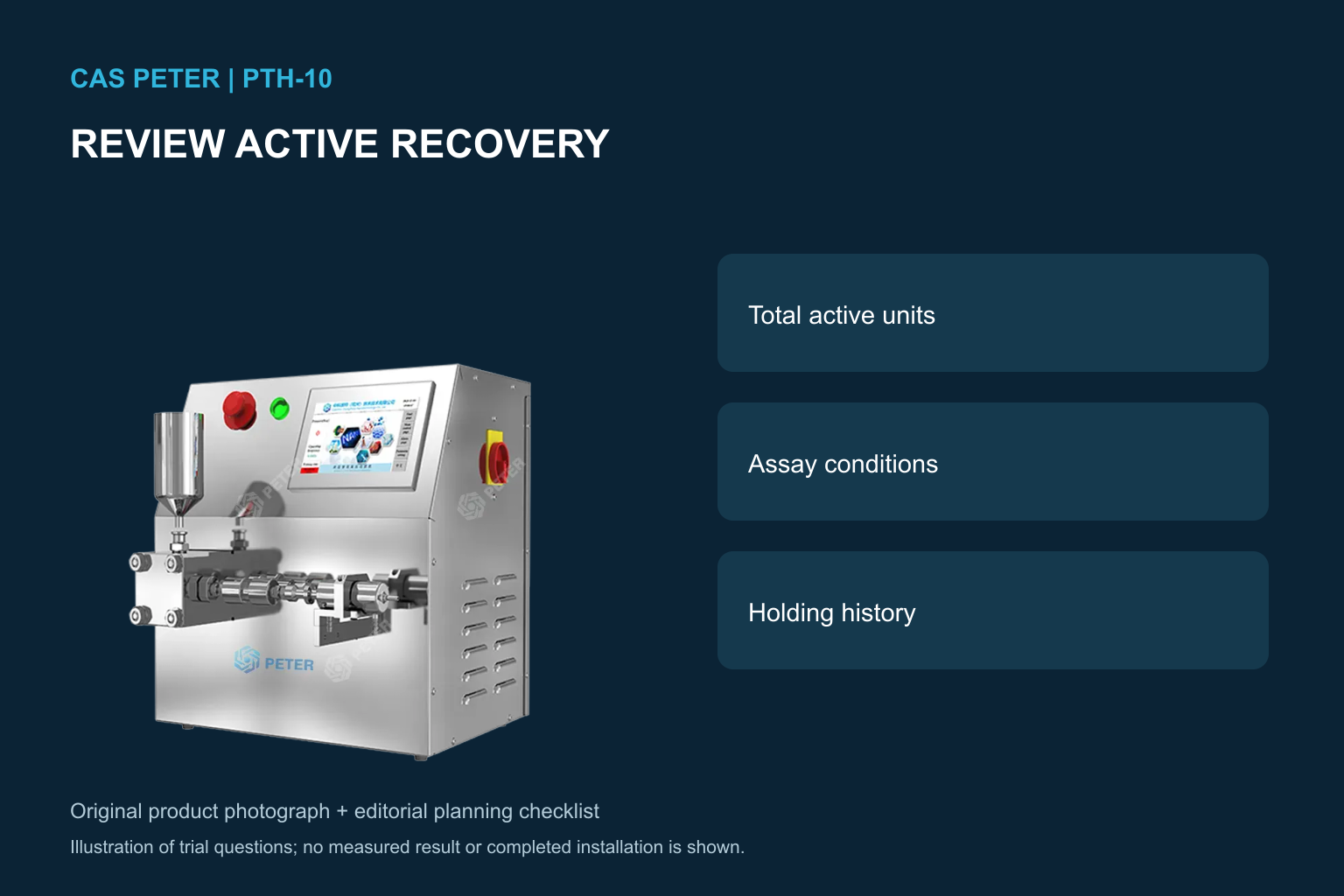
The CAS PETER PTH-10 product page provides a starting point for a cell-lysis discussion. Share the organism, biomass condition, buffer, target fraction, available sample volume and assay plan. Ask for confirmation of feed compatibility, pressure and flow at the intended condition, temperature monitoring, cooling and recovery arrangements for the quoted configuration.
Keep the general cell-lysis equipment guide separate from the enzyme-specific acceptance plan. For complementary preparation questions, review the yeast disruption trial guide and the article on inclusion-body recovery. The latter concerns a different target fraction and helps explain why one recovery workflow should not be transferred automatically to another.
A handoff record should identify the winning condition, the tested range, sample lineage, analytical uncertainty and unresolved limits. Include the conditions that failed, since they define the boundary of the usable window. Request a representative confirmation trial at the next scale instead of assuming that matching a nominal pressure alone reproduces enzyme recovery.
Educational video: why assay conditions matter
The Khan Academy lesson below explains how temperature, pH and substrate conditions affect enzyme activity. It supports the assay-planning section; it does not demonstrate homogenizer performance, validate a production protocol or supply an acceptance limit for the target enzyme.

Educational source: Khan Academy India – English. Watch the lesson on YouTube.
Frequently asked questions
Does more soluble protein mean better enzyme recovery?
No. Soluble protein includes other released components. Compare target activity, total recovered units, measured protein and the relevant product fraction. State whether the reference method supports an absolute recovery percentage.
Should every additional pass improve activity?
No. Further treatment can change release, temperature exposure, assay response and separation behavior in different ways. Keep another pass only when the measured active recovery or another agreed endpoint justifies it within the approved operating window.
Can one published enzyme study set our operating pressure?
No. An enzyme preparation, organism, buffer and analytical method define a particular experimental system. Use research to identify variables and risks, then establish a suitable condition through representative, controlled trials.