

Viscous Cell Lysate After Homogenization: Separate DNA Effects from Solids
A viscous cell lysate after homogenization needs diagnosis before another pass is added. Released nucleic acids, suspended solids, formulation components and sample handling can contribute to difficult flow. Compare representative samples at the same temperature and concentration, retain a record of cell disruption, and measure the target product alongside handling behavior. Do not use stringiness as proof of incomplete lysis or easy pipetting as proof of successful protein recovery. The useful endpoint is a lysate that can enter the intended downstream step while retaining the product attributes that matter for the project.
Identify what the downstream operation needs
Start by naming the product: a soluble protein, an insoluble fraction, a nucleic acid or another intracellular component. The acceptable disruption and handling route depends on that objective. A treatment that makes a sample easy to transfer may be unsuitable when the project requires preservation of a sensitive macromolecule.
List the next unit operation and its feed requirements. Clarification, filtration and an analytical assay can each be affected by a poorly representative or difficult-to-transfer sample. State which handling difficulty is actually being observed: pumping, taking a defined aliquot, separating a liquid fraction or obtaining reproducible analytical results. Avoid reducing all of these to a single viscosity complaint.
Also record the biomass source, concentration basis, resuspension medium and any pretreatment. A wet-cell mass concentration is not interchangeable with an optical-density measurement or a dry-solids concentration. Preserve the units and preparation procedure so that an apparently similar feed does not enter the next trial with a different cell loading.
Separate observation from a proposed mechanism
Write down what happens during transfer and sampling before assigning a cause. Threads extending from a pipette tip, a coarse suspended fraction and an apparently thick but uniform liquid are useful descriptions. None alone establishes the identity or amount of the material responsible.
New England Biolabs’ technical guidance on high-molecular-weight DNA explains that viscous DNA samples can be difficult to handle and measure, and that uneven distribution can complicate concentration assessment. That source concerns prepared DNA samples. It supports caution about representative sampling; it should not be treated as a validated protocol for an untreated industrial cell lysate.
Treat the DNA hypothesis as a testable explanation. Preserve an untreated aliquot and consult an appropriate analytical method for the actual sample matrix. Measurements that are valid for purified DNA may be unreliable in a lysate containing proteins, particulates and buffer components. State the sample preparation and method limits alongside any reported nucleic-acid result.
Make sampling representative before comparing conditions
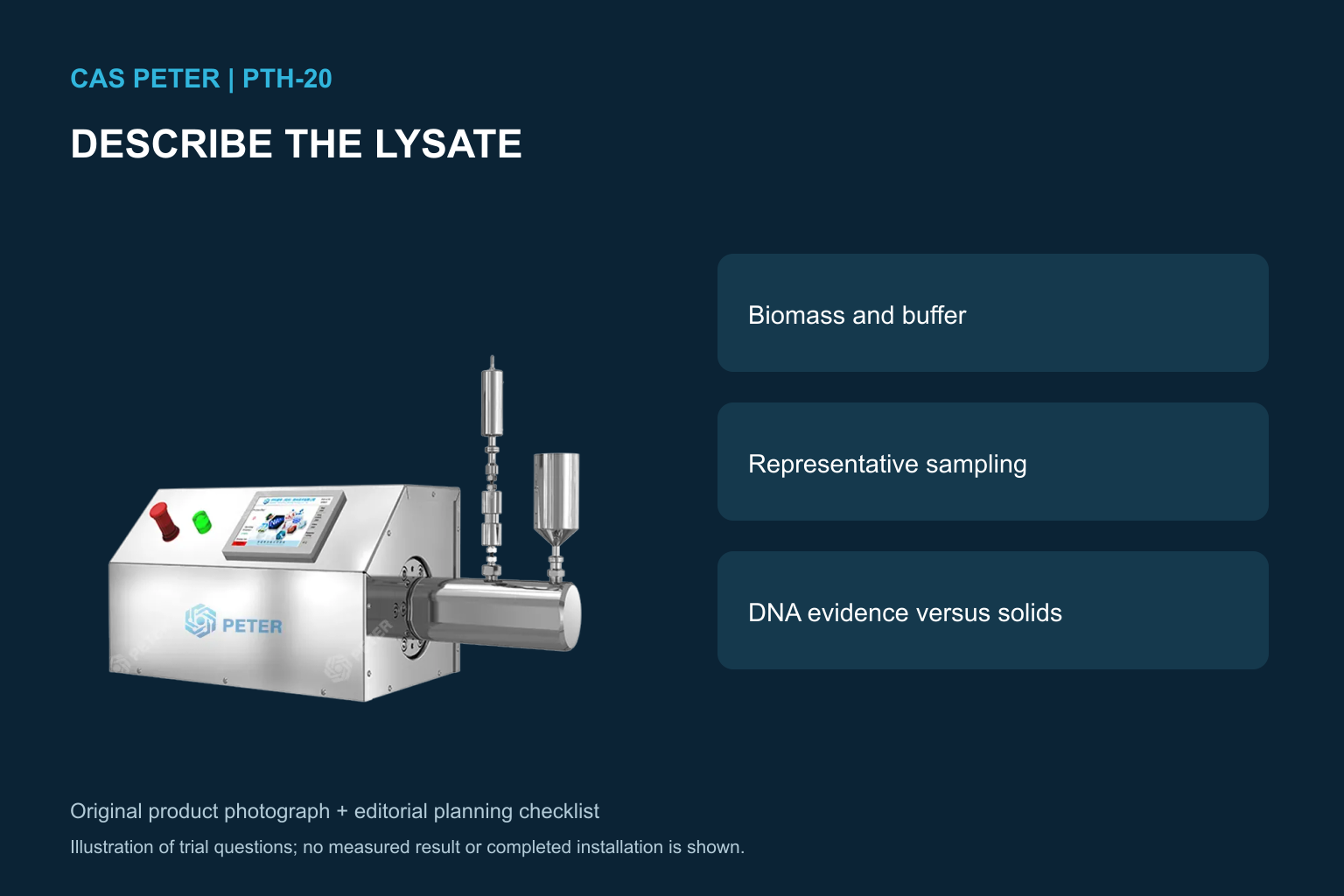
Use a consistent, equipment-compatible mixing procedure before withdrawing an aliquot. Record the sampling point and elapsed time after processing. If settling occurs, decide whether the measurement concerns the whole lysate or a defined fraction. Mixing only the control while allowing treated samples to settle creates a misleading comparison.
Keep sample temperature, container and holding history consistent. Document freezing and thawing where they occur. Do not describe a fresh whole lysate and a previously frozen clarified sample as equivalent materials. If the assay requires a clarification step, preserve enough information to connect its result back to the original batch.
Difficult pipetting can create an apparent concentration difference when the intended volume is not actually transferred. Use a suitable validated transfer method and check practical recovery where necessary. Analytical repeatability should be established before a small difference between processing conditions is interpreted as a biological effect.
Use a diagnostic matrix rather than an automatic extra pass
The table below is an editorial planning framework. It does not diagnose a sample or prescribe nuclease treatment, pressure or a universal viscosity limit. Select the actual methods with the process and analytical teams.
| Observation or question | Useful comparison | Boundary on interpretation |
|---|---|---|
| Sampling is inconsistent | Repeated transfers from a consistently prepared whole sample | Variable transfer may reflect sampling error as well as material heterogeneity |
| A coarse fraction remains | Whole lysate versus a defined separated fraction, with a material balance | Removing solids can improve handling while losing target product |
| DNA is suspected | Matrix-appropriate nucleic-acid evidence with a retained control | Stringiness alone does not identify the responsible component |
| Another pass improves flow | Matched product recovery, temperature history and downstream performance | Better handling does not prove improved product quality |
| Dilution appears helpful | Defined dilution with concentration and batch-volume accounting | Lower concentration can move the problem into a larger downstream volume |
Choose the smallest comparison capable of resolving the current uncertainty. For example, a separation comparison can help locate the handling problem in a fraction, but it cannot by itself explain molecular structure. Keep a clear distinction between a screening observation and a verified mechanism.
Report rheology with its measurement conditions
If a rheometer or viscometer is used, record the geometry or instrument method, temperature, sample preparation, timing and measurement program. Retain the measured curve or underlying observations rather than reporting one unqualified viscosity value. Confirm that the measurement arrangement is appropriate for the suspended material.
The experimental study of DNA solution extensional viscosity demonstrates that DNA solutions can require characterization beyond a simple assumption of water-like flow. Its defined polymer solutions are not crude cell lysates. Use it as a reason to select an appropriate measurement question, not to transfer its results into a pump calculation for an uncharacterized biological feed.
Where the immediate issue is a practical transfer step, retain a controlled handling test alongside formal rheology. State the tool, sample quantity and observation method. A repeatable handling test may be useful for internal decisions, but do not relabel an informal observation as a calibrated viscosity measurement.
Follow product recovery across every intervention
Retain a product assay that answers the actual process objective. For a soluble product, follow the relevant fraction and assay response after the defined preparation procedure. For an insoluble target, establish how much product is retained in the separated fraction. A total-protein measurement cannot substitute automatically for a target-specific assay or an activity result.
Report both concentration and the recovered fraction quantity. A more dilute lysate can show a lower concentration despite unchanged total recovered product. A concentrated sample can appear favorable while much of the batch has been lost during transfer or clarification. State the basis used for comparing runs and include samples, discarded fractions and recovery rinses in the accounting.
This is especially important when testing an additional pass. Record the sample taken before it, the material actually processed afterward and the temperature and hold time between the two. If a large analytical sample has already been removed, the remaining material is no longer the original batch quantity. Keep the record sufficient to reconstruct that difference.
Treat dilution and enzymatic options as process changes
Dilution may make a sample easier to handle, but it changes the downstream volume and potentially the analytical matrix. If it is evaluated, specify the diluent, ratio, resulting volume and any changes in salt or buffer composition. Compare total product recovery and downstream burden, not only the immediate improvement in pipetting.
Any enzymatic treatment requires its own compatibility and clearance assessment. Select it with the responsible process team and the intended product requirements in mind. Do not add a nuclease solely because a generic troubleshooting article mentions DNA. The treatment can introduce new analytical questions and affect the composition entering subsequent steps.
Similarly, changing buffer, holding time or separation conditions introduces a new process variable. Keep controls that distinguish the effect of the intervention from simple dilution or additional waiting. Record what has changed and what remains constant, so that a promising observation can be repeated and interpreted accurately.
Decide when another homogenization run is justified
An additional pass should answer a defined question and remain within the supplier-approved operating conditions for the real feed. If disruption is already adequate and product recovery has stopped improving, a more fluid-looking sample alone may not justify further exposure. Conversely, evidence of incomplete disruption may support a targeted comparison if the product assay and thermal control are in place.
Record inlet and outlet temperatures and the time between passes. Use a consistent cooling arrangement and identify interruptions. A nominally identical pressure comparison with different thermal histories can give a result that cannot be attributed to pressure alone. Stop and review an unexpected change in operating behavior according to the equipment procedures.
Repeat the selected route with a fresh preparation before treating it as a process decision. Instrument repeats from one sample estimate measurement consistency; they do not establish reproducibility of biomass preparation and disruption. Retain both successful and unsuccessful run records to prevent the next team from repeating an uninformative comparison.
Prepare a supplier discussion with an identified bottleneck
The CAS PETER PTH-20 product page is a starting point for discussing a cell-processing trial. Confirm the actual configuration, wetted materials, compatible biomass feed, temperature-control arrangement and cleaning procedure. A model photograph or a general cell-disruption application statement does not establish the outcome for a specific organism or product.
Send the biomass description, concentration basis, buffer, observed handling problem, intended downstream operation and product-assay plan. State whether the objective is improved release, easier transfer or better clarification. These goals may overlap, but naming the current bottleneck helps keep the next trial focused.
Use the cell-lysis process guide for broader context, the inclusion-body recovery guide when the target belongs to an insoluble fraction, and the enzyme recovery guide when activity is the acceptance criterion. This article addresses the narrower problem of interpreting difficult lysate flow without confusing handling with recovery.
Educational video: interpreting flow behavior
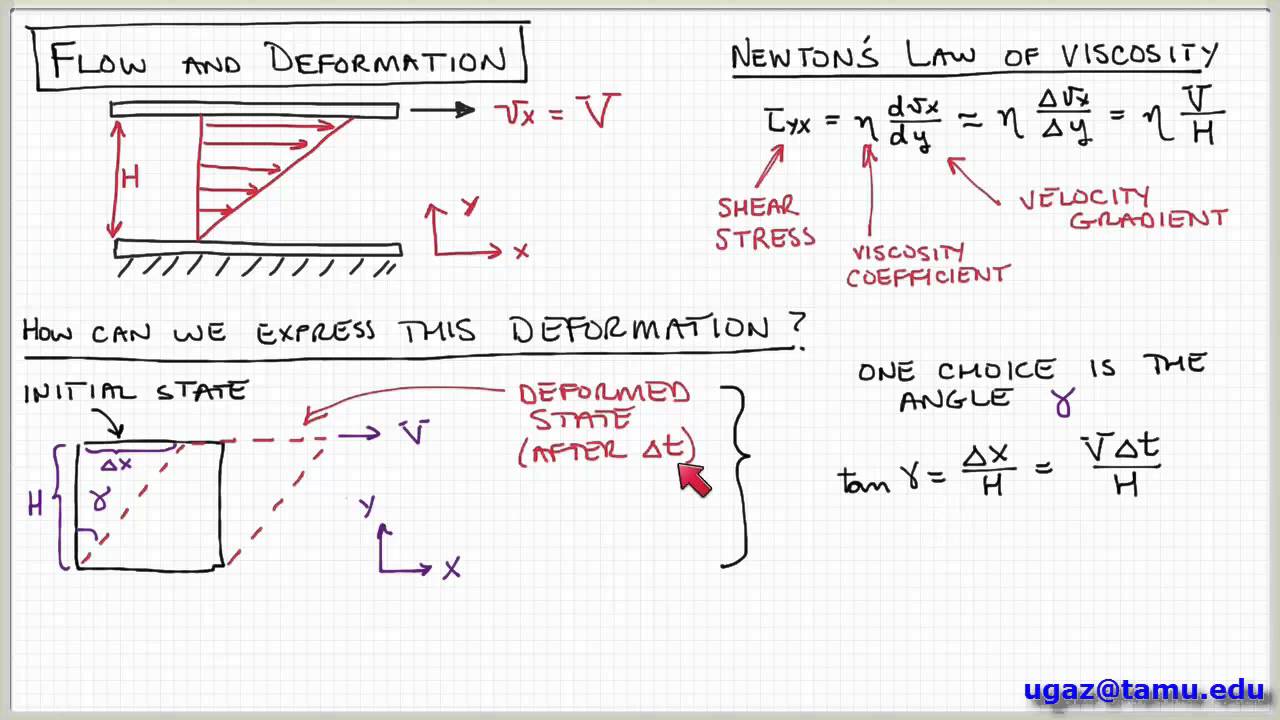
Victor Ugaz’s lecture introduces non-Newtonian fluids and the need to describe how a material responds under stated flow conditions. It supports the measurement discussion here. It does not identify the cause of viscosity in a particular lysate or provide a biological processing recipe.
Educational source: Victor Ugaz. Watch the lesson on YouTube.
Frequently asked questions
Does stringy lysate prove that cells were not disrupted?
No. Record disruption and nucleic-acid evidence using appropriate methods. Appearance alone cannot establish the degree of cell breakage or the component responsible for difficult handling.
Is dilution a complete solution to the problem?
Not necessarily. Account for the larger downstream volume, final buffer composition and recovered product quantity. A more convenient sample transfer can still create an impractical downstream process.
Should another pass be selected from viscosity alone?
No. Compare the handling result with target recovery, relevant quality attributes, thermal history and downstream performance. Confirm that any additional run remains within the approved operating conditions for the actual feed.