

Endotoxin After High-Pressure Homogenization: Evaluate the Downstream Burden
Endotoxin after high-pressure homogenization must be evaluated as an impurity burden within the complete recovery process. Breaking Gram-negative cells can make an intracellular protein accessible while also releasing material that complicates clarification and purification. Homogenization is not an endotoxin-removal claim. A useful development comparison follows target-product recovery, impurity concentration, recovered volume and downstream performance together. This article explains how to frame that comparison for established laboratory or production workflows, without prescribing a cell-disruption protocol, a depyrogenation process or a finished-product acceptance limit.
Why disruption and purification are different questions
A cell-disruption step answers how to make intracellular material accessible. A purification step answers how to separate the desired product from the accompanying material. Optimizing the first operation only for release can create an unfavorable starting point for the second.
For Gram-negative production hosts such as E. coli, endotoxin is associated with the outer membrane. The relevant concern is not simply whether cells have broken, but how the resulting material behaves across the recovery train. A sample with a high target-protein concentration may still impose a difficult impurity load on later operations.
The general cell-lysis equipment guide provides context for homogenization as a mechanical operation. The present discussion concerns the evidence needed after disruption. It does not compare organisms for pathogenicity or provide instructions for modifying biological agents.
Begin with the actual product requirement and established process scope. A research reagent, a process-development intermediate and a finished biopharmaceutical do not have interchangeable release requirements. Define the analytical and quality questions through the responsible product-development team rather than adopting an unsourced universal endotoxin number.
Do not infer endotoxin removal from protein release
When homogenization releases more target product, several explanations may fit the observed concentration change. The sample volume may differ, the target may have moved between fractions, or the measurement matrix may have changed. Total protein is also not necessarily a selective measure of the target protein.
Track product quantity and quality with suitable product-specific methods. Avoid using an increase in bulk protein or a change in appearance as proof that the desired product has been recovered in usable form. A clear-looking supernatant can contain soluble impurities that visual inspection cannot establish.
A primary study comparing recovery approaches measured product and impurity outcomes separately when examining a selective release method against a homogenization reference. The study illustrates why recovery and impurity burden deserve distinct measurements. Its organism, product and process conditions do not establish a general performance expectation for another system.
The comparison also needs a clear boundary. An observation made immediately after disruption cannot be called a final purified-product result. Label each sample by its process position so that a reduction after clarification is not mistakenly attributed to the homogenizer itself.
Follow the impurity burden through the process
Concentration and total burden answer different questions. A concentration result describes the sampled liquid. The load presented to the next operation also depends on the amount of that liquid. Adding buffer can lower concentration without demonstrating that impurity material has been removed.
Keep volume or another appropriate quantity record with each analytical sample, and state the units. If an endotoxin result is expressed per unit of target protein, retain the underlying concentration and product measurement as well. A favorable ratio can otherwise conceal a loss of product or a change in dilution.
At fractionation steps, identify which stream contains the desired product. A soluble target may be followed in the clarified liquid, whereas an insoluble recovery route has a different fraction map. The site’s inclusion-body recovery discussion addresses that distinct recovery objective; its conclusions should not be transferred automatically to soluble products.
A TU Wien research thesis on downstream integration describes how unselective release can burden later processing and compares recovery routes using multiple quality measures. Its abstract supports the systems-level question: what happens after the product is released? It does not validate a specific impurity-removal method for the reader’s process.
Establish an analytical result you can interpret
Complex process samples can challenge an assay. The responsible laboratory should establish whether its selected method is suitable for the matrix and intended decision. Record dilution and sample preparation, and retain the relevant method controls instead of treating every reported number as automatically comparable.
If two treatment samples require different analytical handling, document that difference. A result below a reporting limit is not proof of zero endotoxin. Likewise, a result from an unsuitable or unresolved assay matrix should not be presented as a demonstrated reduction.
Use consistent sampling points and handling conditions. Delays, settling and nonrepresentative sampling can change which fraction reaches the test container. State whether the sample was taken from a mixed bulk stream, a clarified fraction or another defined location.
When a result seems unexpectedly favorable, examine the method and material record before selecting the condition. Check the sample identity, dilution calculation, product concentration and recovered volume. Repeating the same unsupported interpretation does not resolve an analytical uncertainty.
Compare downstream usability, not only disruption strength
The following table is an editorial decision framework. It organizes the recovery questions illustrated by the cited research; it is not a validated analytical procedure or a set of regulatory requirements.
| Process question | Evidence to retain | Important comparison | What the result cannot establish alone |
|---|---|---|---|
| Was the desired product recovered? | Selective product quantity and relevant quality result | Matched starting material and defined fractions | Bulk protein does not prove target recovery |
| What impurity reaches the next step? | Endotoxin result with units and recovered quantity | Concentration together with stream amount | Dilution is not demonstrated removal |
| Is the assay interpretable? | Method suitability and relevant control records | Comparable sample matrices and handling | A low result does not prove absence |
| Can clarification handle the material? | Recovery, throughput and relevant separation observations | Defined downstream operating conditions | A visually clear sample does not prove purity |
| Is the complete route better? | Usable product after agreed recovery stages | Product yield, quality and resource requirements | More disruption does not guarantee better overall output |
Use this framework to agree the trial’s decision before generating a large sample set. For example, if clarification capacity is the practical constraint, a small increase in initial release may be unhelpful when it substantially increases the downstream burden. The full recovery route determines the useful result.
Keep biological variation visible. Starting biomass, culture history and the product’s initial location can affect a comparison. Use a matched-material screen where appropriate, then confirm the selected approach with independent batches under the organization’s established handling controls.
Keep viscosity and impurity conclusions separate
A difficult-flowing lysate can indicate a handling problem, but viscosity does not measure endotoxin. Material contributing to flow behavior and material contributing to an assay signal may overlap only partly. Use the appropriate evidence for each question.
The viscous lysate troubleshooting article discusses how to distinguish nucleic-acid effects from other solids-related behavior. That is complementary to the impurity-load question here. Improving flow may help sampling or clarification without demonstrating endotoxin clearance.
Similarly, a treatment that reduces the amount of visible debris does not necessarily reduce the soluble impurity burden. Retain analytical results for the relevant downstream stream rather than using one convenient physical observation as a surrogate for all quality attributes.
If a process modification improves several outcomes, report each one with its own basis. State which result was directly measured and which remains a hypothesis. This makes it possible for another team to reproduce the comparison without inheriting unsupported assumptions.
Turn the findings into an equipment requirement
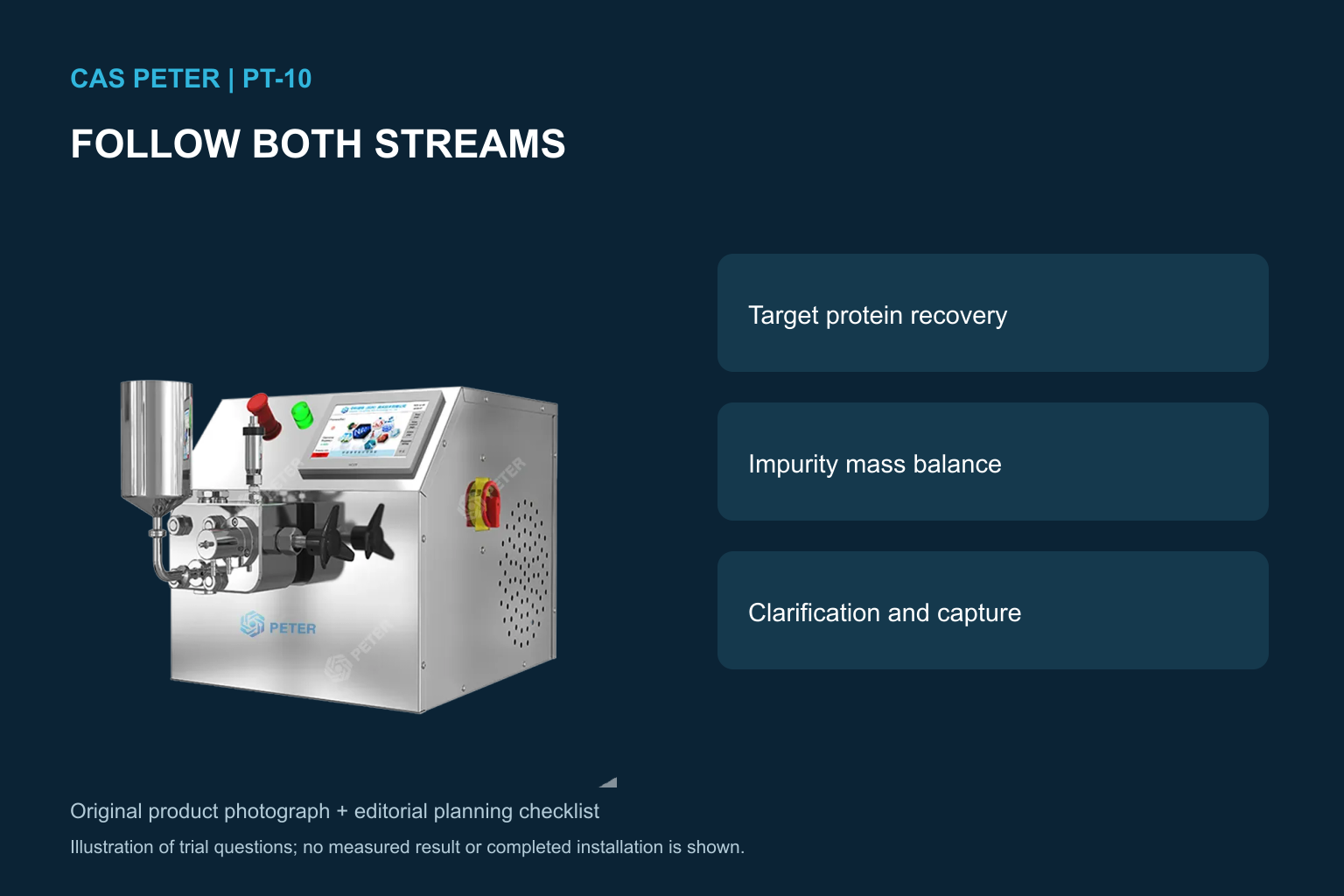
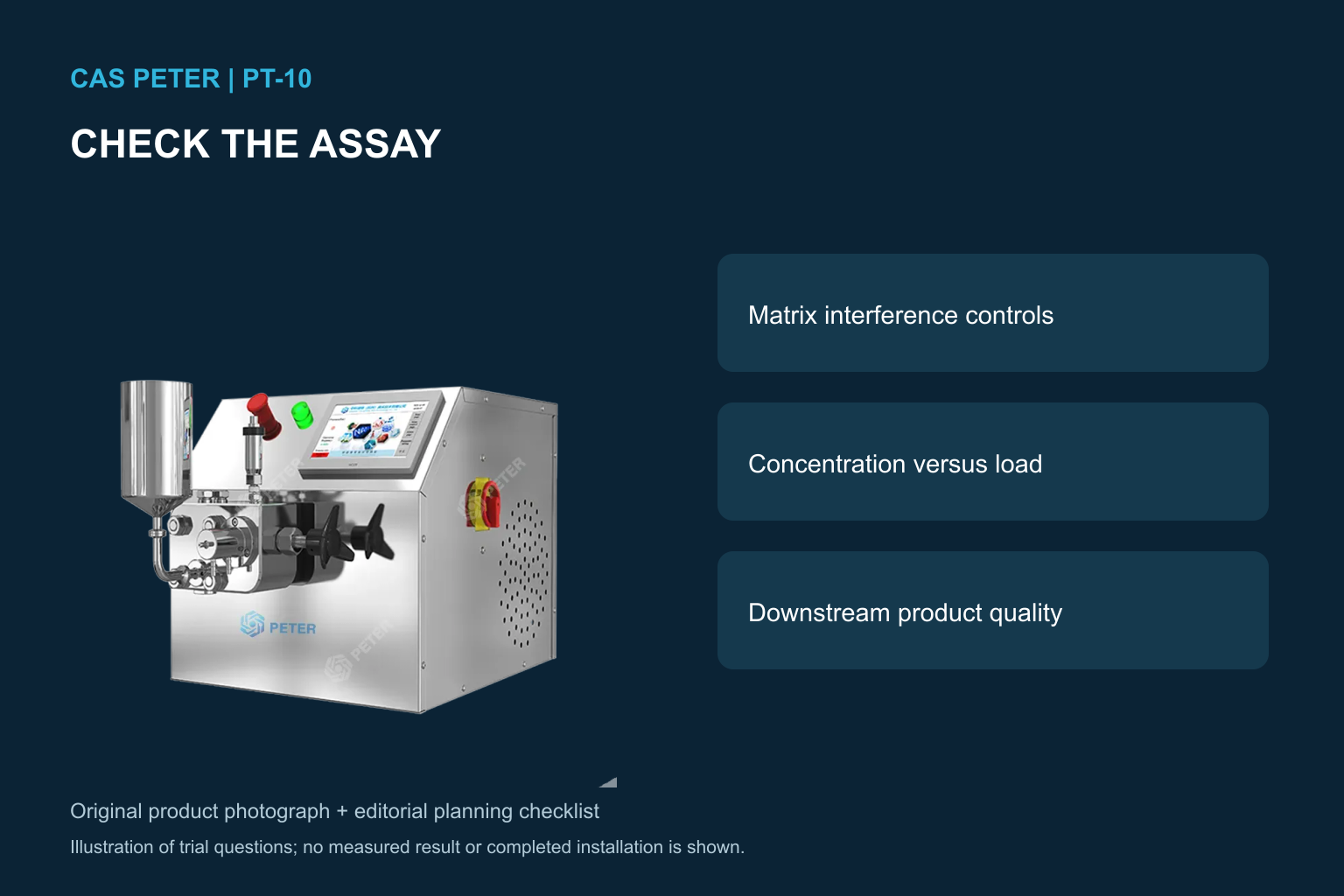
The CAS PETER PT-10 product page provides a laboratory equipment reference for supplier discussion. The illustrations use its original product photograph. They do not show an executed endotoxin study, certify a hygienic configuration or establish suitability for any particular biological material.
Describe the approved process scope, feed characteristics, working volume, temperature-control needs and recovery expectations to the supplier. Ask for confirmation of the proposed configuration, wetted materials and cleaning documentation against the actual use case. Product photographs alone cannot answer those questions.
For development work, consider how samples and recovered product will be accounted for. Equipment hold-up and sampling losses can matter when comparing small batches. Keep those losses separate from analytical recovery and downstream yield rather than attributing all missing product to damage during homogenization.
When considering a larger machine, transfer the product and impurity acceptance questions as well as the basic operating description. Demonstrating comparable initial release is only part of the comparison. The resulting material must also remain suitable for the planned clarification and purification route.
Explain the conclusion at the correct process boundary
A useful report names the starting material, the compared operation, the sampled fractions and the observed downstream outcome. It states the limitations of the analytical methods and the scope of batch confirmation. This is more actionable than declaring one disruption condition universally best.
If the trial shows increased product recovery but unresolved impurity handling, retain both findings. The condition may be promising while still requiring downstream development. If an impurity reduction appears only after a later operation, credit that operation and its verified process boundary.
Do not describe a laboratory comparison as completed product validation. The responsible quality and product teams must determine the applicable requirements and further evidence. The homogenizer’s role can be described precisely without implying that mechanical disruption itself delivers the final purified product.
Further learning: why LPS is biologically significant
The Science Communication Lab lecture below features Yale and HHMI researcher Ruslan Medzhitov discussing inflammation and disease tolerance, including responses to lipopolysaccharide. It provides biological background for why this impurity matters. It is not an endotoxin assay tutorial, a treatment recommendation or a purification protocol.
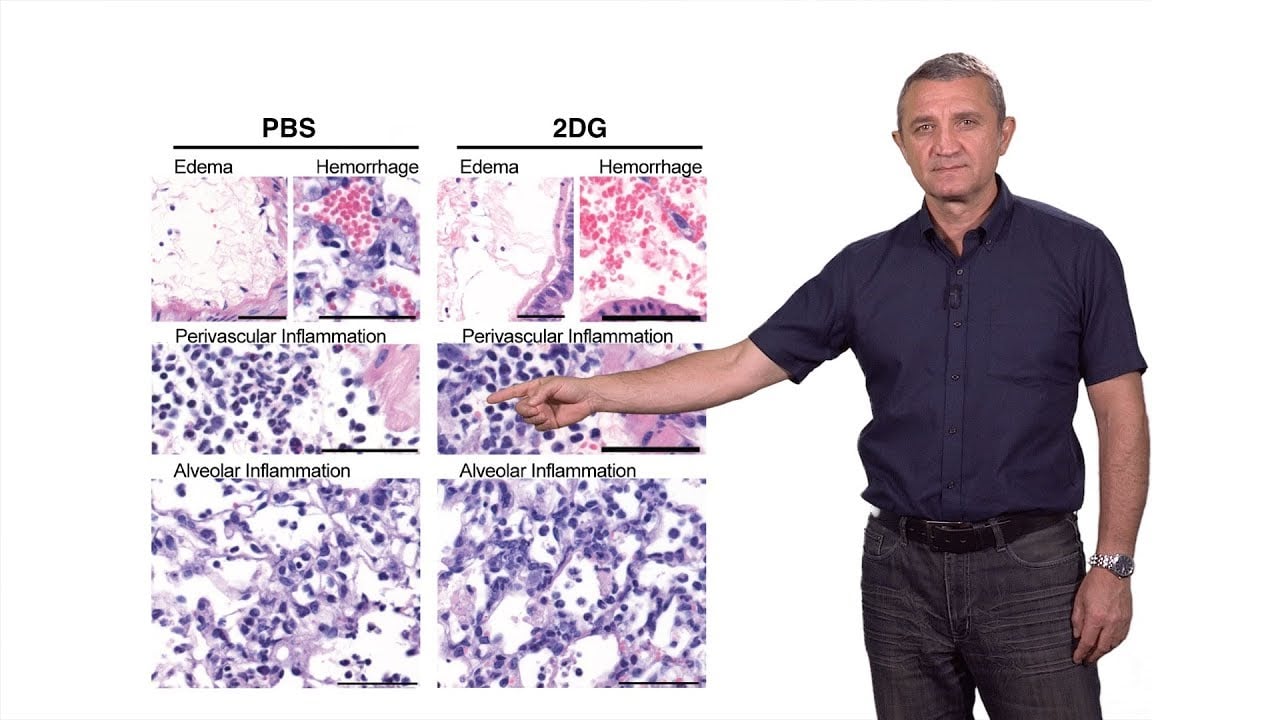
Educational source: Science Communication Lab. Watch the lesson on YouTube.
Frequently asked questions
Does high-pressure homogenization remove endotoxin?
Mechanical disruption should not be treated as an endotoxin-removal claim. For Gram-negative production cells, it can release material that burdens later processing. Demonstrated clearance requires suitable measurements across the relevant recovery and purification operations.
Is a lower endotoxin concentration always a better result?
No. Compare concentration with recovered volume or stream quantity and target-product recovery. Dilution can lower a concentration without proving impurity removal, while product loss can distort a normalized comparison. Retain the underlying measurements and units.
Can a viscosity measurement replace an endotoxin assay?
No. Viscosity describes flow under specified conditions, while endotoxin testing addresses a different property through a suitable analytical method. Flow improvements may help handling, but they do not establish impurity clearance or final-product suitability.