

High Pressure Homogenizer Manufacturer in China
Choosing a high pressure homogenizer manufacturer in China should be an engineering review, not a price-only exercise. The important questions are whether the supplier can reproduce the required result, document the test conditions, control product-contact materials, and support the machine after delivery.
Summary: Evaluate a Chinese supplier by application engineering, pressure and flow stability, wetted materials, factory testing, documentation, quality controls, spare parts, and after-sales support. A representative sample trial should precede a final equipment decision.
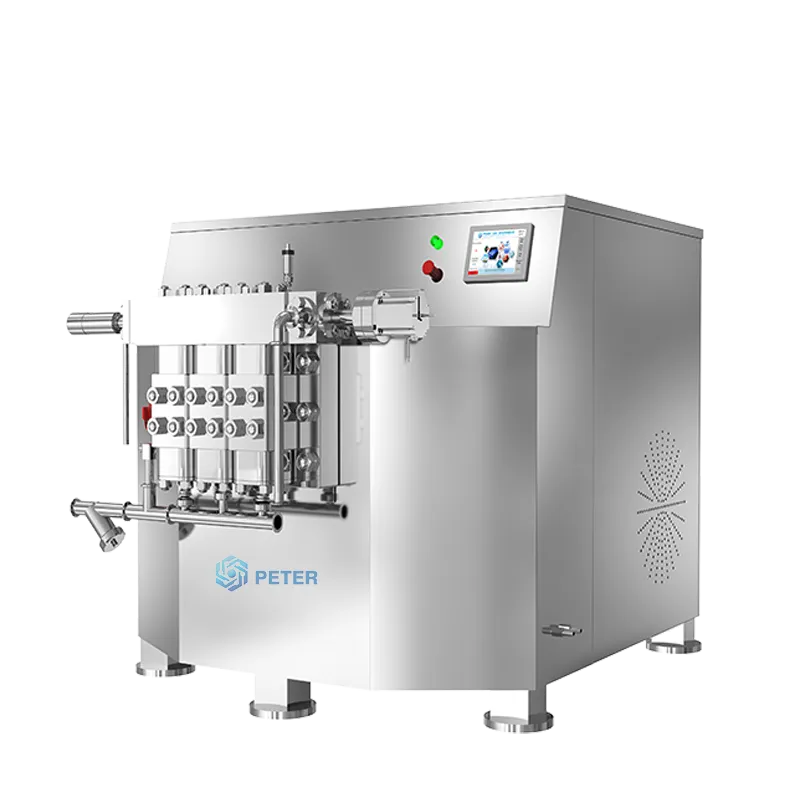
1. What does a high pressure homogenizer manufacturer provide?
A capable manufacturer provides more than a pump and valve. The complete solution may include process consultation, equipment sizing, pressure and flow control, cooling integration, sanitary or laboratory materials, factory acceptance testing, manuals, spare parts, installation support, and method-development guidance. The supplier should be able to explain how the machine changes droplets, particles, agglomerates, or cells in the buyer’s formulation.
2. What engineering evidence should be requested?
| Evidence | What to check | Why it matters |
|---|---|---|
| Performance test | Sample, pressure, flow, temperature, endpoint | Separates verified capacity from nameplate data |
| Material list | Valve, chamber, seals, tubing, wetted metals | Confirms chemical, hygienic, and abrasive compatibility |
| Calibration records | Gauge, sensor, flow, and control checks | Supports repeatability and release decisions |
| Factory acceptance test | Defined pass/fail criteria and deviations | Reduces commissioning surprises |
| Service plan | Wear parts, response time, training, remote support | Protects uptime after delivery |
3. Which specifications determine model fit?
- Maximum working pressure: useful only when paired with stable operation at the target pressure.
- Flow capacity: quote it at the actual viscosity, solids loading, and temperature.
- Minimum feed volume: essential for expensive research or clinical materials.
- Feed particle size: oversized solids can block the valve or damage wear parts.
- Cooling performance: outlet-temperature limits protect proteins, emulsions, and bioactivity.
- Cleaning and sterilization: materials, drainability, and process contact must match the application.
4. How should quality and compliance be assessed?
ISO 9001:2015 provides a framework for documented quality processes, supplier control, calibration, and corrective action. Pharmaceutical buyers should review 21 CFR Part 211 expectations for suitable equipment design, cleaning, and maintenance. ASME BPE can guide hygienic design for bioprocess applications. Buyers should also verify pressure-component ratings, electrical conformity, local import requirements, and the availability of English technical documentation.
5. How should global buyers manage risk?
| Risk | Pre-delivery control | Contract evidence |
|---|---|---|
| Performance mismatch | Representative sample trial | Acceptance endpoint and test report |
| Documentation gap | Review drawings and manuals | Document list and revision control |
| Damage in transit | Inspect packaging and preservation | Shipment photos and inspection procedure |
| Service delay | Identify local or remote support | Response time and spare-parts list |
| Installation error | Confirm utilities and training | Commissioning checklist |
6. What should a supplier trial include?
- Use the buyer’s material or a justified surrogate with similar viscosity and solids.
- Record pressure, flow, pass count, inlet temperature, outlet temperature, and recovery.
- Measure the agreed quality attribute with a named method.
- Repeat the condition and document any deviation.
- Explain how the result transfers to pilot or production equipment.
CAS PETER develops laboratory high-pressure homogenizers, the higher-throughput PT-20, pilot PT-40 systems, and production PT-500 equipment. Buyers can also review the company profile and request a documented application discussion.
7. How should a buyer compare Chinese manufacturing partners?
A serious comparison begins with the same user requirement sent to every supplier. It should state the required high pressure homogenization endpoint, batch size, solids, viscosity, inlet temperature, outlet-temperature limit, and intended cleaning method. Suppliers of high pressure homogenizers should return assumptions with every performance claim so that flow and pressure data remain comparable.
The buyer should also review how the factory controls incoming materials, machining, assembly, calibration, and final testing. For biotechnology homogenizer projects, product recovery and sanitary risk can matter more than peak pressure. A trial report should connect homogenization equipment settings to a named analytical result, while a service plan should identify wear parts, tools, and remote-support procedures.
High pressure homogenization scale-up should be discussed before the laboratory purchase. If the pilot valve, flow path, or cooling strategy changes completely, the development result may not transfer. Well-documented high pressure homogenizers reduce this uncertainty by maintaining a clear chain from sample trial to factory acceptance and site commissioning.
8. Frequently asked questions
What is high pressure homogenization?
It is a continuous process that forces liquid through a controlled valve or interaction chamber at high pressure. Mechanical energy reduces droplets or particles, disperses agglomerates, or disrupts cells.
What are the different types of homogenization?
Common types include rotor-stator shear, ultrasonic cavitation, bead milling, high-pressure valve processing, microfluidization, and specialized impingement. Each has a different heat, scale, and cleaning profile.
What is a pressure homogenizer?
It is a homogenization machine that uses a pump and pressure-controlled restriction to create high velocity gradients and energy dissipation in a liquid stream.
What is the purpose of a homogenizer?
Its purpose is to deliver a more uniform product or a controlled structural change such as smaller droplets, dispersed particles, or ruptured cells.
How to calculate homogenization efficiency?
Define a quality endpoint, then compare the achieved change with energy, time, flow, temperature, and pass count. A practical metric may be particle-size reduction per unit energy or active product recovered per pass.
9. References
A reliable manufacturer is measured by evidence after the quotation—not by the quotation itself. CAS PETER builds high-pressure homogenization equipment for that standard. Send your sample, capacity, endpoint, and destination requirements for a technical review.