

Best High Pressure Cell Disruptor For Labs 2026
The best high pressure cell disruptor for a laboratory is the one that gives a measurable lysis result while protecting the target product. Buyers are looking beyond headline pressure to recovery, temperature control, digital records, cleanability, and a path from experiment to pilot scale.
Summary: Evaluate a high pressure cell disruptor using the real feed, target recovery, pressure stability, cooling, minimum volume, pass count, wear parts, and service support.
For equipment selection, high pressure homogenizer, cell disruptor, and ultra high pressure homogenizer should be assessed against the actual sample, process target, and temperature limit.
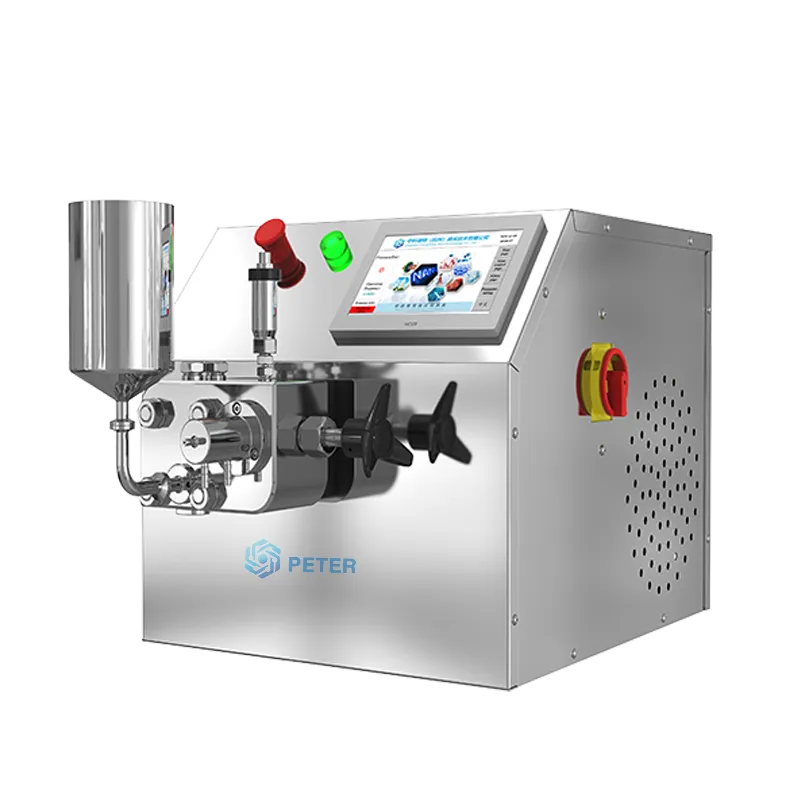
1. What problem does this process solve?
Bacterial and yeast walls, concentrated suspensions, abrasive solids, and heat-sensitive proteins each narrow the useful process window. Feed preparation and cooling are part of selection.
2. Which feed or sample factors matter?
| Factor | Why it matters | Practical check |
|---|---|---|
| Volume and flow | Sets residence time and recovery | Run a timed mass balance |
| Viscosity and solids | Changes pressure stability and blockage risk | Record the real feed condition |
| Temperature | Protects product quality | Measure inlet and outlet |
| Endpoint | Defines whether processing worked | Use an analytical assay |
3. How does the equipment create the result?
Pressure-driven shear and turbulence are generated in a valve or interaction chamber. An ultra high pressure homogenizer is not automatically better if the sample is fragile or the hold-up volume is high.
4. Which operating variables should be optimized?
Change one variable at a time: pressure or speed, flow, pass count, feed concentration, and cooling. The useful setting is the lowest energy that reaches the target without excess heat, foam, wear, or product loss.
5. How should performance be measured?
Record lysis, soluble product recovery, temperature history, and product quality. Repeat the preferred condition with another operator before drawing a purchasing conclusion.
6. What common mistakes reduce repeatability?
- Choosing by maximum pressure or motor speed alone
- Testing water instead of the real formulation
- Ignoring feed preparation and maximum particle size
- Skipping temperature, recovery, or cleaning records
For equipment options, see the PT-10 laboratory homogenizer, PT-20 high-pressure homogenizer, and CAS PETER technical support.
7. How should a laboratory trial be documented?
- Describe sample composition, concentration, and volume.
- Set the acceptance endpoint and temperature limit.
- Record pressure or speed, flow, pass count, and temperatures.
- Repeat the preferred condition with a second run or operator.
- Note cleaning, wear parts, recovery, and deviations.
8. Frequently asked questions
What is the best cell disruptor for laboratory work?
The best system is the one that meets the measured lysis and recovery target on the real sample.
Can high pressure replace chemical lysis?
It can reduce or remove reagents in many workflows, but the choice depends on cell type and downstream compatibility.
How can cells be lysed without overheating?
Pre-cool the feed, shorten passes, monitor temperature, and stop once the analytical endpoint is reached.
Related CAS PETER Articles
Read this related homogenizer article for connected equipment and process guidance.
9. References
- NCBI review of mechanical cell disruption
- 21 CFR Part 211
- FDA cGMP guidance
- ASME bioprocessing equipment
Choose the platform that makes your lab result repeatable and scalable. Contact CAS PETER with your sample and target result.
high pressure cell disruptor supports repeatable processing when pressure, flow, temperature, and endpoint are controlled.