

Dounce Homogenizer vs Bead Mill: Best Tissue Prep Method
When a laboratory manager in Boston prepared delicate tissue for protein recovery, she chose a bead-mill run that appeared successful: the tube cleared quickly, but the lysate emerged unacceptably warm and foamy. The mill was not faulty. The failure was a method-to-sample mismatch – energy, time, bead loading, and buffer conditions had not been matched to a temperature-sensitive recovery target.
Summary: For fragile cultured cells and soft tissues where intact proteins, organelles, or low shear matter, a manual Dounce approach is often the more controllable starting point; bead milling is usually the faster choice for tougher, more numerous, or hard-to-lyse samples. Start with a small, recorded design of experiment – such as 10, 20, and 30 Dounce strokes or short chilled bead-mill bursts – and compare recovery, temperature, and target integrity. ISO 13320 is a particle-size analysis test-method standard, not a homogenizer certification, so it should not be used to imply that either preparation method is inherently compliant.
 width=”600″ height=”800″ />
How Dounce and bead milling apply force differently
A dounce homogenizer is a hand-operated glass tissue grinder: a pestle moves through a close-fitting tube and applies controlled shear. Its practical advantage is direct operator feedback. The user can stop when tissue disperses, retain a cold sample, and avoid the aggressive collision energy that can complicate a sensitive protein-recovery workflow. It is commonly evaluated by microscopy, cell or nuclei yield, protein assay, and the condition of the intended downstream marker rather than by a single universal endpoint.
A bead mill homogenizer moves beads rapidly through a sealed vessel, combining impact and shear. That action can disrupt fibrous tissue, plant material, yeast, and difficult pellets more consistently than hand grinding, especially when many matched samples must be processed. Its trade-off is thermal and mechanical load: overfilled tubes, excessive cycle time, unsuitable bead size, or repeated uninterrupted runs may produce heat, foam, and variable extract quality. For aerosol-generating or infectious-material workflows, the CDC’s Biosafety in Microbiological and Biomedical Laboratories guidance calls for risk-based controls; a closed tube alone does not remove the need to assess the process.
Do not select either category from a disruption headline alone. Define loading, buffer, maximum temperature, recovery assay, and allowed variability. For protein work, compare total protein with activity or immunoreactivity; these measurements make “complete homogenization” defensible.
Application scenarios for Dounce Homogenizer
Manual Dounce processing is a sensible first trial when a small number of soft tissues, cultured mammalian cells, or nuclei preparations need a gentle, observable lysis path. A loose pestle can disperse material before a tighter pestle completes lysis, but the appropriate sequence depends on the sample and assay. Keep the vessel, buffer, and sample chilled when the analyte is temperature-sensitive, and record the actual stroke count rather than describing the result as “several passes.”
Use a bead-based process when repeatability across many tubes, robust mechanical disruption, or confinement of a difficult matrix is more important than manual control. A bead homogenizer can be productive for hard tissues and microbial pellets, but its method sheet should specify bead material and diameter, fill level, burst duration, rest period, and cooling strategy. In both cases, a quick microscopy check or a defined extraction-yield assay after the first few trials is more informative than visual clearing alone.
Where the method boundary matters
Soft liver, brain, and gently pelleted cells often reward lower-energy processing; collagen-rich tissue, seeds, and resilient microorganisms may not. The target can reverse the choice: an operator pursuing intact nuclei may prefer low shear, while one measuring bulk DNA from a difficult matrix may value stronger disruption. For a broader review of laboratory choices beyond these two methods, see laboratory homogenizer machine considerations.
Critical settings for Dounce Homogenizer
For a Dounce method, the controllable variables are simpler than they look: tissue-to-buffer ratio, pestle clearance, stroke count, stroke speed, hold temperature, and elapsed time. Run a small factorial screen rather than changing every variable at once. For example, test 10, 20, and 30 strokes at one conservative tissue loading, then evaluate lysis and recovery. These counts are starting conditions, not validated limits; the correct endpoint is assay-specific.
For bead milling, record frequency or speed, bead-to-sample ratio, cycle duration, number of cycles, and rest interval. Short bursts with verified cooling are usually easier to troubleshoot than one long cycle. If foaming appears, investigate detergent concentration, headspace, mixing energy, and temperature together; simply adding more time can reduce the quality of the recovered target. The NCBI methods literature on homogenization and subcellular fractionation is useful context for matching mechanical treatment to the intended cellular fraction.
There is also a labor and consumables dimension. Illustratively, 12 samples at three minutes of hands-on Dounce work consume 36 minutes before cleaning and documentation. Bead processing may reduce touch time but add tubes, beads, and heat-related retests. Total cost includes failed recovery, not throughput.
Tissue Homogenizer comparison points
The phrase tissue homogenizer covers several mechanisms, so procurement teams should compare the force delivered to the sample rather than compare names. Manual Dounce processing is not high-pressure homogenization: it uses a glass pestle and operator-applied motion. A high-pressure system forces a prepared suspension through a controlled high-energy zone; it may be appropriate for scalable cell disruption or dispersion work, but it needs its own pressure, temperature, cleaning, and containment validation.
| Comparison point | Manual Dounce | Bead mill | High-pressure equipment |
|---|---|---|---|
| Best-fit sample tendency | Soft tissue, cultured cells, nuclei | Tough tissue, pellets, plant or microbial matrices | Prepared suspensions requiring controlled, scalable energy |
| Primary force | Gentle shear | Impact plus shear | Pressure-driven shear and turbulence |
| Heat-management priority | Cold vessel and short handling time | Bursts, rests, and cooling verification | Process temperature monitoring and defined operating window |
| Throughput tendency | Low; operator dependent | Moderate to high; tube based | Depends on configured flow path and validation scope |
| Hidden cost driver | Labor and inter-operator variation | Consumables, bead selection, heat-related retests | Cleaning, qualification, and process-development work |
Scale-up of Dounce Homogenizer for cell lysis and sample preparation
A Dounce procedure does not scale linearly simply by using a larger grinder. As batch size grows, operator force, dwell time, heat pickup, and sample uniformity drift; a method that works for one tube may not transfer to dozens. Scale-up should begin with a clear performance bridge: define the laboratory output, establish its acceptance assay, and compare candidate equipment against that assay rather than seeking to reproduce a stroke count.
| Application or scale | Practical method | What to measure before transfer | Transfer decision |
|---|---|---|---|
| Exploratory, a few delicate samples | Manual Dounce on ice | Yield, marker integrity, lysis by microscopy | Keep manual method if variability is acceptable |
| Routine multi-tube preparation | Chilled bead-mill workflow | Tube-to-tube temperature, recovery, bead carryover | Standardize burst/rest program and consumables |
| Increasing suspension volume or repeated cell-disruption runs | Evaluate high-pressure homogenization | Pressure window, flow, temperature, cleaning and output profile | Run a documented equivalence study |
| Regulated or transfer-sensitive process | Qualified, documented process | Critical parameters, traceability, method suitability | Use a change-control plan |
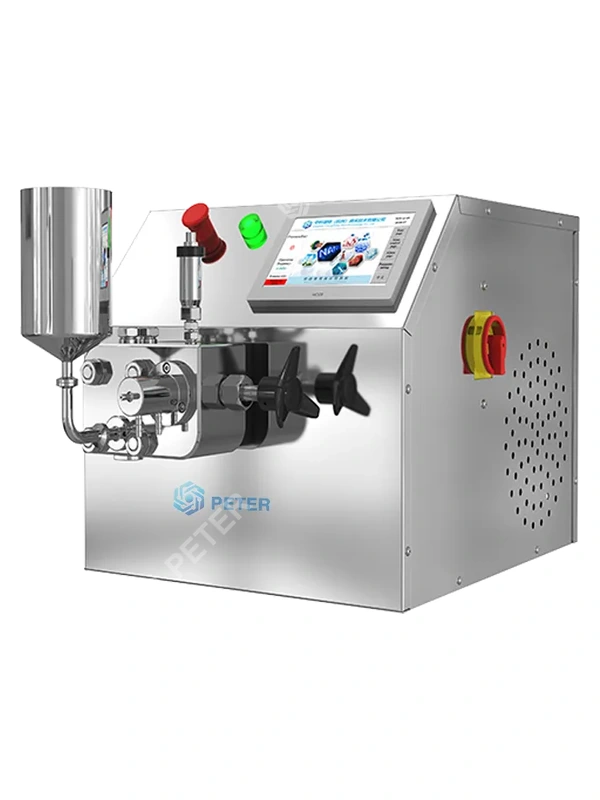
For laboratories assessing that transition, CAS PETER’s PT-10 high-pressure homogenizer can be evaluated as a distinct laboratory-scale option – not as a replacement claim for a Dounce device. The right comparison is whether the pressure-based process can meet the defined recovery and reproducibility criteria at the required volume.
Standards, compliance, and selection guidance
ISO 13320 concerns particle-size analysis by laser diffraction; it can support a defined dispersion or particle measurement plan, but it neither validates cell lysis nor certifies a homogenizer. CDC BMBL guidance informs biosafety risk assessment, including containment and aerosol considerations. In pharmaceutical manufacturing, FDA current good manufacturing practice requirements become relevant only when the material, intended use, and market claim bring the process within that regulated scope. None of these sources should be presented as a blanket approval of a laboratory method or machine.
- Write the analytical outcome first: protein activity, nuclei integrity, RNA quality, particle profile, or another measurable result.
- Run the lowest-energy method likely to reach that outcome, then add energy only when evidence shows incomplete release.
- Set a maximum sample temperature and a sampling point for every process trial.
- For transfer, qualify cleaning, documentation, operator training, and batch-to-batch comparability alongside throughput.
CAS PETER supplies experimental and production-type high-pressure homogenizer solutions and high-pressure microfluidizers; it does not position its high-pressure products as manual Dounce homogenizers. Buyers who need a controlled high-pressure comparison can review the PT-20 high-pressure homogenizer alongside their target assay and process volume. For cell-disruptor evaluation criteria, this guide to high-pressure cell disruptors for laboratories offers additional context.
Frequently asked questions
What is a Dounce homogenizer used for in cell lysis?
It is used to mechanically disrupt cells or gently disperse soft tissue in a controlled buffer, often when preserving a sensitive target matters. The operator chooses the pestle and stroke count, then confirms success with the downstream assay rather than relying on appearance alone.
How does a Dounce homogenizer disrupt cells?
A glass pestle moves through a matching glass tube and applies shear to the suspended cells or tissue. The degree of disruption depends on clearance, strokes, speed, sample loading, and buffer conditions, so it should be optimized and documented for the material.
How does a Dounce homogenizer compare with tissue homogenizer?
A Dounce device is one type of tissue homogenizer, with a manual, relatively gentle shear mechanism. The broader category also includes bead mills, rotor-stators, ultrasonic devices, and high-pressure systems; the appropriate choice depends on matrix toughness, target stability, throughput, and validation needs.
Which conditions improve recovery with a Dounce homogenizer?
Cold handling, a compatible buffer, appropriate pestle selection, measured stroke counts, and prompt analysis commonly improve recovery. Test a small range of settings and track target-specific yield and integrity; more strokes are not automatically better.
References and next step
- NCBI: homogenization and subcellular fractionation methods
- ISO 13320: particle size analysis by laser diffraction
- CDC: Biosafety in Microbiological and Biomedical Laboratories
- FDA: current good manufacturing practice regulations
The best tissue-preparation method is the one that supplies enough energy for the matrix while preserving the measurement that matters. If your next decision is whether a pressure-based process can meet that target at larger scale, discuss the sample and acceptance criteria with CAS PETER and contact the team about a PT-10 or PT-20 evaluation.