

High Pressure Homogenizer for Cell Lysis: Complete Lab Guide
When a downstream-process engineer in Basel encountered lower-than-expected bacterial-cell recovery, she ran one high-pressure pass to obtain a clean-looking lysate. The immediate result was encouraging – clarification improved – but a repeat run delivered less target activity. The reversal came when the team mapped pressure, flow, and outlet temperature together: the machine was not defective; its operating window had never been validated for that strain and product.
Summary: Product recovery after high-pressure lysis depends on a controlled pressure/flow/temperature window, not on choosing the highest attainable pressure. Start with a small, instrumented screening plan, compare release and activity after each pass, and carry the selected window through scale-up. For particle-size measurements used to characterize downstream dispersions, ISO 13320 specifies a laser-diffraction test method; it is not a certification of a lysis system. Cell-disruption literature likewise shows why the method must be matched to the cell envelope and intended analyte.
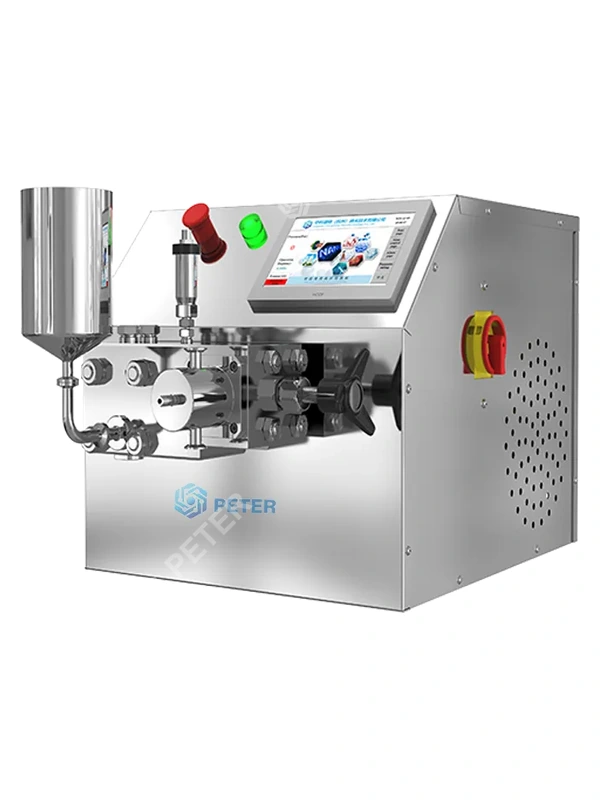
High-pressure systems force a prepared cell suspension through a narrow interaction zone. Pressure drop, shear, turbulence, and impact can open cells rapidly in a closed, repeatable flow path. That makes the approach attractive for soluble intracellular proteins, enzyme intermediates, microbial biomass, liposomal materials, and sample preparation where batch-to-batch consistency matters. It does not, however, make every sample a candidate for the same settings or number of passes.
Application Scenarios for High Pressure Homogenizer Cell Disruption
high pressure homogenizer cell disruption is often considered first for bacterial suspensions because rigid cell envelopes frequently need a stronger mechanical event than mammalian cells. For recombinant bacterial proteins, the useful endpoint is usually not visual cloudiness: it is a balance among released target, retained biological activity, manageable viscosity, and a supernatant that can be clarified economically. Track at least one release assay and one activity or integrity assay rather than treating lysis percentage as the only outcome.
Yeast and fungi usually deserve a separate feasibility study. Their wall architecture can make disruption more demanding, while excessive heat exposure or repeated cycling can compromise a heat-sensitive target. Pretreatment, buffer composition, biomass concentration, and downstream filtration capability may therefore carry as much weight as the pressure setpoint. Mammalian cells, by contrast, generally lyse more readily; a gentler, well-cooled mechanical route may protect nuclei, organelles, or fragile complexes when those are the intended fraction.
Define the analytical endpoint before choosing the hardware
A lysis program should state whether its primary goal is soluble-protein release, inclusion-body recovery, DNA reduction, organelle isolation, emulsion preparation, or analytical sample preparation. A mechanical event that maximizes total protein can be counterproductive if it releases nucleic acids that raise viscosity, burdens clarification, or reduces assay performance. In a regulated or quality-controlled laboratory, predefine acceptance criteria for recovery, activity, temperature, and process repeatability; this turns equipment evaluation into evidence rather than a one-run demonstration.
Critical Settings for High Pressure Homogenizer Cell Disruption
The key variables work as a system. Pressure affects disruptive energy, but actual exposure also depends on flow rate, restriction geometry, inlet solids, pass count, and time spent outside cooling. The honest answer is that there is no universal lysis pressure: bacteria, yeast, and mammalian cells must be assessed in sample-specific trials, using the target analyte and buffer that the process will actually use.
Build a defensible screening window
Use a small design of experiments that varies one or two practical ranges at a time. Record inlet and outlet temperature on every pass, flow stability, pressure, batch mass, hold time, and cleaning state. Measure the same response set after each condition – for example, released target, residual intact cells, enzyme activity, and clarification time. At least three independently prepared replicates at the proposed operating point are a more meaningful starting check than three repeat injections from one prepared sample.
Temperature is frequently the hidden failure mode. Chilled feed, short residence outside temperature control, staged processing, and prompt collection can be more valuable than adding another pass. When comparing different machines, also document actual delivered flow and pressure stability; nominal maximum pressure alone is a poor procurement metric. A technical explanation of high-pressure homogenizer operation can help teams frame these interactions before they specify a trial.
Homogenizer For Cell Lysis Comparison Points
A homogenizer for cell lysis should be compared against the sample, target, throughput, containment needs, and downstream consequences – not simply against another device’s headline pressure. Probe sonication can be useful at bench scale but brings local heating, aerosol-control considerations, and limited path-to-scale. Bead milling is robust for difficult walls but introduces media handling and wear. Chemical or enzymatic routes can be selective, though they can add reagents, time, and removal requirements.
| Method | Strength for cell lysis | Watch item | TCO consideration |
|---|---|---|---|
| High-pressure flow-through | Closed processing and repeatable pass definition | Temperature, valve wear, pressure/flow control | Lower manual handling may offset validation and maintenance effort |
| Bead milling | Effective for many robust microbes | Media separation, abrasion, cleaning | Media consumption and wear parts influence cost per batch |
| Probe sonication | Accessible for small exploratory samples | Localized heating and containment | Labor time and limited scale transfer can dominate |
| Enzymatic/chemical lysis | Potentially selective and mild | Reagent compatibility and residuals | Reagent cost and downstream removal require review |
A tissue homogeniser is a useful category for soft-tissue processing, but its motion and sample-contact format may not suit every microbial or continuous-flow application. Likewise, a mechanical homogenizer is a broad label, not a process specification. Ask suppliers for wetted-material details, cleanability, cooling interface, throughput range, and a trial protocol that captures recovery as well as disruption.
Scale-up of High Pressure Homogenizer Cell Disruption for Cell Lysis and Sample Preparation
Scale-up is a translation exercise, not a multiplication of batch volume. Preserve the validated biology-facing outputs – release, activity, temperature excursion, viscosity, and clarification behavior – while documenting pressure, actual flow, pass number, formulation, and feed temperature. A pilot trial should also expose operational constraints such as operator time, cleaning turnaround, sampling frequency, and maintenance intervals.
| Scale stage | Primary purpose | Minimum validation evidence | Decision gate |
|---|---|---|---|
| Bench screening | Identify a workable operating window | Triplicate condition data; release, activity, temperature | Select one or two candidate windows |
| Pilot confirmation | Test flow, hold time, and cleanability | Comparable output profile across representative lots | Confirm process recipe and sampling plan |
| Production readiness | Demonstrate repeatable operation at intended batch size | Defined acceptance criteria, deviations, maintenance plan | Approve controlled routine use |
For labs moving from screening toward pilot work, compare the working volume and required flow envelope before choosing a platform. The CAS PETER PT-10 high-pressure homogenizer can be reviewed alongside its PT-20 counterpart as part of a capacity, cooling, and documentation discussion. The appropriate selection still depends on verified performance with the actual material, not a generalized pressure claim.
Standards, Biosafety, and Documentation
Standards should be applied within their stated scope. ISO 13320 concerns particle-size analysis by laser diffraction; it may support how a downstream dispersion is measured, but it does not certify a homogenizer or prove lysis efficacy. For work involving infectious materials, the CDC BMBL guidance supports risk-based biosafety planning, including containment and aerosol considerations.
Where output enters a regulated pharmaceutical process, applicable current good manufacturing practice expectations depend on intended use, market, and claims. The FDA’s CGMP regulations resource is relevant to those uses; it is not a blanket endorsement of laboratory equipment. Unsupported compliance language can create avoidable supplier qualification, audit, and commercial risk.
A Structured Selection Guide
- Classify the cell type and target: bacteria, yeast, and mammalian cells should begin with different trial assumptions.
- Set measurable acceptance criteria for recovery, activity, temperature, throughput, and downstream clarification before the demonstration.
- Request a documented, representative-material trial with actual flow and outlet-temperature records, not only a maximum-pressure specification.
- Evaluate the full operating system: feed preparation, cooling, containment, cleaning, spares, and service response all affect usable capacity.
- Use pilot evidence to define the production recipe and change-control boundaries before committing to routine operation.
CAS PETER supports experimental, pilot, and production high-pressure homogenizer selection with application-focused discussions. Buyers should ask for the configuration and evidence that match their own material and validation plan.
Frequently Asked Questions
What is a tissue homogenizer used for in cell lysis?
It mechanically breaks down tissue or cell-containing material so intracellular components can be recovered or analyzed. The best format depends on whether the sample is soft tissue, a microbial suspension, or a fragile cell preparation. Define the desired fraction and downstream assay before selecting the method.
How does a tissue homogenizer disrupt cells?
Depending on its design, it applies shear, grinding, impact, pressure changes, or turbulence to weaken and open cells. The resulting lysate can also contain DNA, cell debris, and organelles, so disruption must be assessed alongside clarity and target stability. Cooling and sample handling determine whether mechanical disruption remains useful for a sensitive analyte.
How does a tissue homogenizer compare with homogenizer for cell lysis?
A tissue-focused tool is commonly optimized for physical handling of tissue pieces or small batches, whereas a high-pressure flow-through unit is often selected for defined passes and scalable liquid processing. Either can be appropriate if its mechanical action, throughput, and temperature behavior fit the sample. Compare recovery data from representative trials rather than relying on category names.
Which conditions improve recovery with a tissue homogenizer?
Controlled temperature, an appropriate buffer, suitable solids concentration, short hold times, and a disruption intensity matched to the target typically improve the chance of useful recovery. Excessive mechanical input can release unwanted material or reduce activity. Run a small matrix and measure both release and functional quality before standardizing the condition.
References and Next Step
- National Center for Biotechnology Information: review of cell-disruption methods
- ISO 13320: particle size analysis by laser diffraction
- CDC: Biosafety in Microbiological and Biomedical Laboratories
- FDA: current good manufacturing practice regulations
Reliable lysis is not the most aggressive run; it is the run that repeatedly delivers the recovery and quality your downstream process needs.
When your team is ready to turn trial data into an equipment decision, review the PT-20 high-pressure homogenizer and contact CAS PETER to discuss a configuration and validation approach for your material.