

Bead Mill Homogenizer Protocol: Improve Cell Lysis Yield
When a microbiology lead in Melbourne encountered inconsistent soluble-protein recovery, she had followed a published bead-milling sequence exactly: the first batch lysed, then repeat samples ran warm and gave uneven results. The reversal came when the team recorded bead loading, cycle timing, and cooling between runs. The cells were not the underlying problem; the unrecorded operating window was.
Summary: A reliable bead-mill protocol controls bead material and diameter, tube fill, short disruption cycles, and the temperature trajectory – not merely motor time. Start with a documented 2-3-cycle screen, including cooling holds and a recovery assay, then lock the condition only after it meets the intended yield and quality criteria. Where particle-size evidence is part of the downstream decision, ISO 13320 is useful as a laser-diffraction particle-size test method; it is not a certification for a homogenizer or a cell-lysis method.
Bead milling lyses cells through collisions and shear in a sealed tube. It suits many small samples, but a published protocol is only a starting point: sample mass, tube geometry, buffer, bead loading, and heat removal change the energy actually delivered.
Set the bead-milling window before chasing more run time
The protocol should define a window rather than a single unexplained setting: biomass or tissue mass, buffer volume, bead mass or fill fraction, bead specification, cycle duration, number of cycles, pause duration, and maximum permitted sample temperature. Record the rotor or instrument setting too, because an elapsed time without the machine condition is not reproducible.
Bead diameter is a practical first decision. Fine beads, often around 0.1-0.5 mm, are commonly screened for small microbial cells; larger beads can provide a more forceful impact for tougher or fibrous material. Zirconia/silica, glass, and steel differ in density, breakage behavior, and compatibility with the assay. The right choice is the one that releases the target while preserving the attribute being measured – enzyme activity, soluble protein, nucleic-acid integrity, or intact organelles – not the one that creates the most visually homogenized suspension.
Tube fill deserves the same discipline. Under-filling can reduce productive bead-sample contact, while over-filling leaves too little movement and can produce erratic mixing. A defensible development screen holds sample mass and buffer constant, compares two bead sizes or materials, and tests 30-60-second bursts with a chilled pause. Use the acceptance metric to set the final condition.
Selecting Bead Mill 24 Homogenizer by product requirements
A bead mill 24 homogenizer is appropriate when the requirement is parallel processing of small, sealed samples and the method benefits from uniform tube handling. Buyers should specify the number of samples per batch, tube formats, required containment, temperature-control approach, cleaning burden, and the analytical endpoint before comparing nominal power. For infectious or potentially infectious material, the containment and workflow should be assessed against the facility’s risk assessment and the CDC’s Biosafety in Microbiological and Biomedical Laboratories (BMBL) guidance.
Performance limits of Bead Mill 24 Homogenizer
Throughput is not the same as yield. A 24-position layout can reduce handling time, yet position-to-position variation may still come from unequal tube mass, inconsistent bead fills, cap seating, or edge-to-centre cooling differences. Compare replicate recovery and temperature, not just whether every tube appears disrupted. An illustrative calculation makes the hidden cost visible: if a batch has 24 tubes and 3 require repeat extraction, the apparent high-throughput run has created 12.5% extra sample work before assay repeats are counted.
Heat is the most common limit on aggressive cycling. Measure a representative tube at the start and immediately after each cycle; if the temperature trend rises beyond the allowed range for the analyte, shorten the burst, add a cooling hold, reduce sample loading, or change the approach. Running longer may increase total extract but lower usable soluble-protein recovery. For this reason, tissue homogenizers should not be judged only by how quickly they make a suspension.
Tissue Homogenizers operating differences and route selection
Rotor-stator tissue tools create shear in an open or semi-open vessel and can be efficient for larger tissue portions, but aerosol control, cleaning, and cross-sample carryover need close attention. Bead mills keep individual samples closed and support parallel processing, while their consumable beads and thermal management require control. Dounce or manual methods are gentler, but labor and operator variation rise with sample count.
| Route | Best-fit operating need | Key limit to validate | Cleaning and TCO consideration |
|---|---|---|---|
| Bead mill | Many small sealed samples | Heat, bead fill, tube-to-tube repeatability | Single-use tubes and beads reduce carryover but add consumables |
| Rotor-stator | Larger tissue portions and flexible vessel volumes | Aerosol control, shear exposure, batch-to-batch operator effect | Reusable probes require validated cleaning between samples |
| High-pressure homogenization | Flow-through processing where a pressure route suits the material | Pass count, pressure setting, temperature and product quality | Wetted-path cleaning, seal wear, and validation documentation matter |
| Microfluidization | Controlled flow through an interaction chamber for suitable dispersions or lysis workflows | Chamber configuration, pass count, temperature and fouling | Cleaning and chamber maintenance must be planned with the process |
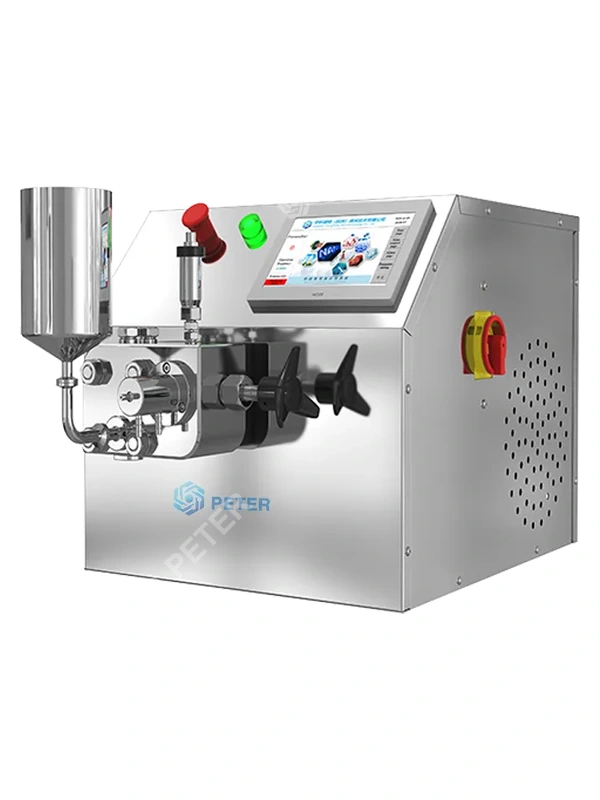
A high pressure homogenizer cell lysis route can be worth evaluating when a process must move from tubes to a controlled flow-through operation, but it is not a universal replacement for bead milling. For a method-comparison study, the laboratory can include a CAS PETER PT-10 high-pressure homogenizer as one candidate and compare normalized recovery, quality, temperature, cleaning time, and sample losses against the current bead protocol.
Likewise, microfluidizer cell lysis can be a suitable development route for materials compatible with its flow path and shear profile. A CAS PETER PTH-10-1 high-pressure microfluidizer belongs in a controlled feasibility comparison, not in a claim that every cell type or sensitive analyte should be processed the same way.
Cleaning and maintenance of Bead Mill 24 Homogenizer
Closed disposable tubes simplify segregation, but they do not eliminate contamination risk. Verify intact caps, use a loading area that separates pre- and post-lysis material, and remove spilled beads or residue before the next run. Where reusable adapters, racks, or other contact surfaces are used, define compatible detergent, contact time, rinse quality, drying, and inspection. Cleaning agents that leave residues can compromise a protein or nucleic-acid assay as effectively as biological carryover.
Record tube-holder wear, imbalance events, lid or interlock status, and cleaning verification. A blank or process-negative control checks carryover but never replaces cleaning. In regulated applications, procedures must fit the intended use and quality system; FDA cGMP regulations apply to drug manufacturing, not every research protocol.
| Application | Primary response | Controlled variables | Useful release check |
|---|---|---|---|
| Bacterial or yeast protein extraction | Soluble-protein recovery and activity, where relevant | Bead size/material, cycles, sample temperature | Replicate assay result plus post-run temperature record |
| Tough tissue extraction | Target analyte recovery from representative tissue mass | Sample mass, buffer volume, bead fill, pause time | Mass-normalized recovery and visible residual-tissue review |
| Nucleic-acid preparation | Yield and fragment-quality fit for the downstream assay | Cycle severity, buffer chemistry, cooling | Assay-specific integrity and blank-control result |
| Scale-up feasibility | Comparable quality at a practical batch or flow rate | Passes, temperature, hold time, cleaning sequence | Side-by-side method comparability study |
Standards, evidence, and a procurement checklist
Three distinctions prevent costly overclaims. First, ISO 13320 concerns particle-size analysis by laser diffraction, so it can support a specified particle-size measurement when relevant but does not approve the equipment or the lysis result. Second, BMBL provides biosafety guidance that should inform a risk-based laboratory workflow; it is not a product certificate. Third, FDA cGMP regulations apply when manufacturing drugs for the US market and should not be presented as a blanket requirement for early research.
- Define the target analyte and a quantitative acceptance criterion before selecting a machine.
- Request a trial using representative samples, tube formats, and the real downstream assay.
- Compare normalised recovery, temperature, repeat rate, cleaning labor, consumables, and downtime – not headline capacity alone.
- Specify the biosafety and documentation needs of the destination site, intended use, and any regulated claim.
CAS PETER can support this disciplined comparison with laboratory-scale high-pressure options where a flow-through route is technically justified. A useful starting point is its overview of cell disruptor homogenizers for laboratory needs; buyers should still validate each route against their own samples and release criteria.
Frequently asked questions
What is a bead mill homogenizer used for in cell lysis?
It is used to mechanically disrupt cells in a sealed tube using moving beads, releasing proteins, nucleic acids, metabolites, or other intracellular targets. It is commonly selected for small-sample parallel work. The appropriate endpoint is assay recovery and quality, not visual disruption alone.
How does a bead mill homogenizer disrupt cells?
Rapid bead motion creates repeated impacts and shear against cells and sample particles. Lysis severity depends on bead properties, fill, tube geometry, cycle duration, and the number of cycles. Cooling pauses are often necessary because accumulated heat can change the analyte being measured.
How does a bead mill homogenizer compare with tissue homogenizers?
Bead mills favor contained, parallel, small-volume processing, whereas rotor-stator tissue tools suit flexible vessel volumes and larger tissue portions. Neither is inherently better across all samples. Compare carryover control, heat, recovery, cleaning, and operator variability with representative material.
Which conditions improve recovery with a bead mill homogenizer?
Start by matching bead size and material to the sample, then control bead loading, sample mass, buffer volume, short cycles, and cooling intervals. Use replicate samples and a blank control to confirm both recovery and carryover performance. Lock the protocol only after the quality attribute stays within its defined acceptance range.
References
- NCBI PubMed Central: peer-reviewed article PMC7923672 – background evidence for laboratory disruption and recovery workflow considerations.
- ISO 13320 – particle-size analysis by laser diffraction; a test-method standard, not a homogenizer certification.
- CDC BMBL – biosafety guidance for microbiological and biomedical laboratories.
- FDA cGMP regulations – US regulatory requirements relevant to drug manufacturing quality systems.
The dependable lysis protocol is the one that records the energy, heat, and recovery evidence – not simply the one that runs longest. When your decision point includes a scalable high-pressure comparison, review the PT-10 high-pressure homogenizer and contact CAS PETER with your sample, target quality attribute, and validation plan.