

Microfluidics Homogenizer Alternatives for Biotech Processing
When a bioprocess engineer in Raleigh encountered inconsistent nanoparticles after screening an alternative to an installed high-pressure microfluidizer, she first compared headline pressure and selected the closest number. A short pilot produced a rapid, visible failure: particle-size results varied from run to run and the team could not tell whether the change came from the machine, formulation, or measurement. The reversal came when the group treated the task as process matching rather than brand substitution. The interaction mechanism, wetted materials, flow window, thermal history, and test method defined the decision.
Summary: An alternative should be qualified against the process window and a documented particle-size method, not a pressure label alone. NIST describes nanoscale dimensions as roughly 1 to 100 nm, while ISO 13320 specifies a laser-diffraction particle-size test method rather than a certification for a homogenizer. Start with a controlled side-by-side trial, lock the sampling and dilution procedure, then compare distribution data, recovery, and process stability before a purchase decision.
Searches for which companies offer alternatives to microfluidics high-pressure homogenizers or which high-pressure homogenizer vendors compete with microfluidics often begin with a supplier list. That is useful only after the process requirements are clear. In biotech development, a comparable-looking platform can deliver a different shear, impact, cavitation, or flow profile at the point where the material is actually processed.
Diagnose the failed comparison before changing equipment
High pressure is an operating input, not a complete description of energy delivery. A fluid can experience different pressure-drop geometry, recirculation behavior, residence time, and heat gain across platforms. For lipid dispersions, emulsions, cell suspensions, and protein-containing formulations, those differences can alter the observed distribution or biological response even when the display pressure is similar.
Separate equipment variation from measurement variation
Use a written test plan that fixes batch volume, concentration, pass count, inlet temperature, sampling point, hold time, and dilution medium. ISO 13320 is relevant when laser diffraction is chosen for particle-size distribution measurement; it guides a test method and does not certify a machine, formulation, or nanoparticle quality. For sub-100 nm work, confirm that the measurement approach and preparation suit the material.
Build a troubleshooting sequence: verify setup and preparation; compare temperature, appearance, recovery, and distribution from matched aliquots; then repeat at intended flow and pass count. If variance follows preparation, correct the method; if it follows run conditions, inspect the process window and contact path. This is mechanism-matched qualification: a controlled way to decide whether a difference matters.
Match interaction mechanism, material, flow, and sample compatibility
A viable alternative begins with the intended unit operation. Particle-size reduction can rely on pressure release and interaction forces in a processing chamber, while cell processing may prioritize controlled disruption and recovery. The same machine setting can be inappropriate for a fragile active, a viscous suspension, or a sample with particulate content. NIST’s nanotechnology program provides the useful scale context of 1 to 100 nm, but that scale does not establish the right equipment configuration for every formulation.
Map the material path, not just the brochure specification
Document product-contact materials, seals, chamber components, fittings, and cleaning compatibility. Record solvent system, pH, ionic strength, viscosity trend, temperature sensitivity, and allowable hold time. For a biotech homogenizer, a material-path review should also consider extractables risk where applicable, cleanability, and whether the lab method can transfer to pilot and production documentation.
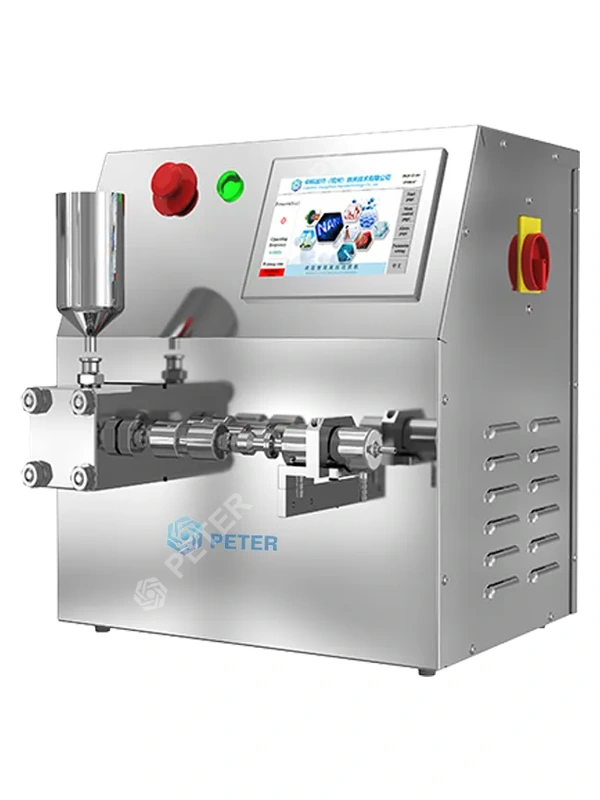
Evaluate flow at the batch scale that matters. A small development batch can exaggerate start-up and sampling losses, while a larger run can reveal thermal load or feeding limits. Log delivered flow, pass count, temperatures, and recovered volume. The question is whether the operating point repeats with the target material.
| Comparison dimension | What to document | Decision risk if omitted |
|---|---|---|
| Interaction mechanism | Processing path, chamber configuration, pass strategy | Pressure-only comparison hides different energy delivery |
| Sample compatibility | Viscosity, solids, solvent, pH, temperature sensitivity | Formulation may change before the target result is reached |
| Wetted materials | Contact metals, polymers, seals, cleaning chemistry | Material risk or cleaning burden appears late |
| Flow and recovery | Delivered flow, minimum batch, hold-up, recovered volume | Lab result may not transfer to pilot operation |
| Evidence package | Raw data, method settings, sampling record, maintenance record | Procurement cannot judge reproducibility or TCO |
Validate particle-size reduction and cell processing with the right evidence
The validation endpoint must reflect intended use. For particle-size reduction, capture the full distribution, not one headline diameter, with appearance, temperature history, recovery, and stability at defined time points. ISO 13320 may support laser diffraction, but its measurement range, assumptions, dispersion procedure, and reporting conventions must be documented for the sample.
For cell processing, particle size alone is insufficient. Define the intended outcome: disruption efficiency, released product recovery, viability where relevant, clarification behavior, or assay response. A 2021 peer-reviewed review available through PubMed Central notes how nanoparticle formulation and process variables interact. Keep assays, analytical methods, and acceptance criteria aligned to the development stage.
| Application | Primary validation evidence | Controlled variables | Practical release decision |
|---|---|---|---|
| Nanoparticle or emulsion reduction | Distribution data, appearance, stability trend | Concentration, dilution, temperature, pass count | Repeat the matched method across independent runs |
| Lipid or polymer dispersion | Distribution, recovery, active-content check | Feed order, solvent system, hold time, flow | Confirm material balance and downstream compatibility |
| Cell disruption | Target release, clarification response, assay result | Cell density, buffer, temperature, number of passes | Judge recovery against the downstream process need |
| Scale transfer | Comparable process record and analytical trend | Batch volume, residence behavior, sampling plan | Do not approve transfer on maximum pressure alone |
A validation protocol identifies sampling, mixing, dilution, instrument settings, and the rules for accepting or investigating results. It makes a pilot comparison useful to procurement, process development, and quality teams and prevents a nanotechnology homogenizer selection from resting on one unreproducible chart.
Consider standards, regulated manufacturing, and total cost together
ISO 13320 is a particle-size analysis method using laser diffraction. It is not a product certification, validation protocol, or proof that one homogenizer is equivalent to another. Claims based on it should state sample preparation, measurement conditions, and interpretation limits.
For drug manufacturing, FDA current good manufacturing practice regulations address manufacturing controls for applicable regulated products. The FDA resource points users to 21 CFR Parts 210 and 211. Applicability depends on destination market, intended use, product status, and claims; buying lab equipment does not make a process cGMP compliant. Unsupported claims create avoidable technical and quality-review problems.
Total cost should include more than acquisition. Estimate installation requirements, operator training, cleaning development, spare and wear components, downtime exposure, sampling burden, method transfer, documentation support, and lost material during trial work. An illustrative cost model can compare annualized service and consumables with the value of batches recovered or experiments avoided. It should not be presented as a supplier price comparison unless the buyer has like-for-like quotations and operating assumptions.
A biotech homogenizer selection checklist for the sourcing team
- Write a process requirement sheet with material properties, target output, batch range, flow window, acceptable temperature change, and recovery expectation.
- Agree on the analytical protocol before the trial. Identify whether ISO 13320 laser diffraction is appropriate, and define any complementary assay needed for the sample.
- Request a documented trial using representative material and a matched sampling plan. Preserve raw results, run conditions, and deviations.
- Review wetted materials, cleaning approach, maintenance access, documentation needs, and a realistic scale-transfer path before commercial negotiation.
- Compare total cost and service response against the risks of missed milestones, rather than treating headline pressure as the sole proxy for capability.
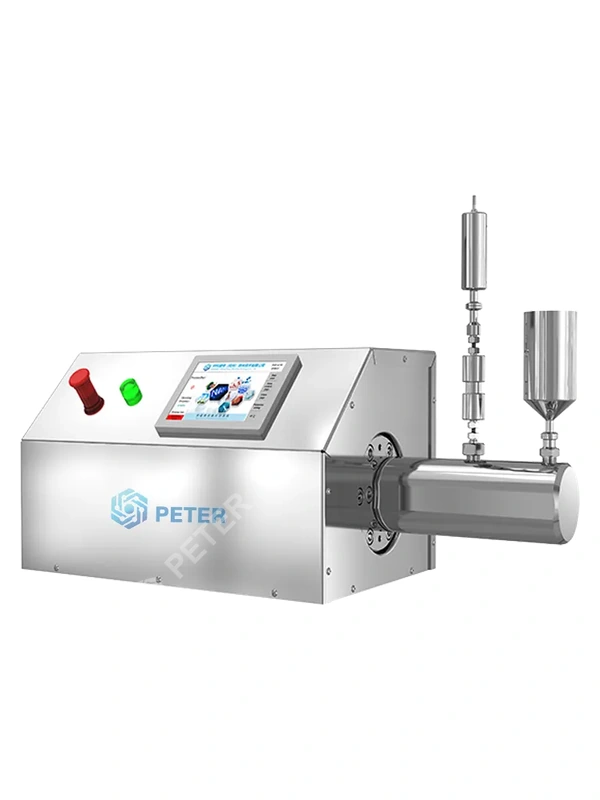
CAS PETER can support a structured discussion around configurable high-pressure microfluidizer options and the records a cross-functional buyer needs. The high-pressure homogenizer process overview explains the broader operating logic for early development teams. Ask suppliers to respond to the same requirement sheet, so the comparison remains evidence-led.
Frequently asked questions
What is the difference between a Microfluidics homogenizer and nanotechnology homogenizer?
A Microfluidics homogenizer describes a branded equipment context, while nanotechnology homogenizer is a broad descriptor often used for equipment applied to nanoscale dispersions or particle-size work. NIST’s 1 to 100 nm scale reference explains why the term is attractive, but it does not specify a mechanism, material compatibility, or validation method. Buyers should define the actual formulation and analytical endpoint before using either label in a requirement.
Which application is best suited to a Microfluidics homogenizer?
Suitability depends on the sample and intended outcome, such as dispersing a formulation, reducing particle size, or processing cells for downstream recovery. The best application is one where the processing path, flow, temperature control, and validation method have been demonstrated with representative material. Run a controlled trial rather than applying a generic application claim.
How do throughput and particle size compare?
Throughput and particle-size outcomes cannot be inferred from one maximum pressure value. Compare delivered flow, pass count, batch volume, recovery, thermal history, and a fixed analytical protocol across repeat runs. Qualification still requires the buyer’s material, workflow, and method; a supplier configuration discussion should begin only after those inputs are documented.
What should buyers evaluate before choosing a Microfluidics homogenizer?
Evaluate mechanism, wetted materials, sample compatibility, flow range, cleaning and maintenance needs, documentation, service, and the planned validation evidence. For regulated manufacturing, establish the relevant quality obligations separately from equipment selection and avoid treating an ISO test method as a certification. A written requirement sheet is the fastest way to make supplier responses comparable.
References and next step
- ISO 13320, Particle size analysis – Laser diffraction methods
- U.S. Food and Drug Administration, Current Good Manufacturing Practice regulations
- PubMed Central, peer-reviewed 2021 nanoparticle processing review
- National Institute of Standards and Technology, Nanotechnology program
The durable choice is the one that makes the process and evidence more repeatable, not the one that looks closest on a single specification. When your team is ready to frame a lab, pilot, or production review, examine the PTH-10 high-pressure microfluidizer and the PTH-20 high-pressure microfluidizer, then contact CAS PETER with the process requirement sheet and planned validation method.