

Nanoparticle Homogenizer: Build Stable Nanoemulsions
When a formulation lead in Cambridge, UK encountered an unstable nanoemulsion, she increased process energy on the assumption that a smaller droplet size would solve the problem. The laser-diffraction result improved after the run, but samples separated more quickly during storage. The reversal was important: the issue was not simply insufficient pressure. The surfactant system, temperature rise and validation window no longer matched the formula.
Summary: A nanoemulsion should be specified by more than its initial average size. Set a target distribution, heat limit, pass strategy and storage test before selecting equipment; ISO 13320 describes particle-size analysis by laser diffraction, a useful but bounded measurement method. The practical recommendation is to screen formula and process together, then prove repeatability at the intended scale.
A nanoparticle homogenizer applies controlled mechanical energy to disperse droplets or particles in a liquid system. In nanoformulation development, the objective is usually a reproducible distribution and acceptable stability, rather than the smallest possible reading on one instrument. NIST’s nanotechnology work highlights why measurement, material behavior and process context must be considered together when working at small scales.
Why smaller droplets do not automatically make a stable nanoemulsion
High-pressure processing drives premix through a narrow interaction region, where shear, turbulence and cavitation can break dispersed droplets. A finer distribution can improve appearance and reduce creaming tendency, but the new interfacial area also demands sufficient emulsifier coverage. If the emulsifier is under-dosed, poorly dissolved or slow to adsorb, freshly created surfaces can coalesce after the sample leaves the process zone.
Temperature is the other frequent mismatch. A multi-pass campaign can add heat even when the feed begins at room temperature. Heat may change viscosity, interfacial behavior, volatile loss or active-material tolerance. Record inlet and outlet temperature on every pass, then compare samples only after they have reached the same defined conditioning point. A 24-hour post-process reading is not interchangeable with a day-0 reading taken immediately after discharge.
For high pressure homogenization nanoparticles, define the result as a window: for example, an agreed particle-size distribution, a limit on large-particle tail, a temperature ceiling and a storage observation at specified time points. The review literature on nanoemulsions notes that formulation composition and preparation conditions both influence stability, so a single pressure setting cannot stand in for development evidence.
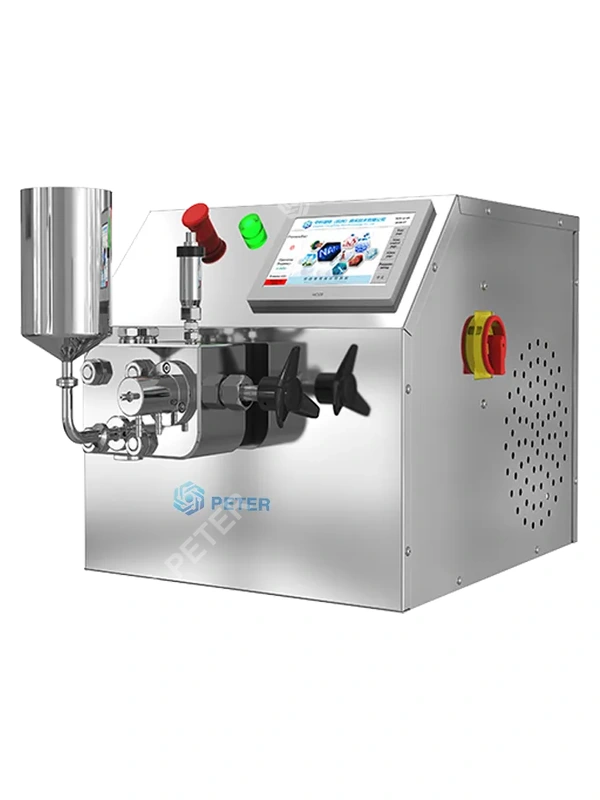
Set the process variables before choosing a machine
Start with the formulation’s measurable constraints. Measure premix viscosity at the intended feed temperature, identify the dispersed-phase fraction, confirm the emulsifier preparation sequence and specify whether the material is sensitive to oxygen, heat or recirculation. A coarse premix with visible phase separation is not a fair starting point for an equipment comparison.
Critical settings to document
- Feed condition: batch size, premix method, feed temperature and viscosity range.
- Energy program: pressure, number of passes, flow rate and whether each pass is sampled.
- Thermal control: inlet/outlet temperature, cooling arrangement and maximum permitted exposure.
- Acceptance tests: size distribution, visual appearance, pH where relevant, viscosity and defined storage points.
- Cleaning fit: product-contact materials, flushing method, changeover risk and documented cleaning verification where required.
A practical screening design holds the formula constant while comparing a small number of energy programs, then holds the chosen process constant while adjusting formula variables. That separation makes causality easier to see. It also prevents a development team from blaming the equipment for an emulsion that changed because its emulsifier ratio or aqueous-phase preparation changed.
Compare a biotechnology homogenizer by development fit, not headline pressure
A biotechnology homogenizer is often evaluated for cell disruption, dispersion or preparation of sensitive biological materials, but its value in a nanoemulsion workflow depends on controllable processing and usable documentation. The same platform may support several tasks only if its wetted materials, hold-up volume, cleaning approach, heat management and sample recovery suit each one.
| Decision dimension | Bench development configuration | Higher-throughput development configuration | What to verify |
|---|---|---|---|
| Batch demand | Small trials and formulation screening | Larger pilot batches or more frequent campaigns | Minimum workable batch versus hold-up volume |
| Process learning | Rapid pass-by-pass sampling | Repeat runs at selected conditions | Sampling point and repeatability plan |
| Thermal exposure | Short trials with close observation | Longer campaigns requiring thermal control | Measured inlet and outlet temperature |
| Changeover | Frequent formulation switches | Fewer, larger runs | Cleaning time, recovery and cross-contamination controls |
| Total-cost tendency | Lower material use, more iterations | More material use, fewer production-like runs | Consumables, operator time and rejected trial cost |
The hidden cost is not only capital expenditure. A configuration that consumes scarce active material, cannot recover representative samples or needs extensive cleaning between formulations can slow a program even when its nominal output is attractive. An illustrative calculation should include trial material, analyst time, cleaning downtime and repeat tests – not an assumed universal cost per litre.
Plan scale-up around energy, residence time and validation evidence
Scale-up is a translation exercise, not a simple increase in batch volume. Hold the formulation and quality targets constant, then assess whether pressure, flow, pass count, temperature profile and residence-time exposure remain comparable enough for the intended claim. Sampling at each stage should show whether the distribution and stability window still hold after the process is run at the target campaign length.
| Development stage | Primary purpose | Useful evidence | Scale-up decision |
|---|---|---|---|
| Feasibility screen | Find viable formula/process ranges | Fresh size distribution and temperature record | Reject unstable combinations early |
| Bench confirmation | Establish repeatability | Replicate runs, pass data and short storage checks | Lock a provisional operating window |
| Pilot translation | Test representative batch handling | Flow, heat profile, recovery and extended stability observations | Adjust cooling or pass strategy with change control |
| Routine manufacture | Maintain approved performance | Defined release and continued-verification records | Use validated limits appropriate to the product |
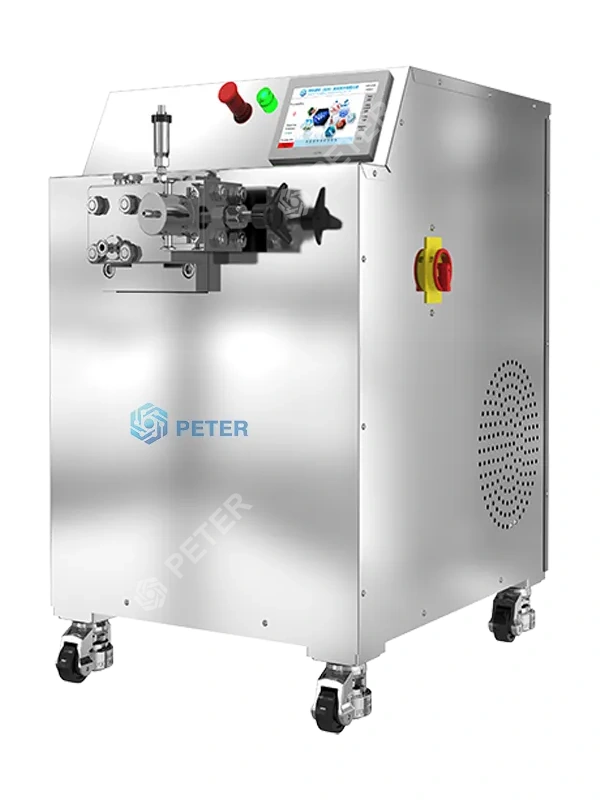
A high pressure homogenizer nanoemulsion program benefits from decision gates. Do not advance a process merely because its mean diameter is lower; advance it when the agreed distribution, temperature behavior, recovery and storage observations are acceptable across replicate runs. For regulated manufacture, document controls in a manner consistent with applicable current good manufacturing practice requirements; FDA cGMP regulations apply to regulated drug manufacture, not to every laboratory or industrial dispersion project.
Standards and compliance: use the right scope
ISO 13320 is a standard for particle-size analysis by laser diffraction. It can support a defensible measurement approach, but it is a test-method standard, not certification that a homogenizer or finished nanoemulsion is compliant. Method settings, dispersion conditions and reporting conventions can affect comparability, so define them in the study protocol.
NIST nanotechnology resources are useful context for measurement and nanoscale terminology, but they do not approve a specific formulation. Where a product is intended for a regulated market, destination, intended use and promotional claims determine the applicable requirements. Unsupported claims about stability, performance or therapeutic benefit can create commercial and regulatory risk; retain the data that supports only the claims actually made.
Selection checklist for technical buyers
- Write an acceptance window covering distribution, temperature and storage condition before requesting a quotation.
- Provide the supplier with feed volume, viscosity range, solids or oil fraction, cleaning expectations and target throughput.
- Ask how operating conditions, product-contact materials, cooling and sample recovery can be documented for your trial.
- Run a representative formulation trial, including the planned number of passes and storage checks, before fixing the scale-up path.
CAS PETER can be considered when a team needs to match a configurable high-pressure platform to its development plan. Buyers assessing smaller development work can review the PTH-10 high-pressure microfluidizer; teams planning for a different throughput discussion can compare the PTH-20 high-pressure microfluidizer against their batch and documentation needs.
Frequently asked questions
What is a nanoparticle homogenizer used for?
It is used to apply controlled mechanical energy to liquid dispersions, including nanoemulsions and particle suspensions. Typical development goals include reducing dispersed-phase size, improving distribution consistency and studying how formulation responds to processing. The correct use depends on a defined analytical and stability plan.
How does a nanoparticle homogenizer work?
A pressurized liquid passes through a restricted processing region that creates intense shear, turbulence and related disruptive forces. These forces can break droplets or deagglomerate material, while the formula stabilizes the newly created interfaces. For a plain-language process overview, see how high-pressure homogenizers work.
What role does biotechnology homogenizer play in a nanoparticle homogenizer system?
It provides a controlled processing platform when a formulation workflow requires reproducible dispersion, sensitive-material handling or documented development conditions. The useful comparison is not whether the label is biotech, but whether flow, temperature, wetted materials and cleaning controls fit the actual material. Confirm this with a representative trial.
Which process limits should you check for a nanoparticle homogenizer?
Check feed viscosity, batch volume, allowable temperature rise, pressure range, pass count, target distribution and cleaning requirements. Also set storage observation points, because a good immediate particle-size result may not predict stability. If the material has regulatory constraints, add the relevant documentation and change-control expectations.
References
- ISO 13320: Particle size analysis – Laser diffraction methods.
- National Institute of Standards and Technology: Nanotechnology.
- U.S. FDA: Current Good Manufacturing Practice regulations.
- NCBI: Nanoemulsion formulation and stability review.
The durable nanoemulsion is usually built by aligning formulation, energy and evidence – not by treating pressure as a universal answer.
When your team is ready to turn that window into a documented equipment decision, review the PTH-10 high-pressure microfluidizer and contact CAS PETER with your formulation, batch and validation requirements.