

Milk Homogenizer Machine: How to Choose the Right System
When a plant engineer in Auckland selected a small system from its nominal capacity, the first higher-fat product run became slow and warm within an hour. The apparent shortfall was not simply capacity: unqualified feed properties, cleaning requirements, and the real duty cycle had been left out of the selection basis.
Summary: A sound purchase decision starts with the product and the process window, then verifies performance on representative material. A homogenizer for milk should be evaluated against viscosity, fat level, inlet temperature, pressure profile, cleaning chemistry, and run time. Use particle-size testing such as ISO 13320 where it fits the measurement plan, and validate at the intended operating duty rather than relying on a nameplate figure.
Milk homogenization applies controlled high pressure and a narrow flow path to reduce and redistribute fat globules. The technical aim is not a single pressure number; it is a repeatable dispersion that supports the product’s target appearance, mouthfeel, cream-line behavior, and shelf-life performance. Food processors also need a hygienic, maintainable system that fits their plant controls.
Start with the product, not the brochure capacity
Nominal throughput is normally established with a defined material and operating condition. Whole milk, cream-based beverages, protein-enriched drinks, and ice-cream mixes can present very different viscosity, temperature, solids, and shear-sensitivity profiles. A higher-fat formulation may increase hydraulic load and temperature rise; a particulate or fiber-containing recipe can create a blockage or wear risk. Ask suppliers to state the conditions behind every quoted flow value.
Build a representative feed specification
Document the minimum and maximum fat percentage, total solids, viscosity at inlet temperature, pH, particle characteristics, and allowable temperature range. Include batch size, upstream hold time, and whether the equipment will run intermittently or continuously. A useful acceptance plan compares pre- and post-process particle distributions; ISO 13320 describes laser-diffraction particle-size analysis, but it is a test-method standard, not a certificate for a homogenizer or a food product.
Also define the quality response that matters. A lower measured particle size can be useful, but the practical question is whether the finished product remains stable through storage and distribution. Review cream separation, viscosity drift, sensory changes, foam behavior, and any downstream heat-treatment interaction. Samples should represent the full operating envelope, including the highest solids and lowest expected inlet temperature.
Size for pressure, flow, temperature, and duty cycle together
Pressure and flow must be considered as a pair. Hydraulic power rises with both, and product temperature can rise as energy is dissipated. For an early technical screen, use the illustrative relationship hydraulic power equals pressure multiplied by volumetric flow, adjusted for real machine efficiency. This is not a capacity guarantee: pump efficiency, valve configuration, recirculation, cooling, and product behavior determine the installed system requirement.
Rather than asking for a universal processing pressure, specify a trial range and the product outcome at each setting. Record inlet and outlet temperature, actual flow, pressure stability, energy use, and particle-size or stability results. A longer campaign changes the picture again. A system that makes acceptable material during a short trial may not hold temperature or repeatability over a four-hour shift.
| Decision dimension | What to compare | Commercial consequence |
|---|---|---|
| Dispersion performance | Particle distribution, cream-line behavior, sensory result | Reduces risk of reformulation, rejects, or unstable product claims |
| Operating window | Flow and pressure at actual fat, solids, and inlet temperature | Avoids undersizing masked by nominal water-like conditions |
| Thermal control | Inlet/outlet temperature, cooling provision, run duration | Protects flavor and process consistency during longer runs |
| Cleanability | CIP sequence, chemical compatibility, drainability, changeover time | Shapes labor, availability, and cross-contact control |
| Wear and service | Valve materials, seal life, spares access, planned inspections | Changes lifecycle cost more than a purchase-price comparison alone |
Troubleshoot the symptoms before changing the machine
Slow flow, high outlet temperature, unstable pressure, and inconsistent product can have different causes. Check feed temperature and viscosity first; then inspect upstream pumping, filters, air entrainment, valve condition, and cooling flow. A sudden pressure fluctuation may point to feed interruption or a worn component, while gradual throughput loss can indicate a changed formulation or a restriction. Do not compensate by raising pressure before confirming that the feed and system are within their approved operating range.
Plan hygienic operation and material compatibility
Dairy equipment needs more than product-contact metallurgy on a quotation. Confirm wetted-material compatibility with milk, acids, alkalis, sanitizers, and any allergen-control cleaning regime. Review elastomers, seals, valve components, and surface-finish expectations with the supplier and the plant sanitation team. A material that is suitable for one routine may not be suitable for a more aggressive cleaning cycle.
Cleaning requirements affect equipment selection because they define downtime, water use, chemical exposure, and validation effort. Map the intended CIP steps, concentration and temperature limits, contact time, rinse verification, and any disassembly points. The FDA Food Safety Modernization Act provides a U.S. food-safety framework; its relevance depends on the product, facility, and market. It does not certify a machine or remove a processor’s responsibility to validate its own hygienic controls.
| Application condition | Selection questions | Validation evidence |
|---|---|---|
| Standard fluid milk | Required stability, shift duration, CIP frequency | Particle data, temperature log, storage observation |
| Higher-fat dairy drink | Maximum viscosity, cooling margin, real throughput | Worst-case run at high-fat and low-inlet-temperature limits |
| Protein or solids-enriched beverage | Shear response, agglomerate risk, upstream screening | Representative sample test plus downstream process review |
| Pilot to production transfer | Scale-up basis, data comparability, operator controls | Documented trials and production acceptance criteria |
Set standards and compliance claims in the right scope
Standards and regulations support a buyer’s specification, but they do different jobs. ISO 13320 concerns a particle-size measurement method. The FAO food safety resources provide international food-safety context and should be considered alongside applicable national requirements. Food-contact, sanitation, labeling, traceability, and preventive-control obligations depend on where the product is made and sold.
For pharmaceutical comparisons only, current good manufacturing practice regulations can illustrate how documented controls and validation are treated in another regulated sector; they should not be presented as dairy requirements or equipment certification. See the FDA’s current good manufacturing practice overview for that qualified comparison. The commercial risk is clear: unsupported compliance claims can delay procurement review, create misleading marketing, or leave a processor with insufficient evidence for its own quality system.
Use a trial-led selection process
- Write a one-page user requirement specification covering feed range, desired product result, target flow, pressure range, utilities, cleaning, and campaign length.
- Run representative samples across normal and worst-case conditions; agree measurable acceptance criteria before the trial.
- Compare temperature control, pressure stability, cleaning time, wear items, service access, and operator steps as part of total cost of ownership.
- Request documentation that shows the supplied configuration, materials, limits, commissioning checks, and recommended preventive maintenance.
- Confirm the scale-up plan before moving from pilot work to a production system.
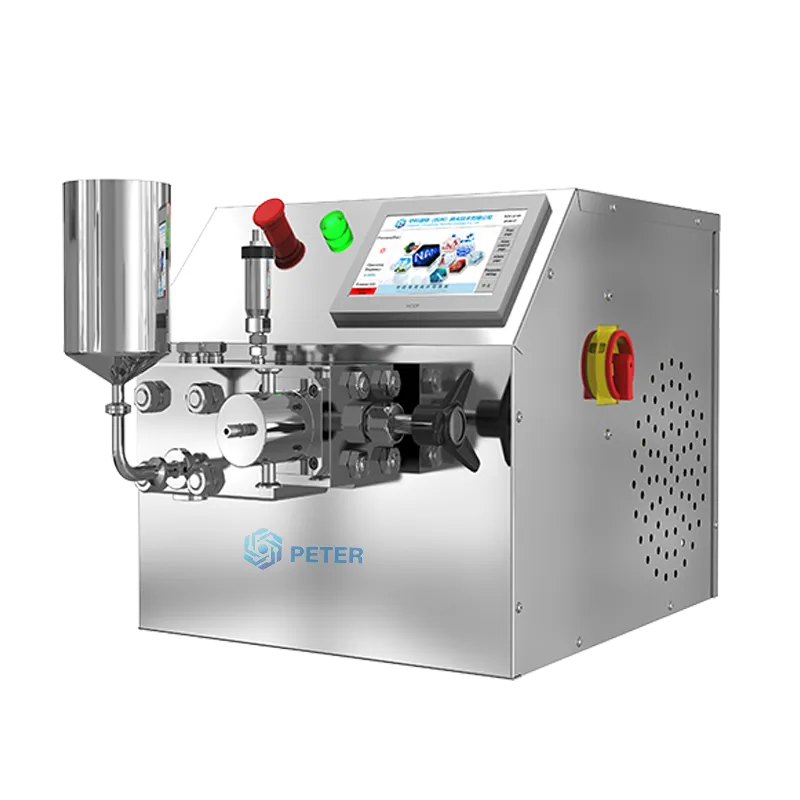
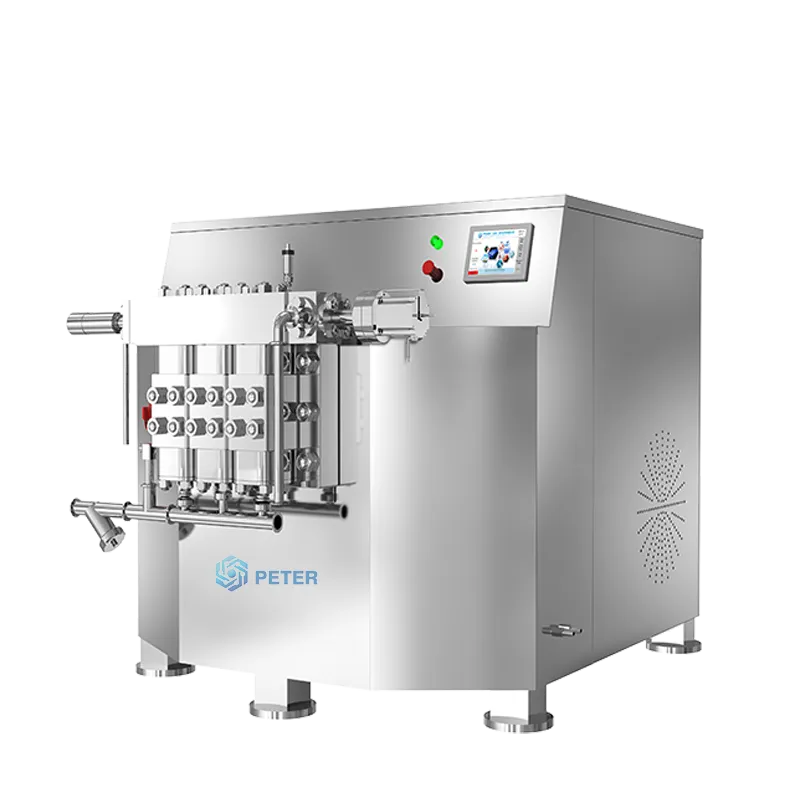
CAS PETER can be considered when a buyer needs configurable high-pressure homogenizer or microfluidizer options and a technical discussion around representative testing and documentation. For smaller development work, review the homogenizer machine for milk option represented by the PT-20; for a production-focused evaluation, the milk homogenizer machine option represented by the PT-500 is a useful starting point for a configuration conversation.
Frequently asked questions
What does a milk homogenizer do to milk?
It reduces and redistributes dispersed fat globules through controlled high-pressure processing, which can reduce visible cream separation and improve uniformity. The final effect depends on formulation, temperature, pressure profile, and downstream treatment. Validate finished-product behavior instead of inferring stability from pressure alone.
What pressure is used for milk homogenizer processing?
There is no universal pressure figure that fits every dairy formulation or machine. Establish a qualified range through trials that measure product quality, temperature, flow, and pressure stability at representative feed conditions. The right setting is the lowest verified setting that meets the product and process criteria; CAS PETER also outlines questions to consider in its guide to the best pressure homogenizer for your needs.
How does homogenizer machine for milk affect product stability?
It can improve dispersion uniformity, which may help reduce cream separation and texture variation. Stability also depends on proteins, emulsifiers, heat treatment, packaging, and storage conditions. Compare retained samples through the intended shelf-life protocol before finalizing the process.
What should processors check before selecting a milk homogenizer?
Check the full feed envelope, desired quality outcome, actual duty cycle, utilities, temperature control, CIP chemistry, wetted materials, safety requirements, service support, and validation method. Ask for a representative trial with agreed acceptance criteria. A useful primer on the process is CAS PETER’s guide to how high-pressure homogenizers work.
References and next step
- ISO 13320: Particle size analysis – Laser diffraction methods
- U.S. FDA: Food Safety Modernization Act
- FAO: Food safety resources
- U.S. FDA: Current good manufacturing practice regulations
The best system is the one that remains predictable when the product, sanitation routine, and production day become real. When your team is ready to define trials, configuration, and scale-up evidence, contact CAS PETER to discuss the operating conditions that matter.