

Milk Homogenization Process: Dairy to Pharma Formulations
When Ravi, a formulation lead in Basel, encountered foaming while moving a stable dairy emulsion recipe toward a lipid-based pharmaceutical suspension, the milk homogenizer process looked transferable on paper. The first pilot batch showed a different particle distribution. The reversal was useful: the unit could create shear, but pharmaceutical excipients, bioburden controls, hold time and temperature limits required a new process definition.
Summary: A pharmaceutical homogenizer is selected by material sensitivity, contamination-control strategy, target particle distribution and scale—not by copying dairy pressure. Use a documented pressure/flow/temperature design space, ISO 13320 or another fit-for-purpose particle method, and GMP risk assessment. Dairy processing may tolerate a broader thermal window than a pharma formulation; verify every transfer assumption.
What Homogenization Changes in Milk and What It Cannot Prove in Pharma
A high-pressure homogenizer accelerates liquid through a restrictive valve, creating turbulent flow, cavitation and intense local shear. Droplets or soft agglomerates can be reduced, but the result depends on viscosity, surfactant, solids, temperature and number of passes. The machine does not “sterilize” a product. Sterility, bioburden reduction and endotoxin control require validated methods outside the homogenization step.
For milk, measure cream-line separation, viscosity, sensory attributes and storage stability. For pharmaceutical or cosmetic formulations, define particle-size distribution, assay uniformity, pH, viscosity, preservative content and microbial attributes as appropriate. ISO 13320 can be used for laser diffraction if dispersion and refractive-index assumptions are controlled; the method does not establish clinical efficacy or product safety.
Which Process Variables Must Be Re-developed for Pharmaceutical Formulations?
| Setting | Dairy question | Pharma/cosmetic question |
|---|---|---|
| Pressure | Does the emulsion remain stable without excess heat? | Does size reduction meet the target without degrading actives or excipients? |
| Flow | Can the line meet the declared batch or continuous rate? | Can residence time and hold-up be controlled and documented? |
| Temperature | Does outlet temperature preserve flavor and protein function? | Does heat affect potency, preservative or polymorph state? |
| Passes | Is one pass enough for cream-line control? | Do additional passes improve distribution or increase degradation risk? |
| Cleaning | Are allergen and soil removal demonstrated? | Are product-contact cleaning and changeover validated? |
Use a design-of-experiments matrix rather than a single “best” pressure. Log inlet temperature, outlet temperature, pressure ripple, flow, energy, pass count and sample identity. A pressure increase that narrows particle size but raises temperature beyond the formulation limit is not an improvement.
Which Dairy Records Can Transfer, and Which Controls Must Be Rebuilt?
The transferable part is the discipline of the experiment: equipment identification, pressure calibration, inlet and outlet temperature, flow, pass count, sampling time, particle method and deviation record can become a starting template. The conclusion cannot transfer automatically. A dairy stability endpoint does not establish drug assay, degradation, microbial control or clinical suitability, and an apparently similar pressure does not show equivalent residence time or specific energy on a different system.
ICH Q8 frames pharmaceutical development around critical quality attributes and the material attributes and process parameters that can affect them. For a drug formulation, redefine those links for the actual dosage form: heat sensitivity may connect outlet temperature to degradation; hold-up and recirculation may connect residence time to size distribution; cleaning and data integrity may connect equipment design to contamination and traceability risks. The resulting control strategy belongs to the product and quality system, not to the dairy recipe or the homogenizer name.
How Equipment Configurations Change the Evidence You Can Collect
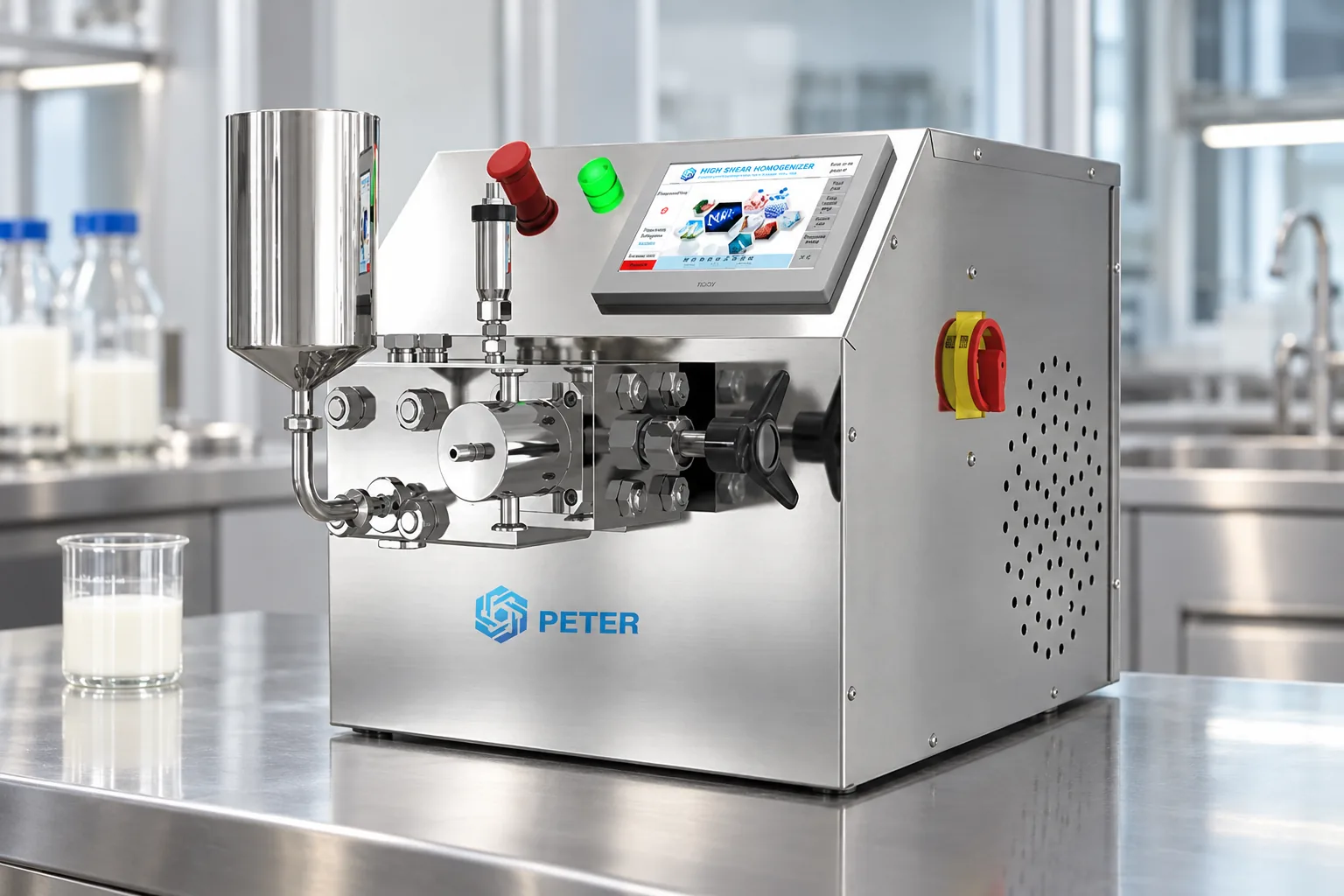
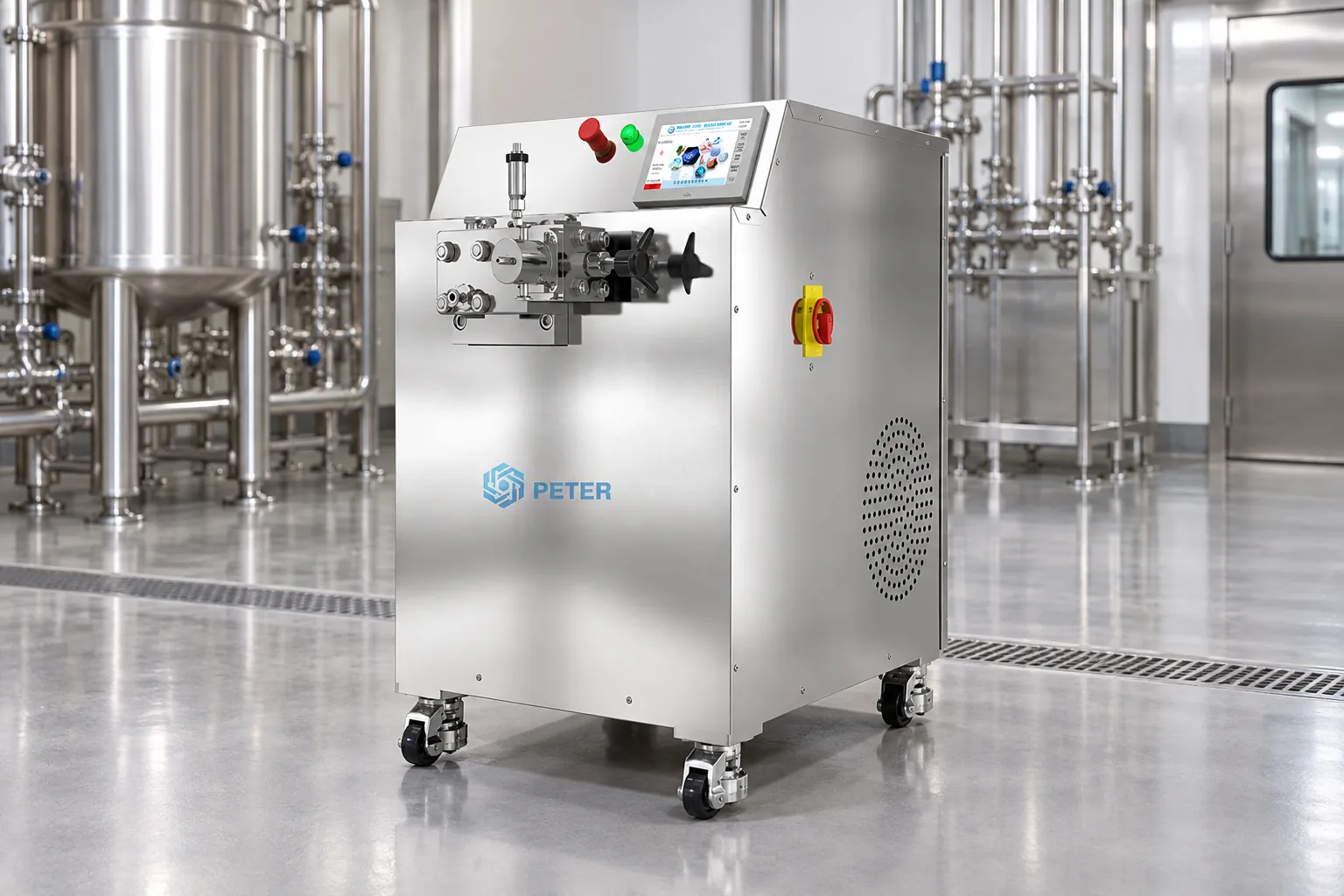
Laboratory units are valuable for formulation screening because they consume less material and enable controlled comparisons. Pilot units reveal pumpability, heat removal, hold-up and cleaning behavior at a more realistic scale. Production units add automation, utilities, validated sensors and maintenance access. A pharmaceutical homogenizer should be specified with the quality unit: contact materials, seals, surface finish, drainability, data integrity and cleaning strategy may be more important than nominal pressure.
A pharma homogenizer and cosmetic homogenizer may share the same pressure mechanism, yet their acceptance tests can emphasize different outcomes: texture, appearance and separation versus drug assay or potency. Preserve this boundary in supplier requirements and internal records.
CAS PETER’s public range includes the PT-20 experimental model and the PT-500 production configuration. Public product pages are manufacturer information, not proof that a formulation is GMP-compliant. Ask for material certificates, instrument calibration, cleaning documentation and a trial protocol that matches your product.
How to Scale Up the Mechanism Without Treating One Pressure as Equivalence
Scale-up should preserve the variables that control product quality: pressure, flow regime, temperature history, pass count, concentration, feed preparation and residence time. Hydraulic power can be screened as pressure multiplied by volumetric flow, adjusted for efficiency; it cannot predict particle size by itself. Compare pre- and post-process distributions and verify that the larger unit does not create a different thermal profile.
For pharmaceuticals, write a risk assessment using the applicable GMP framework in the destination market. U.S. FDA 21 CFR Parts 210 and 211 cover current good manufacturing practice for drugs; EU GMP Volume 4 is the corresponding European reference. Neither standard names a universal homogenizer pressure. The responsible manufacturer must define and validate a process for its product.
How to Run a Controlled Cross-Sector Transfer Experiment
Prepare one representative batch and divide it into controlled aliquots. Compare at least three pressure/pass combinations while holding formulation age, inlet temperature and sampling time constant. Measure particle distribution, viscosity and a product-specific stability attribute immediately and after a defined hold. Repeat the preferred condition on a different day; day-to-day variation is often more informative than an extra pressure point.
Document what cannot be scaled directly. A laboratory loop may have negligible hold-up, while a production skid contains longer piping and a larger recirculation volume. If temperature or residence time differs materially, adjust the pilot configuration or state that the lab result is formulation screening rather than scale evidence.
Predefine the evidence needed to call two scales comparable: the relevant CQA results, the sampling locations, repeat batches, acceptance rules and treatment of deviations. FDA’s process-validation guidance uses a lifecycle approach rather than relying on one successful engineering batch. Apply that principle within its pharmaceutical scope by carrying process understanding into qualification and continued monitoring; it does not prescribe a universal pressure or replace a site-approved protocol.
Which Application Outcomes Require Different Evidence?
| Application | Typical objective | Evidence to collect |
|---|---|---|
| Dairy milk | Uniform fat distribution and reduced creaming | Particle distribution, cream line, viscosity and sensory checks |
| Plant-based beverage | Control sediment and oil separation | Solids, sediment, stability and thermal profile |
| Liposome or nanoemulsion research | Repeatable size and encapsulation conditions | Size/PDI method, assay, temperature and cycle history |
| Cosmetic emulsion | Texture, appearance and separation resistance | Viscosity, microscopy, centrifuge or storage protocol |
Where Standards Draw the Validation Boundary Between Food and Pharma
ISO 13320 is a measurement method; ISO 22000 addresses food-safety management; FDA 21 CFR Parts 210/211 and EU GMP Volume 4 address pharmaceutical GMP. Cleaning validation, sterilization, aseptic processing and product release require separate protocols. Do not claim that a machine is “FDA approved” merely because its wetted material is described as suitable for food or pharma contact.
Define acceptance criteria before the run: sample locations, number of replicates, instrument settings, calibration status, statistical limits, cleaning endpoint and deviation handling. If a method is not stability-indicating or cannot distinguish agglomerates from primary particles, consult a qualified analytical reviewer before using it as a release decision.
Which Selection Steps Keep Dairy and Pharmaceutical Requirements Separate?
- Classify the product as food, cosmetic, pharmaceutical or research and identify the governing quality system.
- Specify concentration, viscosity, temperature, particle size, shear sensitivity and allowable hold time.
- Request a material-specific trial with pressure, flow, pass count and cooling data.
- Map cleaning, changeover, data-integrity and maintenance requirements with QA/engineering.
- Scale only after comparing mechanism-relevant variables and analytical results.
Frequently Asked Questions About Dairy-to-Pharma Homogenization
What does a milk homogenizer do to milk?
It forces milk through a restrictive valve so fat globules are disrupted and redistributed, reducing creaming under the chosen conditions. The product outcome depends on fat, solids, temperature, pressure, valve design and storage; verify with particle and stability tests.
What pressure is used for milk homogenizer processing?
There is no single universal pressure. Processors should define a trial range within the machine rating and select the lowest setting that meets stability and sensory criteria without unacceptable temperature rise or wear.
How does pharmaceutical homogenizer affect product stability?
It may improve dispersion or emulsion uniformity, but excessive shear, heat or repeated passes can degrade an active or excipient. Measure potency, particle distribution, viscosity and stability on the actual formulation.
What should processors check before selecting a milk homogenizer?
Check feed properties, pressure/flow window, cooling, hygienic design, cleanability, wear parts, utilities and the acceptance test. For pharma work, involve the quality unit before making a GMP or sterile-processing claim.
Technical References for Process Transfer and Validation Boundaries
- ISO 13320:2020 laser-diffraction particle-size analysis.
- U.S. 21 CFR Part 210 and Part 211.
- EU GMP Volume 4.
- EMA: ICH Q8(R2) Pharmaceutical Development and FDA: Process Validation—General Principles and Practices (pharmaceutical development and validation scope; neither is an equipment certification).
- CAS PETER PT-500 product information.
Scale-up is credible when the mechanism, measurement and quality boundary travel together. Share your formulation window through the CAS PETER laboratory homogenizer page to scope a trial, and have your qualified quality and process teams approve the final control strategy.