

Pharmaceutical Homogenizer Equipment: Lab to Production
When Daniel, a development engineer in Toronto, encountered poor viscosity uniformity after copying a bench recipe to a production skid, the bulk batch passed a visual check but failed at the tank outlet. The investigation found different recirculation volume and a longer hold time, not a mysterious scale-up effect. Pharmaceutical homogenizer equipment must preserve the mechanism that controls quality, not merely the recipe’s pressure number.
Summary: Move from a lab homogenizer or laboratory homogenizer to production through a staged process: define quality attributes, map pressure/flow/temperature/pass count, test representative material, and verify cleaning and data integrity. A handheld homogenizer can screen small samples, but it rarely predicts production heat removal, hold-up or sanitary changeover. Use ISO 13320 or a justified alternative for particle measurements and involve QA early.
How Process Design Begins with the First Representative Sample
Record formulation concentration, viscosity, pH, solids, temperature, target size distribution, allowable degradation and batch volume. Identify whether the product is an emulsion, suspension, liposome dispersion or cell lysate; each has different sensitivity to heat and shear. Set sampling points before and after homogenization and after the final hold.
Use a cause-and-effect matrix: pressure and valve geometry influence energy input; flow and recirculation influence residence time; temperature influences viscosity and degradation; pass count influences both uniformity and wear. A pilot plan should intentionally challenge the upper solids and lowest inlet temperature expected in manufacturing.
Why the Sampling Plan Must Follow the Actual Flow Path
A tank-top sample may hide non-uniform material at a transfer outlet. Mark samples by time, location, pass number and temperature; include start, middle and end of a batch. If the system recirculates, calculate how many theoretical tank turnovers occur and state the mixing assumption. Retain an unprocessed control so analytical drift can be distinguished from process change.
For a size-distribution result, report D10, D50 and D90 or another justified set rather than only the mean. A narrow average can conceal a large-particle tail that affects sedimentation or injectability. The quality unit should decide which metric is material to the dosage form.
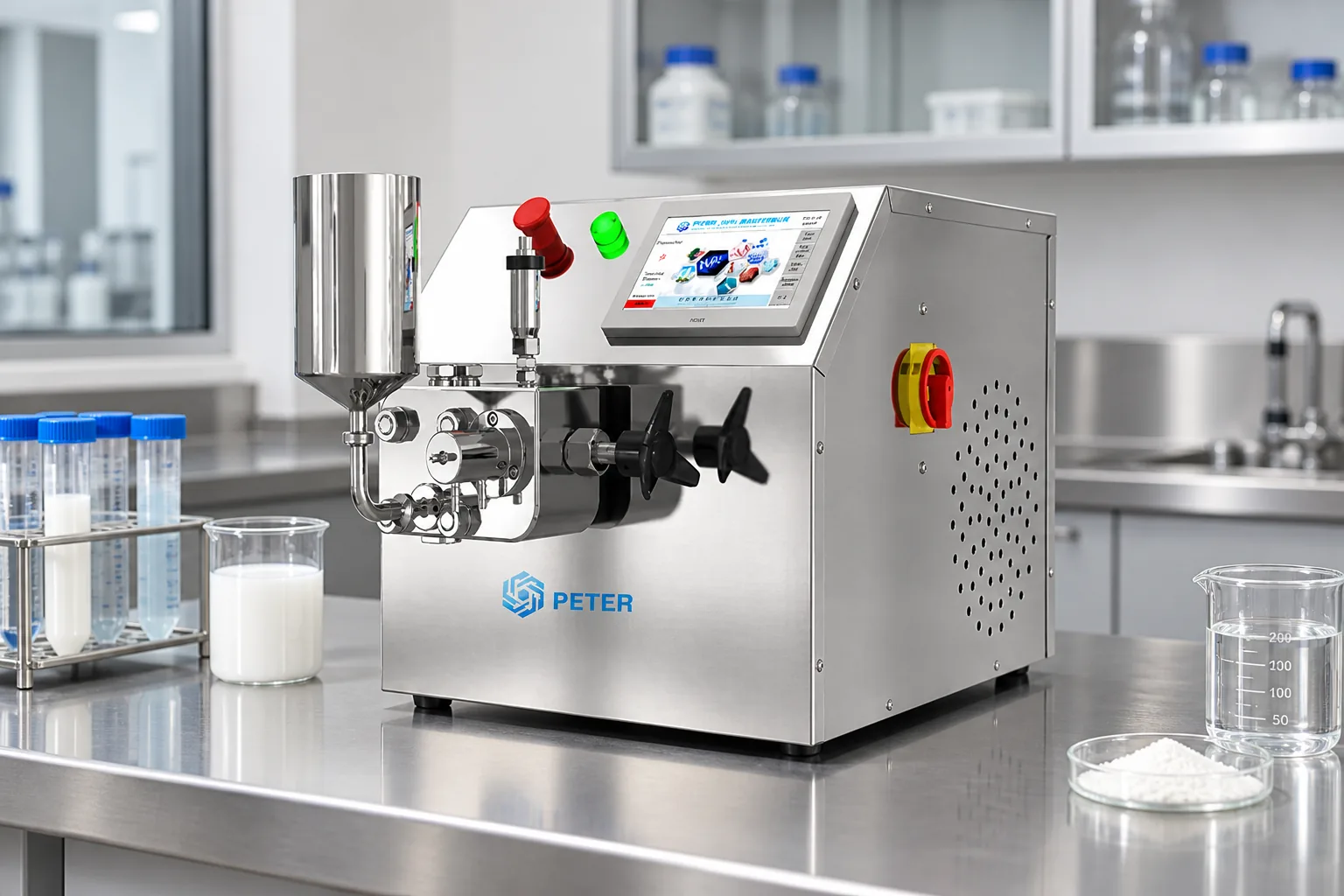
What Laboratory, Handheld, Pilot, and Production Units Can Actually Prove
| Equipment | Strength | Limit to disclose |
|---|---|---|
| Handheld homogenizer | Fast small-sample screening and localized dispersion | Operator-dependent shear, limited temperature control and little scale evidence |
| Lab homogenizer | Repeatable formulation comparisons with low material use | Small hold-up and different hydraulics from production |
| Pilot unit | Tests cooling, recirculation, cleanability and controls | Requires utilities and a realistic batch plan |
| Production unit | Continuous duty, automation and production data capture to qualify | Higher capital, qualification and maintenance commitment |
Do not treat a handheld result as a release method. Use it to rank formulations, then confirm the ranking with a controlled lab homogenizer or pilot trial. Keep sample preparation, temperature and operator technique documented.
How to Optimize Consistency Without Confusing Nameplate and Usable Capacity
Hydraulic power can be approximated by pressure multiplied by volumetric flow and efficiency. The relationship is useful for utility planning, not for predicting particle size or motor size without machine data. At production scale, cooling and recirculation can dominate consistency. Log outlet temperature and pressure ripple at defined intervals, not only at startup.
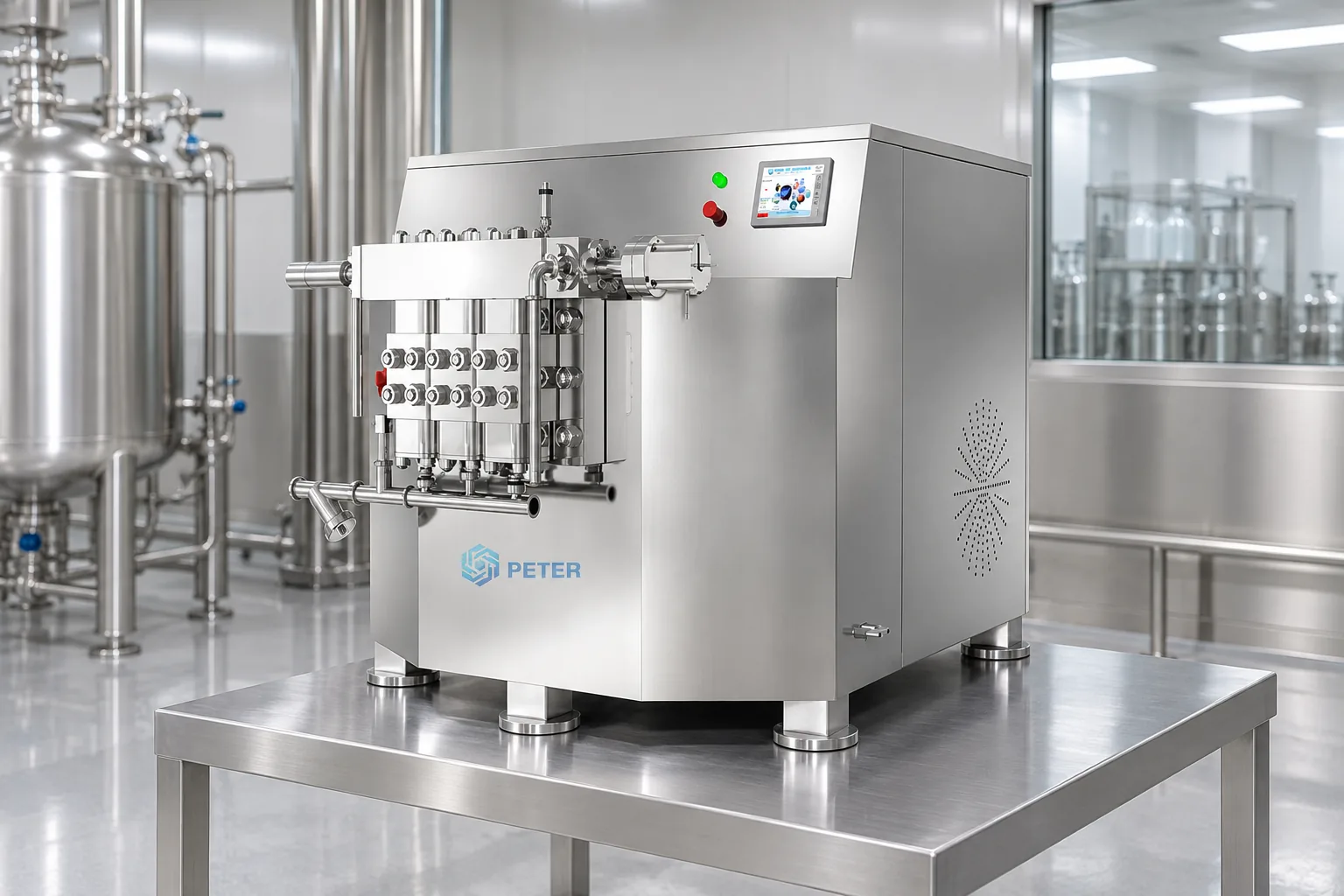
Capacity planning must include batch transfer, cleaning, sampling and changeover. A nominal 500 L/H figure may be stated for a particular viscosity and temperature; ask for the conditions. CAS PETER’s public PT-500 page lists up to 500 L/H and a 1,200-bar maximum under its published specification. Confirm whether those figures match your formulation and duty cycle.
Calculate usable daily capacity rather than nameplate capacity. Illustratively, a line with six hours of processing inside an eight-hour shift has only 75% time utilization before yield loss, maintenance and unplanned stops. Multiply verified material flow by available processing time and expected yield; show every assumption. This simple model clarifies whether a faster pump or a shorter changeover creates more value.
Which Cost and Capacity Inputs Make Production Planning Realistic?
| Planning item | Question | Why it matters |
|---|---|---|
| Batch economics | How much product is consumed per trial and per cleaning? | Determines development cost and sample availability |
| Utilities | What motor, cooling water, compressed air and drainage are required? | Prevents late infrastructure changes |
| Quality testing | Which assays and particle methods are release-relevant? | Sets laboratory capacity and lead time |
| Maintenance | What wear parts and service skills are needed? | Protects uptime and spare-parts budget |
| Validation | Which IQ/OQ/PQ, cleaning and process studies apply? | Defines schedule and documentation effort |
How the FDA Lifecycle Model Changes Lab-to-Production Evidence
FDA’s process-validation guidance describes three connected stages: process design, process qualification and continued process verification. In the design stage, use development data to explain how pressure, flow, temperature, pass count, feed preparation and hold time affect the selected quality attributes. During qualification, confirm that the installed process and trained operations can reproduce the intended result under an approved protocol. After routine production begins, trend relevant process and quality data so drift is detected rather than assumed away.
This lifecycle is a pharmaceutical validation framework, not a claim that a specific homogenizer is validated or FDA approved. The site quality unit defines applicability, the number of runs, statistical approach and acceptance criteria. Repeated batches should use a predefined sampling map and record deviations, interventions, alarms and raw analytical data. When a scale changes the recirculation path or sampling point, demonstrate why the comparison remains scientifically meaningful instead of copying one pressure value.
Which Standards, Qualification Records, and Cleaning Evidence Apply?
ISO 13320 covers laser diffraction; it does not certify equipment. For medicinal products, 21 CFR Parts 210/211 or EU GMP Volume 4 may apply depending on market and product. Qualification typically includes installation, operational and performance evidence, but the exact protocol belongs to the site quality system. Document calibration, software version, alarms, interlocks, cleaning limits and deviations.
For scale-up, compare particle distribution, viscosity, assay uniformity and stability across lab, pilot and production samples. If the laboratory homogenizer method changes with scale, demonstrate comparability or explain the limitation. A single successful engineering run is not a validated process.
Cleaning evidence should cover the hardest-to-clean formulation and the longest dirty hold time. Identify valve, seal and dead-leg locations in the sampling map. A visually clean surface is useful inspection evidence but is not enough when a residue carries pharmacological, allergenic or microbial risk; use an analytically justified limit and recovery method.
Assign ownership before the qualification campaign: engineering can verify utilities and alarms, operations can execute approved procedures, the laboratory can control analytical methods and sample chain of custody, and QA can approve protocols, deviations and conclusions. Supplier records support this work but do not transfer the manufacturer’s regulatory responsibility to the equipment vendor.
Keep the approved protocol, raw instrument files, sample identifiers and final comparison together so future investigations can reconstruct how the scale-up conclusion was reached.
Which Selection Actions Build Scale-Up Evidence Before Purchase?
- Define critical quality attributes and the formulation operating envelope.
- Run a lab design-of-experiments matrix and retain raw data.
- Use a pilot campaign to test cooling, recirculation, hold-up and cleaning.
- Specify utilities, automation, data integrity and spare parts before ordering.
- Approve production only after QA reviews the comparability and validation plan.
CAS PETER’s PT-20 can support experimental work; a production project may require the PT-500 or another configuration. Request a material-specific test and written scope rather than assuming model names predict output.
For quotations, separate the base machine from feed tanks, heat exchangers, transfer pumps, controls integration, installation and qualification support. Request the recommended startup spare kit and expected replacement triggers. This makes two suppliers’ scopes comparable and exposes costs that otherwise appear only after design freeze.
Record the quotation date and currency assumptions as well.
Frequently Asked Questions About Pharmaceutical Homogenizer Scale-Up
What is a pharmaceutical homogenizer used for in pharmaceutical and cosmetic formulation?
It creates controlled dispersion, emulsion or particle-size reduction for products such as suspensions, lipid systems and creams. The machine does not by itself sterilize or validate the formulation.
How does a pharmaceutical homogenizer work?
It drives liquid through a high-energy valve or interaction zone where turbulence, cavitation and shear break droplets or agglomerates. Pressure, flow, temperature and material properties determine the result.
What is the difference between a pharmaceutical homogenizer and lab homogenizer?
“Pharmaceutical” describes the intended quality and documentation context; a lab homogenizer describes scale. A lab unit may support development, while a production system must address utilities, cleaning, automation and validated data.
Which factors affect pharmaceutical homogenizer performance?
Feed viscosity and solids, pressure, flow, valve condition, temperature, pass count, recirculation and sampling method all matter. Trend them together and verify with a fit-for-purpose analytical method.
Technical References for Pharmaceutical Scale-Up and Validation Boundaries
- ISO 13320:2020.
- U.S. 21 CFR Part 211.
- EU GMP Volume 4.
- FDA: Process Validation—General Principles and Practices (lifecycle guidance for pharmaceutical manufacturing, not equipment certification).
- CAS PETER PT-500 manufacturer information.
Good scale-up keeps the same cause-and-effect chain from vial to vessel. Send your batch, material and acceptance data through the CAS PETER lab equipment page so a lab-to-production roadmap can be reviewed with your quality team.