

High Pressure Lab Homogenizer: How to Choose for Your Lab
When Maya, a formulation scientist in Boston, encountered a coarse tail in a promising emulsion, she raised the pressure and ran another pass. Within minutes, the sample warmed, foam appeared, and the size result became less repeatable. In this composite procurement scenario, the reversal was important: the equipment was not simply “bad.” The selected flow path, minimum working volume, cooling plan, and analytical method did not match the formulation.
Summary: Choose a high-pressure lab homogenizer by the complete process window—not by maximum pressure alone. Define feed volume, recoverable volume, inlet particle limit, viscosity, pressure, pass count, flow, outlet temperature, cleanability, and the test method used to judge success. ISO 13320 addresses particle-size analysis by laser diffraction, whereas ISO 22412 addresses dynamic light scattering; each is a measurement standard, not a homogenizer certification. Run a representative material trial and document a scale-up basis before issuing a purchase order.
A high-pressure laboratory homogenizer pumps a liquid or pumpable suspension through a restricted valve or interaction zone. The rapid pressure drop and high local energy input can create shear, turbulence, impact, and—in suitable liquids—cavitation. The useful outcome may be droplet breakup, deagglomeration, dispersion, or cell disruption, but the dominant mechanism and result depend on the formulation and flow-path design. That is why a homogenizer machine for laboratory work should be specified as part of a method, not treated as a universal size-reduction box.
How to Translate Your Application Goal into a Testable Homogenizer Requirement
Start with the job the processed sample must perform. Emulsion teams may need a narrower droplet-size distribution and a stable viscosity. Nanomaterial teams may need deagglomeration without unacceptable contamination from wetted parts. Biotechnology teams may seek cell disruption while controlling product temperature and downstream clarification. Food researchers may compare texture, separation, or stability. In every case, “smaller” is incomplete unless the laboratory also defines recovery, temperature exposure, chemistry, and the time point at which the sample is measured.
Match the analytical method to the expected size range and material behavior. ISO 13320:2020 describes laser-diffraction particle-size analysis, while ISO 22412:2017 covers dynamic light scattering (DLS). A DLS intensity distribution and a laser-diffraction volume distribution are not interchangeable. Report the instrument, dispersant, refractive-index inputs where applicable, dilution procedure, temperature, replicate plan, and whether the stated value is a median, mode, or distribution width.
Pressure units also need discipline. NIST Special Publication 811 lists the bar as 100,000 pascals, so 1,800 bar corresponds to 180 MPa and 2,700 bar to 270 MPa. This conversion helps procurement compare specifications, but it does not predict product quality. A lower-pressure run with an appropriate interaction geometry, feed condition, and temperature limit can be more useful than a higher-pressure run that overheats or blocks.
Which Process Variables Must Be Controlled to Make Trial Results Reproducible
Why Pressure, Pass Definition, and Flow Must Be Recorded Together
Record actual operating pressure rather than only the setpoint or nameplate maximum. Define a pass as one complete traversal of the working zone, and distinguish discrete passes from recirculation because residence-time distributions differ. Log flow or batch time as well: two tests at the same pressure can deliver different thermal histories when flow, cooling, or recirculation volume changes. For an initial screening design, three pressure levels and one to three passes may be practical, but that is an experimental plan—not a universal prescription.
How Feed Particle Size, Viscosity, and Pumpability Set the Operating Window
Measure viscosity at a stated temperature and, for non-Newtonian materials, at a stated shear rate or spindle-and-speed condition. A single “viscosity” number does not fully describe pumpability: yield stress, shear thinning, entrained air, settling, and a paste-like feed response can prevent stable filling even when a reported viscosity appears acceptable. The trial record should therefore include the viscosity method, temperature, time after mixing, observed flow into the pump, and any pulsing or loss of prime.
Screen or premix powders so the largest incoming particles and soft agglomerates remain within the supplier-agreed inlet limit; never assume that an average particle size proves the feed is safe. State the screen opening or microscopy rule used, record whether oversize material is removed or merely broken up, and test the most difficult realistic feed. This separates a formulation limit from a preventable blockage caused by poor pre-screening.
How Outlet Cooling Capacity Should Be Specified for Temperature-Sensitive Samples
Record inlet and outlet temperature for every pass, but do not accept “cooling included” as a complete specification. Define the maximum acceptable outlet temperature at a stated inlet temperature, pressure, flow, pass strategy, batch volume, coolant temperature, and ambient condition. A 10 °C rise can change viscosity or degradation rate enough to confuse a pressure comparison, even when no visible scorching occurs.
Cooling capacity is a heat-removal question, not just a heat-exchanger label. For an illustrative screen, the sensible heat associated with the liquid can be estimated from mass flow × heat capacity × temperature change; actual duty also depends on equipment losses, recirculation, and formulation properties. Buyers should ask the supplier to demonstrate the outlet-temperature limit with the proposed sample or a defensible thermal surrogate rather than extrapolating from water.
Why Sampling and Measurement Methods Must Stay Comparable
Reserve an untreated control and take samples from a defined location after a defined number of passes. Use at least duplicate preparations when material permits; repeated instrument readings from one vial measure reading precision, not preparation repeatability. For ISO 13320 or ISO 22412 work, document dilution and dispersion steps because sample preparation can create or destroy the apparent size change attributed to the homogenizer.
What to Compare Beyond Maximum Pressure When Shortlisting Benchtop Systems
A benchtop label says little about process fit. Compare the usable working range, not one headline value. The table below separates questions that affect development data, operator burden, and total cost. A useful supplier trial should process the most difficult expected formulation—not only water or an easy, dilute emulsion.
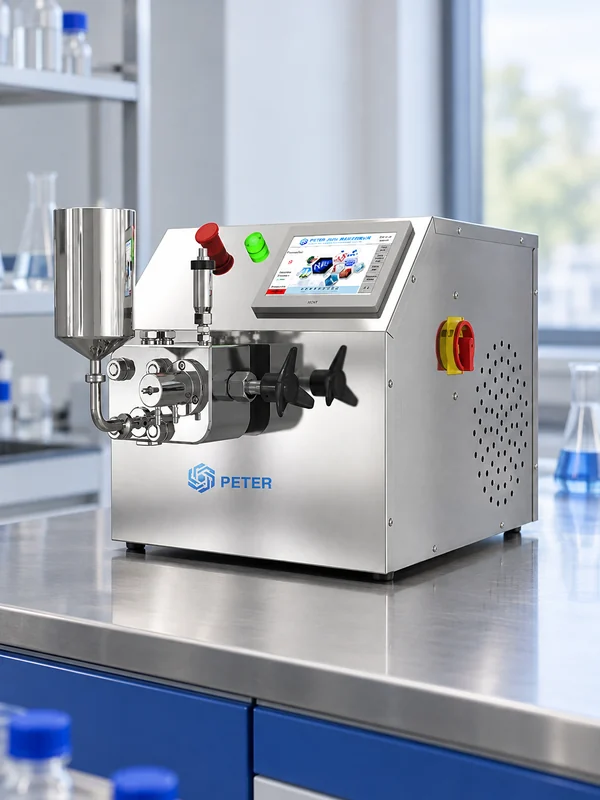
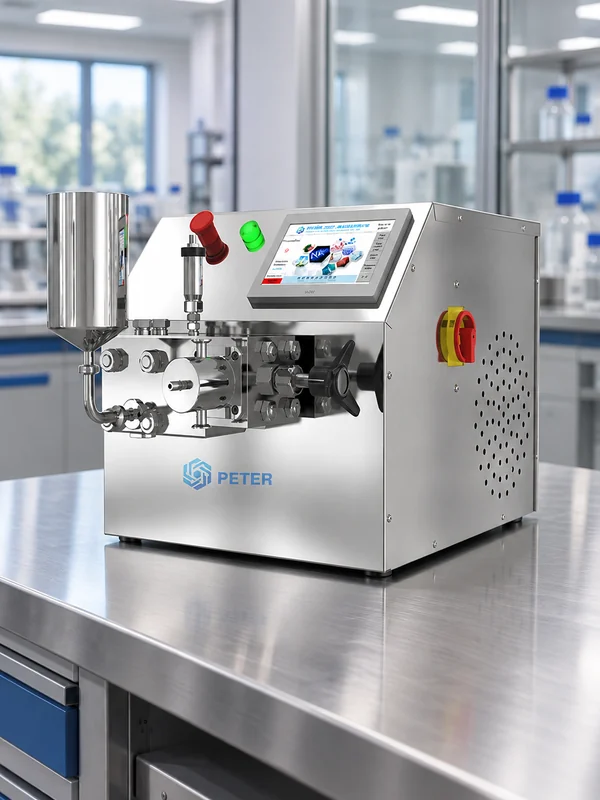
As published on the product pages reviewed for this guide, the PT-10 core specifications list 1,800 bar, 5–10 L/h, and a 15 mL minimum feed; the PT-20 page lists 1,800 bar, at least 20 L/h, and a 25 mL minimum feed. Those figures illustrate why throughput and material demand must be compared together. They are supplier-published specifications rather than independent test results, so confirm the current quoted configuration and use the same ISO 13320 or ISO 22412 measurement method during sample trials.
Why “Minimum Sample Volume” Can Mean Three Different Quantities
A minimum-volume claim is useful only after the parties define what was measured. Ask the supplier to separate three quantities:
- Published minimum or vendor claim: the smallest stated feed requirement under the supplier’s chosen configuration and operating procedure. It may be a screening value, but it does not by itself state how much product will be collected.
- Charged and pumpable volume: the amount placed in the feed vessel that can establish a stable prime and complete the intended pass without drawing air. It includes liquid that remains in the feed path and working zone.
- Recoverable analytical volume: the uncontaminated quantity collected after the defined pass and available for the required assays, retains, and repeats. It excludes line hold-up, priming losses, transfer residue, and any rinse that would dilute the product.
These values diverge because the flow path must first be wetted and filled, while analysis requires a collected fraction with known identity and concentration. For a scarce formulation, request a simple volume or mass balance: starting charge; product used to prime; first fraction disposition; collected undiluted product; residual line hold-up; rinse volume; sampling volume; and final assay-ready recovery. Report recovery as both an amount and a percentage of the charged material. A rinse can improve material accountability, but it should not be counted as usable product unless the analytical method permits the resulting dilution.
| Comparison point | Evidence to request | Why it changes the decision |
|---|---|---|
| Minimum feed and recoverable volume | Mass balance using the proposed flow path | Hold-up, flushes, and samples can consume scarce material |
| Pressure and flow range | Logged pressure, flow, and pass definition | Determines design-space coverage and test duration |
| Thermal control | Inlet/outlet temperature trace and cooling arrangement | Separates pressure effects from heat effects |
| Wetted materials and seals | Material list plus compatibility review | Affects corrosion, extractables, wear, and cleaning |
| Cleaning and changeover | Accessible surfaces, cleaning procedure, and inspection points | Drives downtime and cross-contamination control |
| Service and consumables | Wear-part list, intervals, lead times, and training scope | Reveals lifetime cost beyond purchase price |
How Wetted-Material Compatibility and Cleanability Affect Method Feasibility
Review the entire wetted path—not only the homogenizing valve. The compatibility assessment should identify metals, ceramics, elastomers, polymers, adhesives where relevant, tubing, seals, and the cleaning agents they will contact. A solvent may be acceptable for one component but cause swelling, embrittlement, corrosion, extractables, or loss of sealing elsewhere. Confirm compatibility at the intended concentration, temperature, contact time, pressure cycle, and number of exposures; a generic materials chart is a screen, not a substitute for configuration-specific review.
Cleanability also needs a measurable endpoint. Document the dismantling required, drainability, dead legs or retained pockets, flush sequence, cleaning-agent volume, and inspection access. Depending on risk, verification may combine visual inspection with a product-specific assay, conductivity, total organic carbon, microbial method, or another validated internal method. Under 21 CFR 211.67, applicable drug-manufacturing equipment must be cleaned and maintained at appropriate intervals, but the regulation does not certify a homogenizer or prescribe one universal residue limit.
For broader mechanism selection before a pressure-system purchase, the laboratory homogenizer comparison explains where handheld screening and controlled high-pressure processing answer different questions. When pressure-controlled development is already required, a benchtop high-pressure homogenizer product page can provide a starting specification, but the laboratory should verify the quoted configuration against its own samples.
How to Design a Boundary-Sample Trial with Measurable Acceptance Criteria
The critical limits are feed particle size, viscosity, solids loading, chemistry, inlet temperature, allowable outlet temperature, pressure, flow, pass count, and the safe operating rules for blockage or pressure excursions. Add material compatibility, cleaning chemistry, biohazard controls, and acceptable carryover. For drug manufacturing in the United States, 21 CFR 211.67 requires equipment and utensils to be cleaned, maintained, and sanitized at appropriate intervals; it does not certify a particular model. For food operations, 21 CFR Part 117 addresses current good manufacturing practice and preventive controls, with applicability depending on the facility and use.
Total cost includes development material, operator time, utilities, cooling, cleaning, wear parts, analytical measurements, failed batches, and downtime. Consider an illustrative 250 mL formulation: if 40 mL is unavailable because of flow-path hold-up and sampling, usable recovery is 210 mL, or 84%. That calculation is not a promised recovery rate; it shows why buyers should measure starting mass, collected mass, rinse volume, and retained residue during the actual trial.
Which Small-Batch Boundary Samples Should Be Included in the Trial
Do not spend scarce material on a single comfortable midpoint run. Use a staged boundary design: begin with a safe surrogate or representative midrange formulation to confirm setup, then test the smallest planned charge, the largest expected feed particle that remains within the supplier-agreed limit, the highest pumpable viscosity or yield-stress condition, the most demanding chemistry already cleared by a wetted-material review, and the most temperature-sensitive formulation. These do not need to be five separate products; a compact matrix can select formulations that combine credible worst cases without creating an unsafe or unrealistic mixture.
For each boundary, run an untreated control and a predefined pressure-and-pass condition, using independent preparations when material permits. Capture at least start and end mass or volume, prime and rinse quantities, actual pressure, flow or elapsed processing time, inlet and outlet temperature, pass definition, observations of air intake or pressure instability, collected assay-ready volume, and the agreed quality result. Stop rules should be written before the run—for example, a product-specific temperature ceiling, abnormal pressure behavior, leakage, loss of prime, blockage, or a degradation marker outside its limit.
Which Acceptance Fields Make a Vendor Trial Auditable
An acceptance sheet should identify the sample lot and age; formulation and premix procedure; feed-screen method; viscosity method and temperature; equipment model, serial or trial-unit identifier, flow-path configuration, and wetted materials; pressure, flow, passes, cooling conditions, and temperature trace; charged, priming, recovered, retained, sampled, and rinse quantities; cleaning verification result; analytical instrument and method; replicate count; result and variability measure; acceptance limit; deviation; and named approver. A pass/fail statement without these fields is difficult to compare later or transfer to another scale.
| Process limit | Qualification check | Stop or review trigger | Scale-up record |
|---|---|---|---|
| Feed, viscosity, and inlet particles | Sieve or microscopy result; viscosity method and temperature; observed pumpability | Blockage, loss of prime, unstable feed, pressure spike | Premix method, screen size, and rheology condition |
| Temperature | Calibrated inlet/outlet readings each pass | Product-specific limit exceeded | Cooling duty and residence history |
| Pressure and flow | Trend actual values over the run | Drift outside approved trial band | Valve geometry, pressure, and flow |
| Output quality | ISO 13320, ISO 22412, or fit-for-purpose assay | No improvement or unacceptable degradation | Method, sample prep, and acceptance rule |
| Cleanability | Visual inspection plus product-specific residue test | Residue or carryover above internal limit | Cleaning sequence and verification result |
| Material balance | Charged, prime, collected, sampled, retained, and rinse quantities | Assay-ready recovery below the pre-agreed minimum | Hold-up, recovery percentage, and rinse rule |
These checks turn high-pressure lab homogenizers into comparable process tools. They also expose false economy: a unit with a low acquisition cost may be expensive if it needs large flush volumes, frequent seal changes, or long manual cleaning between formulations.
Which Laboratory Records Make Scale-Up Comparisons Defensible
Scale-up begins by deciding which variables must remain comparable. Pressure and pass count are useful, but they are not sufficient when valve geometry, flow, cooling, hold-up, and residence-time distribution change. Preserve the formulation, premix procedure, feed temperature, pressure profile, sampling point, and analytical method; then document every deliberate difference between laboratory and pilot equipment.
Use a staged protocol. First, screen formulation sensitivity across a small pressure-and-pass matrix. Second, confirm the preferred condition with independent preparations and a time-zero quality test. Third, challenge the upper viscosity, solids, and temperature boundaries. Finally, transfer the condition to pilot scale and compare both process data and product attributes. A difference of 5 °C in outlet temperature or one additional effective pass should be recorded as a process change, not dismissed as operator variation.
For teams building a high pressure homogenizer lab workflow, transfer the measurement method with the process. A result produced by ISO 13320 laser diffraction should retain the same optical model, dispersion procedure, obscuration approach, reporting basis, and sampling time; a result produced by ISO 22412 DLS should retain the same preparation, concentration, temperature, and reporting basis. Logging pressure, flow, temperature, recovery, and product-quality results together is more defensible than transferring a pressure setpoint alone.
Which Standards Support the Method—and Which Claims They Do Not Prove
- ISO 13320:2020: a laser-diffraction particle-size analysis standard. It supports a defined measurement method; it is not a certification of homogenizer performance.
- ISO 22412:2017: a DLS standard for particle-size analysis. Applicability depends on the sample, concentration, optical conditions, and preparation method.
- 21 CFR 211.67: U.S. drug cGMP requirements concerning cleaning and maintenance of equipment. Whether it applies depends on intended use and the regulated operation.
- 21 CFR Part 117: U.S. food cGMP and preventive-controls requirements. Buyers must determine which subparts and exemptions apply to their facility and product.
Procurement should ask for documents that support the intended claim: wetted-material declarations, drawings, operating limits, calibration provisions, cleaning instructions, and trial records. Do not convert “compatible with a method,” “uses a listed material,” or “designed for cleanability” into a certification claim. Unsupported compliance language can delay quality approval, create tender disputes, and require costly requalification.
How R&D and Procurement Can Reach a Defensible Shortlist in Five Steps
- Write a user requirement specification. Include sample range, chemistry, viscosity, solids, particle limit, pressure, throughput, temperature, recovery, utilities, containment, and cleaning needs.
- Define the acceptance method before the trial. State the analytical method, sample preparation, replicates, acceptance range, and stability time point.
- Test boundary samples. Include the smallest batch, highest viscosity or solids, most abrasive feed, and most temperature-sensitive formulation expected.
- Audit lifetime workload. Compare changeover time, consumables, operator training, maintenance access, service response, and documentation—not price alone.
- Plan the transfer. Identify the pilot or production flow path and the process variables that will be recorded at both scales.
CAS PETER publishes laboratory model pages with different feed, flow, and pressure ranges. Treat those pages as a shortlist, then ask for a configuration-specific quotation and sample trial. Its PTH-20 high-pressure microfluidizer page, for example, lists core specifications that can be checked against a user requirement specification; suitability still depends on the actual formulation and required evidence.
Frequently Asked Questions About Selecting a Laboratory Homogenizer
What is a laboratory homogenizer used for?
A laboratory homogenizer is used to disrupt, disperse, emulsify, deagglomerate, or reduce the apparent size of suitable samples before analysis or scale-up. The required mechanism depends on whether the goal is cell lysis, droplet-size control, suspension uniformity, extraction, or another defined quality attribute.
How does a laboratory homogenizer work?
Different laboratory homogenizers use different mechanisms. A high-pressure system pumps a liquid or pumpable suspension through a restricted zone, where pressure drop, shear, turbulence, impact, and sometimes cavitation act on the sample; the outcome depends on pressure, geometry, flow, passes, and temperature.
What role does benchtop high-pressure homogenizer play in a laboratory homogenizer system?
It provides a controlled development platform between small screening tools and larger pilot or production equipment. Its main value is the ability to study pressure, flow, passes, temperature, and product attributes together, provided the laboratory documents differences in geometry and residence time during scale-up.
Which process limits should you check for a laboratory homogenizer?
Check minimum feed and recoverable volume, inlet particle size, viscosity, solids, chemistry, wetted-material compatibility, pressure, flow, temperature, pass count, and cleaning limits. Also define stop rules for blockage, abnormal pressure, leakage, temperature excursion, and any product-specific degradation signal.
Authoritative References for Measurement, Units, and Regulatory Scope
- ISO 13320:2020, Particle size analysis—Laser diffraction methods.
- ISO 22412:2017, Particle size analysis—Dynamic light scattering.
- Electronic Code of Federal Regulations, 21 CFR 211.67, Equipment cleaning and maintenance.
- Electronic Code of Federal Regulations, 21 CFR Part 117.
- NIST Special Publication 811, Guide for the Use of the International System of Units.
The durable rule is simple: scale evidence, not just pressure.
When your user requirement specification and boundary samples are ready, review the CAS PETER PTH-20 and contact CAS PETER to arrange a configuration-specific technical discussion and sample trial.