

High Pressure Homogenizer Suppliers: Compare Your Options
Should you shortlist the supplier that quotes the highest pressure or the one that promises the fastest delivery? Neither detail is meaningful until every bidder is answering the same process question. A machine can reach a headline pressure yet miss the required net flow, exceed the product temperature limit, or need more passes than the production schedule allows. The selection risk is therefore not simply buying a weak machine; it is buying a system whose quoted capability was never defined at your real operating point.
The practical answer is to compare suppliers against a written process window, then test that window with representative material. Define pressure and flow together, set inlet and outlet temperature boundaries, state what one pass means, and agree how the product result will be measured. A credible high pressure homogenizer supplier should be able to turn those requirements into a trial plan, an itemized scope, acceptance tests, controlled documentation, and a service strategy.
High-pressure processing is especially sensitive to context. A recent peer-reviewed review describes performance as the result of interacting factors including valve or chamber geometry, energy input, residence-time distribution, shear and extension, turbulence, cavitation, heating, formulation, and downstream cooling—not nominal pressure alone.[1] That is why supplier comparisons should begin with your feed and endpoint rather than a model list.
Define the process window before comparing supplier quotes
Write a user requirement specification before requesting prices. Identify the application, feed composition, solids or dispersed phase, viscosity at a stated temperature, pH, largest expected particle, abrasiveness, presence of entrained air, required production mode, and cleaning chemicals. If the material is biological or otherwise shear- or heat-sensitive, state which quality attributes must remain within limits. Suppliers can then identify incompatibilities and assumptions instead of quietly pricing different duties.
Pressure should be specified as a working range and a required duty point, not just a maximum. Flow must be the net delivered flow at that duty point with the stated feed, not an unrestricted water value unless water is the intended process fluid. Temperature requires an inlet condition, an allowable outlet limit, and a clear boundary for any cooling equipment. Pass count must distinguish a discrete physical pass from batch recirculation, because recirculation produces a distribution of exposures rather than an identical number of treatments for every volume element.
The following table converts the four most commonly misunderstood requirements into comparable bid fields.
| Requirement | What the buyer should define | What the supplier should return | Common comparison error |
|---|---|---|---|
| Pressure | Working range, required duty point, control tolerance, and any staged pressure arrangement | Documented operating envelope and trial settings for the proposed configuration | Treating maximum pressure as the normal production point |
| Flow | Required net flow at the duty pressure and feed condition | Basis of the flow claim, including fluid, pressure, viscosity, and recirculation losses | Comparing maximum flow and maximum pressure as if they occur together |
| Temperature | Inlet range, outlet limit, hold conditions, and sensitivity of the product endpoint | Measured trial temperatures and the included or excluded cooling boundary | Accepting a cooling claim without stated utilities or heat load |
| Passes | Physical-pass definition, batch size, recirculation logic, sampling point, and total cycle time | Result and throughput at each declared pass condition | Equating recirculation time with a uniform number of passes |
Use representative trials to verify the process window
A supplier trial should answer whether the proposed configuration can repeatedly deliver the agreed product outcome within pressure, flow, temperature, and pass limits. It should not be a demonstration optimized around an undisclosed water-like surrogate. Use production material when safe and practical. If a surrogate is necessary, document which properties it represents—such as viscosity, solids, or particle size—and which conclusions it cannot support.
Approve the trial protocol before material is shipped. Record feed lot and age, pre-mixing or pre-filtration, inlet condition, pressure, flow, outlet temperature, pass definition, sample location, sample timing, cleaning state, and deviations. Define the analytical method and acceptance criterion as carefully as the machine settings. Droplet or particle size may be relevant, but a median alone can conceal a broad distribution; other applications may depend on viscosity, appearance, release yield, stability, or a biological response.
The trial matrix should include a baseline and enough operating points to show direction and repeatability without exceeding the supplier’s documented envelope. Retain samples when the endpoint changes during storage. Ask for raw operating records as well as the summary because a favorable result achieved with falling flow, rising temperature, or an extra pass may not meet the commercial duty.
This is where high pressure homogenizer technology must be evaluated as a complete process. The review cited above warns that increasing severity can eventually encounter limits from viscosity, inadequate interfacial coverage, particulate loading, heating, wear, or post-process aggregation.[1] A useful test therefore establishes a defensible window and its failure boundaries; it does not merely find the most impressive sample.
Check engineering, documents, and change control during qualification
Once the process window is credible, qualify the organization that must reproduce and support it. Ask who owns process testing, mechanical design, controls, quality review, installation, and field service. Confirm which work is performed directly and which is assigned to third parties. Geography can affect response time and parts logistics, but a nearby sales office is not the same as trained field coverage.
The technical file should be agreed as a deliverable, not requested after shipment. Depending on the application, it may include an approved general arrangement, flow or piping schematic, utility schedule, instrument list, electrical drawings, wetted-material declarations, manuals, recommended cleaning procedure, calibration evidence where applicable, spare-parts list, and software or configuration records. Every controlled document should have an identifier, revision, approval status, and equipment serial-number relationship.
Change control matters because a substituted valve, seal, sensor, drive, or software revision can invalidate part of the accepted evidence. Require the supplier to identify changes after design approval, assess their effect on function and documentation, and obtain approval before they are incorporated. For U.S. drug manufacturing, 21 CFR 211.63 requires equipment to be appropriately designed, adequately sized, and suitably located for its intended use, while 21 CFR 211.67 addresses cleaning, maintenance, procedures, and records.[3][4] These are operating-site obligations, not a blanket certification that a machine vendor can confer.
Separate FAT, SAT, and commissioning acceptance criteria
Factory acceptance testing should confirm the approved build before shipment: configuration, major components, mechanical operation, controls, alarms and interlocks, agreed documentation, and the test points that the factory can legitimately reproduce. If the factory uses water or another surrogate, the protocol must say so. A successful water run can verify basic operation; it cannot prove formulation performance or production throughput with a viscous feed.
Site acceptance testing confirms the installed system in its real environment. It should cover utilities, connections, data interfaces, cooling, upstream and downstream equipment, safety functions, operator access, and any duty points reserved for the site. Commissioning then places the system into controlled operation through checks, adjustments, training, cleaning verification, and closure of deviations. EU GMP Annex 15 explicitly recognizes supplier-site evaluation and explains that FAT may be supplemented by SAT; it also cautions that tests need not be repeated only when transport and installation have not affected functionality.[2]
Before testing begins, state who witnesses each test, which instruments and calibration status are acceptable, where raw data will be stored, how deviations are classified, and who authorizes a retest. FAT release should permit shipment, not automatically become final process acceptance. SAT completion should confirm installation, not substitute for application qualification when the product was absent.
| Stage | Primary decision | Evidence to retain | What it does not prove by itself |
|---|---|---|---|
| Application trial | Is the proposed process window viable for the material? | Protocol, feed record, operating data, analytical method, results, and deviations | That the final production build and site interfaces are correct |
| FAT | Does the factory build match the approved scope and operate as tested? | Approved protocol, component check, test data, alarms, document index, and open-item list | That transport, installation, utilities, or real-feed performance are acceptable |
| SAT and commissioning | Does the installed system work safely with actual site interfaces? | Utility and interface checks, site tests, training records, deviations, and turnover package | Long-term process consistency or maintenance performance |
| Lifecycle review | Can performance and uptime be sustained as parts wear and needs change? | Maintenance history, parts consumption, service reports, changes, and recurring performance data | That an unchanged interval suits every feed and duty |
Plan spare parts and service before placing the order
Spare parts should be classified by consequence, not bundled into one start-up kit. Separate commissioning spares, routine wear parts, and insurance spares for low-frequency failures that would stop production. For each item, record the exact part identity, installed quantity, recommended stock, lead time, shelf-life or storage condition if relevant, required tools, and whether replacement needs specialist support. Ask what operating assumptions sit behind each recommended interval.
Service terms should name the first contact, response channel, escalation path, remote diagnostic requirements, field coverage, and training scope. The handover package should teach operators what to record when pressure is unstable, flow falls, temperature rises, leakage appears, or product response changes. Useful evidence includes time-stamped pressure and flow, inlet and outlet temperatures, feed condition, pass history, alarm logs, recent maintenance, and clear photographs; it helps support diagnosis without pretending that every fault can be solved remotely.
For food applications in the United States, 21 CFR 117.40 addresses equipment design, construction, maintenance, and cleanability in food plants.[5] EHEDG’s hygienic-design guidance is another useful design-review reference for processing equipment, but buyers should verify the scope of any claimed conformity rather than treating access to a guideline as certification.[6] Cleaning method, chemical compatibility, drainage, access, and inspection should be evaluated for the actual product and site procedure.
Compare local and overseas service using the same evidence
The search phrase high pressure homogenizers manufacturer usa often reflects a legitimate need for local support, domestic logistics, or familiarity with a regulated market. Location is still only one qualification dimension. Verify where the proposed machine is designed and assembled, where application trials occur, where critical spares are held, who performs field service, and which entity carries the contractual obligation.
Apply the same questions to domestic and overseas suppliers. Can the trial conditions be transferred to the proposed build? Are manuals and drawings controlled in the required language? Are remote access and software arrangements acceptable to the site? Who manages import, installation, travel, taxes, and training? A longer supply chain can be workable when responsibilities and stock are explicit; a local address cannot compensate for missing test evidence or unclear ownership.
Evaluate CAS PETER with the same process requirements
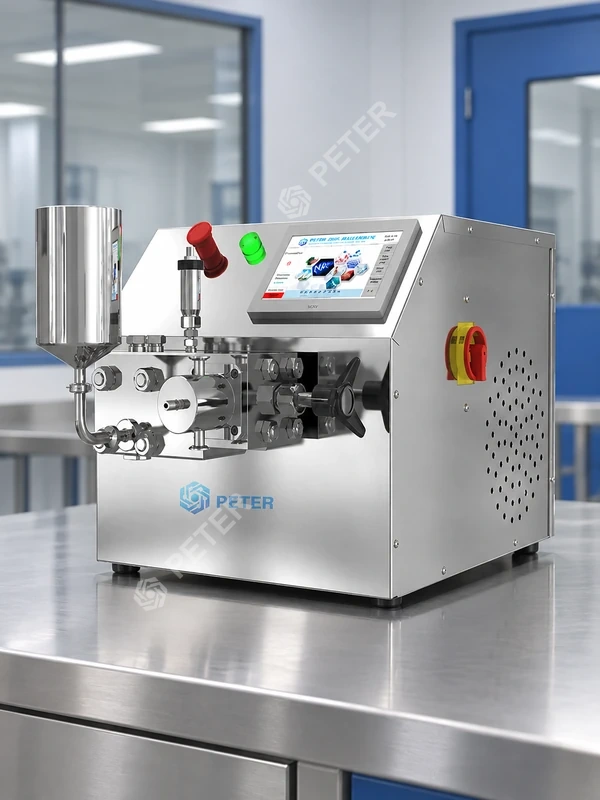
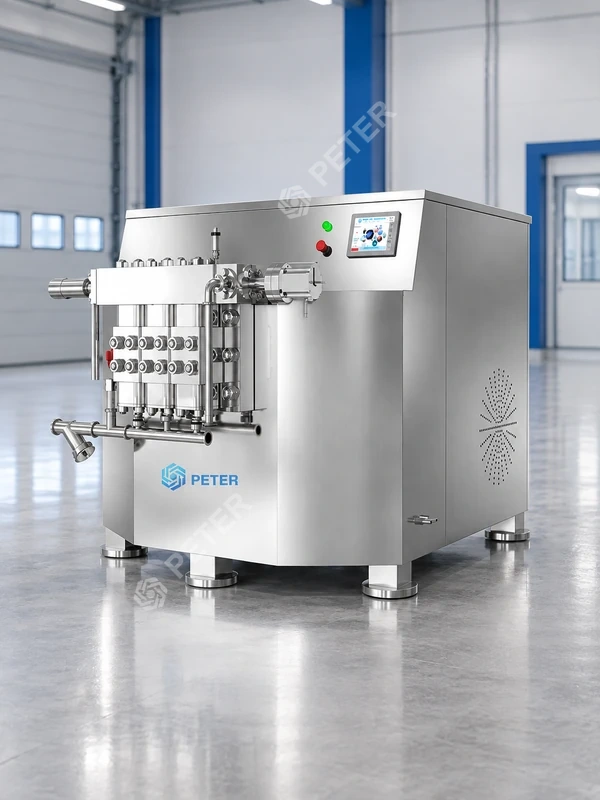
Buyers considering CAS PETER can begin with its high-pressure homogenizer product range, then place individual configurations into the same user requirement specification used for every bidder. The production-type high pressure homogenizer and the PT-1000 high pressure homogenizer are separate product pages; neither page should replace written confirmation of the feed, duty point, temperature boundary, pass definition, utilities, and acceptance test for a specific project.
A broader manufacturer qualification guide can help procurement teams prepare bid questions, while the dairy homogenizer buying guide adds application-specific context. In every case, compare high-pressure homogenizers through representative trials, controlled scope, FAT/SAT responsibilities, commissioning deliverables, spare-parts planning, and lifecycle support—not through a supplier ranking or an isolated catalogue value.
Frequently Asked Questions
What is a high-pressure homogenizer used for?
A high-pressure homogenizer is used to reduce droplets, particles, aggregates, or cells in a pumpable fluid by forcing the material through a high-energy processing zone. Applications can include emulsification, dispersion, particle refinement, and cell disruption, but the suitable endpoint and analytical method depend on the formulation. A supplier trial should confirm the result without exceeding temperature, flow, or pass limits.
How does a high-pressure homogenizer work?
A pump raises the fluid pressure before the material passes through a valve or chamber where rapid pressure change and intense fluid stresses occur. The result can involve shear and extensional deformation, turbulence, cavitation-related effects, impact, and heating; their relative contribution depends on geometry, fluid properties, flow history, and cooling.[1] Nominal pressure alone therefore does not predict the product outcome.
What role does high pressure homogenizer technology play in a high-pressure homogenizer system?
It defines how pressure generation, the homogenizing zone, controls, cooling, flow path, and pass strategy work together to create a repeatable process. The technology must be evaluated at the required feed condition and duty point, because the same pressure can produce different thermal and mechanical histories in different configurations. Buyers should ask the supplier to connect design choices to trial data and acceptance criteria.
Which process limits should you check for a high-pressure homogenizer?
Check working pressure at the required net flow, inlet and outlet temperature, viscosity and solids range, largest expected particle, pass definition, batch or continuous duty, cooling capacity, materials compatibility, and cleaning limits. Also define the product acceptance method and the conditions that require a stop or retest. Confirm these limits together; separate maximum values may not be achievable at the same operating point.
References
- Li, Z. et al. (2026). High-Pressure Homogenization in Food Processing: Mechanisms, Applications, and Industrial Translation. Comprehensive Reviews in Food Science and Food Safety.
- European Commission. EudraLex Volume 4, Annex 15: Qualification and Validation.
- Electronic Code of Federal Regulations. 21 CFR 211.63: Equipment design, size, and location.
- Electronic Code of Federal Regulations. 21 CFR 211.67: Equipment cleaning and maintenance.
- Electronic Code of Federal Regulations. 21 CFR 117.40: Equipment and utensils.
- European Hygienic Engineering & Design Group. Hygienic Design Principles.
The strongest supplier comparison is the one that remains clear after the sales presentation ends: the same feed, duty point, test method, document scope, and lifecycle obligations for every bidder.