

High Efficiency Homogenizer: Reduce Energy and Improve Output
When a process engineer in Rotterdam increased pressure to rescue an unstable emulsion, the visible result was a hot product, a longer cooling hold, and no dependable gain in particle-size consistency. The problem was not automatically a bad pump. The feed had not been screened for viscosity, the selected valve was outside its useful operating window, and the team was comparing motor power instead of energy per accepted batch. That pattern is common when a buyer searches for a high efficiency homogenizer and treats the name as a promise. This guide shows how to define output, set operating limits, compare machine types, and verify energy performance without unsupported savings claims.
Summary: A high-efficiency result comes from matching pressure, flow, formulation, and pass count to the process objective, then measuring kWh per kilogram (or per accepted batch) under repeatable conditions. A high efficiency homogenizer may reduce rework or passes when it reaches the required dispersion with a stable valve and feed system, but no supplier can prove a percentage saving without a baseline. Use ISO 50001 energy-management principles, measure particle size with a defined method such as ISO 13320 laser diffraction where appropriate, and confirm hygienic and machinery-safety requirements before purchase. The next step is a controlled trial with the actual formulation.
What does high-efficiency homogenization mean in a plant?
Efficiency has at least three separate meanings. Energy efficiency is the electrical energy used for a defined mass or accepted batch. Process efficiency is the amount of usable product produced per hour, including feed preparation, cooling, cleaning, and changeover. Quality efficiency is the share of output that meets the particle-size, stability, or release specification on the first pass. A machine can draw fewer kilowatt-hours while creating more rejects, or produce a high flow rate while forcing extra recirculation. Procurement should therefore specify all three measures.
The working mechanism is usually pressure driven: a pump sends a liquid through a restrictive interaction zone, creating turbulence, shear, and cavitation that can break droplets, disperse particles, or disrupt cells. The pressure drop is only one part of the result. Viscosity, solids loading, temperature, gas content, valve geometry, and residence time change the energy transferred to the product. The high-pressure homogenizer working principle guide explains the pressure and valve relationship in more detail.
What is a homogeniser when buyers compare different technologies?
In a procurement specification, what is a homogeniser? It is a process device that reduces scale differences in a multiphase material so the resulting dispersion or emulsion is more uniform. The word can describe high-pressure valve systems, rotor-stator mixers, ultrasonic processors, bead mills, or tissue disruptors; those technologies do not have the same energy path, throughput, heat load, or cleaning method. State the mechanism and the acceptance test instead of relying on the noun alone.
For a high-pressure unit, the useful comparison is usually output at the pressure and feed condition that meet the specification. For a rotor-stator unit, tip speed and mixing time may matter more. For an ultrasonic unit, amplitude, duty cycle, and probe condition can dominate. Treating all of them as interchangeable homogenization equipment can lead to a technically correct quotation that is operationally unsuitable. The second question is whether the selected homogenization equipment can be cleaned and serviced within the plant’s available window.
Which design choices improve output without hiding energy costs?
Start with a material and process envelope. Record viscosity at the actual processing temperature, density, solids or oil fraction, allowable temperature rise, target particle-size distribution, batch size, and required number of passes. If the feed contains abrasive solids, ask how the interaction zone and seals are protected and how wear will be detected. If the product is shear sensitive, set a temperature limit and define the cooling duty that accompanies each pass.
Then separate nameplate capability from validated output. A pump may be able to reach a pressure in an empty-water test while the production formulation causes a lower stable flow. Request trial data with the real feed or a documented surrogate, including inlet temperature, pressure, flow, pass count, product temperature, particle-size method, and accepted yield. ISO 13320 is a useful reference for laser-diffraction particle-size analysis, but the laboratory method still needs a sample-dispersion protocol that fits the formulation. In other words, what is a homogeniser in the brochure matters less than what the tested process can repeatedly deliver.
How should a plant measure energy?
Install or use a calibrated electrical meter at the machine boundary and log kWh, processed mass, pressure, flow, inlet and outlet temperature, and downtime reason. Report kWh/kg and kWh per accepted batch, not motor rating alone. A simple baseline can compare the existing process and trial process over several repeat batches; document ambient conditions and cleaning energy separately so a shorter production run does not look artificially efficient. ISO 50001 and ISO 50006 provide a management and indicator framework for defining an energy baseline and tracking energy-performance indicators.
Energy per kilogram can rise when operators push pressure beyond the point where the quality specification improves. It can also fall after feed pre-mixing, deaeration, or a better staged addition of powders, because the homogenizer no longer performs work that belongs upstream. These are process changes, not guaranteed machine savings, and they should be reported as such. A high efficiency homogenizer is therefore a measured operating result, not a fixed product category.
How do homogenizer types differ in practical operation?
The correct selection depends on the job to be done and the way the plant will clean, validate, and scale it. The table below uses relative descriptions so it remains useful before a trial establishes actual figures.
| Configuration | Typical strength | Efficiency watchpoint | Compatibility and maintenance | TCO question |
|---|---|---|---|---|
| High-pressure valve homogenizer | Continuous reduction of droplets or particles with controlled pressure | kWh/kg rises when pressure or passes exceed the validated window | Check seals, valve wear, temperature control, and cleanability for the formulation | Can fewer passes offset service, cooling, and wear-part cost? |
| Rotor-stator mixer | Fast batch blending and premixing at comparatively accessible scale | Long mixing time and recirculation can dominate electrical use | Inspect shaft, bearings, head clearance, and product contact surfaces | Does one vessel replace a separate premix stage without lowering quality? |
| Ultrasonic processor | Localized treatment for suitable laboratory or specialty formulations | Duty cycle, probe condition, and heat removal affect energy per batch | Control probe erosion, noise exposure, cooling, and clean-down procedure | Is the treated volume large enough to justify scale-up and validation work? |
| Bead mill or media mill | Fine grinding or dispersion for formulations that need media contact | Media separation, recirculation, and wear add hidden load | Manage media, screens, seals, contamination risk, and cleaning validation | How will media replacement and product loss affect cost per accepted kg? |
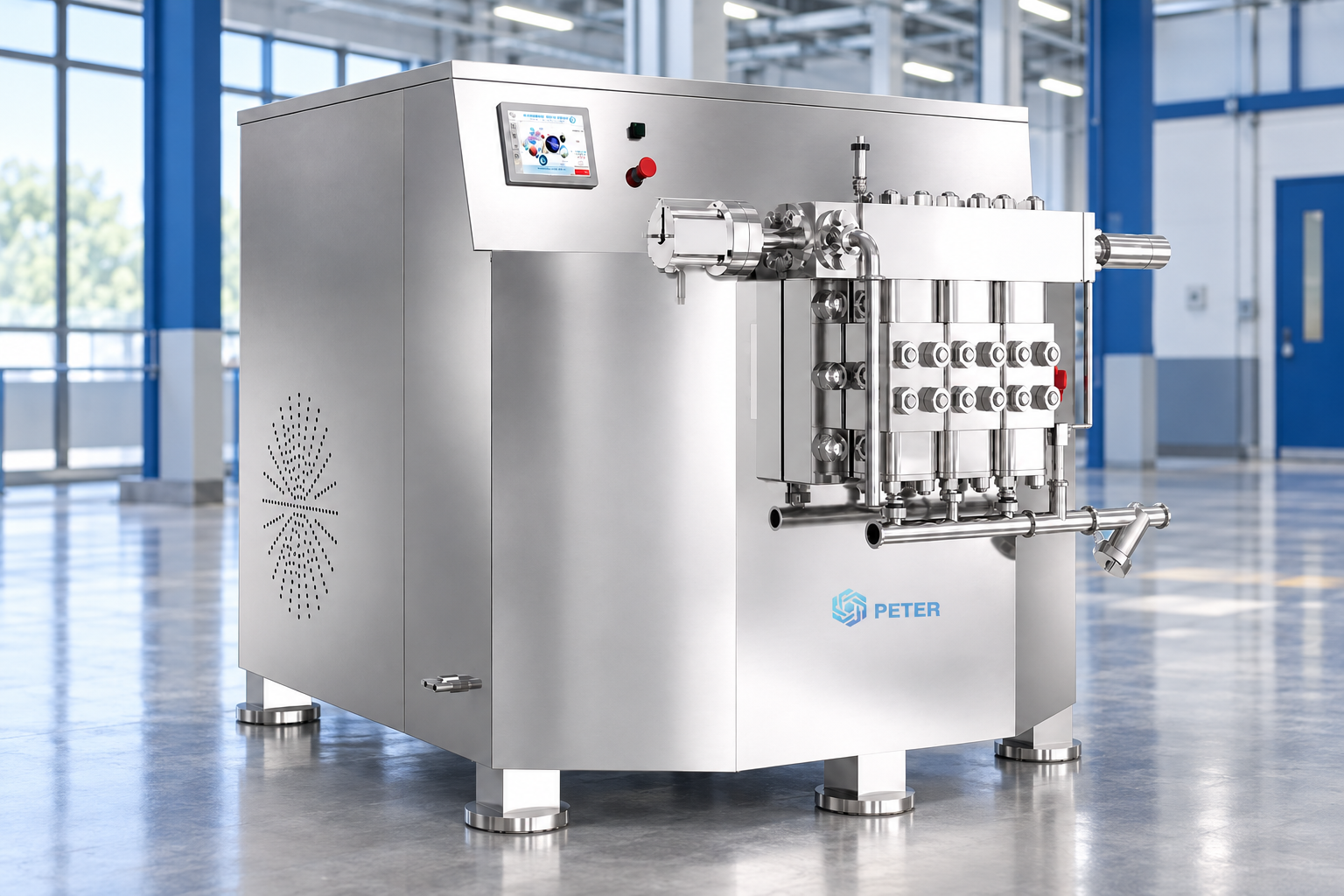
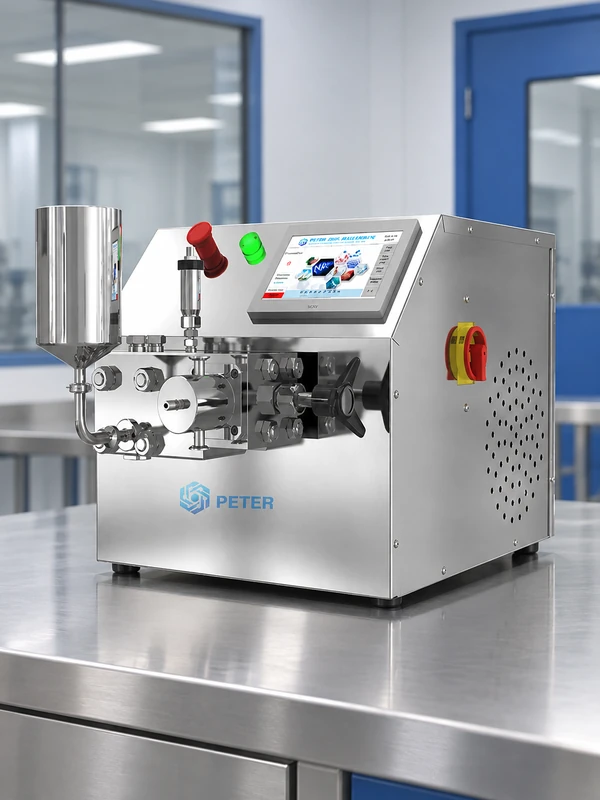
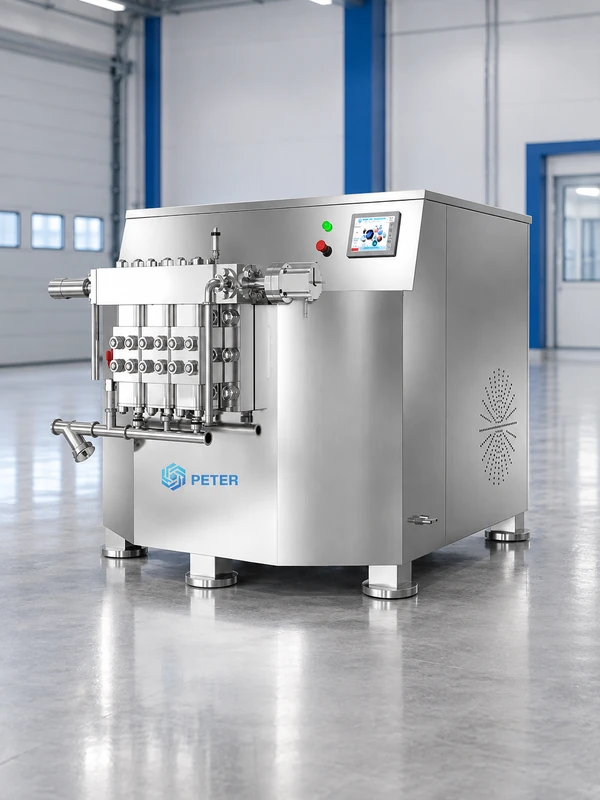
For pressure homogenization, a pilot unit can reveal whether the formulation responds to pressure before a production-scale commitment. CAS PETER lists experimental and production-type high-pressure homogenizers; the PT-20 model page and PT-40 pilot-type page should be treated as starting points for a documented application discussion, not as substitutes for a process trial.
Where do operating limits, cleaning, and maintenance affect output?
Most lost output appears at the boundaries: unstable feed, blocked filters, air entrainment, worn valves, overheated product, or a cleaning cycle that takes longer than production. Define an operating window with minimum inlet pressure, maximum temperature, allowable solids, startup and shutdown sequence, and alarm actions. Keep a trend of pressure fluctuation and flow; a gradual change can indicate wear before a batch fails.
Cleaning should be designed with the same discipline as production. For food or pharmaceutical service, verify wetted materials, drainability, dead-leg control, cleaning chemistry, temperature, time, and rinse acceptance with the quality team. EHEDG hygienic-design guidance and the applicable destination-market rules can help frame the review, while the final procedure must be validated for the actual soil and equipment. ISO 12100 remains relevant to machinery risk assessment, and ISO 13849-1 may apply when safety-related control functions are part of the design.
Routine maintenance normally includes inspection of seals and valves, lubrication where specified, filter checks, tightening and alignment checks, sensor verification, and examination of wear surfaces. The exact interval belongs in the manufacturer manual and the plant preventive-maintenance system. Replacing a wear part on calendar time alone can waste usable life; waiting for visible leakage can create contamination, downtime, and an unreliable energy baseline. Tie the interval to hours, cycles, pressure history, and inspection findings.
How can procurement compare efficiency claims fairly?
Request a test sheet that identifies the feed, pressure, flow, temperature, number of passes, particle-size measurement, electrical boundary, and accepted-yield definition. Ask whether the result is a factory water test, a laboratory formulation test, or a production reference. A claim such as “lower energy” has no decision value until the baseline and functional unit are visible. The homogenizer supplier comparison guide provides a useful checklist for evaluating documentation and support.
| Procurement dimension | Evidence to request | Why it changes the decision |
|---|---|---|
| Product requirement | Target distribution, stability or release test, viscosity range, temperature limit | Prevents a machine from being sized for a nominal liquid that differs from production feed |
| Performance limit | Stable pressure and flow range, pass-count study, wear and temperature observations | Shows where extra pressure stops improving accepted output |
| Energy measurement | Meter boundary, kWh/kg or kWh/batch, baseline period, repeat-batch variation | Separates a measured process improvement from a marketing percentage |
| Cleaning and maintenance | Wetted-material list, clean-in-place or manual-cleaning steps, wear-part plan, access drawings | Captures downtime, water, chemicals, and service labor in TCO |
| Documentation and support | Manuals, risk information, acceptance-test format, training and spare-parts response | Reduces commissioning delay and supports audits in the destination market |
When is homogenization equipment worth considering?
Homogenization is worth evaluating when a measurable product attribute depends on droplet or particle uniformity, when settling or phase separation limits shelf life, or when a repeatable cell-disruption step is required. It may be the wrong first investment when the real issue is poor powder wetting, inadequate premixing, air entrainment, or an upstream filter restriction. A short trial that compares the current method with one controlled homogenization pass can reveal whether the constraint is mechanical, formulation related, or analytical.
Build the trial around an acceptance statement: for example, a defined particle-size percentile, viscosity band, stability observation, or cell-release assay. Record the same sampling point and method for each run. Do not infer improved output from a smoother appearance alone. If the product is regulated, link the acceptance method to the quality system and retain the raw data.
How should a buyer select a high efficiency homogenizer?
- Define the functional unit. State accepted kilograms per hour, batch size, quality endpoint, maximum temperature, and permitted passes.
- Characterize the feed. Measure viscosity, density, solids, gas, and temperature at the point of entry; record changes across the batch.
- Run a representative trial. Compare pressure, flow, kWh/kg, product temperature, quality result, and cleaning time over repeat batches.
- Design for service. Confirm access, seals, valves, filters, spare parts, instrumentation, training, and safe isolation before the purchase order.
- Check the destination rules. Review machinery safety, hygienic design, electrical requirements, and sector-specific food or pharmaceutical controls with the responsible compliance team.
CAS PETER can be considered at the point where the buyer has a defined feed and acceptance method and needs to compare experimental, pilot, or production-scale options. Its product directory is the appropriate place to map the required process scale to available homogenizer families; final suitability still depends on the application data and agreed test conditions.
Frequently asked questions
What type of homogenizer machine is best for homogenizer selection and operation?
The best type is the one that meets the specified quality endpoint at a stable flow, temperature, and cleaning cycle for the actual feed. High-pressure, rotor-stator, ultrasonic, and media systems solve different problems, so compare mechanism and evidence rather than a generic label. A representative trial should decide the configuration.
How do you choose a homogenizer machine?
Choose it by working backward from accepted output: define particle-size or stability criteria, characterize viscosity and solids, set a temperature limit, and establish the number of passes. Then compare validated flow and pressure data, energy per accepted batch, service access, and cleanability. Ask the supplier to document test conditions so quotations remain comparable.
When should homogenization machine be considered?
Consider a homogenization machine when non-uniform droplets or particles, settling, phase separation, or cell-disruption consistency is limiting the process. First rule out upstream causes such as incomplete premixing, air, or filtration restrictions. A controlled A/B trial with the same analytical method provides a defensible decision, and the selected homogenization machine should be judged on accepted output and service time together.
What maintenance does a homogenizer machine need?
Maintenance normally covers seals, valves or interaction zones, filters, lubrication points, sensors, fasteners, and safety controls, with inspection frequency tied to pressure, cycles, and wear evidence. Follow the model manual and validate cleaning for the product soil. Keep records of parts, pressure trends, leaks, and energy changes so maintenance supports both uptime and process control.
References
- ISO 50001:2018, Energy management systems — framework for establishing and improving energy performance.
- ISO 50006:2014, Energy management systems — guidance for energy baselines and energy-performance indicators.
- ISO 12100:2010, Safety of machinery — principles for risk assessment and risk reduction.
- ISO 13320:2020, Particle size analysis — laser-diffraction measurement guidance.
- European Hygienic Engineering & Design Group (EHEDG) guidelines — hygienic design and cleanability resources for food and related processing equipment.
Efficient homogenization is a measured relationship between accepted quality, useful throughput, and the energy and maintenance required to achieve it. Confirm the feed, endpoint, and operating window first; then select the machine and verify the result with repeatable data. Skipping the baseline or the safety and cleaning review can turn a seemingly efficient purchase into a source of rework and downtime. For a documented application review, start with CAS PETER’s homogenization equipment range and contact the team with the trial conditions.