

Bacterial Cellulose Homogenization: Verify Water Holding and Release During Storage
Bacterial cellulose homogenization should be qualified by measuring water holding and water release separately, at matched dry cellulose content and after the intended storage period. A finer-looking suspension or higher initial viscosity does not establish that a wet ingredient will retain water under its actual handling conditions. Start with purified, consistently predispersed material, keep a preparation control, and compare both laboratory stress tests and the finished formulation. This guide concerns wet bacterial cellulose suspensions. It does not establish a drying recipe, a medical application, or a guaranteed processing setting for any CAS PETER machine.
Define what water retention means for your ingredient
A development brief might say that bacterial cellulose must “hold more water.” Before processing, translate that statement into an observable requirement. Is the objective to prevent liquid collecting above a stored paste, retain moisture after centrifugation, reduce drainage in a coating mixture, or maintain a particular texture after pumping? These are different questions. A material may perform well in one test and poorly in another without either observation being wrong.
Write down the sample state, stress, time, temperature and calculation used for each result. Water retained in a sediment after a defined centrifugation procedure is an operational measurement. Liquid released from a standing container describes another condition. Neither measurement alone predicts the performance of a complex formula containing salts, proteins or other hydrocolloids. Keep the application requirement alongside the analytical result throughout the trial.
What the research supports
An NC State University-hosted review of nanocellulose suspension rheology discusses how concentration, fibril characteristics, interactions and measurement conditions affect observed flow. Its scope includes multiple nanocellulose types, so it is useful context rather than a bacterial-cellulose-specific processing recipe. The important development distinction is that structure and flow need defined test conditions; a viscosity reading does not establish water retention under a different stress.
A separate ultrasonic-treatment study available from the University of Leeds repository measured water holding, fibril structure and rheology. The relationship between treatment duration and suspension properties was not simply “more treatment is better.” That work used ultrasound, not high-pressure homogenization. It supports a broader need to examine treatment history and functionality together, but its operating conditions cannot specify a CAS PETER homogenization trial.
The practical plan below is a proposed comparison framework. Its sampling schedule and acceptance criteria should be chosen for the intended ingredient, rather than treated as results already demonstrated by either study.
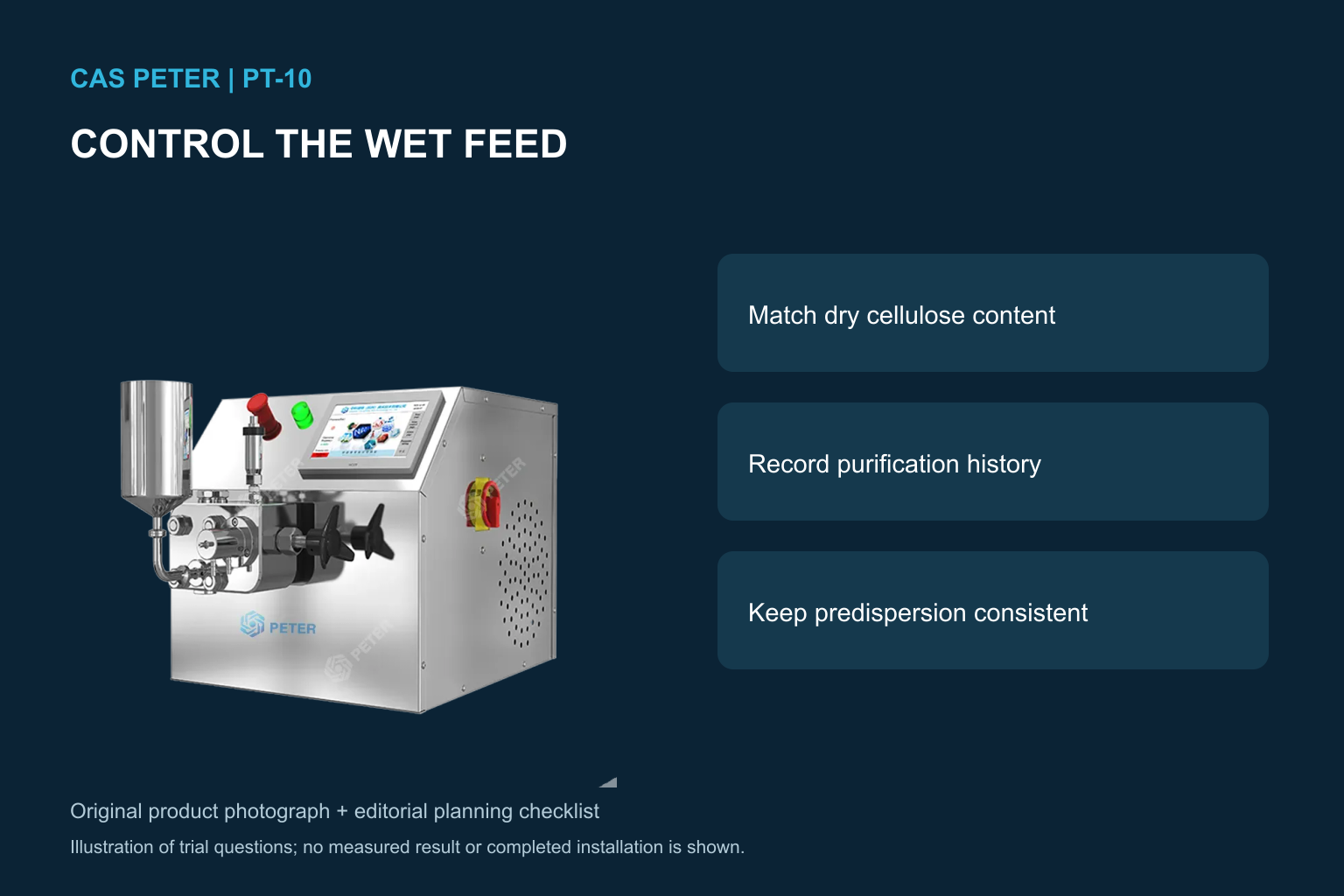
Standardize the purified wet feed before comparing pressure
Wet bacterial cellulose can contain a large and variable amount of water. Weighing the same mass of two wet lots does not establish equal cellulose concentration. Determine dry solids using a suitable documented method, and distinguish cellulose solids from residual soluble material where purification is incomplete. If the starting lots differ substantially, compare them as separate materials instead of attributing their differences to homogenization.
Record cultivation lot, purification history, washing endpoint, storage duration and any previous mechanical treatment. Do not feed untreated fermentation material merely because the intended ingredient is cellulose. Residual cells, medium and purification chemicals change both the material question and the equipment review. This article does not validate a purification or microbiological control procedure.
Prepare a consistent predispersion and examine it for large wet pieces, foreign material and persistent bundles. Agree acceptable feed condition with the equipment supplier before pressure processing. Removing a coarse fraction can change the material being tested, so weigh and record any rejected fraction. Keep an unprocessed predispersion as the control; a wet pellicle and a fully blended suspension are not equivalent starting points.
Plan a limited, traceable homogenization comparison
Choose an initial trial range only after reviewing feed solids, viscosity, bundle dimensions and the proposed flow path. The CAS PETER PT-10 product page provides a real laboratory equipment reference for discussing a small material trial. It does not demonstrate that this particular bacterial cellulose feed is compatible or that a specific water-holding result will be achieved. Confirm the selected configuration, minimum usable batch and cleaning requirements before committing material.
Keep the predispersion method fixed while comparing pressure treatments. Record pressure, pass history, inlet and outlet temperature, cooling arrangement, material recovered and any interruptions. If the suspension thickens enough to change feeding behavior, note that change explicitly. An extra pass on a different feed condition is not a clean comparison with the previous sample.
Take retained samples at defined stages and identify them immediately. Avoid repeatedly taking a little material from the same open container over several days, because handling and evaporation can alter what remains. Prepare separate storage portions when feasible. A short trial with complete records is more useful than many settings whose actual thermal and sampling histories are uncertain.
Measure water holding without hiding the denominator
Select a water-holding procedure suitable for the material and document the separation stress. For centrifugation-based tests, report relative centrifugal force or enough rotor information to reproduce it, along with duration, sample amount and temperature. Record how supernatant is removed and how the retained material is dried or otherwise characterized. A different decanting technique can change the result even when the suspension is unchanged.
State whether the result is expressed per mass of dry cellulose, total dry solids, initial wet suspension or recovered sediment. These denominators answer different questions. Do not combine values from different definitions in one ranking. For example, a wetter sediment is not automatically better if it also contains a different amount of cellulose or soluble residue.
Use independent sample preparations where possible, and retain the individual results. If one tube produces an unusual pellet or visibly incomplete separation, investigate the cause before calculating an average. A water-holding number should be accompanied by the test definition, not presented as an intrinsic material constant that remains valid under every process stress.
Track spontaneous release during storage independently
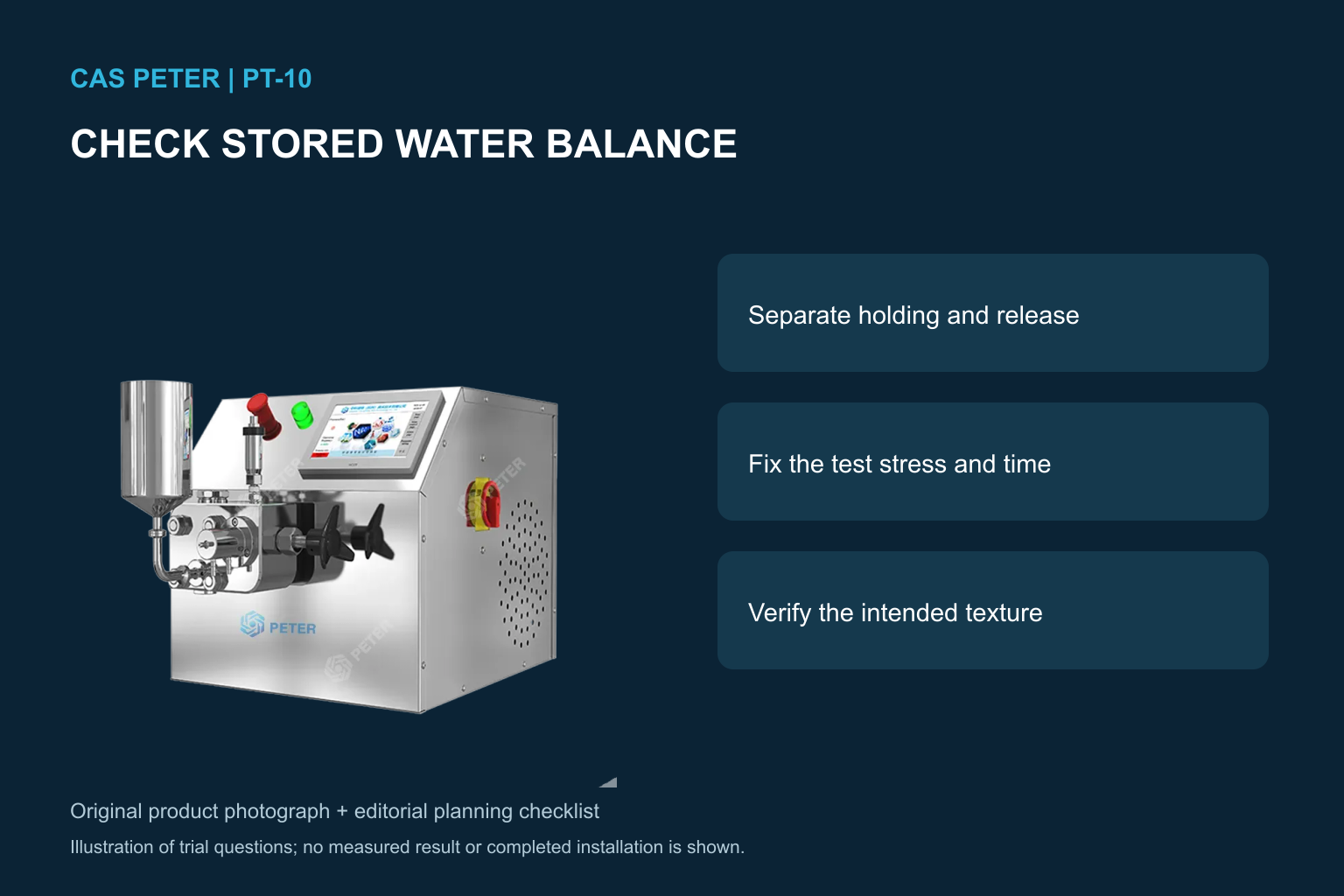
Fill matched containers to a defined level and store them under the intended conditions. Photograph them without shaking, using a consistent background and orientation. Record whether clear liquid appears at the top, around the sides or beneath a contracted structure. Report the observation time and container dimensions, because a thin laboratory layer and a deep production vessel impose different conditions.
If released water is collected, define the collection procedure and its denominator. Keep spontaneous drainage separate from a subsequent centrifugation result. Do not remix a container, remove its released liquid, and then use the altered sample as though it had undergone undisturbed storage. Reserve separate portions for destructive measurements.
A useful comparison includes an early result, an intermediate check and the intended holding endpoint. The timing must reflect the actual supply chain or development question. It is better to say that stability has been observed only over a short trial than to extrapolate an untested shelf life from one favorable photograph.
Connect water measurements to usable flow and texture
| Observation | Additional check | Trial decision it can support |
|---|---|---|
| High water holding but visible liquid release in storage | Review undisturbed storage samples and the water-holding test stress | Keep the two endpoints separate and investigate structure under low stress |
| Higher initial viscosity but poor pumping recovery | Compare matched shear history and recovery after rest | Decide whether the ingredient survives the intended transfer step |
| Similar appearance but different dry solids | Repeat comparison at matched cellulose concentration | Avoid crediting concentration differences to pressure treatment |
| Smaller visible bundles but weaker application texture | Test the actual formula at equal dry cellulose loading | Determine whether improved dispersion also preserves useful structure |
| Variable results among tubes | Review sampling, decanting and sediment recovery | Repair the measurement method before selecting a process |
This is a qualitative trial decision table, not a set of published pass limits. The cited review and experimental study motivate separate structure, flow and water measurements; application acceptance remains specific to the proposed product.
Measure flow under a documented shear and rest history. A single spindle reading may be useful for routine comparisons, but record its conditions and avoid treating it as a full rheological description. When an application relies on recovery after filling or spreading, include that sequence in the test rather than testing only a freshly stirred suspension.
Test the wet ingredient in the intended formulation
After identifying promising suspensions, compare them in a small, representative formula at equal dry cellulose addition. Keep mixing order, dilution, pH adjustment and holding time consistent. Include the control ingredient as well as the processed candidate. Evaluate the feature the product needs: drainage, spreading, suspension of another solid, or texture after a realistic transfer and rest sequence.
Do not assume that a result in deionized water will persist after other ingredients are introduced. If a candidate loses its benefit only in the complete formula, investigate composition and preparation order before increasing homogenization intensity. Conversely, if the formula performs acceptably despite a modest standalone water-holding result, the application evidence deserves consideration alongside the isolated ingredient measurement.
The dispersion methods overview gives the broader process context. For related material questions, see the cellulose nanofibril feed and trial guide and the separate discussion of functional recovery after drying and redispersion. The latter addresses a different starting state; a never-dried wet suspension should not be judged using a dried powder comparison without identifying that change.
Learning resource and trial handover
The following NPTEL lesson introduces colloidal stability. It is background for interpreting suspension behavior, not a bacterial cellulose production protocol or evidence of PT-10 performance.

Educational source: NPTEL-NOC IITM. Watch the lesson on YouTube.
A useful handover package includes the feed specification, purification record, dry-solids method, pressure and temperature history, recovered material quantity, water-holding procedure, storage photographs and application comparison. State which criteria were met and which remain open. This allows a later trial to reproduce the useful result rather than merely repeat a nominal pressure setting.
Frequently asked questions
Does a thicker bacterial cellulose suspension always hold water better?
No. Flow resistance, water retained after a defined stress, and spontaneous liquid release describe different behaviors. Compare them at matched dry cellulose content and under documented test conditions before selecting a treatment.
Can ultrasound settings be converted into homogenizer pressure settings?
No. Ultrasound and high-pressure homogenization apply different processing histories. An ultrasound study can help identify useful measurements, but it cannot establish equivalent pressure, pass count or machine capability.
Should a wet suspension trial include drying and redispersion?
Include those steps only when they belong to the intended product route. Drying changes the material history and introduces a separate recovery question. A successful wet-suspension trial does not establish dried-powder performance.