

Benchtop Homogenizer for R&D: Best Model Selection
When Sofia, a formulation chemist in Manchester, encountered inconsistent droplet sizes while screening a new emulsion, her benchtop homogenizer gave different results between operators. The visible failure looked like a worn tool, but the root cause was sample volume below the head’s immersion line and a ten-degree temperature difference. Model selection and a short method sheet restored repeatability.
Summary: The best lab homogeniser for R&D is the one that matches sample volume, viscosity, solids, temperature and target size while producing traceable data. Use a research and development homogenizer to compare formulations—not to imply production equivalence—then confirm promising conditions on a pilot unit. ISO 13320 supports laser-diffraction measurements when the dispersion method and optical inputs are appropriate.
Why Sample Compatibility Must Be Defined Before Comparing Models
Record minimum and maximum sample volume, vessel geometry, viscosity curve, particle or fiber content, pH, solvent, temperature and air sensitivity. Rotor-stator heads may suit coarse premixes; high-pressure interaction zones can provide narrower size reduction but need a pumpable feed. Fibers, crystals and abrasive pigments can increase clogging or wear. Ask for the maximum inlet particle size and compatible elastomers.
Keep the method constant: pre-mix time, head depth, speed or pressure, pass count, temperature and sampling location. If the formula warms during a run, record both start and end temperature. A change in temperature can change viscosity enough to mimic a machine problem.
How to Build a Representative Sample Set for a Purchase Trial
Do not qualify a model using only an easy, low-viscosity batch. Include the highest expected solids, the most abrasive ingredient, the smallest permitted volume and the coldest feed condition. If raw-material lots vary, include at least two lots or state the limitation. Reserve enough sample for an unprocessed control and repeat measurements.
For biological work, define whether the goal is cell disruption, organelle preservation or bulk mixing. These goals can conflict. Measure an output tied to the purpose—protein yield, viable-cell count or microscopy—not merely visual clarity. Have a qualified laboratory lead approve any safety or biohazard procedure.
How Sample Volume and Product Recovery Change the Economics of an R&D Trial
Minimum sample volume is not only the amount needed to start the machine. Build a material balance that separates the starting mass, equipment hold-up, tubing or vessel residue, flush volume, every analytical aliquot and the sample recovered for stability work. Confirm the numbers for the exact model and flow path because there is no defensible universal recovery percentage. A low-volume unit can still consume an expensive formulation if several passes, rinses and test points are required.
Write the balance before scheduling the trial. First reserve an untreated control and required replicates; next allocate enough material to fill the contact path and maintain stable operation; then account for samples after each condition and for material that cannot be recovered without dilution. Weighing vessels and collection containers can reveal unexplained loss. Report recovered usable sample, not merely processed volume, so procurement can compare development cost across models.
If available material cannot cover hold-up, cleaning, controls and all sampling points, change the protocol rather than quietly reducing replicates. Options include a screening step on another mechanism, fewer well-chosen conditions or a vendor trial on a lower-hold-up configuration. Any mechanism change should be labeled as formula screening rather than scale-up evidence.
Which Checks Explain Inconsistent Results Before Equipment Is Replaced?
| Observation | Likely mechanism | Check before replacing equipment |
|---|---|---|
| Foam or vortex | Air entrainment or excessive speed | Head depth, fill level, deaeration and speed ramp |
| Large size variation | Uneven sampling or temperature drift | Replicate sampling and temperature log |
| Pressure or torque spike | Oversize particle, high solids or blockage | Feed screen, viscosity and valve/head inspection |
| Rapid warming | High energy density or insufficient cooling | Batch volume, duty cycle and cooling method |
| Residue after cleaning | Incompatible chemistry or dead zone | Rinse sequence, swab map and disassembly access |
Use a control sample with known preparation to separate operator variation from equipment drift. Compare at least three replicates and state the mean and spread. Do not report a single “best” particle size without method uncertainty and sample history.
How the Next Development Decision Determines the Right Model Class
- Formula feasibility: use a handheld or rotor-stator bench unit to ask whether the components can form a stable premix.
- Process-window screening: use a controlled benchtop pressure unit to identify a robust pressure, pass and temperature region.
- Scale-risk reduction: use a pilot unit to test whether cooling, flow and cleaning can be repeated.
- Manufacturing readiness: use production-representative equipment to assess capacity, controls and maintenance.
A single machine can support more than one gate, but the evidence claim must remain narrow. A benchtop result can establish a formulation ranking; it cannot establish production uptime. Write the intended decision at the top of the protocol so the team does not overinterpret attractive data.
A research and development homogenizer purchase should therefore be tied to the next development decision, with a defined owner, method and review date rather than a general promise of flexibility.
Move beyond the benchtop method when its operating boundary blocks the next question: required batch volume may exceed practical run time, heat removal may no longer hold the temperature window, data logging may be too limited for a transfer study, or manual cleaning may not represent the intended changeover. Pilot work should then test flow-path hold-up, cooling, longer-duration stability, cleaning access and control resolution. None of these triggers alone proves that a larger model will succeed; they define the evidence the next scale must produce.
Which Model-Selection Checks Should Be Completed Before Purchase?
- Define the smallest and largest batch the unit must process.
- Match head, valve and seal materials to solvents, oils, salts and cleaning agents.
- Confirm speed or pressure control resolution and temperature monitoring.
- Request noise, enclosure, interlock and ergonomic information for routine use.
- Specify data outputs, calibration needs, spare parts and service response.
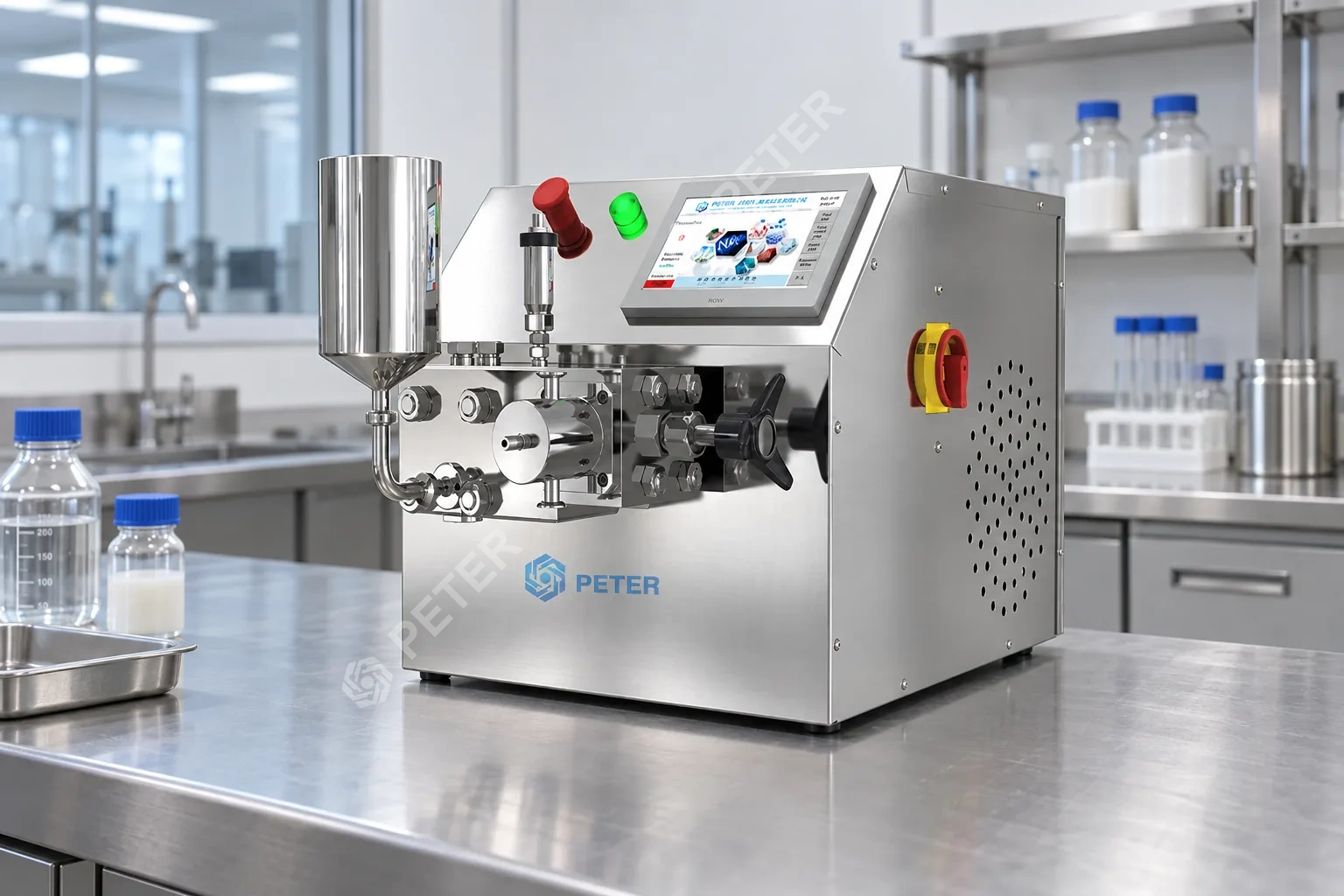
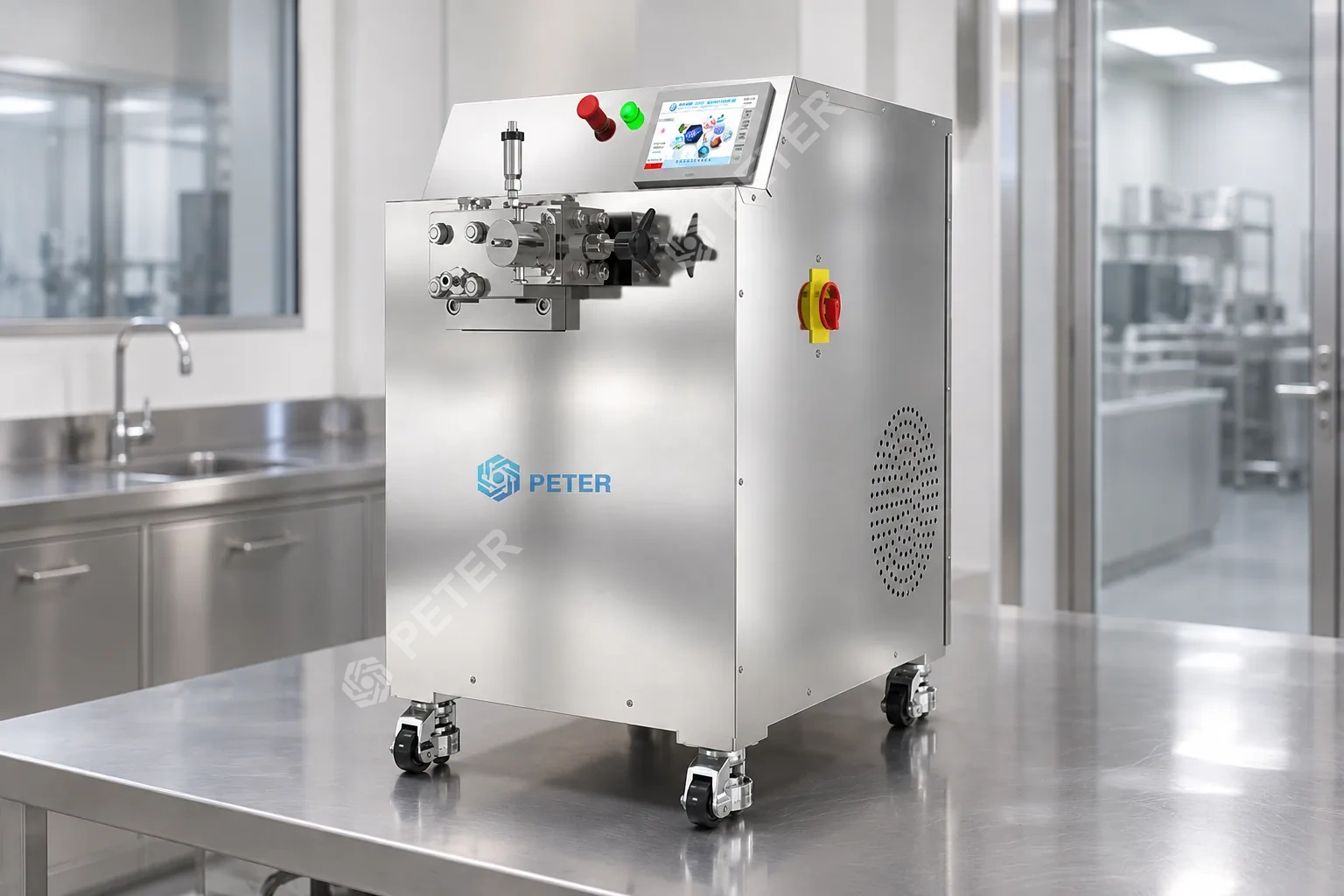
CAS PETER’s PT-20 experimental lab homogeniser is a public reference point for laboratory trials. Treat its published specification as manufacturer information and request a sample-based suitability check. If throughput grows, compare the process with the PT-40 pilot listing before committing to production capacity.
Which Validation Methods Make R&D Results Repeatable and Transferable?
ISO 13320 laser diffraction can quantify a distribution when particles are dispersed without dissolving or re-agglomerating. For submicron droplets, dynamic light scattering may be more suitable; for morphology, microscopy adds context. Choose the method with an analytical scientist and record instrument model, refractive index, dispersant, obscuration and replicate count.
Write an R&D protocol with acceptance criteria for size, viscosity, appearance, temperature and storage stability. Include a deliberate challenge such as maximum solids or minimum sample volume. The result is development evidence, not a regulatory validation, unless it is incorporated into an approved validation plan.
Run a simple measurement-system check before optimizing the machine. Have one operator prepare replicate samples, then have a second operator repeat the sequence. If analyst or preparation variation is larger than the process effect, refine the method first. This prevents the team from buying tighter controls to solve an analytical problem.
How Basic and Configurable Benchtop Systems Differ in Development Value
| Dimension | Basic benchtop unit | Configurable lab high-pressure unit |
|---|---|---|
| Sample size | Very small, fast screening | Small-to-medium with defined flow path |
| Control | Often speed/time focused | Pressure, flow and temperature can be documented |
| Compatibility | Head and vessel dependent | Valve, seal and wetted-material options to verify |
| Maintenance | Simple head replacement | More components, but planned wear-part service |
| TCO | Lower entry cost; may need scale-up confirmation | Higher specification effort; richer process data |
What Laboratory Standards and Safety Reviews Can and Cannot Establish
Laboratories should follow their chemical-safety, electrical-safety and waste procedures. ISO 13320 is a test method, not a homogenizer certification. For food or pharmaceutical projects, ISO 22000 or GMP requirements may apply to the product and facility; a benchtop demonstration does not establish compliance. State the destination market and intended claim before selecting documentation.
Procurement should also check installation details: bench load, ventilation, drain access, electrical supply, noise, guarding and cleaning-water disposal. Ask for a commissioning checklist and a parts diagram. These small constraints often decide whether a theoretically suitable model is practical for daily R&D.
Before acceptance, run a blank, a reference material and the most difficult sample. Confirm that the unit reaches the specified control range without leaks, excessive warming or unstable readings. Photograph the setup, archive raw data and record any deviations; these details make future troubleshooting faster than relying on operator memory.
Frequently Asked Questions About Benchtop Homogenizer Selection
What type of laboratory homogenizer is best for laboratory sample preparation?
Choose by sample volume, viscosity, solids, temperature and target size. A repeatable head and method are more valuable than maximum speed when comparing formulations.
How do you choose a laboratory homogenizer?
Define the feed and acceptance method, then compare control range, materials, cooling, cleaning access, safety features and service. Run a representative sample trial with replicates.
When should lab homogeniser be considered?
Consider one when bench mixing cannot produce repeatable dispersion or when a controlled scale-down is needed before pilot work. Confirm that the mechanism and thermal profile are relevant to the next scale.
What maintenance does a laboratory homogenizer need?
Inspect heads, seals, valves and cables; clean promptly with compatible chemistry; verify calibration and safety interlocks; and trend torque, pressure or temperature. Follow the supplier manual and your laboratory SOP.
Technical References for R&D Measurement and Safety Boundaries
- ISO 13320:2020.
- ISO 22000:2018 (when food-safety management applies).
- IEC 61010-1:2010 with amendments for general laboratory electrical-equipment safety scope.
- CAS PETER PT-20 product information.
- CAS PETER process-selection article.
Reliable R&D starts with a repeatable sample and a transparent method. Share both through the CAS PETER laboratory product page when requesting a benchtop or pilot recommendation.