

Glass Dounce Homogenizer: Gentle Cell Disruption Guide
When a research technician in Cambridge, Massachusetts encountered an unexpectedly poor yield from a delicate tissue sample, Maya was manually drawing the suspension through a glass pestle to finish a routine preparation. A rushed sequence of passes made the suspension cloudy and warm to the touch. The glassware was not defective: the loss of control came from an unrecorded clearance, too many consecutive passes, and no cooling interval. That distinction matters because a gentle method is designed around the sample, not around finishing a fixed number of strokes.
Summary: A Dounce homogenizer is a manual, low-shear option for samples that need controlled mechanical disruption rather than maximum throughput. Start with a small, documented pass series, hold temperature within the method’s defined range, and judge success with a cell-count or microscopy check – not visual cloudiness alone. The two-pestle design is commonly used to separate initial tissue dispersion from a tighter finishing step; however, the actual clearance and pass count must be qualified for the specimen and downstream assay.
Why gentle disruption is a method-control problem
A glass dounce homogenizer uses a glass tube and fitted pestles to create shear as the pestle travels through the sample. Its advantage is operator control: the user can pause, inspect, cool, or stop before sensitive structures are overworked. It suits soft tissue, cultured cells, and organelle-oriented preparations when an intact fraction matters more than a fully uniform lysate.
Define six batch-record fields: sample mass or cell number, buffer volume, pestle identity, clearance, pass count, and temperature. For feasibility, inspect after 5 strokes and again after 10 instead of committing to 20 uninterrupted strokes. These are checkpoints, not universal settings. Compare results by bright-field microscopy, hemocytometer count, or trypan-blue viability assessment, and predefine acceptance.
Heat is a hidden variable. Friction, warm hands, and bench time can alter enzyme activity or organelle integrity. Use chilled, compatible buffers where specified, short pass sets, and defined cooling intervals. Record elapsed processing time; a 2-minute uncontrolled operation and a 2-minute cooled operation are not equivalent.
Selecting a glass Dounce homogenizer by product requirements
Selection begins with the biological outcome. A loose pestle can distribute soft tissue, while a tighter pestle can finish disruption; neither is automatically better. Request stated clearance, working volume, material compatibility, and dimensional documentation. For repeat work, identify each matched pestle/tube pair so interchange does not change the method.
Catalog terminology can confuse procurement: a glass homogenizer may mean several manual tools, not a Dounce-specific configuration. Confirm the vessel/pestle design, stated fit, volume, and cleaning method.
- Sample sensitivity: use the least aggressive action that reaches the target.
- Working volume: prevent overflow and air travel.
- Endpoint: distinguish suspension, viable-cell, organelle, and total-lysate goals.
- Documentation: specify pestle, passes, buffer, temperature, and inspection in the SOP.
The comparison separates manual gentle processing from mechanized alternatives. Final suitability depends on the sample and validated method.
| Option | Primary mechanism | Best control point | Typical scale tendency | Maintenance and TCO consideration |
|---|---|---|---|---|
| Dounce unit | Manual pestle shear | Clearance, strokes, cooling | Small batches | Low equipment complexity; labor and operator variability can dominate cost |
| Rotor-stator | High local shear | Speed and exposure time | Small to medium batches | Fast processing, but heat and probe cleaning must be managed |
| High-pressure homogenizer | Pressure-driven shear and impact | Pressure, passes, temperature control | Repeatable pilot and production workflows | Higher capital and validation effort; lower labor per processed volume can improve economics |
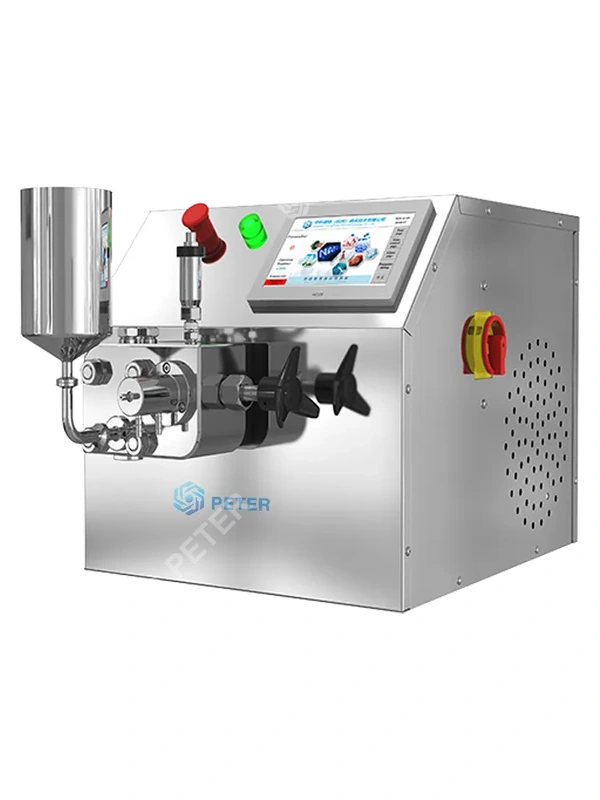
| PT-10 high-pressure homogenizer | Bench-scale pressure processing | Defined pressure/pass study | Laboratory development | Consider it when a manual method becomes a repeatability bottleneck |
Performance limits and the operating differences for homogenizer tissue
A Dounce method has clear limits. Dense, fibrous, cross-linked, or high-volume material may require excessive manual effort. More strokes can improve dispersion but also increase heating, foaming, and damage. Establish an escalation point, such as failure to reach the microscopy criterion after the approved pass range.
The phrase homogenizer tissue is often used loosely, but tissue type changes the process. Soft tissue, a cell pellet, and fibrous connective tissue differ in pre-cutting, buffer uptake, resistance, and endpoint risk. Set a sample-to-buffer ratio, maximum pre-process hold time, and recovery measurement. Protein recovery calls for a matrix-appropriate assay; intact nuclei call for microscopic integrity and fraction yield.
For an illustrative scale decision, 6 minutes per batch across 10 daily batches equals 60 hands-on minutes before records or testing. This is not a price model, but it exposes labor, rerun, and variation costs. CAS PETER supplies high-pressure homogenizer and microfluidizer solutions, not Dounce glassware; its role begins when a qualified manual method no longer meets volume or repeatability requirements.
| Situation | Manual Dounce fit | Control to document | Escalation signal | Next category to assess |
|---|---|---|---|---|
| Delicate cells, low volume | Strong | Pestle, strokes, viability check | Variable recovery between operators | Training and method locking |
| Soft tissue, exploratory work | Conditional | Mass-to-buffer ratio, microscopy endpoint | Residual fragments after approved range | Alternative mechanical preparation |
| Repeated laboratory batches | Limited by labor | Time, temperature, batch record | Queueing or frequent reruns | PT-20 high-pressure homogenizer evaluation |
| Pilot or production transfer | Usually unsuitable as the primary process | Process parameters and sampling plan | Need for defined throughput and reproducibility | Engineered high-pressure process study |
Cleaning and maintenance of a glass Dounce homogenizer
Cleaning protects the next sample and preserves fit. Rinse promptly with a compatible laboratory detergent system, remove residues before drying, and follow supplier instructions for washing, drying, and sterilization. Avoid abrasive tools. Inspect glass for chips, cracks, clouding, and scores; remove damaged components from service.
The close fit of a dounce glass homogenizer makes storage important. Protect matched components from impact, do not force an obstructed pestle, and evaluate a replacement pestle as a new method component because fit may differ.
A simple maintenance log is valuable: record the unit ID, date, operator, inspection result, and any breakage or sticking event. This supports root-cause review when recovery changes. For biological materials, containment, decontamination, and waste handling must follow the agent risk assessment and local biosafety program; the CDC’s BMBL is guidance for risk-based laboratory biosafety, not a cleaning certification for a particular homogenizer.
Standards, biosafety, and regulated-use boundaries
There is no basis for presenting a manual Dounce unit as ISO 13320 certified. ISO 13320 specifies laser-diffraction particle-size analysis methods; it can inform how particle-size data are measured where that test is relevant, but it is not a product approval or proof of cell-lysis performance. Likewise, a microscopy count or viability assay validates only the acceptance criterion it was designed to assess.
The CDC Biosafety in Microbiological and Biomedical Laboratories framework should guide containment and exposure controls for biological work. For a drug-product or regulated manufacturing application, FDA current good manufacturing practice requirements may apply to the process, records, equipment suitability, and change control. Applicability depends on intended use, destination market, and claims; laboratories should not transfer research-only settings into regulated production without a documented qualification strategy.
When to move from manual control to engineered repeatability
Procurement teams can make the decision more defensible by taking four actions: define the analyte or fraction to preserve; run a bounded pass-and-temperature study; calculate hands-on minutes and rerun frequency; and agree on the output needed for the next scale. For broader equipment selection criteria, see this guide to cell disruptor homogenizers for laboratory needs.
If pressure-based processing is under consideration, CAS PETER can discuss experimental, pilot, and production high-pressure homogenizer configurations in relation to the documented sample requirement. That is a sourcing and scale-up conversation, not a claim that a high-pressure system reproduces every gentle Dounce outcome. A side-by-side study should compare recovery, activity, particle state where relevant, cleaning burden, and repeatability using the same release tests.
Frequently asked questions
What is a Dounce homogenizer used for in cell lysis?
It is used for controlled manual disruption of cells or soft tissues, particularly when the operator wants to limit shear and observe progress between pass sets. It can support fraction preparation as well as lysis, depending on the buffer and endpoint. Define whether the objective is viable cells, organelles, nuclei, or total lysate before choosing the method.
How does a Dounce homogenizer disrupt cells?
The sample moves through the narrow space between the pestle and glass tube, generating mechanical shear. The effect depends on fit, sample viscosity, stroke speed, and pass count. Use a controlled sequence and an endpoint measurement rather than assuming that more force delivers a better result.
How does a Dounce homogenizer compare with homogenizer tissue?
A Dounce is a device, while “homogenizer tissue” generally describes the tissue-processing application rather than one defined machine type. Tissue choice determines whether gentle manual shear is suitable. Fibrous or larger-volume samples may require another preparation or disruption approach.
Which conditions improve recovery with a Dounce homogenizer?
Use a matched pestle and tube, a protocol-compatible buffer, controlled temperature, and the lowest pass count that reaches the defined endpoint. Check recovery with a relevant assay or microscopy method, then document the actual settings. Cooling intervals are especially important when the sample contains temperature-sensitive targets.
References and next step
- National Center for Biotechnology Information: peer-reviewed laboratory methods article.
- ISO 13320: Particle size analysis – Laser diffraction methods (test-method scope).
- CDC: Biosafety in Microbiological and Biomedical Laboratories.
- FDA: Current Good Manufacturing Practice regulations (regulated applications).
Gentle disruption is not a property of glass alone; it is the result of a controlled clearance, measured pass sequence, cooling plan, and meaningful endpoint.
When the decision moves beyond manual batches, review the PT-20 high-pressure homogenizer for a scale discussion, or contact CAS PETER with your sample, target output, and throughput requirements.