

High Pressure Homogenizer for Emulsions: Support Guide
A common emulsion-support problem begins before a machine is switched on: a formulation team sends a supplier the target droplet size but not the premix history, phase composition, viscosity, sampling time, or analytical method. A short trial may then appear successful at the outlet, yet a later sample shifts because coalescence, temperature exposure, or inconsistent sample preparation was never separated from droplet breakup. The resulting cost is larger than one failed run—it can include repeated material batches, ambiguous quotations, delayed scale-up, and equipment selected around an unrepeatable endpoint. This guide explains what a useful support program should ask, measure, record, and transfer, while keeping a clear boundary: homogenization can supply controlled mechanical energy, but it cannot replace formulation science, stability studies, or a validated sterilization strategy.
The short answer is that a capable high pressure homogenizer emulsion support program treats formulation, process, measurement, and equipment as one documented trial system. It should define the premix, pressure, cycle count, inlet and outlet temperature, sampling time, analytical method, stability checkpoint, cleaning basis, and scale-up acceptance criteria before recommending a configuration. ISO 13320 and ISO 22412 address laser-diffraction and dynamic-light-scattering measurements respectively; neither is a product certification or a substitute for an application-specific method. The next step is therefore not to request a universal pressure. It is to agree on the target quality attributes, measurement window, material constraints, and transfer package that a supplier must demonstrate.
Start with the formulation and premix, not a pressure number
A high-pressure homogenizer breaks droplets through intense local stresses, but the attainable distribution also depends on what reaches the interaction zone. Oil-phase fraction, dispersed-phase viscosity, continuous-phase viscosity, interfacial tension, emulsifier type and concentration, pH, ionic strength, temperature sensitivity, and the presence of solids can all change breakup or recoalescence. A supplier does not need ownership of the formulation, but it does need enough information to recognize when a machine trial would answer the wrong question.
The premix should already be pourable or pumpable, compositionally uniform, and free of uncontrolled large agglomerates that could obstruct the flow path. The record should state the mixing equipment, addition order, mixing time, speed or tip speed where available, hold time, temperature, and approximate starting droplet distribution. Changing the premix method between trials while treating pressure as the only variable makes the comparison uninterpretable.
Formulation ownership must also remain explicit. Equipment support can help map how a defined formula responds to pressure, passes, and temperature, but it cannot prove that the emulsifier system is chemically compatible, that an active ingredient remains stable, or that a preservative system works. In regulated development, ICH Q8(R2) frames product and process understanding around critical quality attributes, risk assessment, and a control strategy. That quality-by-design logic is more useful than selecting a machine solely from a nominal maximum pressure.
Interpret droplet breakup together with coalescence
A smaller average is not automatically a better emulsion. A narrow central population can coexist with a small number of large droplets, and a sample can change after processing as interfaces reorganize. Support should therefore look at the distribution relevant to the product rather than report one attractive number. Depending on the system, this can include a volume-based distribution, intensity-based hydrodynamic diameter, microscopy, a large-droplet tail metric, or several complementary measures.
A 2022 study of one specific injectable lipid-emulsion formulation varied pressure from 500 to 1900 bar, inlet temperature at 20 or 60°C, and the number of cycles. The authors measured mean particle diameter, pFAT5, and microscopy droplet count, observing that breakup and coalescence effects changed across the tested conditions. Their two-cycle control strategy belongs to that formulation, homogenizer geometry, and quality target; it is useful evidence that interacting variables matter, not a universal recipe for food, cosmetics, or other pharmaceutical emulsions.[1]
Choose the sampling point before comparing trial results
Every result should be linked to a named sampling point and elapsed time. “After homogenization” is not precise enough: an outlet sample taken warm can differ from a cooled sample tested two hours later, and both may differ after 24 hours or after an accelerated stability condition. Record where the sample was collected, its temperature, the container and headspace, dilution procedure, storage condition, mixing before analysis, and the exact test time.
Laser diffraction and dynamic light scattering answer different questions. ISO 13320:2020 establishes guidance for particle-size analysis by laser diffraction, including method-development considerations and reporting; ISO 22412:2017 covers dynamic light scattering for average hydrodynamic particle size and distribution-related information.[3][4] Neither method should be chosen simply because an instrument is available. Dilution can destabilize an emulsion, refractive-index assumptions can affect laser-diffraction output, and a small population of large droplets may not be represented adequately by a single DLS average.
Stability also needs a declared meaning. It may refer to droplet-size retention, visual phase separation, creaming, rheology, active-content retention, oxidation, microbial control, or a product-specific performance test. A useful trial distinguishes immediate process response from stability evidence and states which endpoints still require longer studies. Readers developing nanoemulsions may also benefit from this overview of building stable nanoemulsions with a nanoparticle homogenizer, but its principles still require confirmation in the actual formulation.
Make the trial report answer a process decision
A high pressure homogenizer formulation support provider should define the information exchanged before, during, and after the test. The supplier’s role is strongest when it converts observations into a traceable process window and clearly labels the remaining formulation, analytical, regulatory, and stability work.
| Support deliverable | What it should contain | Decision it supports |
|---|---|---|
| Application brief | Phase composition, sensitive ingredients, viscosity range, initial distribution, batch volume, and target attributes | Whether a high-pressure route is technically appropriate |
| Premix protocol | Addition order, mixing device, time, speed, hold time, temperature, and feed-screening requirement | Whether trial inputs are comparable |
| Run sheet | Pressure, cycles, flow arrangement, inlet/outlet temperature, cooling, observations, and deviations | Which process conditions merit confirmation |
| Analytical plan | Sampling location and time, preparation method, instrument, settings, replicates, and raw-data handling | Whether results are comparable and fit for purpose |
| Transfer package | Proposed operating window, acceptance criteria, utility needs, scale-up risks, cleaning basis, and unresolved studies | Whether the process is ready for a larger trial or purchase specification |
Test pressure, cycles, and temperature together
Pressure affects the energy dissipated through a particular valve or interaction chamber, but pressure alone does not define treatment intensity across different geometries. Cycle count changes cumulative exposure, while product temperature changes viscosity, interfacial behavior, ingredient stability, and the likelihood of unwanted reactions. For that reason, a trial plan should record temperature at both inlet and outlet and define whether cooling occurs between passes.
Testing should progress from a safe, interpretable baseline. A small matrix can isolate the effect of one variable while holding the others stable, followed by confirmation around the most promising region. Repeated passes should stop when the relevant benefit plateaus or when heat exposure, recoalescence, degradation, throughput, or cleaning burden makes another pass commercially unattractive. The correct endpoint is a balanced quality-and-process window, not the highest setting available.
| Decision stage | Evidence to review | Advance when | Hold or redesign when |
|---|---|---|---|
| Premix readiness | Uniformity, pumpability, feed risk, starting distribution | The feed is reproducible and compatible with the proposed flow path | Large agglomerates, separation, or variable hold time confound the trial |
| Screening trial | Pressure, cycles, temperatures, immediate distribution, visual observations | A repeatable operating region meets the pre-agreed immediate target | Results depend on uncontrolled temperature or sample handling |
| Stability confirmation | Time-defined size data and product-specific chemical, physical, or microbial endpoints | The chosen formulation and process remain within defined criteria | Immediate size improves but later quality attributes fail |
| Scale-up trial | Geometry, pass strategy, residence pattern, thermal profile, throughput, yield, cleaning | Quality and operating behavior are reproduced at the intended scale | Nominal pressure matches but thermal or flow history does not |
| Purchase specification | Capacity, utilities, wetted materials, cleaning, maintenance, documentation, acceptance tests | Technical and commercial acceptance criteria are testable | The quote relies on maximum ratings without application evidence |
Preserve the process record when scaling up
Scale-up is not a direct multiplication of laboratory batch volume. A larger unit may have a different valve or chamber geometry, pump pulsation, holdup volume, cooling capacity, recirculation path, and residence-time pattern. Matching nominal pressure while changing these conditions can change droplet distribution and temperature exposure. The transfer package should identify which inputs are fixed, which can be adjusted, and which quality attributes decide equivalence.
The package should also state the pass definition. One discrete pass into a separate receiving vessel is not identical to continuous recirculation, where some material may pass through the interaction zone more often than other material. Sampling points, startup and shutdown material, yield loss, deaeration, and maximum hold time should be addressed before the production trial, not reconstructed afterward.
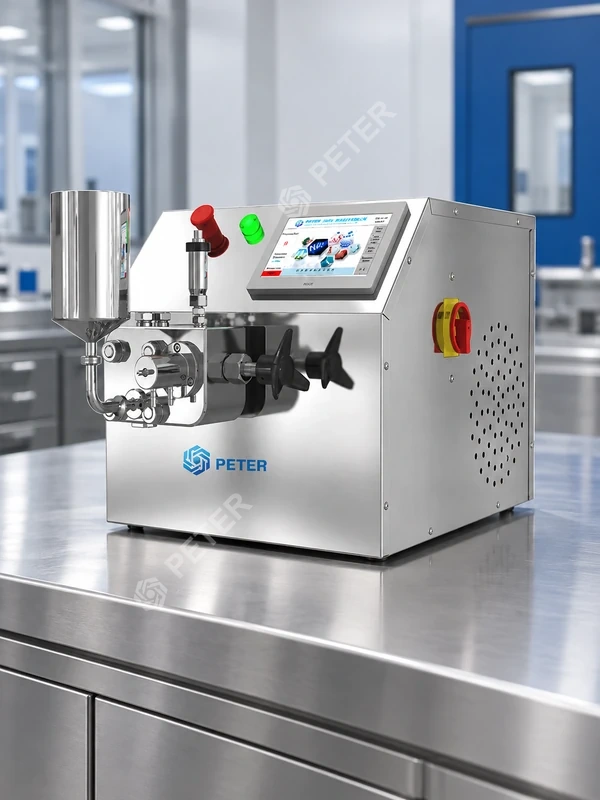
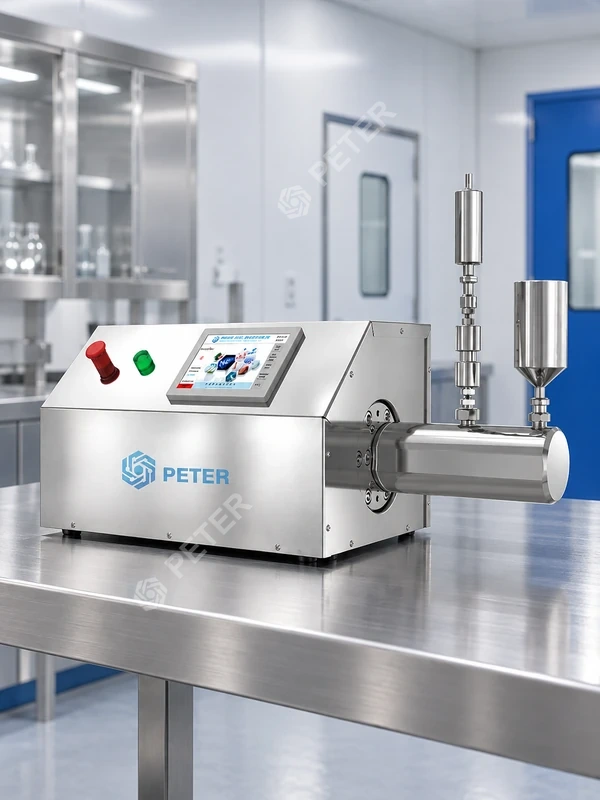
CAS PETER offers experimental and production high-pressure homogenizers and microfluidizers. For teams comparing flow-path approaches, the PTH-20 high-pressure microfluidizer and the PT-20 high-pressure homogenizer platform are two product-level starting points for a discussion. Model suitability, wetted materials, capacity, utilities, and application-specific compliance should be confirmed from the current technical documentation rather than inferred from this guide.
Compare cleaning, service, and analysis in total cost
The acquisition quote is only one line in total cost of ownership. Buyers should include trial material, premix equipment, cooling, labor, analytical testing, product loss in holdup, cleaning chemicals, wastewater, changeover time, wear parts, preventive maintenance, training, and the cost of production interruptions. An inexpensive configuration can become costly if it requires extra passes, difficult disassembly, long cleaning cycles, or repeated off-site analysis.
Cleaning requirements come from the product and risk assessment. A food emulsion, cosmetic emulsion, nonsterile pharmaceutical intermediate, and parenteral formulation do not share one universal cleaning or hygienic design requirement. The supplier should explain drainability, access to product-contact parts, compatible cleaning agents and temperatures, seal and valve maintenance, and available documentation. The user remains responsible for validating the cleaning procedure in the actual process.
Homogenization is also not sterilization. High pressure in this context is applied for droplet disruption and dispersion; it should not be treated as proof of microbial inactivation or sterility. Any required sterilization, aseptic processing, bioburden control, or food-safety step must be separately designed and validated under the rules applicable to the product and market.
Procurement teams reviewing the high pressure homogenizer market should compare vendors against a common application brief and acceptance test. A credible high pressure homogenizer manufacturer will define what its trial demonstrates, provide traceable settings and configuration details, and identify what remains outside equipment support. That boundary is a sign of useful technical support, not a weakness.
Use standards to guide testing, not to claim emulsion certification
ICH Q8(R2) is a pharmaceutical-development guideline describing concepts such as quality target product profiles, critical quality attributes, risk assessment, design space, and control strategy.[2] It does not prescribe a universal homogenization pressure or certify a machine. Its commercial value is the discipline of connecting process variables to product quality and documenting why the proposed operating window is appropriate.
ISO 13320 and ISO 22412 are measurement standards, not claims that a product is safe, stable, sterile, or compliant for a destination market. A method still needs fit-for-purpose settings, sample preparation, instrument qualification, and acceptance criteria. Regulatory requirements ultimately depend on intended use, dosage form, claims, manufacturing location, and sales market; buyers should involve their quality and regulatory teams before equipment specifications are frozen.
Questions to ask before choosing support and equipment
- Will the supplier review phase composition, rheology, temperature sensitivity, premix method, and analytical target before proposing trial conditions?
- Will the run record include machine configuration, pressure, cycles, inlet and outlet temperatures, cooling, deviations, and sampling times?
- Can the supplier explain how laboratory evidence will transfer to the proposed production geometry and pass strategy?
- Are cleaning, wear parts, service response, utilities, yield loss, and analytical workload included in the TCO discussion?
- Does the final recommendation clearly separate demonstrated findings from open formulation, stability, regulatory, and sterilization work?
Frequently asked questions
How much does a high-pressure homogenizer cost?
There is no responsible single price without a defined capacity, pressure requirement, flow-path design, wetted materials, controls, cooling arrangement, documentation package, and service scope. Buyers should request a configured quotation and compare lifecycle cost, not only the base machine price.
What affects the price of a high-pressure homogenizer?
Major drivers include scale, pressure and throughput duty, product-contact materials, valve or interaction-chamber configuration, cooling, automation, data recording, hygienic or regulated-process features, and acceptance documentation. Installation, spare parts, cleaning time, training, and analytical support can materially change the total budget.
How do new and used high-pressure homogenizers compare?
A used unit may lower initial expenditure, but condition, maintenance history, control-system support, wetted-part traceability, available documentation, and the cost of rebuilding the pressure-generating and interaction components require close review. A new unit can be configured around current needs, while either option still requires an application trial and testable acceptance criteria.
How should buyers assess high pressure homogenizer formulation support provider before choosing a high-pressure homogenizer?
Ask for a written workflow covering premix, controlled variables, thermal data, sampling time, analytical methods, stability boundaries, scale-up logic, cleaning, and final deliverables. The provider should show how conclusions follow from recorded evidence and should not present homogenization as a replacement for formulation development, sterilization, or product-specific validation.
References
- Grumbach, C. et al. “A New Control Strategy for High-Pressure Homogenization to Improve the Safety of Injectable Lipid Emulsions.” Pharmaceutics, 2022, 14(8), 1603. Full text at PubMed Central.
- International Council for Harmonisation. ICH Q8(R2): Pharmaceutical Development, Step 4, August 2009.
- International Organization for Standardization. ISO 13320:2020, Particle size analysis—Laser diffraction methods.
- International Organization for Standardization. ISO 22412:2017, Particle size analysis—Dynamic light scattering (DLS).
Conclusion
The best emulsion support does not begin with a universal pressure and end with one droplet-size result. It begins by fixing the formulation and premix conditions, defining the quality attributes and measurement times, and then testing pressure, cycles, and temperature as interacting variables. Only after immediate performance and relevant stability evidence are understood should the team transfer the process, specify cleaning, and compare total cost. Do not skip method suitability, application-specific compliance, or the separate validation of sterilization and microbial controls. CAS PETER’s experimental and production homogenizer product range can provide a practical basis for a documented equipment discussion; share the formulation constraints, target attributes, batch plan, and scale-up needs to request a configuration and trial scope grounded in evidence.