

How Much Does a High-Pressure Homogenizer Heat the Product?
A cooled product leaving the line may have been considerably hotter just after homogenization. For a heat-sensitive formulation, that earlier exposure can matter more than the final tank temperature. Pressure treatment adds heat even when the machine has no heater, so cooling has to be planned around the pressure, flow and temperatures along the product path.
For a first estimate, Tetra Pak’s dairy handbook describes about 1°C of warming per 4 MPa of pressure drop in its milk application. A simplified calculation for a water-like liquid gives a rise of about 24°C at 100 MPa, assuming no heat removal. Neither figure is a universal machine rating. Measure the actual formulation before and after treatment, and distinguish the temperature reached before cooling from the temperature delivered after it.
Why does the product warm up without a heater?
The pump supplies pressure energy that becomes liquid motion around the homogenizing device. Much of that energy dissipates as heat. A homogenizer temperature rise is therefore an expected consequence of pressure treatment, even if the feed and machine start cold. Feed preparation, pumping and a warm holding tank can add to the thermal load.
Tetra Pak’s Dairy Processing Handbook gives the approximate dairy relationship of 1°C per 4 MPa. It is useful for an early heat estimate, but the actual formulation can have different properties and heat losses. A cooler can lower the final outlet temperature without showing how hot the liquid became immediately after treatment.
How can you estimate the temperature rise from pressure drop?
A simplified estimate is ΔT ≈ ΔP ÷ (ρ × cp). Here ΔP is the pressure drop in pascals, ρ is density in kg/m³ and cp is specific heat capacity in J/(kg·K). The calculation assumes the pressure-related energy is dissipated into the liquid with negligible heat removal over the section being assessed. It also ignores changes in properties and other energy terms.
For a water-like example, assume a density of 1,000 kg/m³ and a heat capacity of 4,180 J/(kg·K). At 100 MPa, the calculation is 100,000,000 ÷ (1,000 × 4,180) ≈ 23.9 K, or a temperature rise of 23.9°C. These are assumed properties, not measured data for a formulation or commercial machine.
The estimate helps decide whether cooling deserves attention before the trial. Use the product’s own properties when available, particularly for concentrated formulations, then check the measured rise at the intended duty. The table below uses the same water-like assumptions throughout.
| Illustrative pressure drop | Calculated rise | Assumptions and limits |
|---|---|---|
| 20 MPa | About 4.8°C | ρ = 1,000 kg/m³; cp = 4,180 J/(kg·K) |
| 50 MPa | About 12.0°C | Same assumed properties; no heat removal |
| 100 MPa | About 23.9°C | Same assumed properties; not a machine rating |
| Actual formulation | Measure and verify | Use relevant properties and defined sensor positions |
Where should temperature sensors be placed to catch the hot exposure?
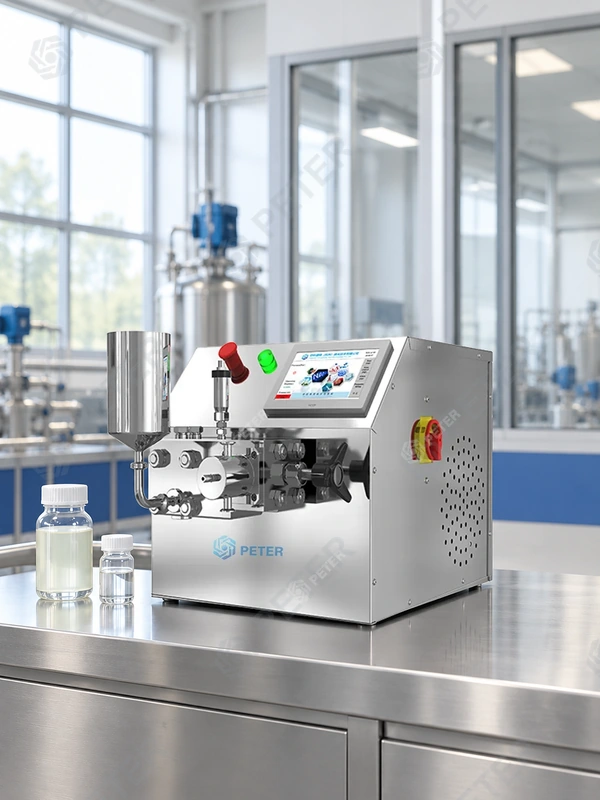
Measure near the machine inlet and after the homogenizing device, before an external cooler where the design allows. A third point after the cooler shows the delivered temperature. Record where each sensor sits and how quickly it responds. A slowly responding tank thermometer can miss a short temperature excursion upstream.
For discrete passes, record inlet and outlet temperature for every pass alongside pressure and actual flow. For recirculation, follow the temperatures over time as the tank warms or cooling removes heat. One reading at the end cannot show whether the first material overheated or whether the inlet temperature gradually increased.
Check the product property that heat could damage, such as activity, viscosity or emulsion stability. Temperature measurements describe the exposure; quality testing shows whether the formulation tolerated it. Where the hottest point cannot be measured directly, identify that limitation instead of treating a downstream reading as proof of the maximum temperature.
How much cooling duty does the process create?
A first pressure-related heat-load estimate is volumetric flow multiplied by pressure drop. At an assumed 500 L/h and 100 MPa, this is approximately 13.9 kW. The example assumes all of that pressure-related power becomes heat to be removed and excludes other heat inputs. It is a planning calculation, not the specified capacity of a chiller or a particular homogenizer.
The cooler must achieve the required product temperature with the coolant actually available at the site. State coolant inlet temperature, flow and pressure as well as the expected product duty. Tetra Pak’s heat-exchanger chapter explains the temperature driving force: sufficient headline cooling capacity does not compensate for an unsuitable temperature difference.
Viscosity, fouling and cleaning also affect exchanger selection. Review these with the product-side pressure requirements before choosing the cooler. Machine-service water for seals or components may serve a separate purpose and should not be assumed to remove the product heat load.
| Cooling question | Required information | Failure hidden by a nameplate |
|---|---|---|
| Can the duty be removed? | Flow, pressure drop and other heat inputs | Installed capacity quoted at different conditions |
| Can the outlet limit be reached? | Product and coolant temperatures | Insufficient temperature driving force |
| Can performance be maintained? | Viscosity, fouling and cleaning requirements | Heat transfer declines during the campaign |
| Can heat-sensitive quality survive? | Exposure trajectory and functional endpoint | Cold final tank masks earlier hot exposure |
Why can repeated passes overheat a batch that started cold?
If warm product returns to a tank, the next treatment starts at a higher inlet temperature unless enough heat has been removed. The rise across one pass and the accumulating temperature of the batch are separate measurements. Cooling between passes can limit the accumulation, but it cannot undo the hottest exposure that already occurred.
At fixed pressure drop, the simple temperature-rise equation does not directly include flow. Higher flow nevertheless increases the total heat duty. In practice, flow, residence time, viscosity and heat transfer can change the observed temperatures. A water trial is therefore useful for checking operation but cannot settle the thermal behavior of every viscous formulation.
Only keep extra passes that provide a useful improvement in size or function. If a further pass adds heat with little quality benefit, reducing that unnecessary treatment may be more useful than adding cooling capacity. The formulation owner still needs to define the acceptable temperature and exposure time; a milk-processing temperature is not a default limit for enzymes or other sensitive materials.
What temperature conditions should the supplier agree to test?
Specify pressure, actual flow, feed temperature, pass strategy and the temperature measurement points. For a laboratory high-pressure homogenizer such as the CAS PETER PT-20, ask what cooling is included and how the proposed temperature claim will be measured. A small fluctuation in discharge temperature is a different claim from a small rise between inlet and outlet.
For a production high-pressure homogenizer, include the expected continuous heat load and the factory’s coolant conditions. Agree who supplies the exchanger and chiller, and where each responsibility ends. This avoids discovering after delivery that machine cooling and product cooling were being discussed as though they were the same service.
Set the temperature and quality acceptance criteria before the run, including the action to take if a limit is exceeded. A fine-looking sample should not override an unacceptable thermal exposure.
Frequently asked questions
How much temperature rise should be expected during homogenization?
Use pressure drop, density and heat capacity for an initial estimate, then measure the product. The dairy handbook’s approximation is about 1°C per 4 MPa. Different formulation properties and heat removal can change the observed result.
Why does homogenizer pressure increase product temperature?
Pressure energy becomes liquid motion and eventually heat around and downstream of the homogenizing device. Feed temperature and any cooling then determine the temperature measured at a particular outlet.
How can outlet temperature be controlled?
Control the feed temperature, avoid unnecessary pressure or passes, and provide product cooling where needed. Measure before the cooler as well as after it so the final cold product does not conceal earlier heat exposure.
When is an external cooling system required?
It is needed when the proposed process cannot otherwise meet the formulation’s permitted temperature and exposure time. Calculate the duty at the intended flow, then check exchanger performance with the site’s available coolant.
Does temperature rise change with viscosity and flow rate?
At fixed pressure drop, the simplified temperature-rise estimate depends on density and heat capacity. Higher flow increases total heat load. Viscosity can change feed losses and heat transfer, so confirm performance with the real formulation.
How should heat exposure be included in a homogenizer trial?
Record inlet, pre-cooler and post-cooler temperatures where accessible, together with pressure, flow and pass history. For recirculation, track the batch over time and check the quality property that heat might affect.
References
- Tetra Pak, Dairy Processing Handbook, chapter 7.3: Homogenizers, accessed 16 October 2026
- Tetra Pak, Dairy Processing Handbook, chapter 7.1: Heat exchangers, accessed 16 October 2026
- CAS PETER, PT-20 product page and original photograph, accessed 16 October 2026
Conclusion
Use the temperature history relevant to the product, including its hottest exposure and repeated treatment. The final delivered temperature is important, but it cannot prove that a sensitive ingredient stayed cool throughout processing. A pressure-based estimate helps plan the trial and cooling duty; measured temperatures and the product’s retained quality determine whether the proposed conditions are acceptable.