

What Causes Cavitation, Foaming, and Air Entrapment During Homogenization?
Noise, unstable pressure and foam can appear together, but they do not prove that a homogenizer has one particular fault. The feed may be short of inlet pressure, pulling in air, or carrying bubbles that the formulation keeps stable. Increasing homogenizing pressure or adding antifoam before separating those causes can leave the real problem unresolved.
Cavitation involves vapor forming where local liquid pressure falls below vapor pressure. Air entrainment is gas introduced into the liquid, while foam is a population of bubbles stabilized by the formulation. Start by recording feed pressure, tank level, temperature, actual flow and return behavior. Compare these with the supplier’s inlet requirements. Follow the approved stop, isolation and depressurization procedure before inspecting fittings or other parts of the system.
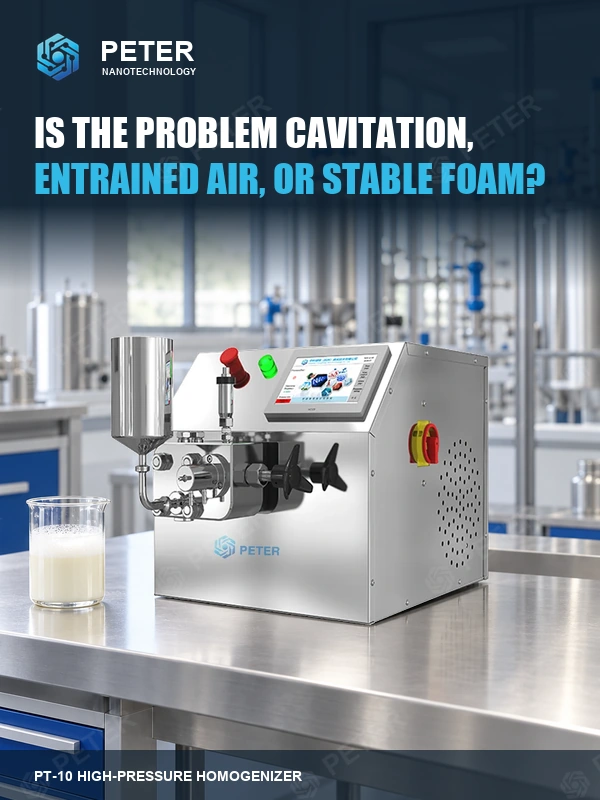
Is the problem cavitation, entrained air, or stable foam?
With cavitation, vapor bubbles form at low local pressure and collapse as pressure recovers. Entrained air is noncondensable gas carried in the feed, for example after a tank vortex draws air into the outlet. Foam persists when the formulation stabilizes bubbles. More than one condition can occur, which is why a frothy tank or a noisy pump is a starting observation rather than a diagnosis.
The Dairy Processing Handbook’s pumps chapter explains the relationship between inlet pressure and vapor pressure. Its deaerators chapter discusses dissolved and dispersed air in milk. These distinctions help determine what to investigate without assuming that every industrial formulation behaves like milk.
| Condition | Physical distinction | First question |
|---|---|---|
| Cavitation | Local vapor formation and collapse | Is pressure adequate relative to vapor pressure? |
| Air entrainment | Gas introduced into the liquid | Where is gas entering or being recirculated? |
| Foam | Bubbles stabilized by the formulation | Which air source and ingredients sustain it? |
| Combined symptoms | More than one mechanism may coexist | Which recorded change precedes the symptom? |
Why does the machine become noisy as the feed tank empties?
A lower liquid level can reduce the pressure available at the inlet or allow a vortex to draw in air. Restrictions, partly closed valves or a blocked permitted strainer can also reduce feed pressure under flow. Compare the symptoms with tank level and actual inlet pressure instead of recording only the homogenizing-pressure gauge.
Temperature and viscosity matter too. Higher temperature raises vapor pressure for many liquids, while greater viscosity can increase inlet losses. Assess these together using the real formulation and piping. There is no single viscosity or tank-level rule that establishes adequate feed for every installation.
For a feed pump, compare available and required net positive suction head (NPSH) using the supplier’s data and an appropriate margin. A reciprocating homogenizer also has pulsating demand and acceleration effects. A centrifugal feed-pump calculation alone may not settle the inlet design. Ask the homogenizer supplier to review the minimum pressure, permitted variation and any required dampening arrangement.
The homogenizers chapter discusses suction pulsation and conditions around the homogenizing device. Keep those locations separate: advice about valve backpressure should not be applied blindly to a pump that is being starved at its inlet.
Where can air enter even when there is no visible liquid leak?
A connection in a low-pressure section can admit air without producing an obvious outward leak. Air can also enter at a vortex or when returning product falls through the liquid surface. Note whether foam begins after recirculation starts or becomes worse below a certain tank level. Those observations help locate the source.
Tetra Pak’s tanks chapter describes submerged entry to avoid splashing and aeration in balance-tank arrangements. A return modification still needs engineering review for hygiene, backflow, drainage and machine operating conditions. It is not a reason to reroute a pressurized line during troubleshooting.
Keep sample preparation consistent while investigating. A frothy sample may change as it stands or during dilution, affecting volume or size measurements. If the laboratory removes gas from one sample but not another, an apparent improvement may come from sample handling rather than a machine adjustment.
When will deaeration or antifoam help?
Find avoidable air entry before treating the foam. Antifoam cannot repair an unsuitable suction line, and reducing visible bubbles does not establish adequate feed pressure. Once the source has been addressed, determine whether dissolved or dispersed gas still creates a process problem.
Deaeration may be useful, but vacuum treatment can affect volatile components, temperature and concentration. The operating conditions described for milk in the handbook are not default settings for solvents, fragrances or pharmaceutical materials. Check the composition and quality effects with the formulation owner.
Antifoam is a formulation change. Assess application approval, compatibility and downstream effects before using it, particularly for regulated or interface-sensitive products. A controlled comparison should measure both foam behavior and the product property the process is meant to deliver. An arbitrary dose can introduce a new variable without identifying the original cause.
Which observations are most useful before changing settings?
Record when the symptom starts and what changed immediately beforehand. Where approved instrumentation is available, collect inlet pressure, homogenizing pressure, flow and temperature on the same timeline as tank level and return operation. A fault that appears as the tank empties calls for a different investigation from one that begins only after the feed warms.
A homogenizer cavitation investigation should keep other possible causes open. Wear, gas, restricted feed and measurement problems can produce overlapping symptoms. Compare the affected run with a known acceptable run, including feed preparation. Do not keep running an unsafe condition just to complete the record.
| Observed pattern | Possible investigation | Evidence to collect |
|---|---|---|
| Worse at low tank level | Feed pressure or vortex-related air entry | Level, inlet pressure and return condition |
| Worse as feed warms | Vapor-pressure margin or changing formulation behavior | Temperature, pressure and viscosity conditions |
| Foam after return starts | Surface aeration and bubble stability | Return arrangement and timed observations |
| Unstable flow without obvious foam | Inlet supply, gas, wear or measurement issue | Synchronized pressure and flow record |
| Result changes after sample stands | Gas or sampling preparation effect | Defined sampling and analytical preparation |
Physical inspection must follow the approved stop, isolation and depressurization procedure. Do not loosen pressurized fittings, bypass supplied protective functions or add an inlet restriction to quiet the machine. Recurrent abnormal operation needs a review of the feed arrangement and duty with the supplier.

What should you send the supplier when the problem repeats?
For a production high-pressure homogenizer such as the CAS PETER PT-500, send the model and configuration, feed composition, viscosity at operating temperature, flow, pressure records and tank operating range. Include a drawing or suitable photographs of the actual feed and return arrangement. A photograph of the machine alone cannot show inlet pressure losses.
A pilot high-pressure homogenizer trial may help separate a formulation’s tendency to foam from a production-layout issue, provided the trial conditions are recorded. For early compatibility work, the experimental homogenizer range offers another equipment context to discuss. Confirm what each trial can represent before drawing a scale-up conclusion.
Have CAS PETER review the proposed inlet and operating conditions for its supplied equipment. The site team should assess piping or control changes, and the formulation owner should assess additives or deaeration. Changing several of these at once can make the apparent improvement difficult to explain or reproduce.
Frequently asked questions
What causes cavitation in a high-pressure homogenizer?
Local pressure below the liquid’s vapor pressure can cause vapor to form. At the inlet, low feed pressure, restrictions, higher temperature and pulsating demand can contribute. Conditions inside the homogenizing device require a separate assessment.
How can foaming be reduced during homogenization?
First locate avoidable air entry at the tank, return or low-pressure connections. Then assess whether the formulation needs an approved deaeration or antifoam approach. Isolate and depressurize the equipment as required before physical inspection.
What is air entrainment and why does it affect repeatability?
It means gas is introduced into or carried with the liquid. Variable gas content can affect feed delivery, volume measurements and sample preparation, making run-to-run comparisons less reliable.
How can inlet conditions prevent cavitation?
Provide the supplier’s required inlet conditions at the actual flow, temperature and viscosity. Review tank level, inlet losses and specified pulsation control. Feed-pump NPSH and reciprocating inlet effects need appropriate design assessment.
Does product viscosity increase the risk of foaming or cavitation?
Higher viscosity can increase inlet losses and change bubble movement or persistence. It does not create one universal threshold: temperature, formulation and the installed path also affect the risk.
Which pressure, flow, and temperature signals indicate an inlet problem?
Compare inlet and homogenizing pressure, flow and temperature with tank level and return behavior. Record what changes before symptoms appear. Noise or foam alone does not uniquely identify the cause.
References
- Tetra Pak, Dairy Processing Handbook, chapter 7.8: Pumps, accessed 16 October 2026
- Tetra Pak, Dairy Processing Handbook, chapter 7.7: Deaerators, accessed 16 October 2026
- Tetra Pak, Dairy Processing Handbook, chapter 7.3: Homogenizers, accessed 16 October 2026
- Tetra Pak, Dairy Processing Handbook, chapter 7.10: Tanks, accessed 16 October 2026
Conclusion
Check whether the liquid is reaching the machine under adequate inlet conditions and where gas is entering the system. Then assess why bubbles persist in that formulation. This sequence keeps a feed problem from being treated as a chemistry problem, or a stable foam from being labeled cavitation on appearance alone. Use the operating record to guide supplier review, and make physical inspections or modifications only after the required isolation and depressurization.