

How Does a Homogenizer Machine Create Uniformity?
A smooth-looking emulsion can still form a cream layer in storage. That does not automatically mean the homogenizer needs more pressure. The machine may have reduced most droplets while leaving a small coarse fraction, or it may have created new droplet surface that the formulation cannot keep stable. These problems look similar in a bottle but need different corrections.
A homogenizer makes a liquid more uniform by applying mechanical stresses to droplets, particles or agglomerates. In a pressure-driven machine, a pump forces the feed through a restrictive homogenizing device. A rotor-stator machine applies shear around a rotating head. Both need a suitable feed and enough treatment, and neither can guarantee storage stability on its own. To judge the result, compare the size distribution, temperature and stored product rather than appearance alone.
What happens to the liquid inside a pressure homogenizer?
The homogenizer machine working principle starts with the pump supplying liquid against a restriction. As the liquid passes through the narrow homogenizing region, pressure energy becomes high liquid velocity. The resulting stresses break droplets or disperse suitable agglomerates. Much of the energy eventually becomes heat, which is why outlet temperature belongs in the process record alongside pressure.
For milk, the turbulent jet downstream of the homogenizing gap plays a central role in fat-globule breakup. Tetra Pak’s Dairy Processing Handbook describes milk homogenization commonly at 10–25 MPa. This is a dairy application range, not a setting to copy into a protein suspension, solvent system or abrasive slurry. The formulation and the homogenizing device determine the useful conditions.
Breaking a droplet also creates more surface area. If that surface is not stabilized quickly enough, droplets can join again after leaving the machine. A higher pressure reading can therefore coincide with little improvement in the stored product.
How is pressure homogenization different from high-speed mixing?
A rotor-stator homogenizer draws material into the region around a rotating head. Head geometry, speed, viscosity and circulation affect the treatment. A pressure homogenizer passes pumpable feed through a restrictive device, so pressure drop, flow and the number of passes describe its operation more directly. Comparing shaft speed with homogenizing pressure does not tell a buyer which machine will produce the better sample.
The two methods can have different jobs in the same process. Mixing may wet a powder or prepare a pre-emulsion before pressure treatment. That preparation matters if poorly wetted ingredients or large agglomerates otherwise reach the pressure machine. Tetra Pak’s mixers chapter explains ingredient incorporation and mixing equipment. Add a preparation step to solve an identified feed problem, then check whether it actually improves the result.
| Process question | Rotor-stator mixing | Pressure-driven homogenization |
|---|---|---|
| Where is energy applied? | Around a rotating mixing head | Across a pressure-driven homogenizing device |
| Which settings need recording? | Head geometry, speed, time and circulation | Pressure, flow, temperatures and passes |
| What can limit the result? | Uneven exposure, feed incorporation or viscosity | Feed delivery, temperature, valve compatibility or stability |
| What proves suitability? | Representative formulation trial | Representative formulation trial |
Why can the same settings give different results with a new feed?
Pressure alone does not describe what entered the machine. Viscosity changes with temperature, and non-Newtonian products also depend on how viscosity is measured. A formulation that feeds easily while warm may become difficult to supply after cooling. Solids concentration, fibers and oversized particles can affect blockage or wear, so the supplier needs more than the product’s name when checking compatibility.
Feed preparation can also change the result without any change to the machine setting. Compare ingredient addition, mixing, temperature and air content when one batch behaves differently from another. Record these conditions before deciding to add another pass. Otherwise, the extra processing may hide inconsistent preparation rather than resolve it.
The machine’s permitted feed size, temperature and wetted-material compatibility should come from its supplied documentation. These limits help establish whether a trial can be run safely; they do not establish that the formulation will remain stable afterward.
| Observation | Question to investigate | Useful evidence |
|---|---|---|
| Fine immediately, unstable later | Is the new interface adequately stabilized? | Stored sample and size distribution |
| Pressure fluctuates | Is feed supply consistent and free of problematic air? | Inlet conditions and pressure trace |
| Extra passes give little benefit | Has size reduction reached a practical plateau? | Size and temperature after each discrete pass |
| Laboratory result fails at scale | Did temperature, feed preparation or exposure change? | Matched trial records and sampling method |
What should a trial measure besides average particle size?
Keep an untreated sample from the same prepared feed. For each processed sample, record pressure, actual flow, inlet and outlet temperature, pass or recirculation history, and the collection point. This gives a useful comparison when two samples differ. A pressure setting with no temperature or feed record is much harder to reproduce.
Look at the distribution, including the coarse end, rather than reporting only a mean. A small average can conceal enough large droplets or particles to cause a practical problem. Keep dilution, sample dispersion and instrument settings consistent. If sample preparation breaks weak agglomerates, a change in the laboratory method can look like an improvement in the machine.
The next check depends on the intended product. An emulsion needs an appropriate storage test and a check for separation or size change. A cell-disruption process needs a relevant measure of release or retained activity. Microscopy can help distinguish droplets from clusters when a size measurement alone is ambiguous. Repeat a promising condition with separately prepared feed where feasible; the result should survive normal preparation variation.
How do you turn a useful trial into an equipment specification?
Describe the job in terms of the material and the required result: what enters the machine, how much is available, which quality measurement must improve, and what temperature must be avoided. For an initial study, a laboratory high-pressure homogenizer should be assessed against sample volume, feed compatibility and the measurements needed during the run.
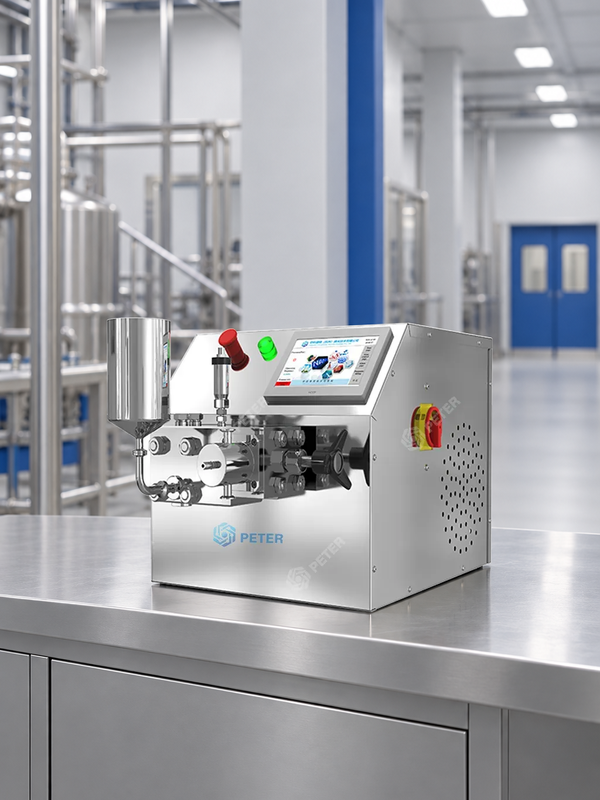
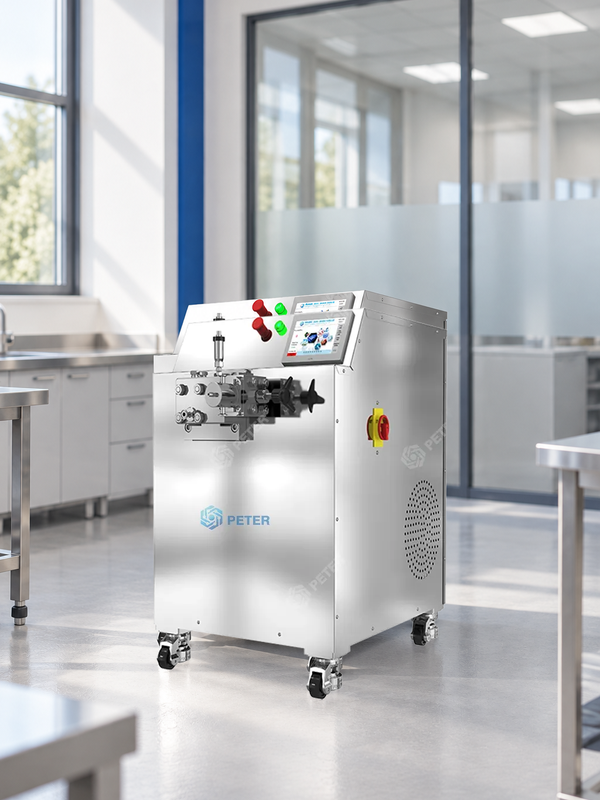
At pilot scale, a pilot high-pressure homogenizer such as the CAS PETER PT-40 provides a model to discuss with the supplier. Ask for the pressure and flow available together, minimum working volume, product recovery and cleaning instructions for the quoted configuration. Confirm these in the quotation before using them in a scale-up calculation.
The existing article on homogenizing valve design covers the treatment region in more detail. For equipment selection, the important link is between the trial result and the conditions that produced it. A good sample is useful only if the next machine can provide comparable treatment without changing the feed, temperature or sampling assumptions.
Frequently asked questions
What is the working principle of a homogenizer machine?
A pressure homogenizer pumps liquid through a restrictive homogenizing device, converting pressure energy into liquid motion and mechanical stresses. Rotor-stator homogenizers use a rotating mixing head instead. Both apply mechanical treatment, but their settings describe different mechanisms.
How does a homogenizer machine create a uniform product?
It breaks droplets or disperses suitable agglomerates while the process gives the material enough treatment. The formulation must keep the new droplets or dispersed material stable afterward. Check the distribution and stored product to confirm that uniformity lasts.
What is the role of machine homogenizer in the process?
The homogenizer supplies the mechanical treatment needed for droplet breakup, dispersion or another defined task. Feed preparation and formulation determine what it can achieve, while testing shows whether that treatment produced a useful result.
Which process settings affect homogenizer machine performance?
For pressure machines, record pressure drop, flow, inlet and outlet temperature, and passes or recirculation time. For rotor-stator machines, record head geometry, speed and time. In both cases, keep feed preparation and sample analysis comparable.
References
- Tetra Pak, Dairy Processing Handbook, chapter 7.3: Homogenizers, accessed 16 October 2026
- Tetra Pak, Dairy Processing Handbook, chapter 7.5: Mixers, accessed 16 October 2026
- CAS PETER, PT-40 product page and original product photograph, accessed 16 October 2026
Conclusion
A successful run produces the required distribution and preserves the properties that matter in use or storage. If a sample separates later, investigate stabilization and the coarse fraction before assuming the pressure was too low. If extra passes make little difference, compare their added heat with the quality improvement they actually deliver. Equipment selection becomes clearer once the trial can explain both the result and the conditions needed to repeat it.