

Laboratory High Pressure Homogenizer: Small-Scale Guide
When a formulation engineer in Boston encountered unstable results during a small-volume emulsion study, she followed a familiar online protocol, loaded the sample, and increased pressure after the first pass looked disappointing. Within an hour, the second fraction was warmer, the particle-size result had shifted, and too little product remained for the planned stability tests. The machine was not necessarily defective; the trial had been specified around a pressure number instead of a process window, recoverable volume, and measurement plan.
Summary: Select a laboratory high pressure homogenizer by the usable pressure window, sample recovery, temperature control, feed compatibility, cleaning evidence, and transfer path—not by maximum pressure alone. Because 1 MPa equals 10 bar, unit conversion is simple; proving that a setting produces the required quality without unacceptable heat or loss is the real work. Define acceptance criteria, run a representative sample trial, and obtain a signed configuration-specific data sheet before purchase.
How a Laboratory High-Pressure Homogenizer Proves It Is Fit for Small-Scale Work
A high-pressure homogenizer pumps a prepared, pumpable feed through a restricted processing zone. The pressure drop creates intense local forces that may reduce droplet or particle size, deagglomerate material, or disrupt cells, depending on formulation and equipment design. Pressure alone does not describe the result. Feed state, valve or interaction-zone geometry, flow, pass count, temperature history, sampling, and the analytical method all influence what the laboratory observes.
The first question is therefore not “How high can the machine run?” but “Which measured window delivers the required quality with acceptable recovery and risk?” Where particle-size distribution is an endpoint, ISO 13320:2020 provides a laser-diffraction method and ISO 22412:2025 covers dynamic light scattering for mainly submicrometre dispersed systems. These are measurement standards, not homogenizer certifications, and their results are not automatically interchangeable.
How a Written Process Window Makes Supplier Comparisons Reproducible
How to Define the Feed Before Comparing Equipment
Procurement should ask R&D to describe the most difficult credible feed, not only the nominal formula. The user requirement specification should state composition, concentration, viscosity at a stated temperature, solids loading, largest expected particle or fibre, pH, solvent, biological hazard, inlet-temperature range, foaming tendency, and sensitivity to air. A clear boundary sample exposes pumpability, blockage, seal compatibility, and cleaning issues that a water demonstration cannot reveal.
Record at least five process variables during every screening run: actual pressure, delivered flow or processing time, inlet temperature, outlet temperature, and pass count. Pair them with the relevant outcome—such as the complete particle-size distribution, viscosity, target-protein recovery, cell disruption, appearance, or separation after a defined hold. An average size without its sampling and preparation method is weak purchasing evidence.
How to Separate Required Capability from Optional Pressure Headroom
Maximum rated pressure is a safety and design boundary, not an everyday setpoint. Begin with a justified screening range and increase pressure only when the previous condition fails a defined endpoint without breaching a temperature, degradation, or wear limit. Pressure units should be written consistently: 100 MPa is 1,000 bar. Confusing MPa and bar can make a test plan unusable and, more importantly, can obscure an unsafe instruction.
How Endpoint Testing Identifies the Lowest Effective Pressure and Pass Count
A useful screening study changes one major process factor at a time or uses a documented design of experiments. Hold feed preparation, concentration, inlet temperature, sampling point, analytical settings, and storage time constant. Include an untreated control and retain enough material for repeat measurement. Repeated readings from one vial show instrument repeatability; independent preparations are needed to reveal preparation and process variation.
Stop adding pressure or passes when the relevant benefit reaches a plateau, variability increases, outlet temperature crosses the product limit, or a damage marker worsens. For an emulsion, that decision may use distribution width and separation rather than only median diameter. For cell disruption, it may combine released target with activity, impurity load, viscosity, and clarification burden. A higher energy input that produces more debris or lower biological activity is not a process improvement.
Cooling also belongs inside the process window. Log inlet and outlet temperatures for every condition and state whether cooling occurred before, during, or after the pass. If a supplier reports a particle-size result, request the feed formula, pressure, pass count, thermal history, sampling point, dilution procedure, and instrument method behind it. Without those conditions, the figure cannot be reproduced or compared fairly.
How Sample Recovery and Hold-Up Affect Cost per Usable Analytical Sample
Small-scale users often discover too late that “minimum feed” and “recoverable sample” are different quantities. Product may remain in the feed line, pump head, valve block, heat exchanger, recirculation loop, collection path, and rinse fraction. This hidden hold-up is a thin but commercially important topic: losing 20 mL is minor in a water test and potentially decisive when the sample contains a scarce active or a week of upstream work.
How to Close a Mass Balance Without Hiding Rinse or Residual Hold-Up
Run a gravimetric mass-balance trial using a safe, representative surrogate before committing valuable material. Define the batch boundary first, then record the charged mass, the separately collected main product, rinse, waste, analytical samples removed during the run, and measurable residual hold-up. If priming material is introduced before the batch, record it separately: it affects operating cost and contamination risk even when it is not part of the charged batch.
Use the following reconciliation, with every term in the same mass unit: unaccounted mass = charged mass − (main product + rinse + waste + samples + measured residual hold-up). Mass-balance closure is the sum of those accounted outlets divided by charged mass, multiplied by 100. Main-product recovery is main-product mass divided by charged mass, multiplied by 100. Do not quietly add the rinse to recovered product; count it as usable only when its composition, concentration, contamination status, and intended analytical use all meet the written acceptance rule.
The remaining gap is not automatically “machine loss.” Evaporation, foam, spills, material adhering to collection vessels, scale resolution, and timing differences can all affect closure. Set an acceptable closure range in the protocol before the trial, investigate deviations rather than forcing the numbers to 100%, and repeat the test at the intended pass count because recirculation can change both hold-up and sampling loss.
How to Calculate Cost per Usable Analytical Sample Without Inventing Prices
First define a usable analytical sample as an aliquot with the required mass or volume, composition, concentration, and quality status for the planned method. Then calculate cost per usable analytical sample = total allocated run cost ÷ number of valid aliquots or valid data sets produced. The numerator can include allocated equipment cost, charged formulation value, sample lost to priming and hold-up, rinse and cleaning consumables, operator and changeover labour, wear-part allocation, calibration or acceptance-testing allocation, and service or downtime exposure. Use the buyer’s own quotations and labour rates; this is a method, not a price claim.
Ask the supplier to explain how start-up, steady-state, shutdown, and recirculation affect recovery. A low nominal sample requirement may be misleading if the method needs a separate priming volume or several passes through a large loop. Conversely, a slightly larger charge can be economical if it yields more valid aliquots after processing. For competing systems, keep the feed, analytical minimum, replicate plan, pass strategy, and definition of “valid” constant so the denominator cannot be improved by producing smaller or lower-quality samples.
How to Preserve Cause and Effect When Scaling Beyond the Laboratory
Copying a laboratory pressure to a larger machine does not prove equivalent processing. Scale-up should preserve the causal variables that matter for the product: feed preparation, pressure profile, interaction-zone principle, flow stability, number of effective passes, temperature exposure, residence and recirculation history, and sampling location. The analytical method and acceptance rule must travel with the process.
Before leaving the laboratory, establish three evidence sets: a quality window, an operating window, and a failure boundary. The quality window shows where the product meets its endpoint. The operating window shows where the machine remains stable and repeatable. The failure boundary records what happens with the highest viscosity, largest feed particle, warmest inlet, longest run, or other credible worst case. This prevents pilot procurement from being based on one favourable midpoint run.
For U.S. drug manufacturing within the scope of 21 CFR Part 211, 21 CFR 211.110 requires written procedures that describe in-process controls and the tests or examinations performed on appropriate samples; those procedures must be followed. The rule does not prescribe homogenizer design or certify a laboratory machine. Its narrower procurement lesson is to define the process controls, sampling points, methods, and acceptance criteria that must remain comparable during transfer rather than merely repeating a pressure setting.
How Cleaning, Service, and Spare-Part Evidence Determine Real Availability
Cleanability begins with the product and contamination risk. Specify wetted materials, seal compatibility, allowable detergents, maximum cleaning temperature, drainability, dismantling steps, and how the laboratory will detect residue or carryover. If a regulated drug operation is in scope, 21 CFR 211.67 requires equipment and utensils to be cleaned, maintained, and sanitized at appropriate intervals; it does not certify a model or replace site-specific cleaning validation.
For procurement, the useful question is not how to perform maintenance but what evidence makes availability forecastable. Request the high-wear component list, inspection basis, special tools, calibration scope, service contact route, stated response time, spare-part stocking location, normal and worst-case lead times, and any control or component obsolescence notices. A verbal promise of “fast support” is not equivalent to a response commitment and an identified route for obtaining pressure seals, valves, and other critical parts.
Build a comparable ownership-cost worksheet with the same boundary for every supplier: acquisition and required accessories; installation, cooling, training, and acceptance testing; priming and rinse volume; sample loss; changeover and cleaning labour; wear parts; calibration and periodic testing; and service or downtime exposure. Keep uncertain items as named assumptions or ranges rather than replacing them with invented prices. This procurement view deliberately stops at evidence and cost allocation; detailed preventive-maintenance instructions belong in the equipment manual and the site maintenance program.
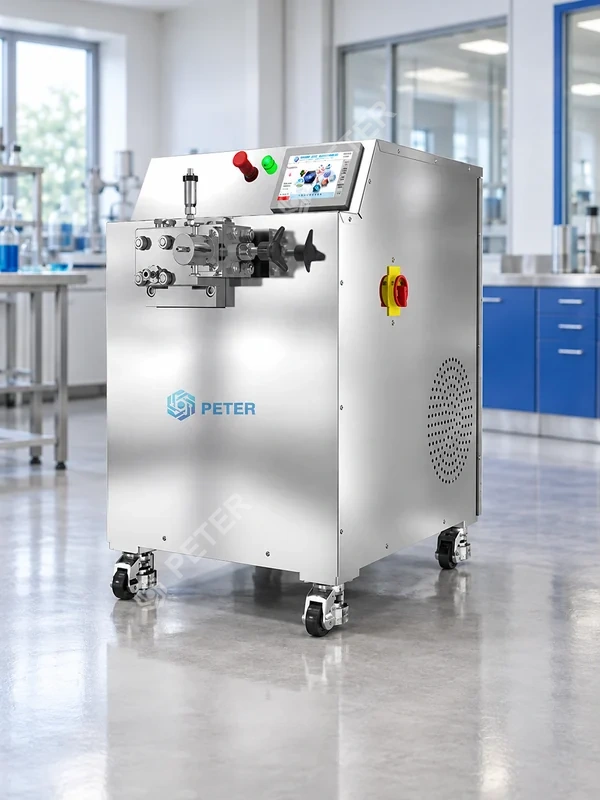
Operating risks include blocked feed paths, pressure excursions, leaks, hot surfaces, aerosols, incompatible chemicals, and incorrect reassembly after cleaning. IEC 61010-1 sets general safety requirements for electrical equipment used for measurement, control, and laboratory use, but applicability and conformity must be confirmed for the delivered configuration and destination market. Site risk assessment, operator training, guarding, interlocks, and written lockout or depressurization steps remain essential.
What Buyers Learn by Comparing Small-Scale Homogenization Routes
| Decision dimension | High-pressure laboratory system | Rotor-stator or ultrasonic screening | Procurement evidence |
|---|---|---|---|
| Process mechanism | Controlled flow through a pressure-drop zone | Local mechanical shear or acoustic energy in a vessel | Process-flow sketch and material-specific trial |
| Scale-up relevance | Useful when the intended production route uses a comparable pressure-based mechanism | Useful for rapid formulation ranking; transfer may require a new correlation | Documented cause-and-effect scale-up basis |
| Sample economy | Depends on system hold-up, collection path, and recirculation strategy | Often convenient for very small vessels, but probe or vessel losses still matter | Gravimetric recovery and mass-balance test |
| Thermal control | Requires inlet/outlet logging and a defined cooling arrangement | Requires time, duty-cycle, and vessel-temperature control | Temperature history tied to quality results |
| Maintenance and TCO | High-pressure seals, valve or interaction-zone parts, pump service, and calibration | Probe, rotor, stator, bearing, or generator maintenance | Wear-part list, labour estimate, service plan, and downtime assumptions |
What Acceptance Evidence Each Laboratory Application Requires
| Application | Primary endpoint | Hidden failure to test | Useful decision record |
|---|---|---|---|
| Emulsion development | Droplet distribution, viscosity, and separation over a defined interval | Heat-driven degradation or a coarse tail hidden by the average | Matched feed, pressure, pass, temperature, and stability table |
| Suspension or nanoparticle work | Fit-for-purpose size distribution and physical stability | Dilution artefact, re-agglomeration, abrasion, or contamination | ISO 13320, ISO 22412, microscopy, or another justified method |
| Cell disruption | Target release plus retained activity or integrity | Excess debris, viscosity, heat, or difficult clarification | Release, activity, temperature, and downstream recovery results |
| Scarce research material | Usable recovered mass and sufficient aliquots for follow-on tests | Hold-up, foam, adsorption, sampling loss, or unusable rinse dilution | Stage-by-stage gravimetric mass balance |
| Regulated formulation development | Defined critical quality attributes and reproducible operating records | Uncontrolled cleaning, calibration, software, or change history | URS, trial protocol, deviations, calibration, and qualification plan |
How to Separate Test Methods, Regulatory Duties, and Product Claims
- ISO 13320:2020 specifies laser-diffraction particle-size analysis. It is a test-method standard, not proof that a homogenizer will achieve a particular distribution.
- ISO 22412:2025 addresses dynamic light scattering for mainly submicrometre dispersed systems. Sample concentration, viscosity input, dilution, and multiple scattering can change interpretation.
- 21 CFR 211.67 applies to equipment cleaning and maintenance within covered U.S. drug-manufacturing operations. Applicability depends on intended use and the regulated quality system.
- IEC 61010-1 concerns general laboratory electrical-equipment safety. A supplier should state the delivered configuration, test evidence, and destination-market conformity rather than using the standard as a vague performance claim.
Unsupported claims such as “FDA approved,” “GMP certified,” or “compliant for every application” can create audit, contracting, and market-access risk. Procurement should ask which requirement applies, which organization assessed it, which configuration was assessed, and which report or declaration supports the claim. Product-contact materials, electrical conformity, cleaning validation, and process performance are separate evidence streams.
How Procurement Converts a Sample Trial into Comparable Total-Cost Evidence
- Issue one user requirement specification. Give every supplier the same feed envelope, target attributes, temperature limit, operating schedule, utilities, cleaning needs, destination market, and documentation list.
- Test boundary material. Include the credible worst-case viscosity, particles, solids, concentration, and temperature rather than approving the machine with an easy demonstration fluid.
- Measure recovery and changeover. Record loaded and recovered mass, sample handling, cleaning time, water and detergent use, dismantling labour, and the number of follow-on test aliquots produced.
- Price the delivered process. Compare accessories, cooling, installation, training, commissioning, priming and rinse volume, sample loss, changeover labour, wear parts, calibration, service, and likely downtime with the base equipment.
- Require traceable proof. Attach trial raw data, configuration list, deviations, acceptance results, and the signed data sheet to the technical bid evaluation.
Which Acceptance Evidence Should Accompany a New Homogenizer?
Before release for routine laboratory work, tie each acceptance check to the delivered serial number and configuration. The evidence pack should identify the model, wetted-path configuration, software or controller version where relevant, utilities, accessories, and safety features; it should also include current manuals, drawings or flow schematics, declared wetted materials, calibration records for measured variables, and the agreed spare-parts and service scope.
- Configuration evidence: purchase order, signed data sheet, serial numbers, options, utilities, and approved deviations from the URS.
- Condition and function evidence: documented inspection, leak-free operation, pressure and flow control checks, alarms and interlocks, temperature monitoring, and a safe shutdown or depressurization demonstration as applicable to the delivered design.
- Performance evidence: a protocol using the agreed representative feed, with raw pressure, time or flow, temperature, pass, recovery, and endpoint results against pre-approved criteria.
- Handover evidence: calibration documents, operating and cleaning instructions, training records, recommended critical spares, service contacts, response terms, and spare-part lead-time assumptions.
Where U.S. drug CGMP requirements apply, 21 CFR 211.110 requires written in-process control procedures and defined tests or examinations on appropriate samples. It does not prescribe this equipment checklist, apply automatically to every R&D laboratory, or certify a homogenizer model. The relevant procurement rule is therefore narrower: approve the delivered configuration against written controls, sampling methods, and acceptance criteria rather than a generic brochure or a successful demonstration on different material.
What Additional Evidence Makes a Used Homogenizer Comparable to a New One?
A used machine should meet the same current URS and acceptance endpoints as a new machine; a lower initial quote does not reduce the required evidence. Missing history is a purchasing risk to price and manage, not a fact to fill with assumptions. Add the following used-equipment checks to the new-equipment evidence pack:
- History: ownership, previous applications, operating hours if recorded, service reports, faults, repairs, modifications, moves, storage conditions, and contamination or decontamination records.
- Pressure-path condition: documented inspection of the pressure boundary, fittings, valve or interaction zone, pump, seals, gauges or transmitters, and any safety-relief provisions present in the design.
- Supportability: manuals and original configuration records, controller and software versions, licence-transfer status where relevant, obsolescence notices, service availability, critical-spare availability, and quoted lead times.
- Recommissioning proof: calibration records, leak and functional checks, verified alarms and interlocks, cleaning assessment, mass-balance recovery, and a representative-feed acceptance run after refurbishment and transport.
Keep inspection, calibration, and functional-test records together so cosmetic condition cannot substitute for pressure-boundary and process evidence. If the pressure path cannot be assessed, the safety functions cannot be demonstrated, or critical spares are obsolete without a supported alternative, treat the gap as an unresolved acceptance condition rather than relying on a discounted quotation.
The commercial comparison is therefore new versus used on an equivalent delivered basis: purchase and refurbishment, missing accessories, recommissioning, acceptance testing, calibration, documentation recovery, control obsolescence, service response, spare-parts lead time, sample risk, and downtime. No general price advantage should be assumed without those buyer-specific inputs.
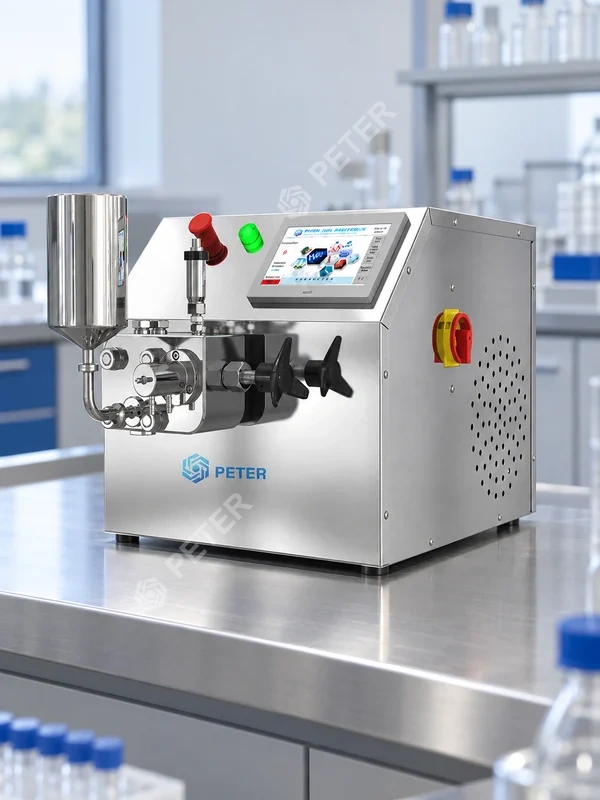
CAS PETER can enter that evidence-led shortlist after the process boundary is defined. A buyer can use the PT-10 page as a starting point for a lab high pressure homogenizer discussion. Public pages are manufacturer information; any conflict in flow, minimum volume, or other specifications should be resolved through a current signed data sheet and a representative sample test.
What Buyers Ask Most Often About Laboratory Homogenizer Purchases
How much does a laboratory homogenizer cost?
The honest answer is that a useful price depends on the required pressure range, wetted materials, cooling, controls, accessories, documentation, installation, and service scope. A small homogenizer machine or small homogenizer for sale should be compared on delivered and annualized cost, including wear parts, cleaning labour, sample loss, calibration, and downtime—not on the machine-only quotation.
What affects the price of a laboratory homogenizer?
Pressure-rated components, pump and interaction-zone design, material compatibility, automation, temperature control, cleanability, safety features, data capture, and qualification documents all affect price. Request an itemized quotation tied to the URS so an omitted cooler, spare-part kit, or service visit does not appear later as a false saving.
How do new and used laboratory homogenizers compare?
A used unit may reduce initial capital cost, but buyers should verify service history, pressure-test and calibration records, seal and valve condition, control-system support, spare-part availability, contamination history, and the cost of recommissioning. A new system usually offers clearer configuration control and supplier support, while its value still depends on a successful sample trial and written acceptance criteria.
How should buyers assess laboratory high pressure homogenizer before choosing a laboratory homogenizer?
Assess the full process for every laboratory high pressure homogenizer: representative feed, pressure and temperature stability, recovered sample, endpoint quality, cleaning, maintenance, safety, documentation, and scale-up logic. Use one scored protocol for every supplier, resolve public-page discrepancies against signed documents, and reject any comparison that changes the sample or measurement method between machines.
Which Authoritative Sources Support the Measurement, Safety, and Qualification Checks
- ISO 13320:2020, Particle size analysis—Laser diffraction methods.
- ISO 22412:2025, Particle size analysis—Dynamic light scattering.
- Electronic Code of Federal Regulations, 21 CFR 211.67, Equipment cleaning and maintenance.
- Electronic Code of Federal Regulations, 21 CFR 211.110, Sampling and testing of in-process materials and drug products.
- IEC 61010-1:2010, Safety requirements for electrical equipment for measurement, control, and laboratory use.
The smallest useful homogenizer is not the one with the smallest footprint; it is the one that preserves enough sample, evidence, and process understanding for the next decision.
When the URS, boundary sample, and acceptance protocol are ready, contact CAS PETER to request a configuration-specific review, signed technical data, and a representative trial plan.