

Milk Homogenization Equipment: Pressure and Cost Guide
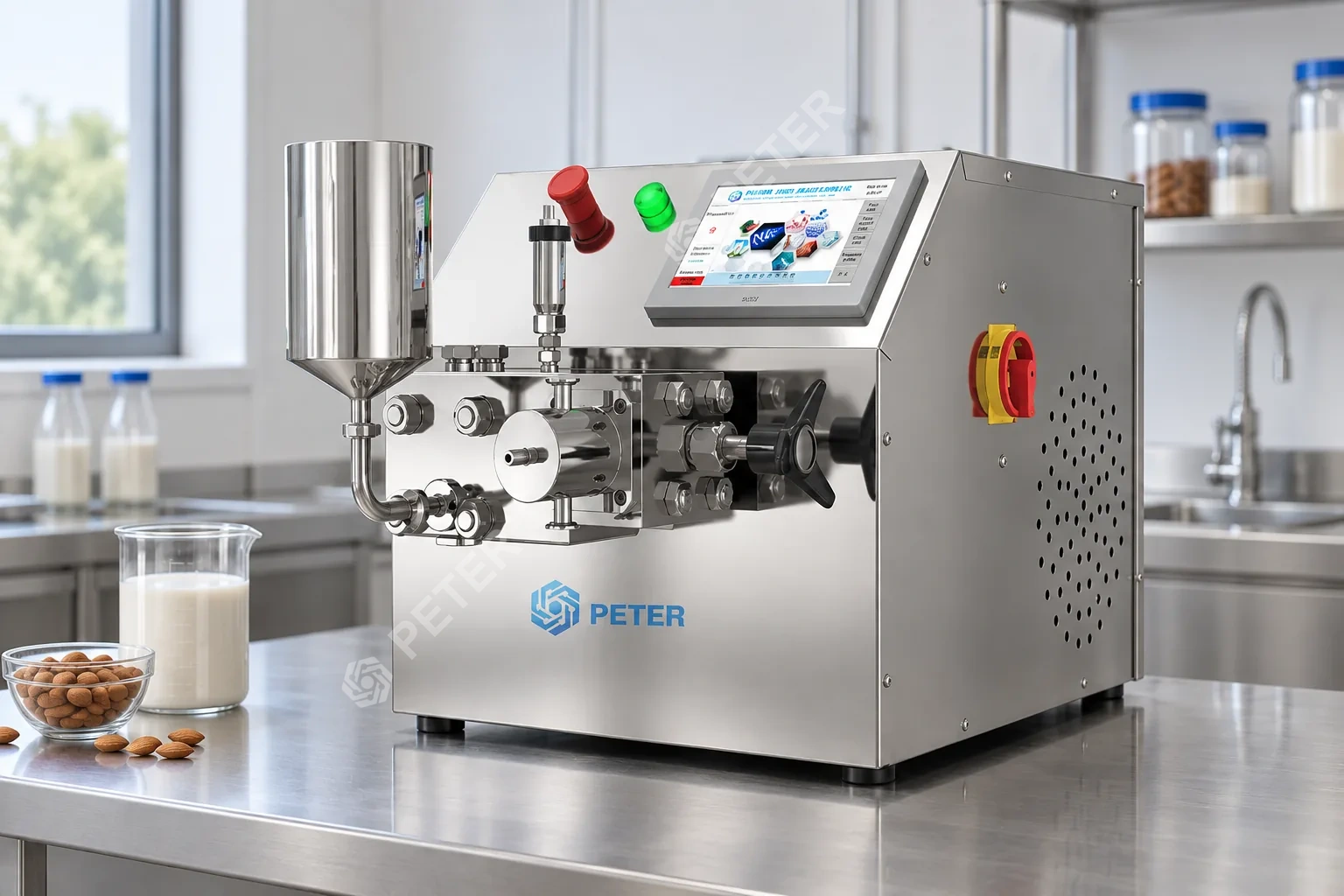
When Elena, a process engineer in Melbourne, encountered unstable almond milk after switching the line, the homogenizer mixer used for almond milk delivered a smooth sample for ten minutes, then the outlet warmed, the pressure gauge oscillated, and sediment appeared in the bottle. The reversal came after a feed audit: the new recipe had insoluble protein clusters, a colder inlet, and a screen that was too fine. The equipment was not simply “bad”; the specification and pretreatment were mismatched.
Summary: Choose milk homogenization equipment from the material and duty cycle first, then set a trial window for homogenizer pressure for milk. ISO 13320 can support laser-diffraction particle-size measurement, but it is a test method, not a product certificate. Ask for representative trials, temperature logs, pressure stability and cleaning evidence before discussing milk homogenizer price. A quoted flow rate without feed viscosity, solids, inlet temperature and run time is not a comparable price or performance claim.
Why Almond Milk Requires a Feed Specification Before Pressure Is Selected
Almond milk combines oil, protein, minerals and fine solids; particle size and hydration change during soaking, grinding and heat treatment. Record fat, total solids, viscosity at the actual inlet temperature, pH, particle-size distribution and any stabilizer. Note the largest particle that can reach the homogenizing valve. If a supplier only receives “almond milk” as a description, the pressure recommendation is an assumption.
A useful screening trial measures inlet and outlet temperature, actual flow, pressure, energy and samples before and after each pass. Use ISO 13320 laser diffraction when the dispersant, refractive index and sampling method are documented. Pair the measurement with a storage test: creaming height, sediment mass, viscosity drift and sensory observations at defined days. A smaller D50 alone does not prove shelf stability.
How to Select Homogenizer Pressure for Milk Without Over-Processing
Pressure and flow are linked through hydraulic power. As an illustrative screen, hydraulic power is pressure multiplied by volumetric flow; pump efficiency, valve geometry and recirculation determine the installed motor requirement. Use the equation to compare scenarios, not to promise a capacity. Higher pressure may reduce droplet or particle size, but it can also increase heat rise, wear and foaming.
Define a pressure ladder, for example low, middle and upper trial points within the machine’s documented range. At each point record outlet temperature, pressure ripple and product response. For dairy emulsions, a two-stage valve may help manage free fat and reduce re-agglomeration; whether it helps a plant must be demonstrated on that formula. Do not copy a pressure from cow’s milk to an oat or almond formulation without a trial.
Use a written stopping rule before the first run. Advance to the next pressure or pass only when the current condition misses a defined stability target; stop escalating when the target is met consistently or when extra energy produces no meaningful improvement. A rising outlet temperature, wider distribution, renewed coarse tail, viscosity shift, worse cream line or increased sediment is a reason to investigate over-processing rather than continue toward the machine maximum. Collect samples at the same point and product age so the comparison reflects the process instead of inconsistent sampling.
Which Compatibility Checks Define a Valid Representative-Material Trial?
- Confirm feed particle size is below the supplier’s maximum; PT-500 public data, for example, lists a 300 µm feed limit and up to 500 L/H at 1,200 bar under stated conditions.
- Check seal, valve and wetted-material compatibility with oils, acids, salts, cleaning chemicals and temperature.
- Define cooling capacity and maximum product temperature, especially when proteins or flavors are heat sensitive.
- Specify whether operation is batch, recirculating or continuous and how many hours per shift.
Which Cost Drivers Make Two Milk Homogenizer Quotations Comparable?
| Cost dimension | What to compare | Commercial consequence |
|---|---|---|
| Performance | Particle/cream-line result at declared pressure and flow | Reduces rejected lots and reformulation risk |
| Thermal control | Cooling, inlet range and outlet-temperature limit | Avoids a separate chiller or heat-damaged product |
| Hygiene | Wetted materials, drainability, CIP/SIP boundary | Changes cleaning time, validation work and downtime |
| Durability | Valve and seal wear parts, abrasive-solids tolerance | Sets maintenance inventory and service intervals |
| Capacity | Validated flow at real viscosity, not water only | Prevents undersizing and expensive parallel equipment |
There is no responsible universal milk homogenizer price. Capital cost for milk homogenization equipment varies with pressure rating, pump size, automation, cooling, sanitary construction, spare parts and regional installation. Total cost of ownership adds utilities, water and chemicals for cleaning, wear parts, labor, qualification and lost production. Ask vendors to itemize those elements and to state what is excluded.
Tetra Pak’s published investment guidance separates the purchase decision from operating consequences such as energy use, maintenance, downtime, water use and product-quality loss. Use those five categories as a common denominator across proposals: state the production hours and local utility assumptions, list planned valve and seal service, assign a cost to unavailable production time, estimate cleaning resources, and record the cost of off-spec product. Higher pressure can affect more than electricity because it also increases load on wear components. This is a comparison framework, not a promise of a particular lifetime or savings figure.
When New, Used, Rental, and Pilot Equipment Create Different Commercial Risks
| Option | Best fit | Risks to verify |
|---|---|---|
| New pilot unit | Recipe development and repeatable trials | Lead time, commissioning scope and sample plan |
| New production unit | Defined continuous duty and documented utility capacity | Acceptance test, cooling and spare-parts support |
| Used unit | Budget-constrained projects with technical inspection | Unknown wear, obsolete controls, missing hygienic records |
| Rental or toll trial | Uncertain formulation or seasonal demand | Transfer losses, cleaning responsibility and data ownership |
A used machine is only comparable when the serial plate, pressure test, pump hours, valve condition, seals, control firmware and cleaning history are available. Require a wet run on representative material or price a rebuild; do not infer remaining life from exterior appearance.
What Standards and Validation Records Can and Cannot Prove
ISO 13320 covers laser-diffraction particle-size analysis. ISO 22000 provides a food-safety management framework, while U.S. 21 CFR Part 117 describes preventive controls for human food in its jurisdiction. These references do not certify a homogenizer. Hygienic design, allergen controls and cleaning validation remain site- and product-specific. For pharmaceutical or cosmetic products, confirm the applicable GMP rules with the responsible quality unit; dairy evidence cannot be transferred automatically.
Build an acceptance protocol with feed recipe, temperature, pressure, flow, number of passes, sampling points, test method, repeatability limits and cleaning procedure. Record deviations and retain raw data. If a supplier claims “FDA” or “GMP” materials, request the exact material declaration and scope; a marketing phrase is not a certificate.
For a comparable factory acceptance test, lock the representative material or an agreed surrogate, inlet condition, pressure/flow points, outlet-temperature limit, sampling map, analytical method, cleaning sequence and deviation process before the test begins. Record raw readings as well as the final pass/fail decision. A water run can confirm mechanical operation, but it cannot by itself demonstrate almond-milk stability, real-feed throughput or cleaning recovery.
Which Buyer Actions Turn Equipment Specifications into a Testable Purchase?
- Send a one-page feed specification with minimum and maximum properties.
- Request a pressure/flow matrix and outlet-temperature log from a representative test.
- Define particle-size and storage-stability acceptance criteria before the trial.
- Price cooling, utilities, wear parts, installation and qualification separately.
- Review cleaning access and the boundary between vendor documentation and your validation.
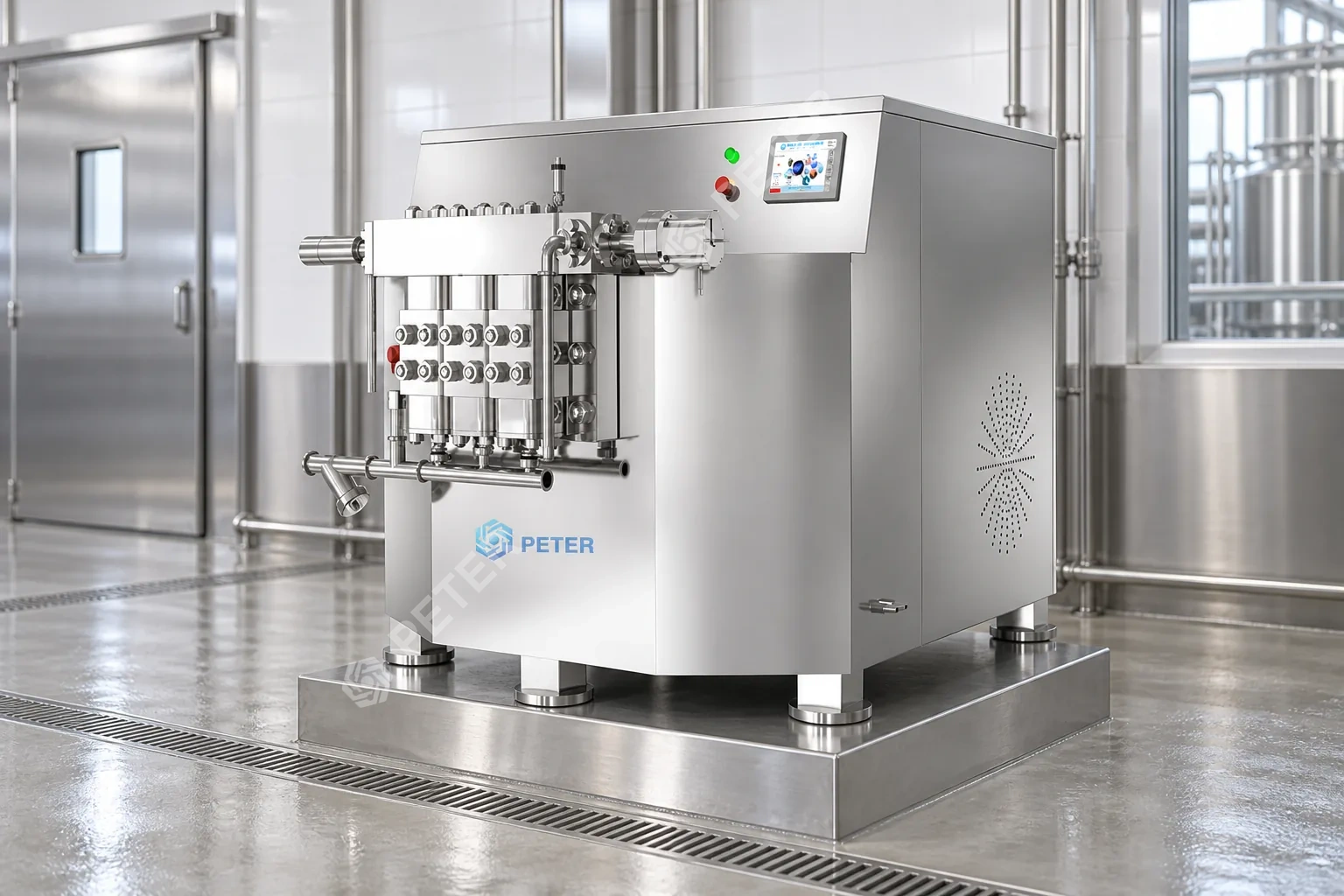
CAS PETER publishes pilot and production configurations, including the PT-20 laboratory model and PT-500 production model. Treat published figures as starting specifications; request a material-specific trial and written conditions. A larger PT-1000 listing may suit higher throughput, but capacity and pressure still require confirmation for your formula.
Frequently Asked Questions About Milk Homogenization Equipment and Cost
How much does a milk homogenizer cost?
Prices are configuration- and region-dependent, so a defensible answer requires pressure, flow, sanitary options, cooling, automation and service scope. Request an itemized quotation and compare total cost of ownership rather than a single equipment number.
What affects the price of a milk homogenizer?
Pressure rating, pump size, wetted materials, controls, cooling, validation documents, spares and installation are common drivers. Verify which utilities and commissioning activities are excluded from the quote.
How do new and used milk homogenizers compare?
New equipment normally provides current controls, documented tests and a clearer support path; used equipment may lower capital cost but adds inspection and rebuild risk. Decide only after reviewing wear history and completing a representative wet test.
How should buyers assess homogenizer pressure for milk before choosing a milk homogenizer?
Run a pressure ladder on representative feed and record temperature, flow, pressure stability, particle-size or stability results and energy. Select the lowest setting that meets the defined product outcome with acceptable thermal and maintenance margins.
Technical References for Pressure Selection, Cost, and Compliance Boundaries
- ISO 13320:2020: Particle size analysis—Laser diffraction methods.
- ISO 22000:2018: Food safety management systems.
- U.S. 21 CFR Part 117, Current Good Manufacturing Practice and preventive controls.
- Tetra Pak Dairy Processing Handbook: Homogenizers and Tetra Pak guidance on calculating a homogenizer investment (established-industry process and TCO guidance, not independent performance testing).
- CAS PETER: Milk homogenizer machine selection notes (manufacturer information).
The durable principle is simple: pressure is a process variable, not a purchasing shortcut. When your recipe, test method and duty cycle are explicit, CAS PETER can help scope a pilot or production solution; contact the team with your feed specification and acceptance criteria.