

Milk Homogenizer vs Food Homogenizer: Key Differences
When a dairy applications manager in Rotterdam encountered unstable output on a higher-solids sauce line, the problem appeared within minutes: a homogenizer proven on milk was producing visible variation and an inconsistent finished texture. The team had assumed the same machine and settings would translate directly. The reversal came during process review: this was not equipment failure, but a mismatch between formulation, viscosity, hygiene design, and validation requirements.
Summary: A milk and a food process can both use high-pressure homogenization, yet they should not be specified as interchangeable. A food homogenizer must be qualified against the actual solids, rheology, particles, and cleaning regime; a dairy homogenizer is normally centered on a milk emulsion and its defined quality targets. Use representative product trials, documented particle-size and stability criteria, and a capacity calculation that includes cleaning and changeover time. Where laser-diffraction particle sizing is appropriate, ISO 13320 provides a defined test-method framework rather than a machine certification.
Why milk and food applications diverge
The core action is similar: fluid passes through a controlled high-energy zone, reducing dispersed-phase size and improving distribution. For a homogenizer of milk, the practical objective is often a stable fat emulsion with the expected mouthfeel, appearance, and downstream behavior. Milk is not simple, but its composition and process route can be comparatively repeatable when the plant controls incoming raw material and standardization.
A sauce, protein drink, fruit preparation, or plant-based dispersion may introduce fibers, starches, gums, cocoa, inclusions, air, or a much higher solids load. These variables change apparent viscosity, shear response, heat generation, valve wear, and the risk of plugging. In other words, the relevant question is not whether a machine has processed a liquid before; it is whether its wetted path, valve configuration, feed conditions, and operating window suit this formula.
Testing should connect the process to measurable acceptance criteria. Particle-size distribution can be monitored with an agreed method; ISO 13320 describes laser-diffraction particle-size analysis, but users should confirm that the method fits the material and size range. A practical qualification also records viscosity at a stated temperature, visual separation after a stated hold time, throughput, inlet condition, and outlet temperature. Comparing at least two representative lots is more useful than approving a single favorable trial.
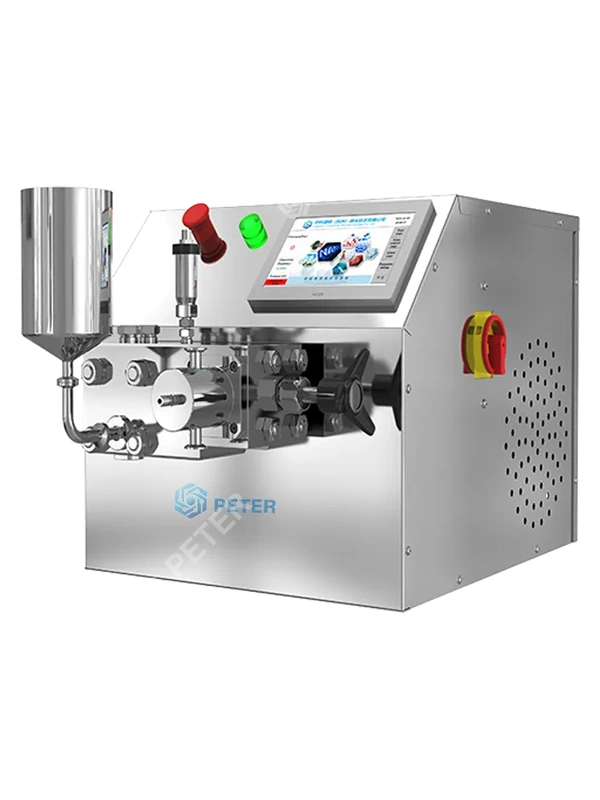
For an engineering explanation of the energy and valve action involved, see how high-pressure homogenizers work. The mechanism matters because a formula can respond differently as viscosity and dispersed material change.
Food homogenizer process design starts with the formulation
Food process design begins upstream of the pump. Confirm the ingredient addition order, hydration time, premixing quality, screen protection, feed tank agitation, and temperature range before defining the homogenizer duty. A food homogenizer for formulation development still depends on a stable premix; a high-pressure stage cannot reliably correct every undispersed powder, trapped air pocket, or oversized particle introduced earlier.
Use a staged trial plan. First, establish whether the formula can be fed consistently. Second, compare candidate operating windows against the agreed particle-size, viscosity, and sensory or visual targets. Third, repeat the best condition after a normal cleaning cycle and with a second production-representative batch. The third step is often where a promising laboratory outcome reveals a sanitation, hold-up, or changeover issue.
A food formula may need pressure, temperature, flow, or pass count to be adjusted during qualification, but there is no universal pressure figure that applies to every product. The right setting is the lowest validated condition that achieves the defined result without unacceptable heat load, wear, or loss of product quality. This same discipline applies to dairy, although milk-specific targets and upstream controls may be different.
| Decision dimension | Milk-focused homogenization | Broader food homogenization |
|---|---|---|
| Primary formulation concern | Fat emulsion and milk composition | Solids, rheology, particles, emulsifiers, and heat sensitivity |
| Useful qualification evidence | Fat-globule or particle trend, separation, sensory checks | Particle-size trend, viscosity, stability, appearance, and run consistency |
| Feed-system focus | Standardized supply and controlled temperature | Premixing, hydration, agitation, screening, and consistent feed |
| Hygiene review | Cleaning route and dairy changeover needs | Allergen, recipe, particulate, and changeover requirements |
| Scale-up risk | Different milk composition or thermal route | Viscosity rise, wear, plugging, heat load, and variable raw materials |
Consistent output depends on validation, not nameplate similarity
Teams often compare models by nominal capacity alone. That is a start, not a design basis. Net output must account for feed interruptions, planned cleaning, product recovery, changeovers, quality holds, and the actual viscosity of the qualified formula. A line that can only achieve its nominal rate with an ideal thin liquid may not deliver the required daily volume for a sauce or suspension.
Set a batch record that captures at least five operating observations: inlet temperature, product flow, process setting, outlet temperature, and defined quality result. Add pressure fluctuation, motor load, or product loss if those are relevant to the line. Trend data makes it easier to distinguish raw-material variation from an emerging valve or seal issue, and it creates a shared basis for supplier, production, and QA decisions.
The phrase homogenizer milk processing should therefore mean more than a machine specification. It includes the preheat and feed conditions, the target emulsion behavior, the test plan, and the cleaning sequence. For non-dairy food formulas, qualify the same chain against their own formulation rather than borrowing dairy acceptance limits.
Capacity and cost planning: compare the whole operating picture
Capital cost is visible; downtime, consumables, qualification work, and lost output are less visible but often more consequential. An illustrative planning case might compare two candidate systems over one production day: the relevant result is saleable liters or kilograms after normal startup, cleaning, and expected changeovers, not an unqualified theoretical flow rate. Procurement should request a duty-point discussion using the intended product range.
| Application or cost driver | Questions for capacity planning | Commercial implication |
|---|---|---|
| Milk, cream, or dairy beverage | What composition range, thermal route, and target stability apply? | Size around validated product flow, not only peak demand. |
| High-solids sauce or dressing | Can the premix feed consistently, and what is the expected viscosity range? | Allow for trial work, possible wear, and lower effective throughput. |
| Multiple recipes or allergens | How long do cleaning, verification, and changeover take? | Include lost production time in total-cost comparisons. |
| Growth forecast | Will one line need more than one shift or future formulation changes? | Compare modularity, service access, and upgrade path. |
For a concise discussion of how duty and application affect equipment choice, review how to choose the best pressure homogenizer for your needs. Treat any supplier output figure as a starting point to be confirmed under the product’s real operating conditions.
Standards, food safety, and claims scope
Food safety obligations depend on destination market, product type, and the processor’s role. In the United States, the FDA’s Food Safety Modernization Act framework addresses preventive controls and other food-safety responsibilities; it does not certify a particular homogenizer as safe for every food application. FAO food-safety resources provide international context, but they do not replace local legal review or a plant-specific hazard analysis.
ISO 13320 is a particle-size test-method standard, not a food-equipment approval or a promise of product stability. If laser diffraction is chosen, define sampling, dispersion, reporting, and acceptance criteria with the product team. For a pharmaceutical comparison only, current FDA cGMP regulations concern drug manufacturing; they should not be used to imply food compliance. Unsupported food-safety or certification claims can create procurement, audit, and market-access risk.
A practical selection guide
- Write the formula envelope: solids, particle characteristics, viscosity range, temperature limits, and sensitive ingredients.
- Define acceptance tests before trials, including a particle-size method where relevant, stability observation, yield, and cleaning acceptance.
- Calculate net capacity using normal production and sanitation time, then test the duty point with a representative product.
- Review wetted materials, seal and valve access, cleaning sequence, documentation needs, utilities, and service support.
- Qualify dairy and non-dairy formulas separately; do not assume a successful milk run validates a sauce, beverage, or plant-based product.
CAS PETER can support this discussion with configurable high-pressure homogenizer options and application-focused sizing conversations. A compact development or pilot requirement may begin with a PT-20 high-pressure homogenizer; the final selection should still follow evidence from the customer’s actual formula and operating plan.
Frequently asked questions
What does a milk homogenizer do to milk?
It applies controlled mechanical energy to reduce and distribute the fat phase more uniformly, supporting a more consistent emulsion and appearance. The result depends on milk composition, temperature, thermal route, and the validated operating condition. Confirm performance with agreed stability and particle-size or fat-globule measurements.
What pressure is used for milk homogenizer processing?
There is no responsible universal figure. The suitable operating condition depends on the milk product, target texture, fat level, temperature, desired stability, equipment geometry, and local process validation. Establish it through trials and document the condition that meets the defined result.
How does dairy homogenizer affect product stability?
A dairy homogenizer can improve dispersion of the fat phase and help reduce visible separation when the whole process is correctly designed. It cannot compensate for unsuitable raw materials, temperature control, or downstream handling. Evaluate stability over the product’s intended shelf-life and storage conditions.
What should processors check before selecting a milk homogenizer?
Check the product range, validated net capacity, cleaning and changeover requirements, utilities, service access, and the measurements that define acceptable quality. If the same asset may run non-dairy products, assess those formulas independently. Ask suppliers to discuss the duty point and the qualification plan, not just the maximum rating.
References
- U.S. Food and Drug Administration: Food Safety Modernization Act
- ISO 13320: Particle size analysis – Laser diffraction methods
- Food and Agriculture Organization of the United Nations: Food safety
- U.S. Food and Drug Administration: Current Good Manufacturing Practice regulations (pharmaceutical comparison only)
The durable choice is the one that proves stable output on the real product, not the one that merely resembles a successful line elsewhere.
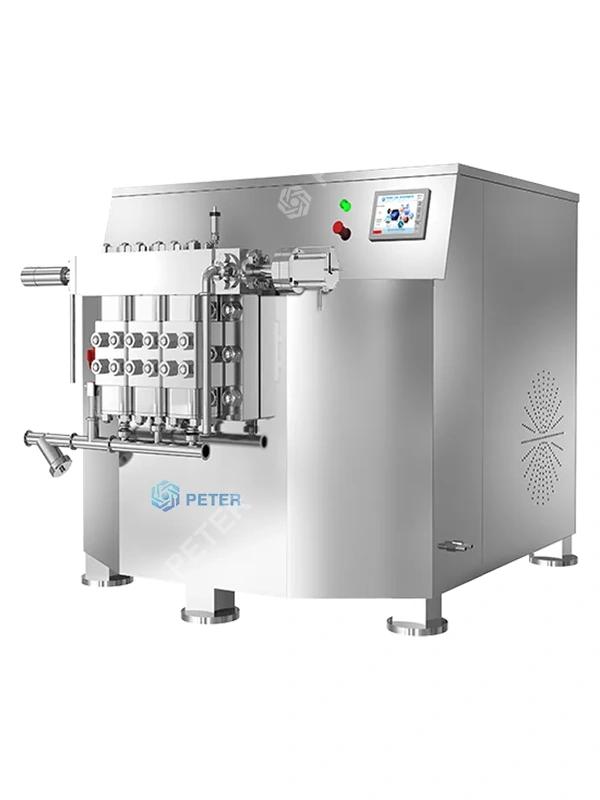
When you are ready to review a production duty point, explore the PT-500 production-type high-pressure homogenizer and contact CAS PETER with your formulation, target capacity, and validation criteria.