

Milk Homogenizer Working Principle: Process and Price
When a procurement manager in Monterrey encountered repeated cream-line variation after approving a dairy-line upgrade, the team first blamed the new machine’s quoted capacity. A closer review showed that the quotation had paired a maximum water-like flow with an unconfirmed milk temperature, while pressure, cooling, and cleaning boundaries had been left outside the comparison. Once the product path was mapped, the failure made sense: the issue was not simply a weak machine or an expensive one, but a duty point that had never been specified for the actual process.
Summary: The milk homogenizer working principle is a controlled pressure drop across a homogenizing valve or interaction zone; it only delivers a useful result when feed condition, pressure, flow, temperature rise, and cleaning are defined together. Because 1 MPa equals 10 bar, a 20 MPa duty is 200 bar—but pressure alone does not establish capacity or product quality. Specify a measured product duty point, map product and CIP boundaries, and compare the whole delivered scope before treating any quotation as a price comparison. ISO 13320 may support a laser-diffraction particle-size test plan where suitable; it is a test method, not a machine certificate.
In dairy processing, homogenization reduces the size and improves the distribution of the dispersed fat phase, helping the processor manage visible cream separation and make downstream behavior more repeatable. The outcome still depends on fat and solids, viscosity, inlet temperature, premixing, valve condition, and the residence time of the production run. Understanding the milk homogenizer working principle therefore matters just as much to a buyer assessing risk as to an operator setting a process.
Map the product path, pressure boundaries, and cleaning boundaries
A high-pressure homogenizer uses a positive-displacement pumping system to establish pressure, then forces product through a closely controlled homogenizing valve or interaction zone. The sudden pressure drop produces high local velocity and fluid stresses that act on the dispersed phase. In two-stage arrangements, the first stage usually provides the main disruption while a second stage can help break clusters and stabilize the discharge. The exact mechanism and useful setting depend on the valve design and the milk entering it; higher pressure is not an automatic instruction to increase quality.
What a milk homogenizer diagram should show
A credible milk homogenizer diagram is a process map, not a component portrait. It should trace the product from balance tank and feed pump through filtration, preheat point, homogenizer inlet, pressure indication, valve stages, sample point, any downstream cooler, and the receiving process. Mark the normal flow direction, isolation points, relief or protection devices where fitted, and the places where pressure is measured. That lets engineering distinguish a valve problem from a starved inlet, entrained air, a blocked screen, or an upstream temperature shift.
The same drawing should also identify the CIP route and its boundaries: which valves are included, where solution enters and returns, where circuits drain, which short branches need attention, and whether the homogenizing section is cleaned in the intended sequence. A drawing that only labels pump, motor, and valve cannot answer whether product residue can be isolated from a cleaning circuit. Use it to create a trial and acceptance sheet recording formulation range, fat and total solids, viscosity at a stated temperature, inlet and outlet temperature, actual flow, pressure stability, run time, sampling location, and the agreed result. For background on the process hardware, see how high-pressure homogenizers work.
Set pressure, flow, and temperature as one operating window
Pressure and flow are inseparable in the power balance. As a first screen, hydraulic power is pressure multiplied by volumetric flow: at 20 MPa and 1 m³/h, the ideal hydraulic load is about 5.6 kW before drive, pump, and system losses. Doubling the flow at the same pressure doubles that hydraulic demand; increasing pressure at a fixed flow does the same. It is an illustrative calculation, not a motor-selection guarantee, because efficiency, product rheology, pulsation control, suction conditions, and cooling all affect the installed system.
Temperature is part of that same balance. Energy dissipated through the pump and valve appears largely as heat in the liquid and equipment; for a water-like product, 20 MPa divided by a specific heat near 4.2 kJ/kg·K gives a theoretical liquid rise of roughly 4.8 °C if the pressure energy becomes heat. Milk composition, equipment losses, recirculation, and heat exchange change the observed value, so the useful purchasing evidence is a measured inlet-to-outlet temperature rise at the stated product, flow, and pressure—not a generic promise. The Tetra Pak Dairy Processing Handbook likewise treats homogenization as part of a broader dairy process rather than an isolated pressure setting.
Trend a representative run, not only the first minutes. Record inlet pressure, discharge pressure, delivered flow, inlet and outlet temperature, motor load where available, and an agreed product observation or particle-size result. ISO 13320 describes laser-diffraction methods when that technique is appropriate, but the processor must still define sampling, dispersion conditions, and acceptance limits for its own milk. Raising pressure to compensate for poor premixing or an interrupted feed can conceal the real cause while increasing thermal load and valve wear.
| Comparison point | What to verify | Commercial consequence |
|---|---|---|
| Dispersion result | Defined sampling point, particle-size or stability trend, visual uniformity, and storage observation | Prevents approval based on appearance alone. |
| Actual duty | Measured product flow at stated pressure, solids range, viscosity, and inlet temperature | Separates a usable duty point from a nominal rating. |
| Thermal response | Inlet-to-outlet temperature rise and cooling margin over the intended campaign | Shows whether product quality and downstream controls remain workable. |
| Cleanability | CIP route, chemical and seal compatibility, drainability, and changeover verification | Defines availability and sanitation workload. |
| Wear and service | Valve, seat, and seal access; recommended spares; inspection interval; and service route | Often changes lifecycle exposure more than the initial quote does. |
Evaluate price scope before estimating lifecycle cost
There is no defensible universal purchase price for a milk homogenizer because a quotation is a scope statement, not a complete cost-of-ownership result. Capacity and maximum pressure matter, but so do product-contact materials, hygienic connections, controls, instrumentation, cooling integration, factory testing, documents, installation interfaces, commissioning, training, and service availability. A low figure can be comparable only if its exclusions match the same operating requirement.
Build the comparison from net production, not nameplate flow. An illustrative daily model subtracts startup, CIP, changeovers, quality holds, planned inspection, and expected intervention time from the production window, then applies the qualified run rate. It does not predict guaranteed output; it gives each bidder the same operating assumptions. Add utilities, cleaning chemicals, water, seals and valve parts, labor, downtime risk, and product lost during maintenance. This is where an apparently cheaper package can become the costlier option over the life of the line.
| Cost or application driver | Questions for the RFQ | Planning implication |
|---|---|---|
| Standard fluid milk | What product flow, stability objective, shift length, and cleaning frequency are included? | Quote the proven product duty rather than peak theoretical demand. |
| Higher-fat or solids-enriched dairy drink | What maximum viscosity, inlet-temperature range, pressure stability, and cooling margin are demonstrated? | Allow for the real energy load and representative trials. |
| Multiple recipes or allergen controls | Which valves and circuits are in the validated CIP path, and how long do cleaning and verification take? | Put changeover loss and sanitation work into lifecycle cost. |
| Used equipment or line expansion | Which records, inspections, pressure tests, parts, and modifications are included in the handover? | Budget restoration and verification separately from the asking price. |
For a structured starting point, use this dairy homogenizer machine price guide, then make suppliers state the product, duty point, included services, and exclusions behind every number. Price can be compared; only a common scope makes that comparison meaningful.
Apply food-safety and test references in the right scope
Standards and regulations do different jobs. ISO 13320 concerns particle-size analysis by laser diffraction; it can inform a measurement plan but does not certify a homogenizer or prove shelf-life stability. In the United States, 21 CFR Part 117 establishes current good manufacturing practice and preventive controls for covered food facilities. Its applicability depends on the food, facility, and market; it does not transfer a processor’s compliance responsibilities to a machine supplier.
Codex General Principles of Food Hygiene provide a recognized framework for hygiene and hazard control, while local law, customer specifications, and the plant food-safety plan determine the controls that apply. Buyers should tie materials, gaskets, cleaning chemicals, surface condition, documentation, and validation work to the destination market and intended use. Calling a machine “food compliant” without defining that scope can delay approval and create avoidable audit or claim risk.
Choose against written evidence, including used-equipment evidence
- Write the product envelope: composition, viscosity, inlet-temperature range, throughput, pressure range, quality objective, downstream process, and expected campaign length.
- Request the same measured duty-point statement from each supplier, including actual product flow, inlet and outlet temperatures, pressure stability, utilities, CIP boundary, and acceptance criteria.
- For used equipment, obtain the nameplate and serial number, manuals, parts list, maintenance and repair history, previous products and cleaning chemicals, product-contact material information where available, and details of any valve, pump, control, or weld modification.
- Ask for a recent pressure-test record that identifies the tested boundary, method and medium, test pressure and hold period, calibrated instruments, observations, repairs, and responsible competent party. Confirm the proposed test with the OEM and the applicable local requirements; pressure testing is not a substitute for hygienic inspection or cleaning validation.
- Compare recommended spares, safe service access, commissioning, documentation, and support as explicit lifecycle-cost lines before selecting a configuration.
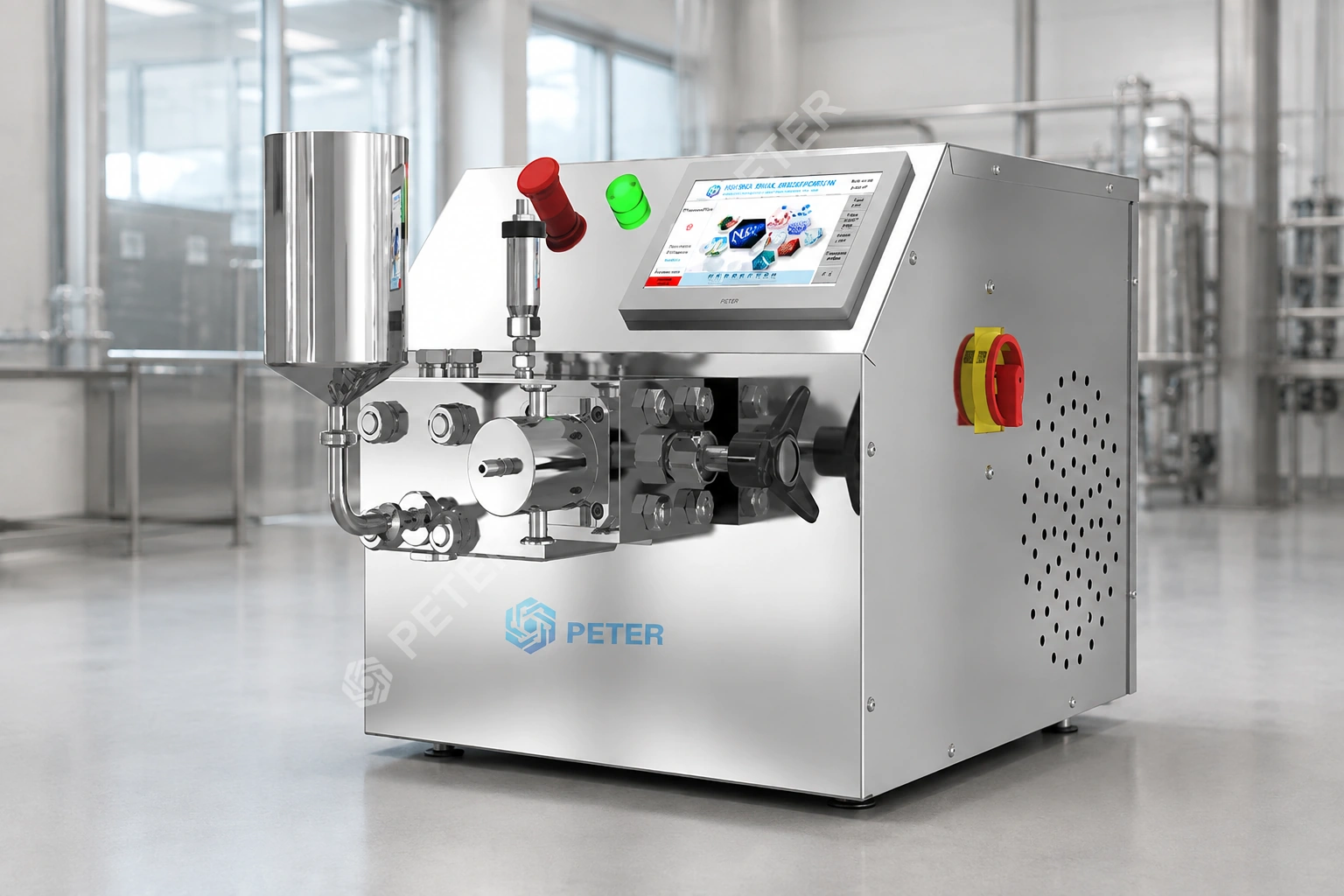
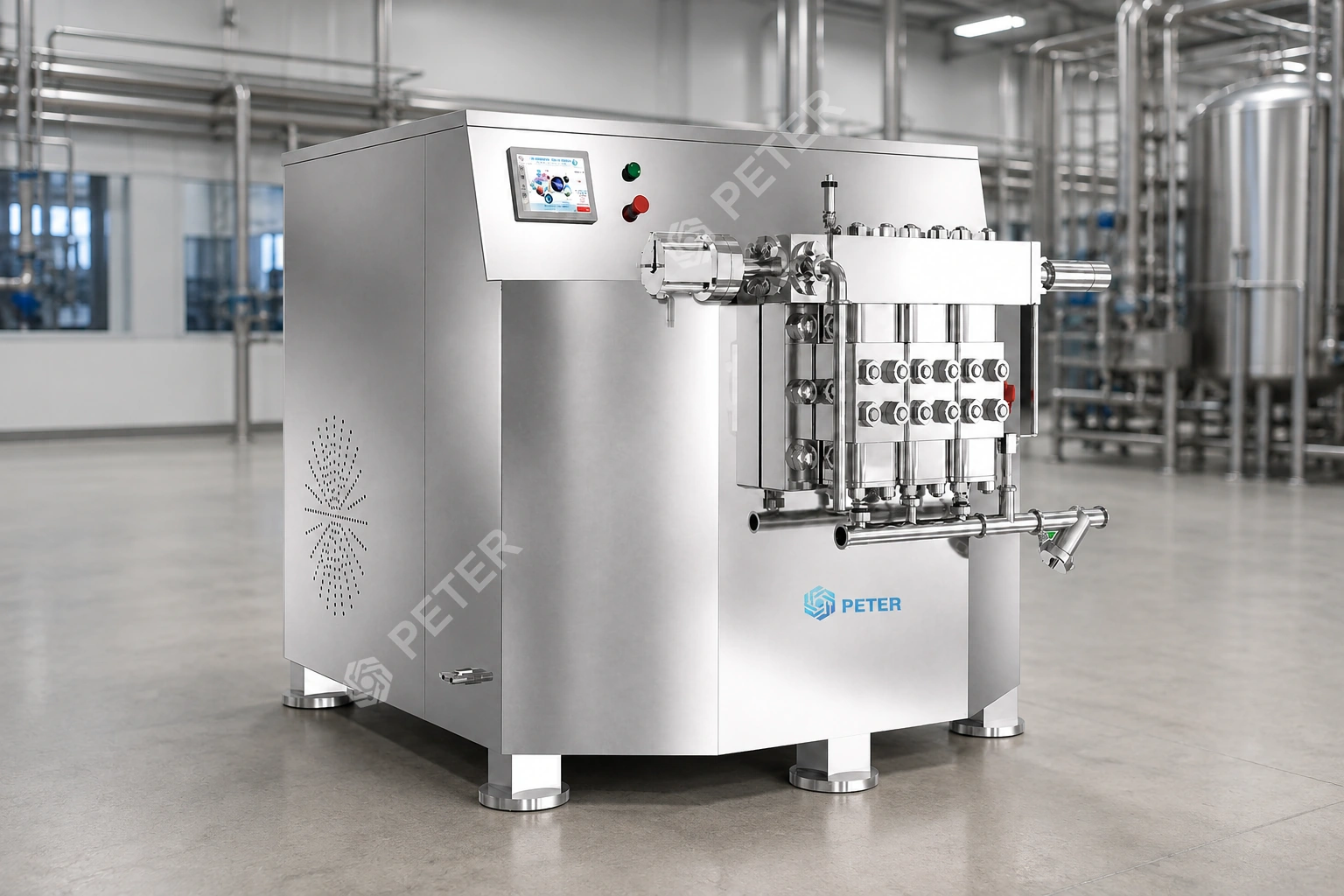
CAS PETER can be considered within that RFQ process when a buyer needs configurable high-pressure equipment and a technical discussion around trials and documentation. For development work, assess a milk homogenizer for sale against the actual feed condition and test plan. For a production budget, compare a milk homogenizer machine price only after flow, pressure, cleaning, support, and lifecycle scope have been made comparable.
Frequently asked questions
How much does a milk homogenizer cost?
Cost depends on the qualified duty point and the commercial scope, so a generic figure is a poor buying basis. Compare quotations only after they state product flow, pressure, product-contact design, controls, cleaning provisions, testing, documentation, installation interfaces, and service assumptions. Ask for itemized scope and exclusions before approving a budget.
What affects the price of a milk homogenizer?
Capacity, pressure, product properties, wetted materials, hygienic design, automation, cooling, validation support, installation scope, and service coverage all affect price. The same is true of what happens after purchase: energy, cleaning, wear parts, downtime, and lost product belong in the comparison. Each option should connect to a stated process need or risk.
How do new and used milk homogenizers compare?
New equipment can be configured for the intended process with an agreed test and documentation plan. Used equipment can be suitable for a tightly defined duty, but only after its product-contact condition, cleaning suitability, safety functions, parts availability, modification history, and pressure-test evidence are reviewed. Compare restoration, verification, and support costs with the asking price.
How should buyers assess milk homogenizer for sale before choosing a milk homogenizer?
Start with a shared application brief, then ask every supplier to respond to the same product, flow, pressure, temperature, cleaning, and acceptance criteria. Review evidence at the quoted duty point, the process and CIP drawing, available technical records, and the support route in the destination market. A representative trial is particularly valuable when the product response or scale-up relationship is not established.
References and next step
- Tetra Pak Dairy Processing Handbook, Homogenizers — process background on dairy homogenization and its place in a production line.
- ISO 13320, Particle size analysis — Laser diffraction methods — a test-method reference whose suitability should be confirmed for the material and measurement plan.
- U.S. FDA, 21 CFR Part 117 — current good manufacturing practice and preventive controls for covered food facilities.
- Codex Alimentarius, General Principles of Food Hygiene (CXC 1-1969) — a hygiene and hazard-control framework to apply alongside local requirements.
The right purchase is the one whose pressure, flow, sanitation routine, and proof of output still make sense when the production day becomes real. When your team is ready to define the duty point, contact CAS PETER to discuss configuration, trials, and documentation for a milk-processing application.