

How Is Pharmaceutical Homogenizer Cleaning Validated?
Clear rinse water is reassuring, but it can give a misleading picture of a pharmaceutical homogenizer’s cleanliness. A residue may remain on a seal or in a difficult-to-reach path while the collected rinse contains too little to detect. The question is whether the cleaning and sampling methods can show that relevant residues have been removed to justified limits throughout the defined product-contact system.
Cleaning validation demonstrates that an approved procedure consistently meets scientifically justified residue limits. For a homogenizer, that requires a map of product-contact surfaces, representative cleaning challenges, suitable sampling and analytical methods, recovery data and reviewed study records. EU GMP Annex 15, section 10, addresses cleaning validation; 21 CFR 211.67 covers cleaning and maintenance procedures and records for finished pharmaceuticals. Neither provides a universal residue limit that can be copied into every study.
Which surfaces must the cleaning study include?
Start with the installed product-contact path. Depending on the supplied design, this can include feed and discharge lines, pump chambers, check valves, homogenizing components, seals, a cooler and sampling assemblies. Obtain an as-built drawing and material list instead of assuming the machine boundary stops at its casing.
For each part, identify how it is cleaned and inspected: in place, after removal, or manually. Record any disassembly needed. A location should not disappear from the study simply because it is awkward to reach. Its access may require a different sampling approach or a design discussion with the supplier.
The FDA’s July 1993 cleaning-process inspection guide discusses equipment design and the limitations of sampling. Read it alongside the current requirements and the site’s quality procedures. A polished housing or a general flushing instruction does not explain how residue is removed from the internal product-contact surfaces.
Which product and cleaning conditions make the hardest test?
The product that is hardest to wash away may not have the most restrictive carryover limit. Assess cleanability, solubility, potency and toxicity together, including relevant degradation products and cleaning-agent residues. A defensible homogenizer cleaning validation study explains why its chosen products and conditions cover the intended use.
EU GMP Annex 15, section 10, addresses worst cases, campaign length, and dirty and clean hold times. A wash immediately after a short run may not represent equipment left dirty for the maximum permitted period. Manual cleaning steps also need enough detail to be performed consistently by different trained operators.
Set these conditions before execution. If equipment or products are grouped under one study, document why the selected challenge represents the group. Convenience alone does not make one product or one machine representative of the others.
| Risk dimension | Question to document | Evidence needed |
|---|---|---|
| Product residue | Hardest to remove or most restrictive carryover? | Cleanability and toxicological rationale |
| Dirty hold time | What delay is permitted before cleaning? | Defined challenge condition |
| Manual steps | How much can technique vary? | Detailed procedure and operator qualification |
| Campaign | What is the approved maximum duration? | End-of-campaign challenge justification |
| Clean hold time | How is cleaned equipment protected? | Storage conditions and relevant monitoring |
Why can a clean rinse sample miss residue on the equipment?
A rinse can reach paths that a swab cannot, but it may fail to dissolve an insoluble deposit. A large rinse volume can also dilute residue below the analytical method’s capability. Swabs can target accessible difficult surfaces, although their results depend on how effectively the residue is recovered from those surfaces. The methods often complement each other.
Demonstrate recovery using the relevant materials, sampling tools, solvents and analytical method. Check blanks and interference from swabs, detergent or the equipment surface. A result reported as ‘not detected’ applies to the method and sample tested; it is not proof that absolutely no residue remains anywhere in the system.
Plan disassembly where sampling requires it. The sequence should preserve a meaningful link to the cleaning process being evaluated. Selecting an easily cleaned surface merely because it is convenient to swab can leave the more difficult part of the machine unanswered.
| Method | Useful contribution | Limitation to address |
|---|---|---|
| Direct swab | Targets accessible difficult surfaces | Surface and analytical recovery |
| Rinse sample | Covers paths difficult to reach directly | Solubility, dilution and representative contact |
| Visual inspection | Finds visible residue or obvious problems | Cannot generally be the only acceptance evidence |
| Routine indirect signal | May support an established control strategy | Correlation and limits need justification |
How should residue limits be set for shared equipment?
For shared medicinal-product equipment, qualified toxicological input and the applicable health-based approach should inform the assessment of the actual product sequence. The EMA guideline on health-based exposure limits, adopted in 2014, provides a basis for assessing cross-contamination risks. Converting that assessment into equipment and sample limits requires documented assumptions about the next product, batch and equipment train.
State the limit’s units, the sampled area or rinse volume, how recovery is treated and the analytical quantification capability. A generic 10 ppm value or fraction-of-dose rule does not replace this reasoning. If the combined sampling and analytical method cannot assess the required limit, the study needs further method development or a different control strategy.
Keep visual inspection in the assessment, but do not generally use it as the only acceptance criterion. Consider microbial and endotoxin risks where relevant. Cleaning, sanitization and sterilization answer different questions; successful cleaning validation does not automatically validate an aseptic process.
What must be approved before the first validation run?
The protocol should define scope, responsibilities, the cleaning procedure, challenge conditions, sampling locations, recovery evidence, analytical methods and acceptance criteria. It should also explain the number of executions and how deviations will be handled. Do not assume that three runs are a universal requirement for every study.
21 CFR 211.67 requires written procedures and records for cleaning and maintenance of equipment used in finished-pharmaceutical manufacture. It addresses responsibilities, schedules, relevant disassembly instructions and protection of cleaned equipment. These routine controls need to support the procedure studied during validation.
If a run fails, investigate the cause and assess the impact. Repeated washing and testing until a passing sample appears does not demonstrate that the original procedure works consistently. After validation, changes to a formulation, seal, valve assembly, detergent or campaign length need an assessment of whether the existing study still applies.
Which cleaning information should come from the supplier?
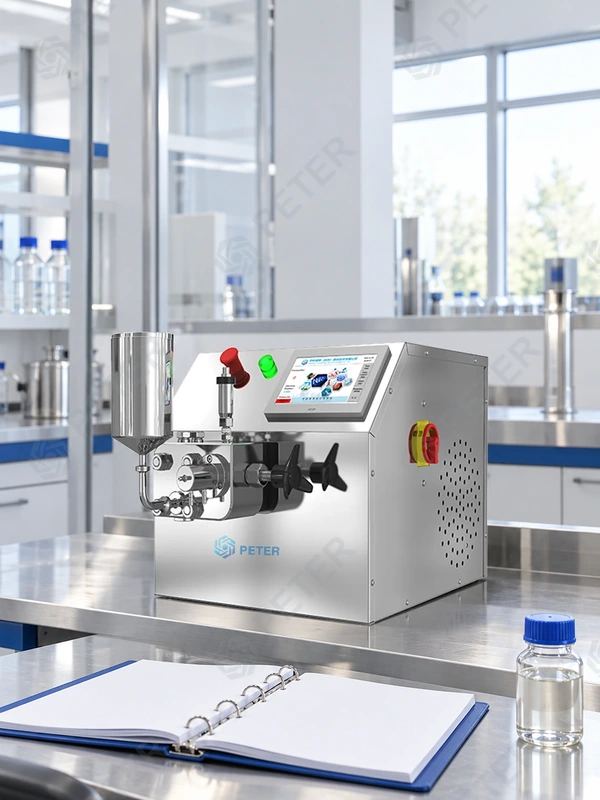
Ask for product-contact drawings, material and seal information, cleaning compatibility, disassembly instructions and inspection access. When assessing a laboratory high-pressure homogenizer such as the CAS PETER PT-10 for pharmaceutical work, review that documentation against the intended use before planning the study.
A move to a production high-pressure homogenizer also changes the contact path and potentially the connected equipment. Do not transfer a laboratory cleaning conclusion unchanged. Discuss the documentation available for the selected machine within the CAS PETER equipment range, including any access limitations that will affect sampling.
The supplier provides technical information about the equipment. The pharmaceutical manufacturer defines and approves the cleaning strategy for its products and site. Resolve missing access or recovery information before executing a study whose samples cannot answer the cleaning question.
Frequently asked questions
What is cleaning validation for a pharmaceutical homogenizer?
It is documented evidence that the specified cleaning procedure consistently reduces relevant residues to justified limits. The evidence includes appropriate challenges, sampling recovery and analytical results. One satisfactory routine check is not the same as a validation study.
Which parts of a homogenizer should be included in cleaning validation?
Include the product-contact surfaces within the defined installed boundary, including relevant valves, seals, piping and connected equipment. Use the actual drawings to identify parts; internal geometry cannot be established from an external photograph.
What sampling methods are used after homogenizer cleaning?
Swabs target accessible surfaces, while rinse samples can cover less accessible paths. Their suitability depends on residue solubility, recovery and analytical capability. Visual inspection adds useful information but generally cannot be the sole criterion.
How are residue limits established for a homogenizer?
Use a scientifically justified assessment of the residues and product sequence, with qualified toxicological input and applicable health-based requirements. Translate the assessment into clear equipment and sample limits rather than copy a generic ppm figure.
What should a cleaning validation protocol contain?
State the equipment boundary, cleaning procedure, challenge conditions, sample locations, methods, recovery, limits and responsibilities. Define run numbers and deviation handling before execution, then assess all results in the report.
How do 21 CFR requirements affect homogenizer cleaning records?
It requires established cleaning and maintenance procedures, assigned responsibilities and records for equipment used in finished pharmaceuticals. It also addresses protection and inspection of cleaned equipment. It does not set one universal cleaning-validation limit.
References
- European Commission, EU GMP Annex 15: Qualification and Validation, 2015, section 10
- FDA, Validation of Cleaning Processes inspection guide, July 1993
- EMA, guideline on health-based exposure limits in shared facilities, adopted 2014
- 21 CFR 211.67: Equipment cleaning and maintenance, Cornell LII reproduction, accessed 16 October 2026
Conclusion
A convincing result comes from samples that can detect the relevant residue at the required limit in locations that represent the difficult parts of the system. Clear rinse water and a clean-looking surface are useful observations, but neither can fill a gap in sampling recovery or acceptance criteria. Define those details before the study, then assess failures and changes through the site’s quality system so the validated procedure remains meaningful in routine use.