

Pharmaceutical Homogenizer Machine: Cosmetic Formulation Guide
When Mei, a formulation scientist in Singapore, encountered separation after moving a sunscreen emulsion from a rotor-stator to a high-pressure skid, the first batch had looked glossy for a week. The root cause was not a defective pump: the trial used a different surfactant hydration time, a warmer feed and no defined pass-count limit. A homogenizer pharmaceutical decision has to start with product requirements, not a catalogue label.
Summary: Choose a pharmaceutical homogenizer machine or homogenizer machine for cosmetics by target droplet/particle distribution, thermal sensitivity, contamination controls, batch size and cleanability. Use ISO 13320 or another justified method for particle data, and keep cosmetic performance claims separate from pharmaceutical GMP claims. A test on a representative formula is the fastest way to expose compatibility and maintenance limits.
How Product Quality Attributes Should Drive Machine Selection
List oil phase, solids, viscosity, pH, surfactants, active concentration, temperature limit and shear sensitivity. For creams, measure droplet distribution, viscosity curve, appearance and separation. For a pharmaceutical suspension or lipid carrier, add assay, content uniformity, degradation products and microbiological attributes as required by the product dossier. A pharmaceutical homogenizer machine should not be expected to establish sterility; that requires a validated sterile process.
Set a design space for pressure, flow, pass count and temperature. A formulation may need a lower pressure with cooling if an active is heat-sensitive. Conversely, a viscous cream may need pre-mixing or dilution before it can enter the valve. Document maximum particle size at the inlet and the screen or filter arrangement.
How the CQA-to-CPP Chain Becomes a Practical Control Strategy
Start with a quality attribute the product must maintain, then identify the material attributes and process parameters that can change it. For an emulsion, droplet distribution and separation may be linked to surfactant system, pressure, pass count and temperature. For a suspension, a coarse-particle tail and content uniformity may be linked to feed size, solids loading, flow path and sampling. ICH Q8 describes this pharmaceutical-development logic, including risk assessment, design-space thinking and control strategy; it does not certify a machine or prescribe settings for cosmetics.
Turn each proposed link into a testable control: name the sensor or analytical method, sampling point, operating range, response rule and data owner. Some values may remain development ranges until stability and repeatability evidence justify tighter limits. This prevents a catalogue maximum from becoming an unsupported product specification.
| Formulation class | Selection priority | Validation evidence | Do not assume |
|---|---|---|---|
| Oil-in-water emulsion | Droplet distribution, surfactant system and cooling | Size distribution, viscosity and defined storage study | More pressure always improves stability |
| Suspension | Largest feed particle, solids loading and abrasion resistance | D10/D50/D90, assay or content uniformity, sedimentation | A small mean excludes a problematic coarse tail |
| Heat-sensitive formula | Outlet-temperature limit, cooling and minimum effective passes | Temperature history plus a stability-indicating assay where applicable | A visually unchanged active retains potency |
| High-solids or shear-thinning formula | Pumpability, premix sequence and viscosity at feed temperature | Flow/pressure trend, rheology method and recovery yield | A water-based throughput rating transfers directly |
Why Cosmetic and Pharmaceutical Operations Require Different Evidence
| Dimension | Cosmetic formulation | Pharmaceutical formulation |
|---|---|---|
| Primary outcome | Texture, appearance, separation and sensory profile | Defined quality attributes, assay and stability |
| Documentation | Batch record and cleaning evidence appropriate to claims | GMP records, calibration, deviations and validated methods |
| Cleaning | Allergen/fragrance and residue control | Product-contact cleaning validation and changeover limits |
| Scale decision | Preserve droplet size and consumer feel | Preserve critical process parameters and product quality |
Both sectors benefit from hygienic design and controlled temperature, but “cosmetic grade” does not mean “pharmaceutical GMP compliant.” Confirm the market and claim scope with regulatory and quality staff. In the United States, 21 CFR Parts 210 and 211 describe drug GMP; cosmetics follow a different legal framework. EU GMP Volume 4 applies to medicinal products in its scope.
How Formulation Rheology Changes Pumpability, Cooling, and Model Choice
Viscosity is not a single material constant. Many creams are shear-thinning, so record the test temperature, spindle or geometry, shear rate and time. ASTM D2196 describes rotational viscosity testing for non-Newtonian materials; it is a method reference, not a release specification for every cosmetic. Agree the method with the analytical team and use the same sample conditioning for comparison.
A thick product may be pumpable after preheating but become too thin to protect droplets during cooling. A wax phase can crystallize in transfer piping, while a high pigment load can wear valves. Map each phase transition and ingredient compatibility against the machine’s wetted materials. If the required feed temperature threatens an active or fragrance, test an alternative premix sequence before selecting a larger motor.
How Feed Properties and Pressure Affect Performance Limits and Maintenance
A homogenizer machine for cosmetics can reduce droplets yet high pressure may accelerate seal, valve and plunger wear. Abrasive pigments, crystals or undissolved powders create additional risk. Track pressure ripple, flow, motor load, outlet temperature and wear-part condition. Replace a wear part based on inspection and defined limits, not on a generic calendar alone.
Cleaning starts with soil characterization: oils, waxes, proteins, pigments and preservatives require different chemistry and temperature. Validate the cleaning method with swab or rinse sampling, an analytical recovery study and an acceptance limit appropriate to the product. Record chemical concentration, contact time, flow velocity and final-rinse quality. A vendor statement that materials are “FDA compliant” is not a cleaning validation.
Which Maintenance Sequence Protects Repeatability Without Assuming a Fixed Wear Interval?
- Inspect valve seats, seals and contact surfaces after the first defined campaign.
- Trend pressure stability and outlet temperature against a qualified baseline.
- Verify sensor calibration and safety interlocks at the scheduled interval.
- Keep traceable spare parts and document lubricant or elastomer compatibility.
Why More Pressure or More Passes Can Make Some Formulations Worse
Over-processing is formulation-specific. A 2024 Pharmaceutics study reported non-monotonic particle-size and distribution behavior across tested high-pressure conditions for its particular formulation. That observation supports a stop-rule mindset, but its pressure, cycle count, ingredients and analytical setup must not be reused as a universal recommendation. A different emulsion, suspension or active can respond differently.
During development, plot the target CQA beside outlet temperature, viscosity, size distribution and pass count. Stop escalating when an additional pass produces no meaningful benefit or when PDI, the coarse tail, viscosity, assay or stability worsens. Recheck sampling and analytical repeatability before blaming the machine. A response confirmed across justified repeats is more useful than the smallest value from one run.
Which Validation Methods Can Support a Formulation Decision?
Use a risk-based protocol. Identify critical quality attributes (for example droplet size or viscosity) and critical process parameters (pressure, flow, temperature, pass count). Use ISO 13320 laser diffraction when the optical model and dispersion protocol are suitable; microscopy or dynamic light scattering may be better for another size range. Report sample preparation and repeatability, not only a headline average.
Perform three or more justified repeat runs across the intended operating window, then challenge the upper solids and lowest inlet temperature. For pharmaceutical products, connect the homogenization study to process validation and stability protocols approved by the quality unit. Do not claim validation from a demonstration sample.
How Should a Failed Stability Test Be Interpreted Before Pressure Is Changed?
Separation after accelerated storage does not automatically prove insufficient pressure. Check surfactant ratio, phase-addition order, pH, ionic strength, cooling profile and container interaction. Centrifuge and freeze-thaw screens can rank prototypes, but they do not equal real-time shelf-life evidence unless a justified correlation has been established. Record visible defects and mass balance as well as instrument readings.
Which Supplier Evidence Makes a Machine Comparison Defensible?
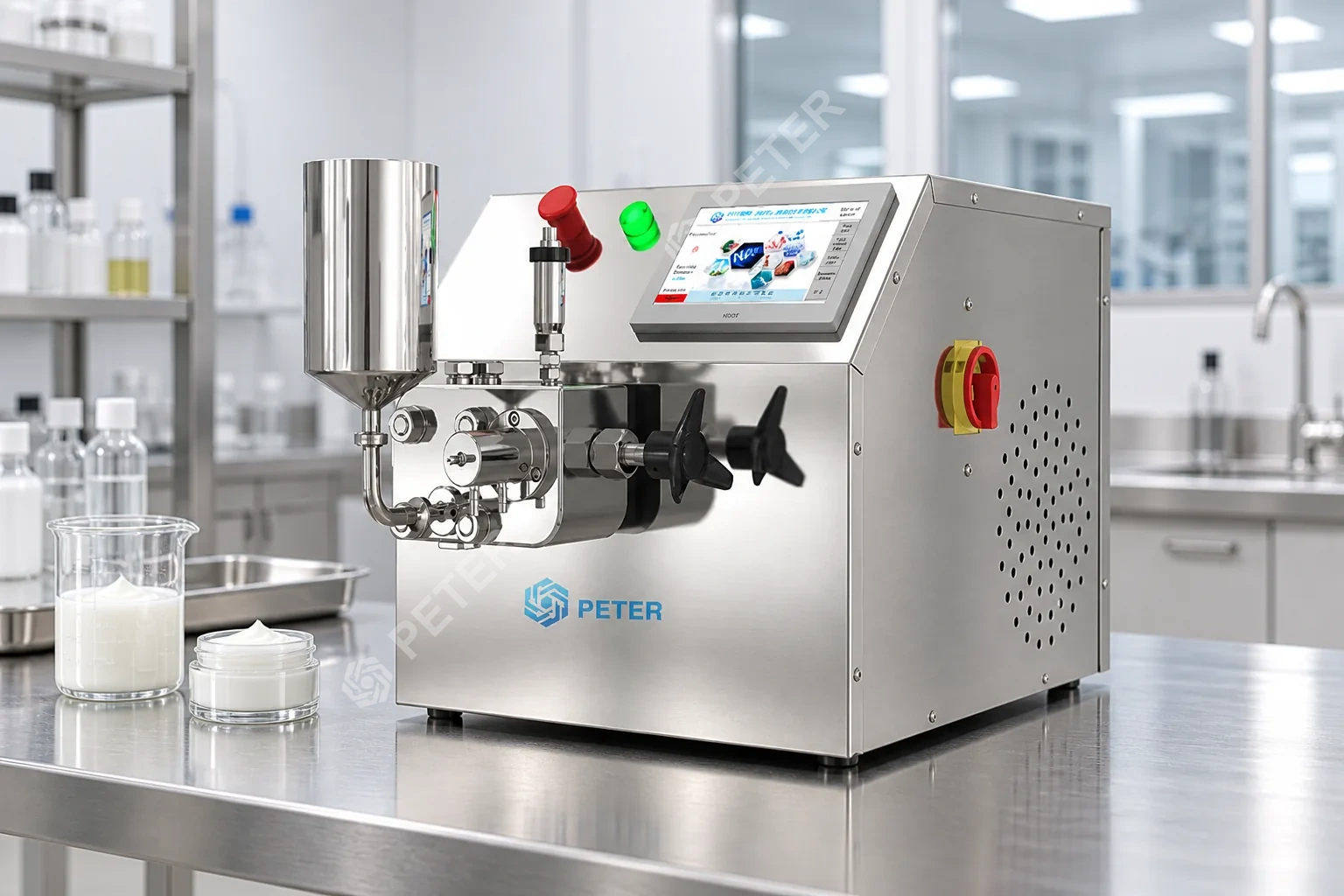
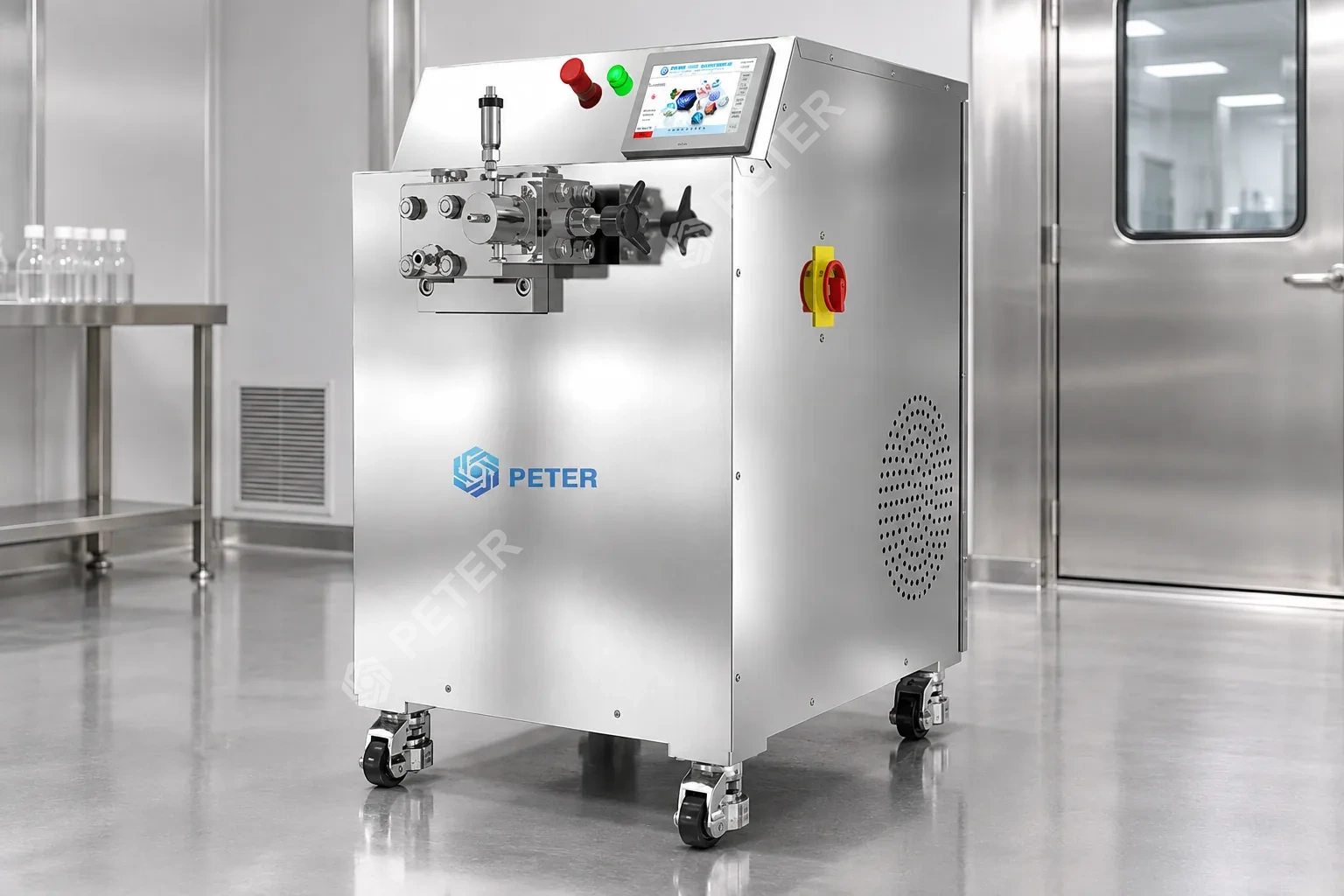
Ask suppliers to state the test material, pressure, flow, temperature and number of passes behind every performance figure. CAS PETER provides a public PT-20 experimental model for small formulation trials and a PT-500 production model for larger duty. These pages describe manufacturer specifications; they do not replace a product-specific qualification.
Before purchase, request a wetted-material list, seal options, cleaning boundary, utility schedule, spare-parts list, calibration certificates and acceptance-test format. If a future scale-up is likely, reserve sampling points and data fields now.
Ask who owns the formulation trial data and how samples will be returned or disposed of. Define confidentiality, cleaning responsibility and the acceptance decision before shipping material. This small procurement step prevents a technically successful trial from becoming unusable evidence.
Write the factory acceptance test around measurable outcomes: stable pressure at the agreed feed condition, flow within a stated tolerance, alarm checks, outlet-temperature limit and complete documentation. Site acceptance should then repeat the critical checks with installed utilities. Keep formulation release outside the equipment test unless the quality unit has deliberately combined the protocols.
When comparing a homogenizer machine for pharmaceutical production, also specify the data-retention, user-access and change-control expectations; these requirements may be irrelevant to an early cosmetic screening tool but decisive in a regulated manufacturing system.
Frequently Asked Questions About Pharmaceutical and Cosmetic Homogenizers
What type of pharmaceutical homogenizer is best for pharmaceutical and cosmetic formulation?
The best type matches viscosity, particle target, thermal limit, batch size and contamination strategy. A laboratory unit is useful for screening, while a pilot or production unit is needed to prove heat removal, hold-up and cleaning at scale.
How do you choose a pharmaceutical homogenizer?
Write the material specification and critical quality attributes first; then compare pressure/flow range, contact materials, cooling, cleanability, controls and service. Require a representative trial with a defined analytical method.
When should homogenizer machine for cosmetics be considered?
Consider it when droplet reduction, texture, appearance or separation control cannot be achieved repeatably with the existing mixer. Confirm that pressure, heat and shear will not damage fragrances, pigments or actives.
What maintenance does a pharmaceutical homogenizer need?
Inspect valves, seals, plungers and contact surfaces; trend pressure and temperature; calibrate instruments; and document cleaning and spare-part changes. The interval should follow a risk assessment and actual wear data.
Technical References for Formulation Control and Regulatory Boundaries
- ISO 13320:2020 particle-size analysis by laser diffraction and ASTM D2196 rotational viscosity methods (method references, not product specifications).
- 21 CFR Part 210, Part 211, and EU GMP Volume 4 (medicinal-product scope subject to jurisdiction and quality-unit review).
- EMA: ICH Q8(R2) Pharmaceutical Development.
- Pharmaceutics 2024, 16(1), 11 (formulation-specific research; the tested conditions are not general recommendations).
- CAS PETER PT-20 product information.
Formulation success is a controlled window, not a maximum-pressure contest. Bring your formula limits and test plan to the CAS PETER PT-20 team so the machine, method and maintenance strategy can be evaluated together.