

Small Milk Homogenizer for Juice and Dairy Startups
When a startup founder in Ho Chi Minh City encountered unstable texture and long cleaning downtime after the first pilot runs in a limited-floor-space workshop, the team blamed the recipes. The failure was quick to see: a juice SKU lost its cloud and began to settle, a dairy drink developed a cream line during hold, and the next run slipped while the system was being cleaned. The turning point came when the founder mapped utilities, service access, product changeovers, and actual pressure-flow duty. The issue was process fit and specification—not simply a bad product or a small room.
Summary: A small milk homogenizer should be selected from evidence on the real recipes, the available utilities and clearance, and the time and product lost at each start and changeover. Pressure must be stated at the required flow and product condition: 1 MPa equals 10 bar, so a 20 MPa target is 200 bar, not a result inferred from a water-like demonstration. Write a duty sheet, run representative samples, and use a suitable method such as ISO 13320 for particle-size comparison where laser diffraction fits the product; texture evidence is useful, but it is not a food-safety validation.
For a young juice or dairy business, homogenization sits between formulation and operations. It can improve dispersion, reduce visible separation, and make a process more repeatable; it does not establish juice HACCP controls, shelf life, or sanitation on its own. The practical buying question is whether the machine and its operating window let the team learn quickly without creating avoidable cleaning, utility, or scale-up problems.
Define the real startup duty before choosing equipment
Capacity on a quotation is only one line of the duty. Record the product family, fat or solids range, pulp load, inlet temperature, target flow and pressure, batch size, planned number of SKU changes, and the maximum time the line can be down. Include the hardest likely recipe, not just the launch SKU. A compact unit that performs acceptably on a warm, low-solids sample may not give the same flow, temperature rise, or stability on a cold protein drink or a pulp-bearing beverage.
Plan the room as an operating area rather than a rectangle around the skid. Confirm the site electrical supply, water and drainage arrangement, any cooling or compressed-air requirement stated by the supplier, hose routes, access for opening service points, and a safe path for operators carrying samples or cleaning connections. Ask the supplier to mark both equipment footprint and maintenance clearance on the layout; the latter is often what makes a compact installation impractical.
For products intended for the United States, 21 CFR Part 117 addresses current good manufacturing practice and preventive controls for human food, while 21 CFR Part 120 addresses juice HACCP. Those rules apply to the processor and its operation; they do not certify a homogenizer or turn a texture result into a safety claim.
Materials and sample compatibility for small-batch projects
Compatibility is more than a stainless-steel checkbox. Acidic juice, dairy fat, stabilizers, flavours, and the selected cleaning chemistry can affect seals, valves, elastomers, residue removal, and maintenance intervals differently. Give suppliers representative samples or a realistic formulation range, and ask which wetted parts, seals, and cleaning limits they are proposing. That conversation is especially important when one machine will alternate between fruit beverages and flavoured dairy drinks.
Troubleshoot texture without confusing it with process safety
Most early complaints are variations on the same pattern: a batch looks good at discharge, then separates during hold; it foams during filling; the outlet warms more than expected; or cleaning takes longer than the production plan allowed. Record inlet and outlet temperature, actual flow, pressure, number of passes, and observed hold behaviour on every trial before adjusting hardware. That gives the team a comparable record instead of a collection of impressions.
A juice homogenizer machine should be evaluated against cloud stability, pulp suspension, foam, and acid-related material compatibility. A dairy trial should also examine fat distribution, cream-line behaviour, and the response of the complete formulation. Better dispersion or smoother mouthfeel does not replace hazard analysis, pasteurization or other process controls, sanitation, or shelf-life work. ISO 13320 is a particle-size test method when laser diffraction is appropriate; retained samples and defined hold observations answer different questions.
Start-up and shutdown losses deserve a line on the trial sheet. Weigh or measure the product displaced during priming, the portion rejected while pressure stabilizes, and the recoverable or unrecoverable volume at shutdown; then compare that loss with a normal batch size. For a short run, a few repeated losses can matter more than a small difference in nameplate throughput. Also record how the operator drains, rinses, opens, inspects, and restarts the system, because those steps expose the real labour requirement.
Compare new, pilot, and used options on lifecycle risk
Founders often put a new compact unit, a larger pilot unit, and used equipment on the same short list. Use one written duty and one sample plan for all three. A lower purchase price can be sensible, but unknown wear, missing records, or a cleaning route that does not suit the product portfolio can convert an apparent saving into repeated production loss.
| Option | Best fit | Main upside | Main caution | Cost tendency | What to verify first |
|---|---|---|---|---|---|
| New compact unit | Early commercial launch with limited room and frequent recipe changes | Known configuration and a clearer documentation and training path | Can be undersized if duty is based on water-like assumptions | Higher upfront, lower uncertainty | Delivered flow at required pressure, product condition, utilities, and service clearance |
| Pilot-to-small-production unit | Teams moving from development into short-run manufacturing | More useful evidence for later scale-up and a wider operating window | May need more utilities, drainage, or access space than the room allows | Mid-to-high upfront, potentially lower scale-up risk | Footprint plus maintenance envelope, cleaning route, and product-loss routine |
| Used equipment | Budget-constrained projects with known formulations and local inspection access | Lower initial purchase cost | Unknown wear history, parts availability, and validation gaps | Lower upfront, potentially higher lifecycle correction cost | Valve condition, seals, records, safety devices, and cleanability for the intended products |
Compare total operating risk rather than price alone. The buyer should be able to install, clean, inspect, and restart the system without heroic workarounds. Under 21 CFR Part 117, responsibility for the food operation and its records remains with the processor.
Build pilot evidence that can support a later scale-up decision
A pilot is most valuable when it answers a future procurement question, not merely when it produces one attractive sample. Agree acceptance criteria before the run: the target operating point, an observable texture or separation result, the sampling times, cleaning acceptance, restart performance, and the measurements to be retained. Include at least one normal condition and one credible edge condition, such as the highest-solids recipe or coldest practical inlet temperature.
Keep product evidence and operating evidence together. Product evidence can include particle-size results where applicable, viscosity, visual separation, foam, and retained samples. Operating evidence should show pressure and flow stability, inlet and outlet temperature, pass count, start-up and shutdown losses, cleaning time, and repeatability after restart. This creates an audit trail for the next equipment size decision without pretending that a pilot run has proven commercial compliance.
| Application dimension | Pilot evidence to retain | What it makes defensible later | Procurement implication |
|---|---|---|---|
| Low-pulp juice beverage | Cloud and foam observations at agreed hold times; relevant particle-size data where suitable | Whether appearance remains acceptable over the planned production window | Pressure control and cleaning performance may matter more than peak flow |
| Pulp-bearing juice SKU | Suspension, blockage observations, product loss, and residue after cleaning | Whether upstream preparation and the operating window are robust enough for the SKU | May justify conservative limits or changes upstream of homogenization |
| Standard dairy drink | Fat distribution, cream-line observations, and repeatability after a restart | Whether one-pass performance is usable for the intended process | Supports a justified choice between compact and pilot-scale duty |
| Protein-rich or higher-solids dairy beverage | Temperature trend, pressure stability, hold observations, and cleaning results | Whether the harder formulation narrows the viable operating window | Can justify additional robustness even when daily volume is modest |
For a startup, one agreed trial sheet and a disciplined sample plan are more useful than a large but inconsistent stack of notes. They make it possible to explain later why the selected scale, utilities, and cleaning design were chosen.
Control changeovers and compliance language in the right scope
When dairy, flavours, and juice products share a line, changeover is a product-control issue as well as a scheduling issue. Map the sequence of product families, identify residues that are difficult to remove, define the cleaning and verification approach with the food-safety team, and document the result before releasing the next product. Allergen and flavour cross-contact controls depend on the ingredients, process, cleaning validation, and destination-market requirements; a homogenizer is one part of that system, not proof that the controls are effective.
ISO 13320 describes a laser-diffraction particle-size method, not a product certificate or a stability guarantee. In the United States, 21 CFR Part 120 addresses juice HACCP and 21 CFR Part 117 covers preventive controls for human food. Destination market, intended use, and marketing claims determine what else applies. Unsupported claims about compliance, sanitation, or safety can create a commercial problem even if the equipment performs well in a trial.
Small-scale selection checklist
- Issue one duty sheet covering recipe range, target pressure and flow, utility details, cleaning routine, product-loss expectations, and room limits.
- Place both the skid footprint and supplier-specified maintenance clearance on the layout before committing to a room.
- Run representative dairy and juice samples, including the harder SKU, and capture the same operating and hold data every time.
- Test changeover in the intended sequence; involve the food-safety team in defining cleaning and cross-contact verification rather than relying on equipment claims.
- Choose the smallest system with a documented operating window for the demanding recipe and a credible route to the next scale.
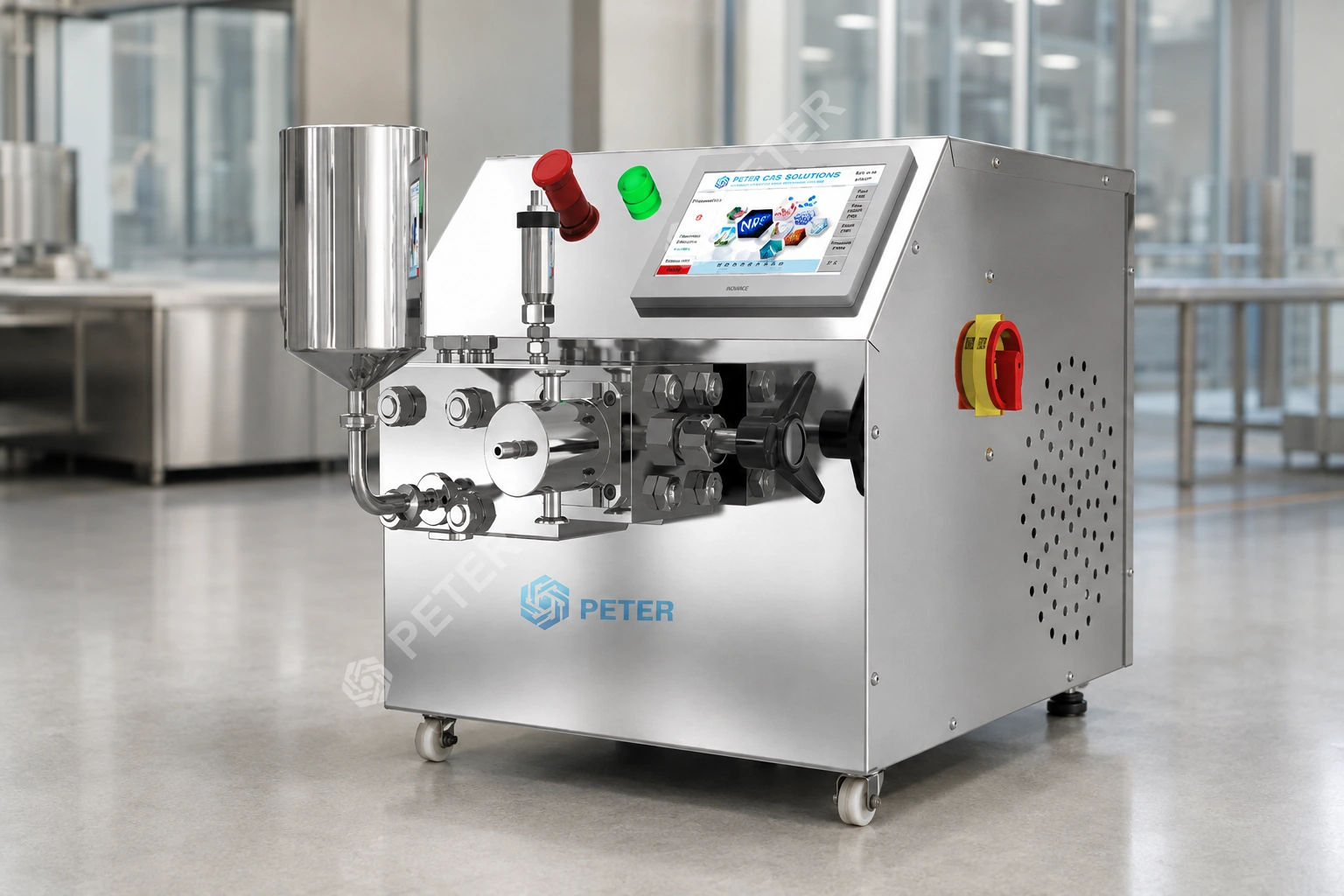
A small scale milk homogenizer is most useful when its trial results can be carried into a later capacity decision. Once the checklist is complete, CAS PETER can enter the shortlist as a technical supplier rather than a speculative quote. Buyers can compare a small milk homogenizer for compact development work with a juice homogenizer machine for limited-space beverage runs, then ask each supplier to answer the same duty sheet and trial criteria.
Frequently asked questions
How much does a milk homogenizer cost?
There is no reliable universal price because pressure, flow, product behaviour, cleaning design, controls, documentation, and local service all change the scope. For a startup, the useful comparison is the operating point and cleaning performance actually covered by the quotation. Include expected commissioning, spare parts, utility work, and repeated start-up loss in the budget discussion.
What affects the price of a milk homogenizer?
Price moves with the required pressure-flow combination, product-contact materials, valve and seal specification, controls, cleaning route, and requested testing or documentation. A compact system can cost more when the formulation is demanding or the line must cope with frequent changeovers. Compare quotations at the same recipe conditions and acceptance criteria rather than comparing model names alone.
How do new and used milk homogenizers compare?
New equipment usually offers a clearer configuration, parts route, and commissioning path. Used equipment can be appropriate when formulation behaviour is already known and the buyer can inspect it, but only after checking wear, records, safety devices, cleanability, and parts availability. The decision is about restoration effort and process risk, not just the asking price.
How should buyers assess small scale milk homogenizer before choosing a milk homogenizer?
Start with the full product mix, room layout, utilities, cleaning routine, and target operating point, then require representative trials with agreed acceptance criteria. Review evidence for texture or separation, restart consistency, product loss, and the proposed changeover procedure. If dairy and juice will share the system, assess both sample sets and let the harder cleaning or cross-contact requirement influence the decision.
References and next step
- ISO 13320: Particle size analysis — Laser diffraction methods
- 21 CFR Part 117 — Current Good Manufacturing Practice, Hazard Analysis, and Risk-Based Preventive Controls for Human Food
- 21 CFR Part 120 — Hazard Analysis and Critical Control Point (HACCP) Systems for Juice
- FAO Food Safety
The soundest startup purchase is the one that still works when the harder recipe, the tighter room, and the second cleanup of the day all arrive together. When your team is ready to compare trials, floor-space limits, and scale-up options, contact CAS PETER for a practical discussion of the process window you need to prove.