

Soluble Protein Recovery After E. coli Homogenization: Follow the Target, Not Total Protein
Soluble protein recovery after E. coli homogenization should be judged by the amount and quality of the target protein reaching a defined clarified stream. Total released protein, a clearer suspension or fewer intact cells cannot establish that result. Plan a comparison that follows the target through cell preparation, disruption, clarification and a representative downstream capture step. Keep buffer, biomass loading and handling time controlled, and measure a property relevant to the intended protein function. The useful operating condition is the one that delivers acceptable recoverable target with manageable processing demands, rather than simply the strongest disruption treatment.
Define the protein stream you actually want
Start with the location and physical state of the expressed target. A soluble intracellular protein, a periplasmic protein and an insoluble inclusion-body product lead to different recovery decisions. This guide concerns an intended soluble target after mechanical disruption. It does not provide an inclusion-body solubilization recipe or a purification specification for a therapeutic product.
Use the broader high-pressure cell lysis guide to frame the disruption operation. For this narrower comparison, write the required collection point explicitly: for example, clarified lysate entering capture chromatography after a defined hold. A measurement taken immediately from crude lysate answers a different question from one taken after filtration, transfer and waiting.
Before processing, retain samples of the cell suspension and any discarded liquid from harvesting or washing. These samples help investigate whether the target was already outside the cells. Without this check, a disappointing homogenization result may partly reflect losses that occurred before the machine received the feed.
What the research supports
Pekarsky and colleagues’ soluble-protein homogenization case study examined product quantity and quality together using a multivariate approach. Its abstract supports a product-specific optimization strategy, rather than universal disruption conditions. The linked university record identifies the publication; the research description here is limited to its indexed abstract. It is not a basis for transferring the paper’s operating settings to another protein or a CAS PETER machine.
The NIH-hosted protocol for preparing soluble proteins from E. coli describes clarification and subsequent purification of a particular recombinant protein. Its methods and commentary distinguish cell breakage, soluble-fraction assessment and purification, and discuss protection against unwanted changes during isolation. That protocol is a methodological example, not a guaranteed yield or a universal buffer formulation.
Together these sources support two practical questions: how much of the intended target reaches the chosen stream, and whether it still meets the required quality attributes. The trial framework below turns those questions into a traceable comparison. Acceptance limits must come from the product development team and its analytical methods.
Prepare a matched feed before comparing pressure
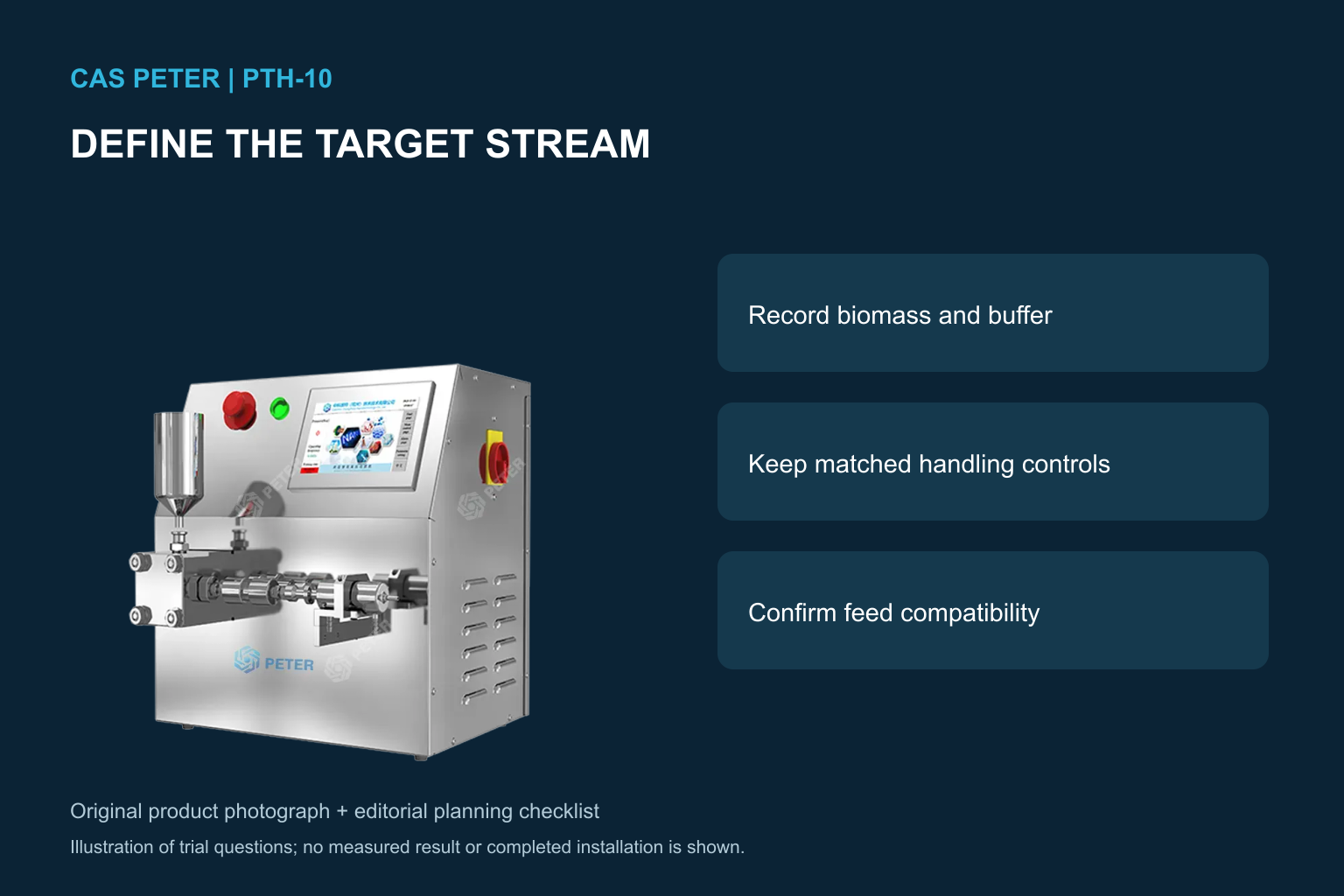
Use one well-characterized biomass lot for the initial screening where feasible. Record strain, expression history, harvest method, storage condition and thawing history. When multiple fermentation lots are unavoidable, treat lot identity as a separate experimental factor. Mixing that variation into a pressure comparison makes the conclusions harder to interpret.
Define loading on a stated basis, such as wet biomass per suspension volume, and retain the original weighing records. An optical-density reading alone may be unsuitable for comparing concentrated, differently prepared suspensions. Record the actual resuspension buffer, pH, conductivity and any additives, including their compatibility with later assays and purification.
Check suspension uniformity before drawing samples. If settled biomass is sampled inconsistently, apparent recovery can change without any process improvement. Likewise, unrecorded dilution during processing can reduce a concentration result while leaving target mass unchanged. Document every buffer addition and the reason for it.
Select a small comparison that can be interpreted
Ask the equipment supplier to confirm suitable conditions for the actual biomass suspension and configuration. Then compare a limited set of pressure and pass conditions within that approved envelope. Retain a handling reference subjected to comparable waiting, transfers and temperature control, so that processing effects can be distinguished from deterioration during the trial itself.
Sample at defined points between passes rather than comparing only the final containers. Record inlet and outlet temperatures and the time spent waiting for cooling or transfer. If a higher-pass treatment also spends longer warm or waiting, it is a combined treatment. That may reflect a real production workflow, but the report should not attribute every difference solely to pass count.
Run independent preparation or processing replicates for promising conditions. Repeated instrument readings from one tube show analytical repeatability; they do not show that another batch can reproduce the recovery. Establish sampling and assay precision before judging small changes as meaningful improvements.
Measure target mass, purity and useful quality separately
A total-protein assay measures the mixture released from the host. It can support a disruption assessment, but it does not identify the target or demonstrate its function. Use a target-specific quantitative method suitable for the sample matrix. Pair it with identity or purity information and an activity, binding or other relevant quality measurement where appropriate.
Define how the sample is clarified before calling the target soluble. Record centrifugal force, duration, temperature and collection method, or the filter and its handling conditions. Changing the separation procedure can change which particles and associated proteins remain in the measured supernatant. Do not silently compare differently prepared fractions under the same label.
Retain the pellet and selected transfer residues until the mass balance is understood. If target disappears from the clarified liquid, checking those streams helps distinguish incomplete release, association with debris and losses during separation. Any extraction used to examine a pellet is a diagnostic preparation and should not be treated as recovered soluble product.
| Trial observation | Additional check | Decision it supports |
|---|---|---|
| Total protein rises but target concentration does not | Target-specific assay and identity check | Whether extra disruption releases mostly host material |
| Target concentration falls after a buffer addition | Actual stream volume and dilution record | Whether target mass fell or the sample was diluted |
| Target appears in the pellet | Defined pellet sampling and target detection | Whether clarification removes part of the target |
| Target mass is similar but useful activity falls | Assay suitability and matched handling reference | Whether recovery quality deteriorated |
| Crude recovery improves but capture recovery falls | Representative downstream loading and fraction analysis | Whether the disruption condition creates a later processing penalty |
This is an editorial decision table based on the distinction between release, clarification and purification in the cited methods. It contains no measured CAS PETER performance results.
Use a mass balance with an honest denominator
For each collected stream, calculate target mass as concentration multiplied by measured stream volume, correcting any analytical dilution on a documented basis. Report the concentration units and volume units together so another person can reproduce the calculation. Account for retained samples and unrecovered equipment hold-up when these are material to the comparison.
A simple illustration shows why concentration alone is insufficient: a collected stream containing 2 milligrams per millilitre in 100 millilitres contains 200 milligrams of target. Another containing 1.8 milligrams per millilitre in 130 millilitres contains 234 milligrams. These are invented arithmetic examples, not trial data, expected recoveries or recommended feed quantities.
Only calculate a recovery percentage when the input target amount has a defensible measurement basis. Total cellular protein is not the input amount of a particular recombinant protein. If the starting target cannot be quantified reliably, report recovered target mass per stated biomass input and disclose that absolute target recovery remains unknown.
Test a realistic clarification and capture challenge
Compare the processing burden created by the shortlisted conditions. Record clarification time, filter throughput where applicable, visible solids carryover and the practical ability to transfer the lysate. The existing article on viscous lysate after homogenization explains why released material can complicate handling. Here, the question is whether that burden changes recoverable target at the chosen collection point.
Apply a representative capture test using a defined load basis. Loading every condition at the same liquid volume may be unfair when target concentration differs. Conversely, matching target mass while ignoring changes in host impurities can hide a practical capacity problem. Record both the target load and the accompanying stream composition relevant to the capture method.
Follow the target through loading, flow-through, washes and recovered fractions as appropriate. A treatment that improves crude titer but reduces captured useful target requires further investigation. It should not be selected solely because the immediate post-homogenizer sample looked better.
Match the equipment discussion to the verified workflow
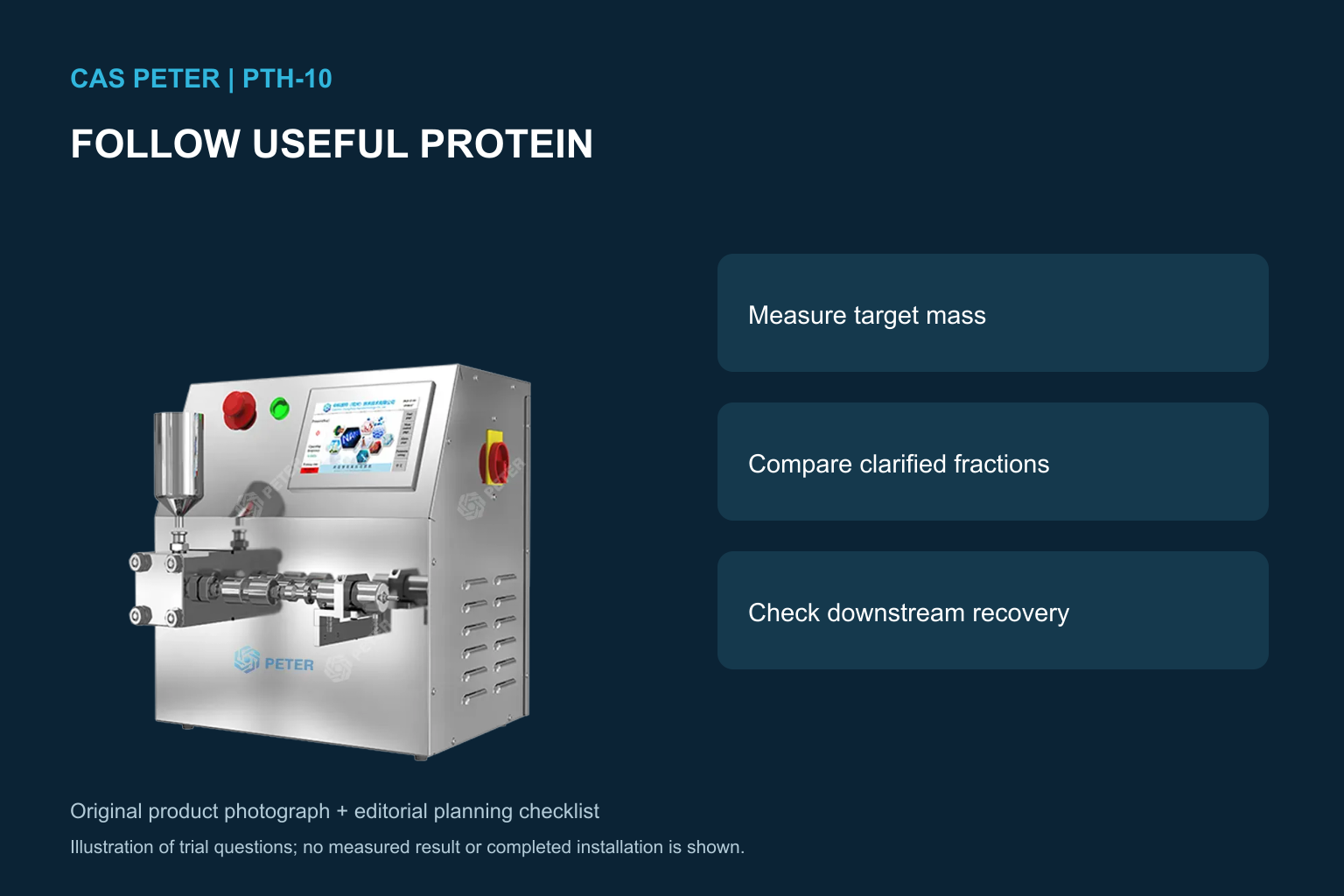
The CAS PETER PTH-10 product page provides a real equipment reference for discussing a development trial. Its appearance and model identity do not establish suitability for a particular strain, buffer or quality requirement. Confirm the actual processing path, feed compatibility, cleaning needs, cooling arrangement and sample quantity before agreeing a trial configuration.
Send a supplier the suspension basis, buffer chemistry, expected solids, target sensitivity, available sample quantity and proposed measurements. Ask how retained volume, sample collection and temperature records will be handled. These details determine whether the comparison can support a scale-up decision and whether enough material reaches the analytical team.
For function-sensitive targets, the separate guide to enzyme activity after pressure disruption provides complementary questions. A successful cell-lysis trial does not by itself establish purity, safety, regulatory suitability or final product performance. Those require the relevant downstream and product-specific evaluations.
Learn the physical stability principles
The following neutral colloid-stability lesson provides background for understanding dispersed material and changes in a liquid system. It does not teach a protein purification protocol or validate a pressure-processing condition. Use it as supporting education alongside the target-specific measurements described above.

Educational source: NPTEL-NOC IITM. Watch the lesson on YouTube.
FAQ
Does more total released protein mean better soluble target recovery?
No. Total released protein includes host proteins and other assay-responsive material. Measure the target specifically, account for collected volume, and check an appropriate quality attribute before selecting the condition.
Can the same pressure and pass count be used for every E. coli protein?
A fixed condition is a starting hypothesis that requires validation. Strain, biomass preparation, buffer, target properties, temperature history and downstream separation can all affect the outcome of the comparison.
What should be retained when the target is missing from the clarified lysate?
Keep representative crude lysate, clarified liquid, pellet and relevant transfer or filtration samples under a suitable handling procedure. Target-specific analysis of those streams can help locate the loss before the disruption settings are changed.