

Tissue Homogenizer Machine: Protect Delicate Samples
When an assay-development engineer in San Diego encountered an enzyme-recovery problem, she was processing small tissue batches with a quick bench setup; the first lysate looked promising, but a second run lost enzyme activity. The tissue was not suddenly “bad.” Unmeasured mechanical energy and temperature rise had changed the outcome, turning a seemingly simple preparation step into the real variable.
Summary: Delicate tissue work is best specified as a controlled energy-and-temperature process, not as a search for the fastest disruption method. Start by recording sample mass, buffer ratio, endpoint temperature, and pass or cycle count; for particle-size work, ISO 13320 is a laser-diffraction test method, not a homogenizer certification. Match the method to the recovery target, then qualify it on representative material before scaling.
A sample homogenizer is the process system that converts non-uniform tissue or cell material into a workable suspension. Its useful result may be whole-cell release, a uniform extract, a defined particle-size distribution, or preserved enzymatic activity. Those are different outcomes, so the same instrument setting cannot responsibly be assumed to suit every sample.
For many laboratories, a tissue homogenizer machine must balance disruption with retention of fragile analytes. A cell homogenizer may be selected for controlled cell breakage, while a dounce tissue homogenizer is often chosen where low-shear manual disruption and visual control matter. The correct choice follows the tissue, target molecule, batch size, containment needs, and acceptable variability.
Process design around Sample Homogenizer
Design begins with the analytical question: are you releasing intact organelles, extracting soluble protein, reducing tissue fragments, or preparing a stable dispersion? Document tissue origin, starting mass, frozen or fresh condition, buffer chemistry, inhibitor use, target recovery metric, and maximum permitted temperature. A method can appear successful by visual clarity while failing the actual activity, yield, or morphology requirement.
Translate that question into a small, controlled design of experiments. Hold buffer and tissue mass constant; compare one factor at a time – stroke count, rotor speed, bead size, or pressure/pass count – and measure output and damage indicators. Mechanical approaches apply different forces, as the cell-disruption methods review explains, so do not transfer a supposedly “best” setting without qualification.
Temperature is a process variable, not an afterthought. Pre-chill compatible components, use short exposure intervals where appropriate, record initial and final temperatures, and define a pause or cooling trigger before the first routine run. For a small batch, a simple log with mass, buffer volume, cycles or passes, and temperature can uncover the cause of inconsistent activity more quickly than changing multiple reagents.
Optimizing Sample Homogenizer for consistent output
Consistency comes from a measurable endpoint. Depending on the work, that may be percent recovery against a control, residual intact-cell count, microscopy score, particle-size distribution, or an enzyme-activity assay. Set acceptance limits before comparing methods, retain representative aliquots, and use a defined cleaning and assembly check between runs. An illustrative qualification sequence might compare three energy levels across three independent tissue preparations, then select the lowest level that meets the recovery criterion; it is not a universal recipe.
Method choice determines which controls deserve the most attention. A Dounce device relies on clearance, stroke count, and operator technique. A rotor-stator system adds probe geometry, immersion depth, vortexing, and heat input. A bead mill adds bead material, bead-to-sample ratio, cycle time, and vibration or rotation. High-pressure processing adds pressure, number of passes, feed temperature, and flow-path cleaning. Record the settings that create force rather than only the final visual result.
| Method | Primary disruption mechanism | Useful fit | Main control point | Delicate-sample consideration |
|---|---|---|---|---|
| Dounce | Manual shear between pestle and tube | Small, soft samples and controlled cell lysis | Clearance and stroke count | Low heat input, but operator variation can be material |
| Rotor-stator | High local shear and turbulence | Rapid tissue dispersion | Speed, time, and probe position | Watch foaming and temperature rise |
| Bead mill | Impact and shear from moving beads | Tough tissue or parallel small batches | Bead selection and cycle schedule | Intermittent cooling may be needed |
| High pressure | Pressure drop, shear, and cavitation-related forces | Controlled repeat processing and larger throughputs | Pressure, passes, and feed temperature | Qualify energy exposure against the target analyte |
When to use Tissue Homogenizer Machine
Choose manual Dounce processing when sample numbers are low, tissue is soft, and the operator needs to stop as soon as the desired lysis state is reached. Choose rotor-stator processing when rapid bulk dispersion is the priority and the target tolerates the associated shear. Choose a bead mill when difficult matrices or parallelization justify the consumable and optimization burden. High-pressure equipment is worth evaluating when repeatability, closed-flow handling, or a route from laboratory development to pilot work matters more than a one-off manual preparation.
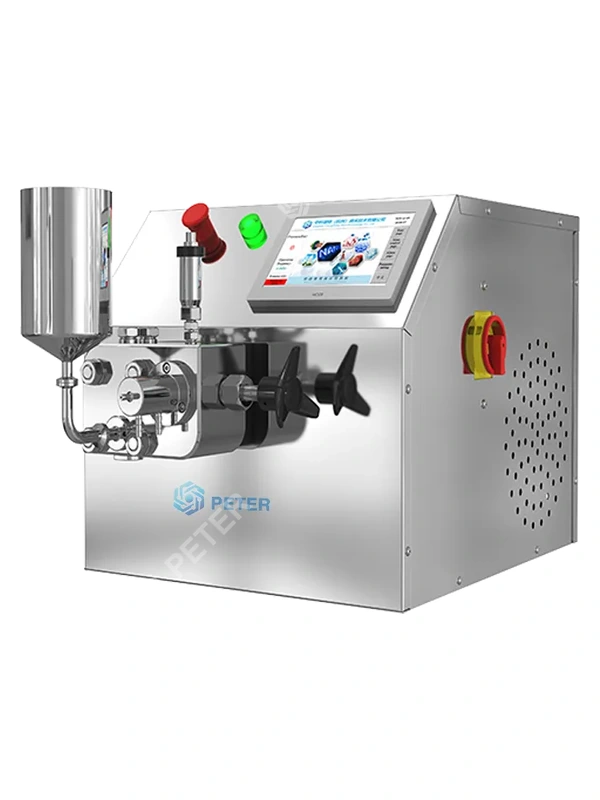
For high-pressure evaluation, specify the material path as carefully as the nominal pressure. Ask about wetted materials, minimum workable volume, sample feed characteristics, cleaning validation needs, and how pass count is documented. The CAS PETER PT-10 high-pressure homogenizer is a relevant laboratory option to discuss when a buyer needs a documented high-pressure trial rather than an unsupported promise of improved recovery. Compare its process fit with your actual sample and assay acceptance criteria.
| Application and scale | Typical starting approach | Evidence to collect before release | Capacity-planning question |
|---|---|---|---|
| Exploratory tissue lysis; small batches | Dounce or bead-mill screening | Activity or yield, temperature, operator variability | Can one trained operator meet the schedule? |
| Routine research batches | Rotor-stator, bead mill, or controlled high pressure | Run-to-run recovery and cleaning record | What is the true samples-per-shift requirement? |
| Process development or pilot transfer | High-pressure trials with defined passes | Mass balance, feed stability, and hold-time data | Will the method transfer without a new disruption mechanism? |
| Regulated manufacturing support | Qualified process equipment and documented controls | Approved protocol, traceable records, change assessment | What documentation is required by the intended use? |
Cost and capacity planning for Sample Homogenizer
Purchase price is only one part of total cost. Include labor per batch, sample loss from rework, consumables, cleaning time, service access, throughput at the validated setting, and training. A low-cost manual method may be economical for ten samples a week yet become expensive when two operators must reproduce it across many batches. Conversely, a high-throughput platform can be poor value if its minimum volume or cleaning burden does not fit the work.
An illustrative calculation frames the decision: if a validated workflow requires 20 minutes of hands-on work per batch and a semi-automated option reduces that by 10 minutes, the labor saving is 10 minutes multiplied by annual batches – not a guaranteed equipment payback. Add expected consumables, downtime exposure, and the cost of repeating failed assays before comparing alternatives. CAS PETER’s guidance on cell disruptor homogenizers for laboratory needs and high-pressure cell disruptors for labs can help structure early comparison questions; verify every final specification with the supplier.
Standards, biosafety, and procurement controls
ISO 13320 describes laser-diffraction particle-size analysis; it can support a particle-size measurement plan when that endpoint is relevant, but it does not certify a homogenizer or establish biological recovery. The CDC’s Biosafety in Microbiological and Biomedical Laboratories provides risk-based biosafety guidance that should inform containment, aerosol control, decontamination, and training for the organism and procedure in use. Select containment and cleaning practices through your institutional risk assessment.
For regulated pharmaceutical applications, current good manufacturing practice requirements apply according to the product, intended use, and jurisdiction; laboratory research use alone does not make a machine cGMP compliant. Unsupported claims about validation, sterility, containment, or recovery can create procurement and marketing risk. Ask suppliers for scoped documentation, not broad compliance labels, and make the final decision against your quality system.
A practical selection checklist
- Define the analyte, acceptable recovery range, and maximum temperature before selecting a mechanism.
- Run representative tissue through a documented comparison, including the lowest energy setting likely to work.
- Size capacity at the validated cycle time, including setup, cooling, and cleaning – not nominal throughput alone.
- Confirm sample-volume range, wetted-path compatibility, maintenance access, and the records your team must retain.
CAS PETER can be a sourcing partner when buyers need to assess configurable high-pressure homogenization equipment across experimental, pilot, or production planning. The useful conversation is about material, process window, documentation, and scale path – not a claim that one method protects every sample.
Frequently asked questions
What is a Dounce homogenizer used for in cell lysis?
A Dounce homogenizer is used to gently disrupt cells or soft tissue by repeatedly moving a pestle through a close-fitting glass tube. It is often considered when the user wants hands-on control and limited heat input. The correct clearance and stroke count must be qualified for the cell type and the desired degree of lysis.
How does a Dounce homogenizer disrupt cells?
The pestle creates shear as the sample passes through the small clearance between pestle and tube. Repeated strokes progressively disrupt the material, so force is controlled largely by the pestle fit and operator technique. Keep the sample cold where the assay requires it and record the stroke count for reproducibility.
How does a Dounce homogenizer compare with tissue homogenizer machine?
A Dounce is a manual, low-throughput tool, whereas a tissue homogenizer machine can refer to powered rotor-stator, bead-mill, or high-pressure systems. Powered systems may support greater repeatability or capacity, but they introduce their own energy, cleaning, and setup controls. Compare methods against the analyte endpoint rather than treating automation as inherently gentler.
Which conditions improve recovery with a Dounce homogenizer?
Recovery often improves when tissue mass, buffer composition, pestle clearance, stroke count, and temperature are controlled consistently. Use a cold-compatible workflow when the target is heat sensitive, and stop when the defined endpoint is met rather than applying arbitrary extra strokes. Confirm improvement with the assay that matters, such as activity, yield, or intact-organelle assessment.
References
- National Center for Biotechnology Information: review of cell-disruption approaches
- ISO 13320: particle size analysis by laser diffraction
- CDC: Biosafety in Microbiological and Biomedical Laboratories
- FDA: current good manufacturing practice regulations
Protecting delicate samples is less about choosing the gentlest-looking tool than about controlling the energy actually delivered to the material.
When your team is ready to compare a documented high-pressure route, review the CAS PETER PT-20 high-pressure homogenizer and contact CAS PETER with your sample, target recovery, and scale requirements.