

Top Homogenizer for Efficient Sample Preparation
Efficient sample preparation means reaching a defined analytical endpoint with the least avoidable heat, foam, material loss, and operator variation. A sample that looks uniform can still fail if the process has damaged the analyte or left too much material in the vessel and tubing.
Summary: Select a high-efficiency homogenizer by sample volume, matrix, viscosity, target structure, temperature limit, recovery, cleaning, and repeatability. Measure the endpoint and the energy path together so a fast preparation is also usable downstream.
1. What makes sample preparation efficient?
Efficiency combines preparation time, usable recovery, quality, energy consumption, operator effort, and cleaning. A sample is not efficiently prepared if it is mixed quickly but loses activity, contains foam, or requires a second clarification step. Define the endpoint first: extraction yield, particle size, cell rupture, dispersion stability, or complete wetting.
2. Which laboratory homogenizers fit different matrices?
| Matrix or task | Suitable mechanism | Watch for |
|---|---|---|
| Soft tissue or liquid samples | Rotor-stator or ultrasonic | Foam and temperature |
| Tough microbial cells | High-pressure or bead milling | Debris, heat, and recovery |
| Fine emulsions | High-pressure or microfluidizer | Droplet distribution and cooling |
| Powder wetting | Rotor-stator pre-mix plus high-pressure finish | Agglomerates and air entrainment |
| Abrasive slurries | Wear-resistant valve or bead system | Component erosion |
3. How do energy and heat affect results?
Mechanical energy becomes heat through shear, collision, turbulence, and compression. A useful trial records inlet temperature, outlet temperature, speed or pressure, flow, pass count, and time. For heat-sensitive extracts, use pre-cooling, short controlled passes, or immediate cooling. A higher setting may reduce preparation time while lowering biological activity; the best condition is the one that preserves the downstream endpoint.
4. Which specifications should a lab request?
- Minimum and maximum sample volume
- Feed viscosity and particle-size limit
- Pressure, speed, or frequency range
- Throughput at the intended material
- Temperature measurement and cooling options
- Residual volume and sample recovery
- Product-contact materials and cleaning method
- Repeatability data and service-part availability
5. How should options be compared?
| Metric | Good evidence | Common mistake |
|---|---|---|
| Preparation time | Time to endpoint on representative samples | Comparing motor speed only |
| Recovery | Mass balance and residual volume | Ignoring hold-up in tubing or chamber |
| Quality | Assay, size, or yield after processing | Using visual uniformity alone |
| Energy | Pressure/speed, flow, pass count, temperature | Calling peak power efficiency |
| Cleaning | Documented cycle and inspection | Assuming a quick rinse is enough |
6. Which standards support reproducible preparation?
ISO 9001:2015 supports controlled methods, calibration, and corrective actions. In regulated laboratories, 21 CFR Part 211 is relevant to equipment design, cleaning, and maintenance. ASME BPE can guide hygienic product-contact choices for bioprocess work. Laboratory safety procedures should also cover aerosols, biological containment, noise, moving parts, and stored pressure.
7. How should a sample-preparation method be qualified?
- Define the sample matrix and quality endpoint.
- Run a small study across energy level, pass count, and cooling condition.
- Measure recovery and downstream assay performance.
- Repeat the preferred condition on different operators or days.
- Document cleaning, maintenance, and acceptable deviation limits.
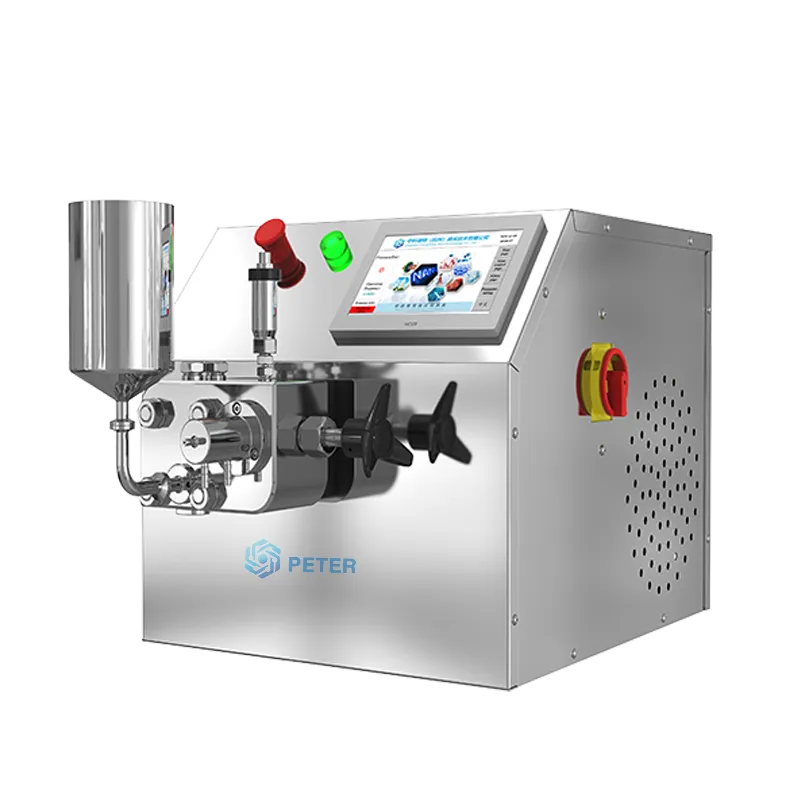
CAS PETER supports efficient sample preparation with the PT-10 laboratory homogenizer, PT-20, and PTH-20 high-pressure microfluidizer. The application library helps teams frame a material-specific trial before scaling.
8. Practical ways to prevent failed preparations
A high efficiency homogenizer should reduce failed preparations, not simply consume fewer watts. Pre-wet powders, remove oversized particles, select the smallest practical flow path, and stop when the analytical endpoint reaches a plateau. These steps reduce unnecessary passes, cleaning water, cooling demand, and sample loss.
Laboratory homogenizers should also be scheduled around compatible materials so that changeover is simpler. A lab homogeniser with excessive hold-up can waste more value in product than it saves in electricity; likewise, an energy efficient homogenizer that requires repeated runs is not efficient in practice. The most useful metric combines recovered sample, quality, operator time, and energy.
For mixed workflows, a mixing homogenizer can prepare a uniform feed before high-pressure processing. This protects the valve and improves consistency. A high efficiency homogenizer method then records feed preparation, pressure or speed, pass count, flow, temperature, and recovery so another operator can reproduce the result.
What is homogenization efficiency?
It is the useful quality improvement achieved relative to time, energy, material loss, and heat. It should be calculated from a defined endpoint, not from speed or power alone.
What does a lab homogenizer do?
It applies controlled mechanical energy to mix, emulsify, disperse, wet, deagglomerate, or disrupt a laboratory sample.
How does a high-pressure homogenizer work?
A pump drives the sample through a narrow valve or interaction zone. Rapid velocity change, shear, turbulence, and impact modify droplets, particles, or cell structures.
9. References
The efficient sample is not the one processed fastest; it is the one that reaches the next analytical step with its quality intact. CAS PETER builds laboratory homogenizers for that balance. Discuss your matrix, volume, and assay endpoint with the technical team.