

Top Homogenizer Machines Global Buyers Guide
A useful homogenizer buying guide starts with the process, not the headline pressure or motor rating. Buyers need to know what the machine must change: droplet size, particle distribution, cell-rupture yield, texture, stability, or simply mixing time.
Summary: Compare homogenizer machines by mechanism, working volume, actual viscosity, heat control, cleaning, wear parts, and scale-up evidence. A representative sample trial is usually more valuable than a catalogue maximum.
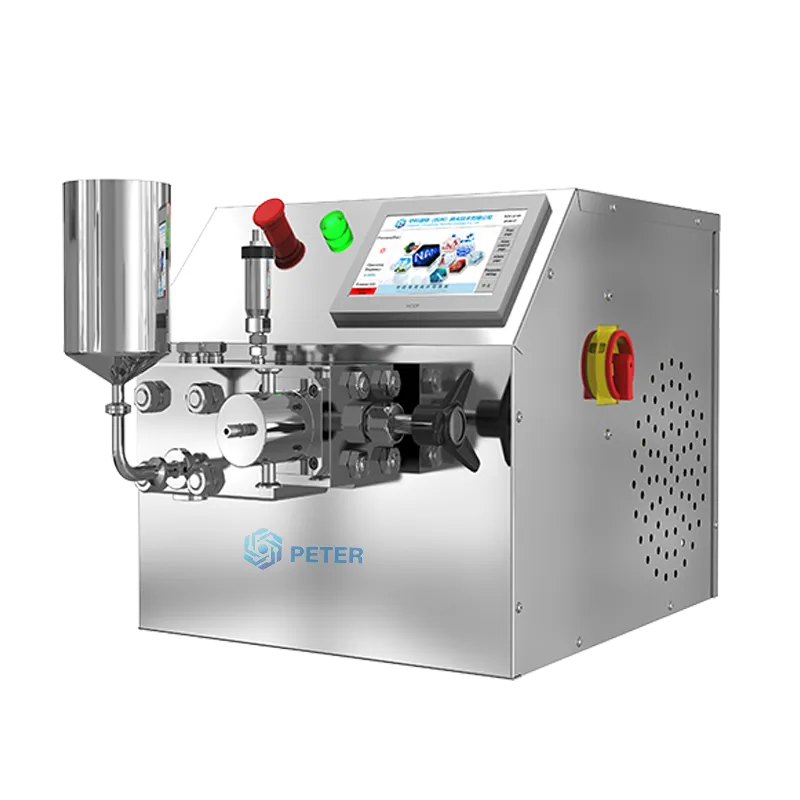
1. What is a homogenizer machine?
A homogenizer machine applies controlled mechanical energy to make a multiphase material more uniform. Depending on its design, it may reduce droplet size, disperse powders, deagglomerate particles, mix viscous phases, or disrupt cells. Rotor-stator mixers use high rotational shear; ultrasonic systems use cavitation; high-pressure homogenization forces liquid through a valve or interaction chamber; bead mills use collision and grinding.
The word “homogenizer” therefore describes a family of equipment, not one performance class. Define the target as particle size, droplet size, lysis yield, mixing time, stability, or another measurable quality attribute before comparing quotations.
2. Which machine types should buyers compare?
| Machine type | Best fit | Typical control issue | Scale-up path |
|---|---|---|---|
| Rotor-stator homogenizer | Pre-mixing, wetting, coarse emulsions | Aeration and local heating | Match geometry and tip speed |
| Ultrasonic homogenizer | Small-volume lysis and dispersion | Hot spots and probe wear | Limited by energy distribution |
| Bead homogenizer | Tough cells and small batches | Bead wear and separation | Match bead loading and residence |
| High-pressure homogenization machine | Fine emulsions, nano-dispersion, lysis | Heat, pressure, and valve wear | Strong continuous-flow path |
| Microfluidizer | Narrow distributions and high-value formulations | Blockage and chamber compatibility | Transfer chamber and flow conditions |
3. Which specifications matter globally?
- Pressure or speed: request the usable operating range and stability, not only the maximum.
- Capacity: compare flow at the real viscosity, pressure, solids loading, and temperature.
- Minimum volume: hold-up and residual volume can dominate laboratory economics.
- Feed compatibility: verify maximum particle size, pH, abrasiveness, and solvent exposure.
- Cooling: record inlet and outlet temperature because compression and shear create heat.
- Cleaning: ask about drainability, product-contact materials, inspection, and validated cleaning cycles.
4. How should performance and cost be compared?
| Decision dimension | Evidence to request | Why it changes TCO |
|---|---|---|
| Output quality | Particle-size or lysis result with method | Prevents rework and extra passes |
| Throughput | Flow at target pressure and viscosity | Determines batch time and capacity |
| Heat balance | Measured inlet/outlet temperature | Protects activity and stability |
| Wear parts | Valve, seal, probe, or bead service interval | Controls downtime and variability |
| Service | Training, spares, response time | Reduces lifecycle risk across regions |
5. What standards and regulatory signals matter?
ISO 9001:2015 supports documented design, calibration, supplier control, and corrective action. Pharmaceutical users should consider 21 CFR Part 211 requirements for suitable equipment design, cleaning, and maintenance. ASME BPE is a useful hygienic-design reference for bioprocess product-contact systems. CE-related conformity, electrical safety, pressure-component ratings, and local import documentation should be checked for the destination market.
6. How should a buyer run a qualification trial?
- Send the supplier the real formulation, solids loading, viscosity, batch volume, and endpoint.
- Run one or more pressure, speed, or pass conditions with immediate temperature measurement.
- Record recovery, particle or droplet size, lysis, energy, and cleaning time.
- Repeat the best condition to test variability.
- Confirm which parameters transfer to pilot and production equipment.
CAS PETER supports global evaluation through the PT-10 laboratory high-pressure homogenizer, the higher-throughput PT-20, and the PTH-20 microfluidizer. Buyers can review the complete product range and the application library before a representative trial.
7. How can international buyers build a defensible shortlist?
First, group Homogenizer Machines by mechanism instead of comparing every quotation in one list. Next, remove any homogenizer machine that cannot process the real minimum volume or viscosity. A homogenization machine should then earn its place through a documented sample trial, not through a catalog maximum. Finally, compare the homogenizer mixer and high-pressure options on recovery, cooling, cleaning, wear parts, operator training, and delivery risk.
This approach keeps Homogenizer Machines tied to business outcomes. It also prevents a low-cost homogenizer machine from becoming an expensive bottleneck after utilities, spare parts, and rework are included.
8. Frequently asked questions
What are the common problems with homogenizers?
Common problems include overheating, foaming, unstable pressure or speed, blockage, wear, poor dispersion, incomplete cell rupture, difficult cleaning, and a mismatch between nameplate capacity and real formulation performance.
What are the different types of homogenizers?
The main groups are rotor-stator, ultrasonic, bead, high-pressure valve, microfluidizer, and specialized membrane or impingement systems. Their energy mechanism and scale-up behavior are different.
What is a homogenizer machine used for?
It is used for emulsification, dispersion, deagglomeration, cell disruption, sample preparation, and mixing of multiphase liquids. The endpoint should be measurable and tied to the application.
What are the main components of a homogenizer?
Depending on the type, components may include a feed vessel, pump or motor, rotor-stator head, probe, bead chamber, high-pressure valve, interaction chamber, cooling path, controls, guards, and product-contact seals.
What industries use homogenizers?
Food and beverage, biopharma, cosmetics, vaccines, diagnostics, nanomaterials, specialty chemicals, and research laboratories all use homogenization equipment.
How much does a homogenizer cost?
Price varies with pressure, flow, materials, automation, cooling, containment, validation, and service. A useful comparison includes utilities, wear parts, cleaning, downtime, and product loss.
9. References
The right machine is not the one with the loudest specification; it is the one that turns a real formulation into a repeatable result. CAS PETER builds homogenization platforms for that decision. Contact the technical team with your material, volume, endpoint, and destination market.