

Top Homogenizers for Pharmaceutical Applications
Pharmaceutical homogenizers are selected by the quality attribute they must control: droplet or particle size, encapsulation efficiency, active recovery, viscosity, physical stability, or cell-disruption yield. Pressure alone is not a meaningful specification unless the formulation, temperature history, flow, and pass count are also defined.
Summary: Compare pharmaceutical homogenizers by formulation, endpoint, pressure or shear, temperature control, hygienic design, minimum volume, cleaning, validation, and scale-up. A suitable machine makes the process repeatable and auditable—not merely powerful.
1. What are the main uses in drug manufacturing?
Homogenization is used for emulsions, suspensions, liposomes, vaccines, cell disruption, nanoparticles, topical formulations, and preparation of active or excipient systems. A laboratory homogenizer helps develop the process; pilot and production equipment must then reproduce the relevant energy and cooling conditions.
2. Which pharmaceutical homogenizer types should be considered?
| Type | Typical pharmaceutical use | Critical control |
|---|---|---|
| Rotor-stator | Premixing, creams, coarse emulsions | Air entrainment and shear history |
| High-pressure valve | Emulsions, suspensions, lysis | Pressure stability and heat |
| Microfluidizer | Liposomes and narrow distributions | Interaction chamber and blockage |
| Ultrasonic | Small-volume development | Hot spots and probe contamination |
| Bead mill | Tough-cell disruption | Bead wear and separation |
3. Which quality attributes should drive the choice?
- Particle-size or droplet-size distribution
- Encapsulation efficiency or release profile
- Active ingredient recovery and potency
- Viscosity, rheology, and physical stability
- Bioburden, endotoxin, and cross-contamination controls
- Temperature exposure and degradation risk
The same homogenization machine can be suitable for one formulation and unsuitable for another. A process window should state pressure, flow, pass count, temperature, concentration, and cleaning status.
4. What does validation require?
21 CFR Part 211 expects equipment used in drug manufacturing to be appropriately designed, suitably located, cleaned, and maintained. ISO 9001:2015 supports controlled procedures, calibration, records, and corrective action. ASME BPE is a useful hygienic-design reference for bioprocessing. Depending on the product and jurisdiction, buyers may also need documented material certificates, cleaning validation, sterilization compatibility, change control, and data-integrity controls.
5. How should equipment be compared?
| Dimension | Qualification question | Why it matters |
|---|---|---|
| Process control | Can pressure, flow, temperature, and passes be recorded? | Repeatability and deviation review |
| Hygiene | Are product-contact materials and drains suitable? | Cleaning and contamination control |
| Scale-up | Which energy variables transfer? | Reduces development risk |
| Recovery | What is the hold-up and residual volume? | Protects high-value product |
| Service | Are spares, training, and calibration supported? | Maintains validated status |
6. What should a pharmaceutical trial include?
- Use a representative formulation or a justified surrogate.
- Define particle-size, potency, encapsulation, or lysis acceptance criteria.
- Record pressure, flow, temperature, pass count, and cleaning conditions.
- Repeat the condition and document variability.
- Review scale-up, sterilization, maintenance, and change-control implications.
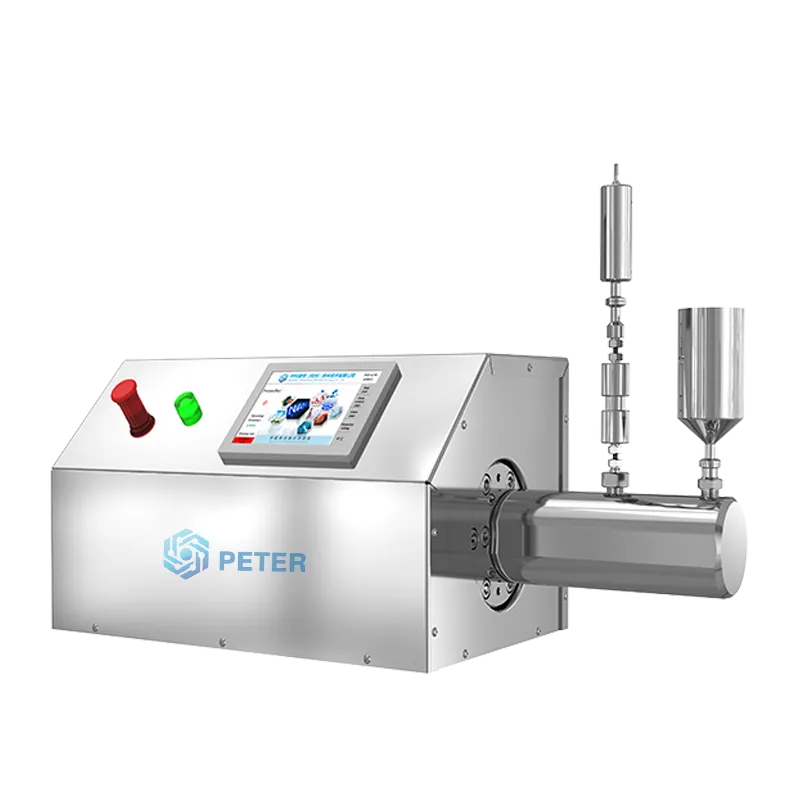
CAS PETER supports pharmaceutical and biotech development through the PTH-20 microfluidizer, the PT-10 laboratory homogenizer, and the PT-40 pilot platform. Teams can review biopharma and cosmetics applications and ask for a process-specific selection discussion.
7. How should development transfer to manufacturing?
A laboratory homogenizer study should create more than a preferred pressure or speed. It should define the feed condition, concentration, temperature, flow, pass count, recovery, and analytical method. A pharma homogenizer at pilot scale must then reproduce the critical energy and cooling conditions closely enough to maintain the quality attributes.
For a biotech homogenizer process, the transfer package should also cover biological containment, hold-up volume, cleaning, and the effect of debris on downstream clarification. The production homogenization machine should be challenged at normal and edge-of-range conditions before the process is locked.
Scale-up is successful when a laboratory homogenizer result becomes a controlled manufacturing range. A pharma homogenizer should not be accepted on mean particle size alone if distribution, potency, or temperature history changes. Likewise, a biotech homogenizer should be evaluated by active recovery rather than rupture percentage alone.
8. Frequently asked questions
What does a lab homogenizer do?
It creates a controlled mechanical environment for mixing, emulsifying, dispersing, reducing structure size, or disrupting cells during development and sample preparation.
What are the different methods of homogenization?
Methods include rotor-stator shear, high-pressure valve processing, microfluidization, ultrasonic cavitation, bead milling, and specialized impingement. Choice depends on product and validation needs.
What is the difference between a homogenizer and a probe sonicator?
A homogenizer may use a rotor-stator, valve, chamber, or other mechanism; a probe sonicator uses ultrasonic cavitation. Probe sonication is convenient for small samples but can create hot spots, aerosols, and scale-up challenges.
Which machines are used in the pharmaceutical industry?
Pharmaceutical facilities use high-pressure homogenizers, microfluidizers, rotor-stator mixers, bead mills, ultrasonic systems, and specialized sterile or containment equipment.
9. References
In pharmaceutical processing, the winning homogenizer is the one that produces a controlled result and a defensible record. CAS PETER builds platforms for that balance. Contact the technical team with your formulation, endpoint, volume, and validation needs.