

Top Uses of Homogenizer in Industries
Homogenizers are used whenever a manufacturer needs to control droplets, particles, agglomerates, or cells in a repeatable way. The familiar examples are milk and cream, but the same processing principle is also used for plant-based drinks, liposomes, vaccines, cosmetics, pigments, battery materials, and microbial cell disruption.
The useful question is not simply “What does a homogenizer do?” It is “What physical change does this product need?” A dairy processor may want smaller fat globules and less creaming. A biotech team may want high protein recovery after cell rupture. A coatings producer may need to break soft pigment agglomerates without damaging the primary particles.
1. Why do industries use homogenizers?
Industrial homogenization improves consistency by distributing one phase through another or by changing the structure of the material itself. Depending on the application, the result may be a finer emulsion, a more stable suspension, a smoother texture, a narrower particle-size distribution, or a higher cell-disruption yield.
That is why the same industrial homogenizer cannot be judged by pressure or motor power alone. Product viscosity, solids content, feed particle size, heat sensitivity, target size, and required throughput all affect the result.
2. Food and beverage: shelf stability, texture, and mouthfeel
Food processing is one of the largest application areas. In dairy products, homogenization reduces fat-globule size so cream rises more slowly and the product feels more uniform. Plant-based beverages use the process to improve the dispersion of oils, proteins, fibers, and stabilizers. Sauces, dressings, flavor emulsions, and beverage concentrates benefit from better phase stability and a smoother texture.
Pressure is only one part of the method. The inlet temperature, number of passes, upstream mixing, and formulation determine whether the product becomes stable or simply becomes hotter. For oxidation-sensitive beverages, deaeration and short residence time can matter as much as droplet size.
3. Pharmaceuticals and biotechnology: liposomes, nanoemulsions, and cell disruption
Pharmaceutical and biotech teams use high-pressure homogenizers for lipid nanoparticles, liposomes, emulsions, suspensions, vaccines, and microbial cell disruption. These applications usually have a measurable endpoint such as particle-size distribution, encapsulation efficiency, active-protein recovery, or physical stability.
Heat control is especially important. Every pass adds energy, and part of that energy becomes heat. A process that achieves a small average particle size but damages a protein or broadens the distribution is not successful. Development work should therefore record pressure, flow, pass count, inlet and outlet temperature, recovery, and the analytical method used.
4. Cosmetics and personal care: stable emulsions and pigment dispersion
Creams, lotions, serums, sunscreens, and color cosmetics rely on controlled mixing and dispersion. Homogenizer equipment can help reduce oil-droplet size, wet powders, break soft agglomerates, and improve product uniformity. The practical targets are often appearance, viscosity, spreadability, and stability after temperature cycling.
More shear is not always better. Excess processing may introduce air, change rheology, or overheat fragrances and sensitive ingredients. Many cosmetic processes use a rotor-stator mixer for premixing, followed by high-pressure processing only when a finer emulsion or dispersion is required.
5. Chemicals and advanced materials: inks, coatings, ceramics, and batteries
Pigment concentrates, inks, catalysts, ceramic slurries, graphene dispersions, carbon nanotubes, and battery-related suspensions are common non-food applications. Here the goal is often deagglomeration rather than grinding the primary particles. A narrower distribution can improve color strength, coating quality, conductivity, or downstream filtration.
Abrasiveness and blockage risk deserve special attention. Hard particles shorten valve and seal life, while oversized feed can obstruct a narrow processing zone. A realistic trial should use the actual solids concentration and report both product results and wear observations.
6. Which type of homogenizer fits each use?
| Technology | Common uses | Main strength | Main limitation |
|---|---|---|---|
| Rotor-stator | Premixing, powder wetting, coarse emulsions | Handles a broad viscosity range | May entrain air; limited fine-size reduction |
| High-pressure valve | Dairy, beverages, emulsions, cell disruption | Continuous processing and scalable energy input | Heat generation and wear parts |
| Microfluidizer | Liposomes, nanoemulsions, fine dispersions | Controlled interaction geometry | Feed-size and blockage limits |
| Ultrasonic | Small laboratory samples and dispersions | Convenient for low volumes | Hot spots, probe wear, difficult scale-up |
| Bead mill | Tough cells, pigments, abrasive materials | Strong impact and grinding action | Bead separation and contamination risk |
7. How should an industrial homogenizer be selected?
- Start with the endpoint: droplet size, particle distribution, stability, lysis yield, texture, or another measurable result.
- Test the real formulation: water-based capacity figures do not predict performance on viscous or concentrated products.
- Check feed limits: confirm maximum particle size, viscosity, solids loading, pH, solvent compatibility, and abrasiveness.
- Measure heat: record inlet and outlet temperature for every pass.
- Include cleaning and recovery: hold-up volume and changeover time can dominate the economics of high-value products.
- Plan the scale-up: keep the relevant pressure, energy density, chamber or valve geometry, flow, and cooling conditions comparable.
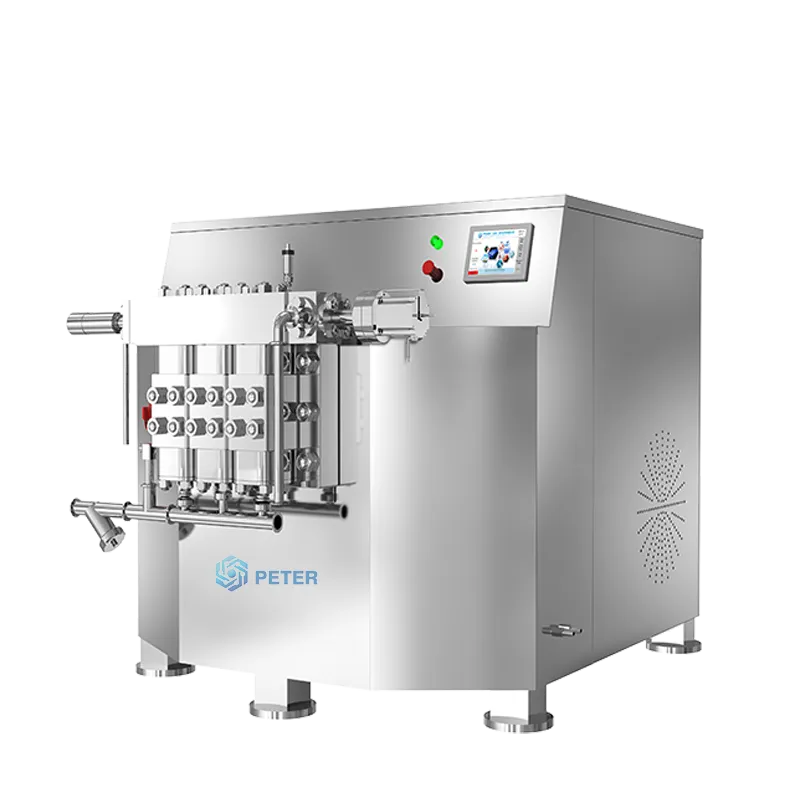
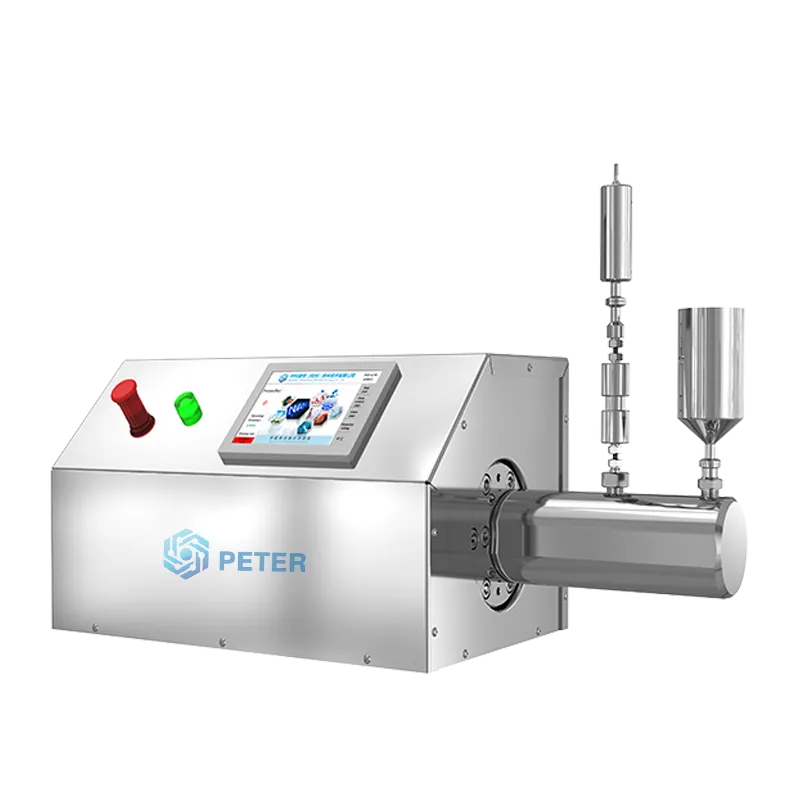
CAS PETER offers the PT-500 production homogenizer, the PT-40 pilot platform, and the PTH-20 microfluidizer. The best starting point is a representative material trial with a defined endpoint, not a comparison of maximum pressure alone. More examples are available in the application library.
8. Frequently asked questions
What is a homogenizer used for in the food industry?
It is used to reduce fat or oil droplets, disperse ingredients, improve texture, and slow separation in products such as milk, plant-based beverages, sauces, dressings, and flavor emulsions.
What is the difference between a mixer and a homogenizer?
A mixer mainly distributes bulk ingredients. A homogenizer applies more localized energy to reduce droplets, break agglomerates, or disrupt cells. Many production lines use a mixer first and a homogenizer second.
Can homogenization reduce particle size?
It can reduce droplets and break soft agglomerates. Whether it reduces hard primary particles depends on the material and mechanism; abrasive grinding applications may require a bead mill.
How many passes are needed?
One to three passes are common in high-pressure work, but there is no universal number. Stop when the target result reaches a plateau or when additional passes add heat without meaningful improvement.
Does homogenization heat the product?
Yes. Mechanical and pressure energy becomes heat. Heat-sensitive products often require a cooled feed, an external heat exchanger, or controlled pauses between passes.
What causes poor homogenization results?
Common causes include weak premixing, oversized feed particles, unstable pressure or flow, insufficient cooling, the wrong number of passes, worn processing parts, and an endpoint that was never clearly defined.
9. References
Choosing homogenizer equipment starts with the product, not the catalog. Send CAS PETER your formulation, throughput, and target result for a practical equipment recommendation.