

What Is a Homogenizer Machine? Functions and Selection Tips
When a lab manager receives a sample that separates after mixing, the instinct is often to increase speed or buy a larger motor. That decision can miss the real issue: a homogenizer machine is a process system whose result depends on the energy mechanism, feed condition, exposure history, heat removal and measurement method. A rotor-stator head, a high-pressure interaction zone, a probe tool and a bead vessel can all be described as homogenizers while producing different stress fields and different recovery losses. The practical question is therefore not only what the machine is called, but what function the sample requires and how the result will be verified. This guide defines the equipment in process terms, compares common routes and gives lab managers, materials researchers and procurement teams a defensible selection path.
Summary: A homogenizer machine reduces variation in a mixture by applying controlled mechanical energy to disperse, emulsify, suspend, disrupt or otherwise standardize a sample. The short list of variables is simple—sample composition, viscosity, solids, target endpoint, temperature limit, throughput, cleaning and recovery—but the correct machine depends on their interaction. ISO 13320 covers laser diffraction and ISO 22412 covers dynamic light scattering; they are different measurement methods, so the analytical endpoint must be selected before equipment is compared. Define the sample envelope, run a representative trial, record heat and recovery, and specify the acceptance test before choosing a model.
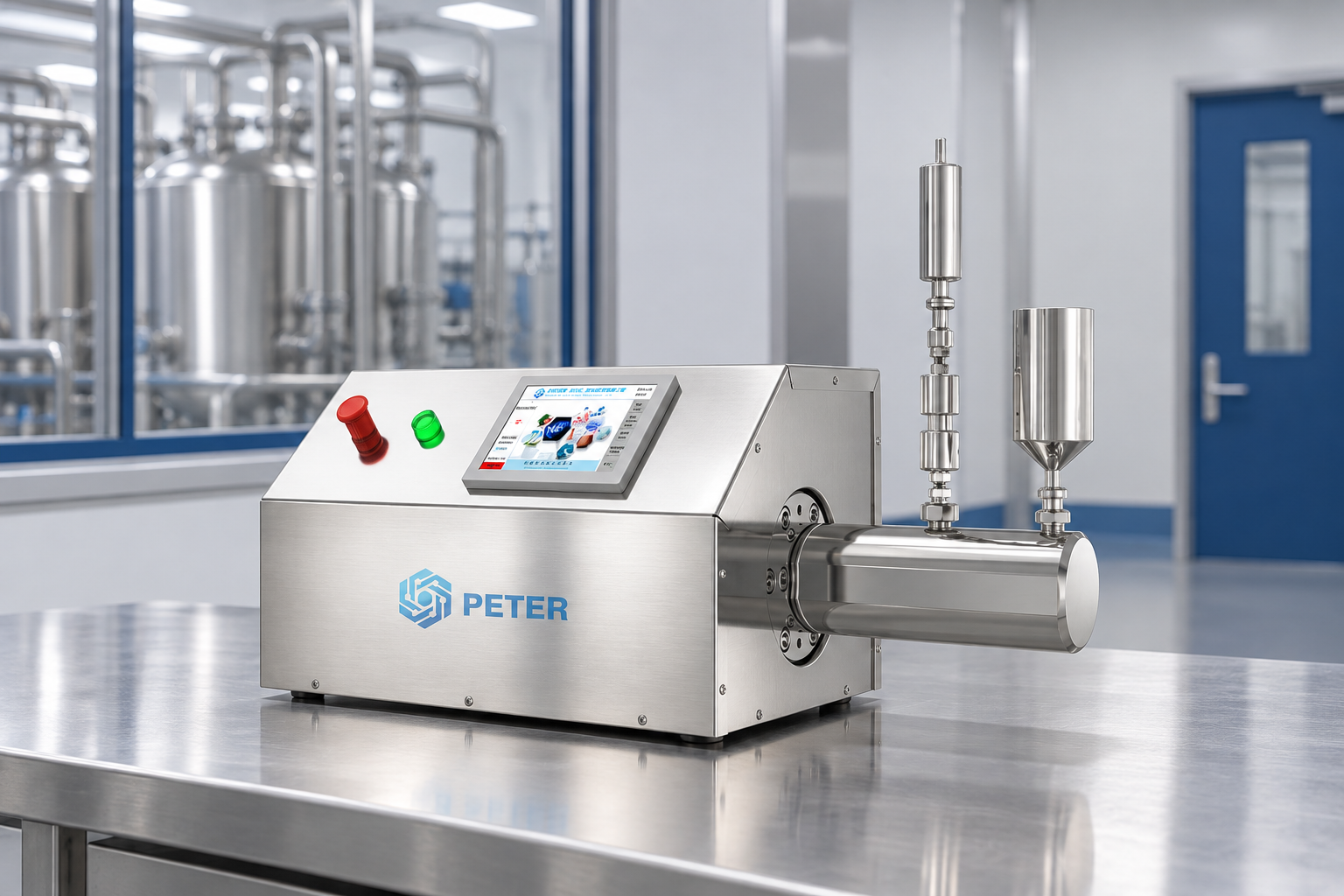
What is a homogenizer machine in process terms?
In process terms, a homogenizer machine is equipment that applies mechanical energy to a heterogeneous material so its phases, particles, cells or droplets become more uniformly distributed or reach a defined disruption state. The machine may use a rotor-stator gap, a pressure-driven interaction zone, a probe, a vessel with beads or another documented mechanism. “Homogenized” should therefore be linked to an observable result—such as a particle-size distribution, droplet-size distribution, extraction yield, viscosity range, microscopy score or cell-lysis endpoint—rather than to the appearance of the batch alone.
People searching what is a homogenizer machine may be comparing laboratory tools with production equipment. The distinction is useful: laboratory equipment is often optimized for small samples, quick iteration and flexible setup, while production equipment must sustain a defined throughput, cleaning route, utility load and service plan. A small machine can still require disciplined controls; a large machine can still fail if its feed contains gas, oversized particles or incompatible chemistry.
The query what is homogenizer machine is also used for broad catalog searches, so procurement should translate the term into a written user requirement. If a catalog repeats the shorter phrase what is homogenizer machine, treat it as a prompt to ask about function, sample path and endpoint rather than as a defined equipment class. State whether the material is a liquid, suspension, paste, emulsion, tissue, cell culture or powder-to-liquid system; then state the desired endpoint and how it will be measured. This prevents a supplier from selecting a configuration from a vague category label.
Which functions can a homogenizer perform?
A machine can perform several functions, but no single mechanism is automatically best for all of them. Dispersion breaks agglomerates and distributes a solid phase; emulsification divides one liquid phase into another; suspension keeps solids distributed; cell disruption opens biological structures; and pre-mixing prepares a feed for a later high-pressure or filtration step. The function is determined by the material and process conditions, not by a marketing adjective.
In this context, high speed homogenization normally refers to rapid mechanical mixing with a rotor-stator or similar head. It can be useful for wetting powders, making a coarse emulsion or preparing a consistent feed, but the endpoint depends on head geometry, tip speed, viscosity, vessel shape, batch volume, air entrainment and residence time. High speed does not by itself define a particle-size result or prove that the formulation will remain stable after storage.
In contrast, a pressure-driven system sends a pumpable feed through a controlled restriction or interaction zone. A pressure drop can create turbulence, shear, impact and decompression effects, while cooling manages the associated temperature rise. A bead mill introduces collision and friction in a contained vessel. A hand or probe tool gives an operator flexible access to small samples but can be sensitive to depth, timing and motion. Each function should be connected to an acceptance test before the machine type is selected.
| Machine route | Primary function | Control variables | Main selection boundary |
|---|---|---|---|
| Rotor-stator or high-speed head | Wet-out, coarse dispersion, blending and emulsification | Speed, gap, head geometry, fill level, time and temperature | Air entrainment, local heat and operator or vessel dependence |
| High-pressure homogenizer | Repeatable fluid dispersion, emulsification or cell disruption | Pressure differential, flow, interaction geometry, passes and cooling | Requires a stable, pumpable feed and pressure-compatible path |
| Probe or hand homogenizer | Fast small-volume tissue, sample or formulation preparation | Immersion depth, motion, time, vessel and operator technique | Repeatability and recovery can vary with manual handling |
| Bead or ball mill | Impact-assisted milling, lysis or deagglomeration | Bead material, size, charge, speed, fill, time and cooling | Wear debris, wall retention and heat must be measured |
How does high speed homogenization differ from high-pressure processing?
high speed homogenization delivers energy locally through a rapidly moving head. It is often practical for a bench vessel because the sample can be inspected and adjusted quickly. Its process history is shaped by head position, batch geometry, air entrainment, viscosity and the operator’s decision to stop. It is a useful screening and pre-mixing route when those variables are controlled and the acceptance endpoint is modest or formulation-specific.
High-pressure equipment separates feed transport from the interaction zone. A pump establishes pressure against a defined restriction, then the pressure differential is converted into local velocity gradients and energy dissipation. Pressure is only one input; inlet stability, gas content, viscosity, temperature, flow and pass count also influence the result. The high-pressure homogenizer working-principle guide explains why a pressure reading cannot replace a complete trial record.
For a biological application, the selected route should protect the required assay and temperature window while meeting the disruption target. CAS PETER’s cell-lysis guide is a useful reference for linking sample condition, passes, cooling and downstream analysis. Buyers should still confirm actual configuration, wetted materials and acceptance conditions for their sample.
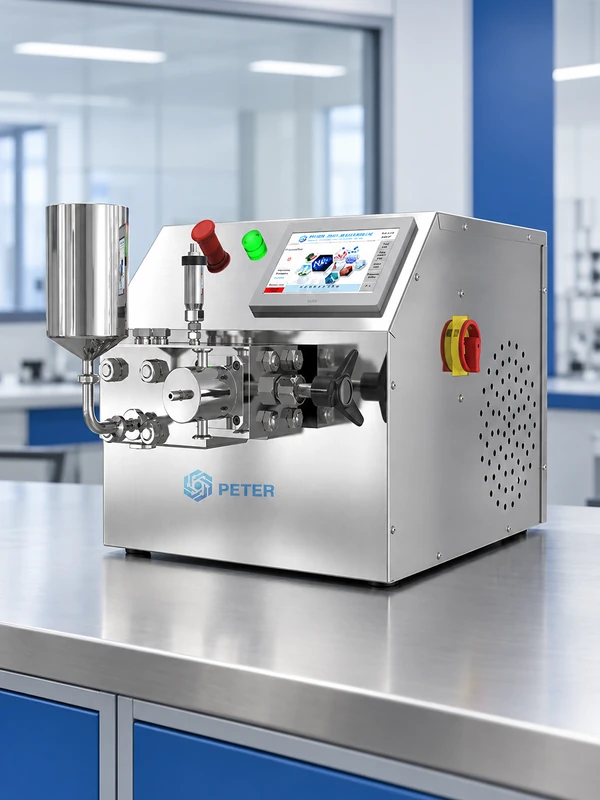
Which sample and material factors should be checked first?
Start by describing the material before discussing a machine. Record viscosity at the intended temperature, solids concentration, largest particle or agglomerate, pH, solvent, abrasiveness, volatility, oxygen sensitivity and any tendency to foam. State whether the sample can tolerate bead contact, a metal probe, recirculation, pressure, shear or a rise in temperature. Check the compatibility of all wetted materials, seals, vessels, beads and disposables; a suitable motor cannot correct a chemically unsuitable sample path.
Powders may require wetting and deagglomeration before a pump can fill consistently. Fibers or oversized particles can obstruct a narrow interaction zone. Viscous emulsions can require a controlled feed temperature and inlet arrangement. Biological samples may require a buffer, a defined cell-viability window and a downstream assay that is sensitive to heat or foaming. These are selection requirements, not after-the-fact troubleshooting notes.
Recovery must be part of compatibility. Weigh loaded and discharged material, inspect vessel walls and shafts, record line hold-up and include flush or transfer losses. When a sample is expensive or scarce, the route with the smallest nominal volume is not necessarily the route with the highest usable recovery.
How should heat and recovery be validated?
Mechanical energy becomes heat, although the location and magnitude depend on the mechanism. A high-speed head can warm a small batch around the rotor; a ball mill can retain heat inside a closed vessel; and a high-pressure system can show a substantial immediate outlet rise before cooling. Record feed, immediate outlet, cooled outlet, coolant condition and hold time. A single cooled reading can hide a transient that altered a protein, solvent, cell or emulsion.
Use a pre-defined thermal limit where the formulation has a known sensitivity, and verify it with a calibrated measurement method suitable for the vessel and flow path. If the endpoint improves only after a temperature rise, run a control that separates thermal exposure from mechanical exposure. This prevents the team from crediting the machine for a result caused by uncontrolled heating.
Recovery data should be paired with the quality endpoint. A process that reaches a smaller apparent particle size but loses material to a vessel, line, filter or cleaning step may have a higher cost per accepted batch. Include usable mass, waste mass, cleaning time, consumables and rework when comparing total cost.
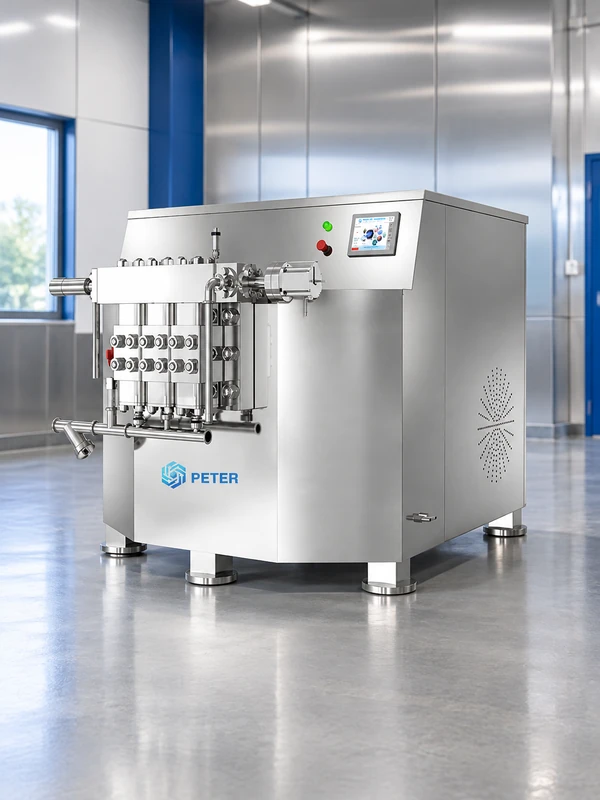
What practical selection checklist should a lab manager use?
The following table turns a broad what is a homogenizer machine search into a purchase brief that suppliers and internal users can review together.
| Selection question | Record or test | Decision consequence |
|---|---|---|
| What must the machine change? | Particle or droplet distribution, extraction yield, viscosity, microscopy or lysis endpoint | Selects the energy mechanism and analytical method |
| What is the feed envelope? | Volume, viscosity, solids, gas, particle size, chemistry and temperature | Rules out incompatible heads, vessels, seals or pressure paths |
| How repeatable must the output be? | Replicate runs, operator effect, route, passes, speed or pressure and sample age | Determines whether manual control is acceptable or automated history is needed |
| How will heat be managed? | Inlet, immediate outlet, cooled outlet, coolant and maximum hold | Sets cooling, batch size, pass count or alternative process requirements |
| What is the real throughput? | Accepted mass per hour or batch after setup, cleaning and recovery losses | Prevents maximum flow from being mistaken for usable capacity |
| How will the machine be supported? | Wear parts, spares, service interval, training, documentation and acceptance test | Converts maintenance and downtime into a visible ownership cost |
For early process work, the CAS PETER product range lets buyers review experimental and production-type homogenization categories. The PT-20 page and PT-40 pilot page can help frame questions about laboratory-to-pilot transitions; model ratings, wetted materials, utilities and options should be confirmed in the quotation and representative trial. The objective is a documented fit, not a generic machine class.
How can troubleshooting distinguish a process problem from a machine problem?
First repeat the run with a fixed sample preparation, vessel fill, temperature and sampling point. If an operator-led result changes, lock the probe depth, motion, time and vessel geometry. If a ball or bead process drifts, check bead charge, wear, wall coating, seal condition, speed and cooling. If a high-pressure process pulses, inspect gas entrainment, inlet head, suction leaks, feed viscosity, filter condition, valve wear and actual flow before changing the pressure setpoint.
A measurement disagreement can be a method problem. ISO 13320 and ISO 22412 are separate standards for different particle-size approaches; a laser-diffraction result, a dynamic-light-scattering result and microscopy should not be treated as interchangeable without a method bridge. Document dilution, dispersant, instrument settings, replicate rule, sample age and data treatment. If the method is unstable, equipment comparisons will be unstable as well.
Escalate immediately when a pressure boundary leaks, a vessel or shaft is damaged, a safety interlock fails, contamination cannot be ruled out or the accepted endpoint cannot be restored after basic checks. Use the supplier’s maintenance instructions and site safety procedures; do not bypass a control or improvise a pressure repair to keep a run moving.
What type of homogenizer machine is best for homogenizer selection and operation?
The best type is determined by the sample, endpoint and required process history. Use a rotor-stator or probe route for flexible small-batch screening when operator and vessel variables can be controlled. Use a bead or ball mill when collision-assisted treatment is appropriate and bead compatibility, heat and recovery are accepted. Use high-pressure equipment when the feed is pumpable and the process needs defined pressure, flow, cooling, passes and scale-up evidence.
Run the shortlisted routes on representative material with the same analytical method, acceptance limit and sampling plan. A visible reduction in agglomeration is useful evidence only when it is connected to the property the buyer must release or reproduce.
How do you choose a homogenizer machine?
Write the feed envelope and quality target first, then compare energy mechanism, sample path, temperature control, throughput, recovery, cleaning, utilities, wear parts and service. Ask for a trial protocol that records operating conditions and defines a pass or fail rule. The quotation should identify what is included in the configuration and which ratings require a specific material, temperature or flow condition.
When should high speed homogenization be considered?
Consider high speed homogenization when a rotor-stator head can deliver the required wet-out, coarse dispersion or emulsion under a controlled vessel and temperature window. It is often a practical screening or pre-mixing step, but it may be unsuitable when the sample needs a tightly documented flow history, very low contamination risk, a narrow thermal window or an endpoint that depends on multiple controlled passes. Confirm the result with the method and hold-time test that matter to the application.
What maintenance does a homogenizer machine need?
Inspect and clean the sample path after each use according to the supplied procedure. Check rotor-stator or probe surfaces, shafts, seals, vessel closures and bearings; for high-pressure equipment, also trend pressure stability and inspect valves, seals, gauges, filters and cooling components. Document wear criteria, spare lead times, safe disassembly and post-service acceptance testing. Maintenance is complete only when the machine is clean, safe and able to reproduce the defined endpoint.
References
- ISO 13320:2020, Particle size analysis — Laser diffraction methods.
- ISO 22412:2017, Particle size analysis — Dynamic light scattering.
- U.S. FDA, Process Validation: General Principles and Practices (2011).
- ICH Q8(R2), Pharmaceutical Development.
- U.S. eCFR, 21 CFR 211.110, in-process controls and tests.
Conclusion
A homogenizer machine is best understood as a controlled energy-and-measurement system rather than a universal mixer. Define what must change in the sample, confirm compatibility, select a mechanism that can deliver that change, and verify heat, recovery, throughput and maintenance at the intended duty point. Keep the analytical method and acceptance rule fixed while comparing routes; ISO 13320 or ISO 22412 can define a measurement method, but neither certifies equipment performance. CAS PETER’s homogenizer range gives procurement teams a starting point for configuration and trial discussion. The defensible choice is the machine that reproduces the required endpoint with a documented, supportable process history.