

Yeast Protein Recovery After Homogenization: Follow the Final Ingredient
Yeast protein recovery after homogenization should be judged by the protein collected in the intended product stream, its composition and its functional performance. A high disruption percentage alone cannot establish recovery: released protein can remain with debris, precipitate during a pH change, or be lost during washing. For a food ingredient, the useful endpoint may be a redispersible protein concentrate rather than maximum soluble material immediately after rupture. Build the trial around measured feed, supernatant, pellet and final ingredient quantities, then compare recovery and application performance together.
This guide addresses downstream recovery from disrupted yeast. Use the separate yeast cell disruption guide when the main question is opening the cell wall. Here the decision is whether an additional processing step actually delivers more useful protein after separation.
Define the recovered ingredient before adjusting the machine
Start with the intended ingredient specification. A soluble extract, an acid-precipitated concentrate and a whole disrupted biomass ingredient contain different fractions. Their recovery percentages cannot be compared until the denominator and collection boundaries agree. State whether the feed is intact washed yeast, spent brewing yeast, an autolysate or a commercial protein powder. Processing an already isolated powder does not demonstrate extraction from intact cells.
Write down the intended use as well. An emulsifier needs performance at the food’s pH, salt concentration and oil loading. A beverage ingredient may need low sediment and acceptable flavor. An enzyme product needs an activity assay. Total protein concentration answers none of these questions by itself. Choose the main release test before running a pressure series so that an impressive early measurement does not replace the original objective.
The study Spent Yeast Valorization for Food Applications compared extraction approaches across yeast materials and assessed recovered fractions. Its relevance is that biomass identity and extraction route matter. Its results are not a universal prediction for a different yeast supply, equipment configuration or final ingredient.
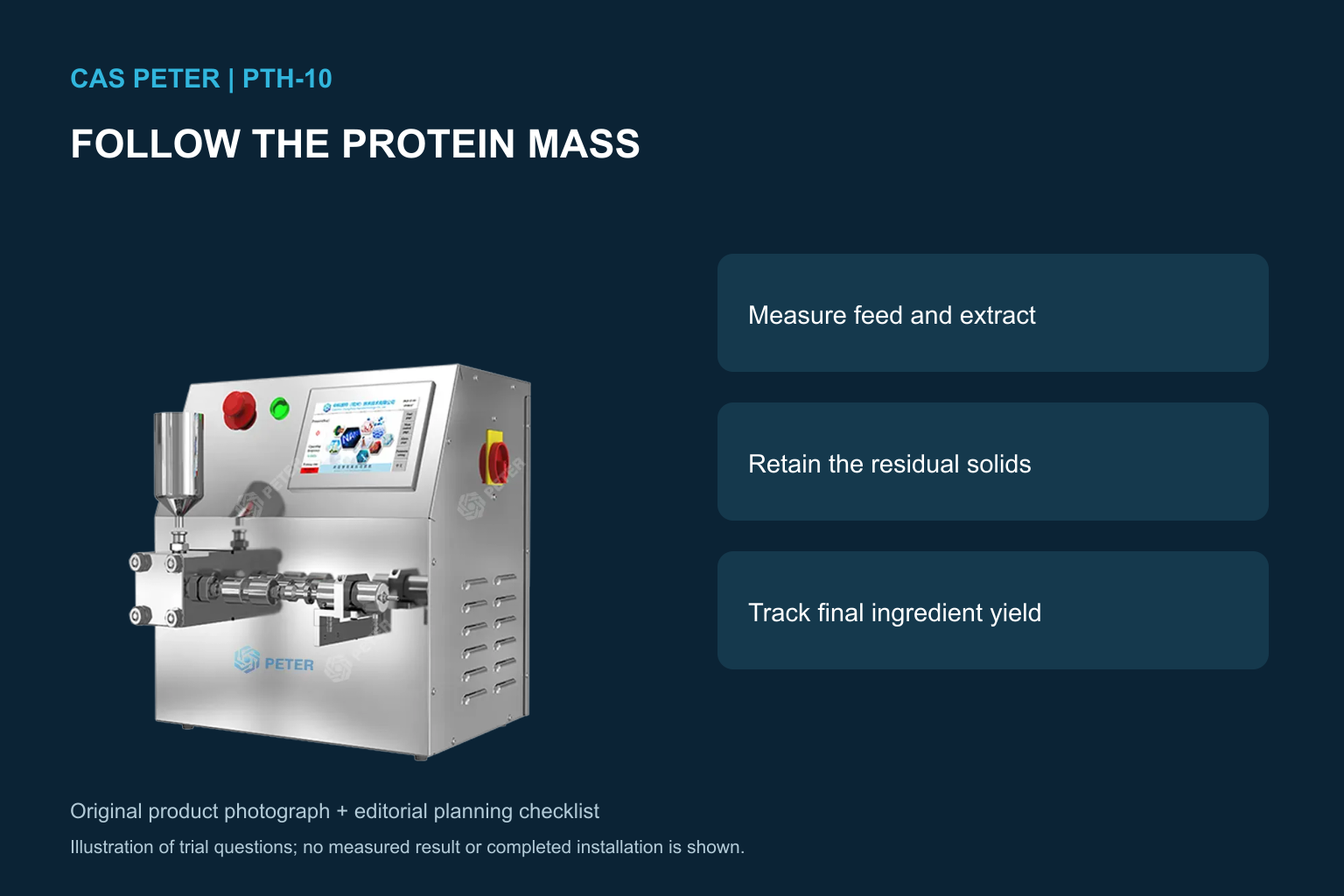
Build a protein balance that follows every separation
Use a consistent analytical method for feed and recovered fractions, with appropriate preparation and blank correction. Record wet mass or volume as well as protein concentration. A concentrated supernatant can contain less total protein than a more dilute one. If the assay reports nitrogen-derived protein, retain the conversion basis and assess whether nonprotein nitrogen affects comparison between fractions.
A practical calculation is:
Protein recovery (%) = 100 × protein mass in the specified recovered fraction / protein mass in the defined feed.
Protein mass is concentration multiplied by the corresponding stream volume when concentration is expressed per volume. Use compatible units. If concentration is in grams per litre and volume is in litres, the result is grams. For a dry ingredient, determine dry mass and its measured protein fraction instead. Do not mix wet-basis and dry-basis concentrations in the same calculation.
For an illustrative calculation only, suppose an initial batch contains 12 g of measured protein and the collected extract contains 7.2 g. Recovery to that extract is 60%. If subsequent precipitation and washing leave 4.8 g in the final ingredient, overall recovery is 40%, even though the first extraction looked stronger. These are invented arithmetic inputs, not CAS PETER test results or expected yields.
Account for analytical samples, retained liquid, washings and equipment hold-up. A balance that does not close is a reason to investigate sampling and assays before attributing loss to pressure damage. Report unexplained differences instead of forcing fractions to total exactly one hundred percent.
Separate extraction, clarification and precipitation effects
Clarification determines which released materials enter the extract. Fix centrifugation conditions using relative centrifugal force, duration and temperature, or define the filtration medium and operating conditions. Rotational speed alone does not describe equivalent separation across different rotors. Record how long the disrupted suspension waits before clarification, because an uncontrolled hold changes the comparison.
Precipitation introduces another decision. Changing pH can transfer protein from supernatant into a recoverable pellet, but the collected material may redisperse differently later. The primary study on pH-controlled yeast protein precipitation examined proteins collected at different precipitation pH values and their later emulsion behavior. This supports testing the isolated ingredient after redispersion; it does not establish a single optimum precipitation pH for every yeast product.
Keep neutralization, wash volume and redispersion conditions consistent. Measure the pH after sufficient equilibration rather than assuming the amount of acid or base added guarantees the same endpoint. Include dilution and salt introduced by adjustment in the final mass balance. A more intensive wash can improve purity while decreasing overall recovery, and both changes belong in the result.
Use matched controls to locate the actual loss
Split a representative feed into matched portions. Retain an unprocessed control and define the reference extraction route. When comparing a pretreatment followed by homogenization, include the pretreatment without homogenization if that comparison is needed to identify its contribution. Avoid changing pretreatment, pressure, separation and drying simultaneously and then crediting the entire difference to the machine.
Sample at defined points: prepared feed, disrupted suspension, clarified extract, recovered precipitate and final redispersed ingredient. Keep enough material for repeat assays and an application test. Use sample labels that identify the batch and the exact collection stage. Similar-looking cloudy liquids are easy to confuse when several pressure conditions are running together.
The following decision table is an editorial trial-planning framework. It contains no recommended pressure setting or guaranteed recovery threshold; the research above provides the context for separating processing stages.
| Observation | First comparison | Useful follow-up | Decision it informs |
|---|---|---|---|
| More disrupted cells but unchanged extract protein | Equal biomass input and identical clarification | Protein in the residual solids | Whether extraction or separation is limiting |
| Higher extract concentration but lower collected volume | Total protein mass in the extract | Liquid retained in debris and equipment | Whether apparent improvement is concentration only |
| High precipitation recovery but poor redispersion | Same redispersion pH and mixing history | Sediment and soluble fraction after reconstitution | Whether the ingredient suits its final use |
| Lower final yield after washing | Protein in each wash fraction | Purity gain against recovered mass | Whether the wash sequence is justified |
| Good total protein but weak application performance | Matched ingredient dose in the application | Emulsion stability or the relevant activity assay | Whether functional quality limits acceptance |
Control heat and hold time without assuming a universal limit
Log inlet and outlet temperature for each processing condition. Include cooling between passes and the cumulative duration of the run. A final cold sample does not prove that the material avoided earlier heating. If temperature differs systematically between conditions, pressure and heat effects cannot be separated confidently.
Set an allowable temperature and hold-time window from the actual ingredient objective and supporting validation. Do not borrow a limit from an unrelated enzyme or protein. If preserving an active enzyme is the goal, the enzyme activity recovery guide explains why activity and total protein need separate measurements. A food protein concentrate may have different acceptance criteria, but still requires controlled processing history.
Also document storage before processing. Fresh yeast and a stored spent-yeast slurry may have different starting compositions and degrees of degradation. Compare pressure conditions within a common material lot first, then check robustness across representative lots. One favorable batch is not enough to establish a purchase specification or routine process window.
Test the recovered material in its intended medium
Redisperse recovered ingredients using a written procedure: ingredient concentration, water quality, pH, temperature, mixing method and hydration time. Measure the fraction that remains dispersed under the conditions the customer will actually use. An ingredient that disperses in a dilute laboratory buffer may behave differently in a salted, acidified food.
For an emulsifier application, compare equal measured protein doses, rather than equal masses of ingredients with different purity. Keep the oil phase and emulsification method constant. Examine initial droplet behavior and the chosen storage endpoint. For a beverage application, document sediment, appearance and the relevant sensory requirements through the proposed life of the product.
Avoid interpreting every increase in turbidity as a loss of protein or every clearer liquid as improved purity. Suspended fragments, aggregates and other components can change optical appearance. Use a suitable assay and inspect the solids when an apparent recovery change is large. A functional result should be reproducible with a second independently prepared sample.
Match equipment discussions to the complete recovery route
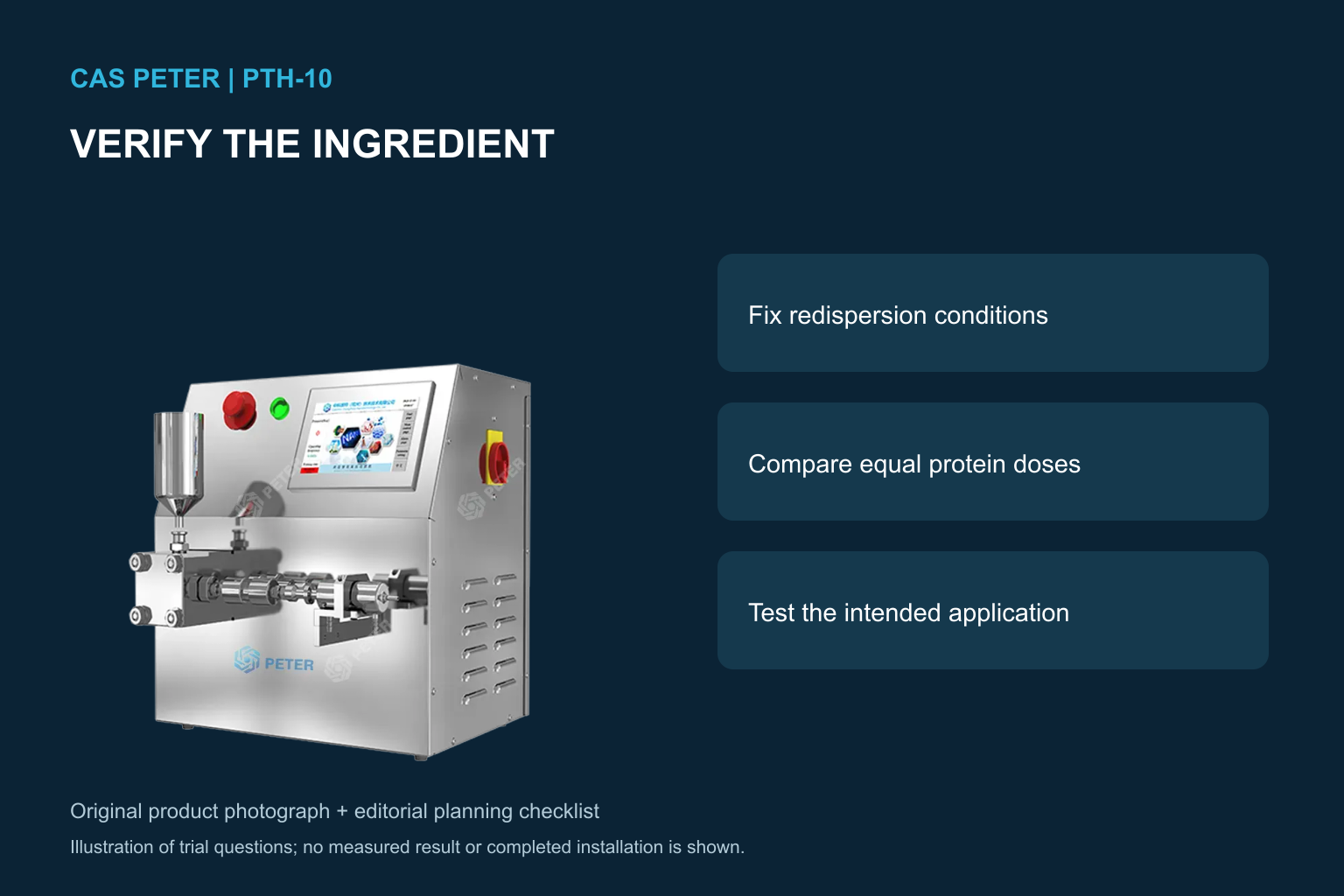
The CAS PETER PTH-10 microfluidizer is a real product to discuss for laboratory process-development work. Its photograph illustrates equipment selection, not a completed yeast-protein production line. Confirm feed suitability, wetted materials, cooling, working volume, hold-up and cleaning with the supplier for the proposed suspension. A paper using another machine does not prove identical rupture or recovery on this model.
Send the supplier the whole recovery route, including solids removal and precipitation. Ask how samples will be collected reproducibly and how much product remains in the system. Small-batch recovery can be strongly affected by hold-up, making this a practical selection issue rather than an accounting detail. The broader cell lysis equipment guide provides context for that discussion.
Agree on trial acceptance in advance: overall recovered protein mass, ingredient purity, redispersion behavior, application performance and repeatability. Compare those results with processing time, utility demand and downstream workload. An extra pass is useful only if its benefit survives the remaining operations.
Further learning: protein purification
The NPTEL IIT Kharagpur lesson below introduces protein purification techniques. It provides background for thinking about recovered fractions and separation steps; it is not a yeast-specific production recipe or validation of a CAS PETER operating condition.
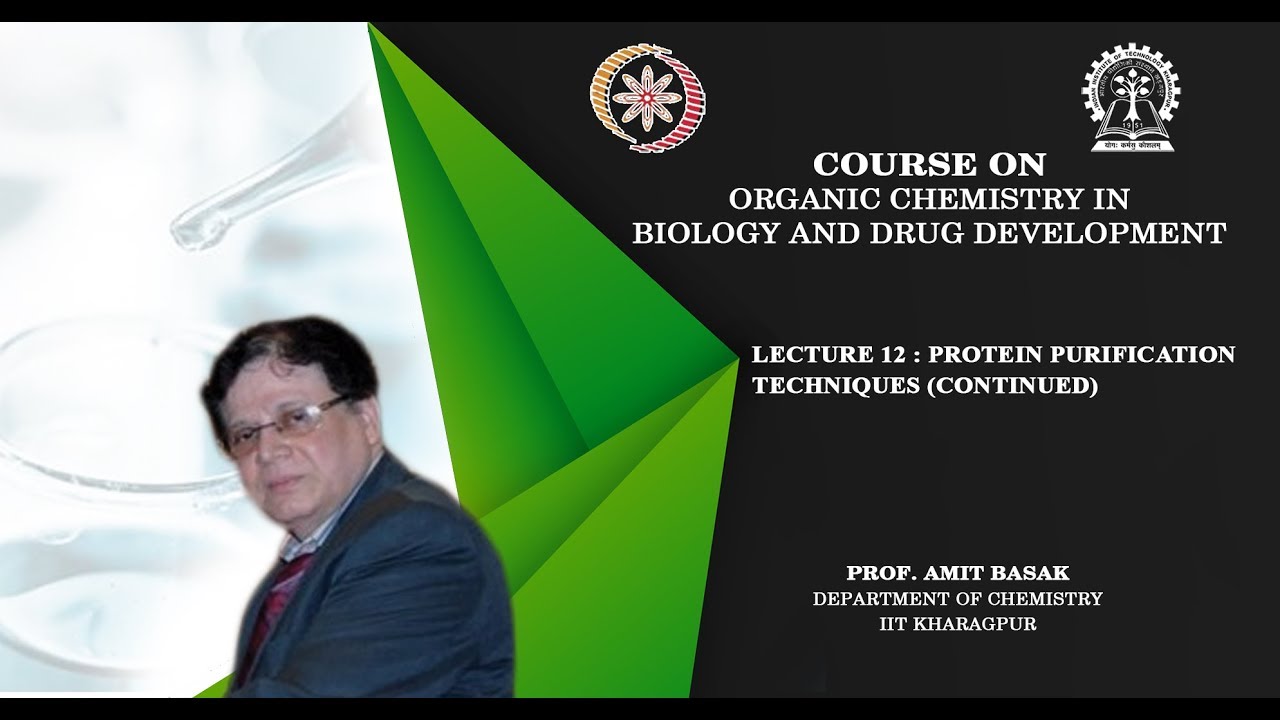
Educational source: NPTEL IIT Kharagpur. Watch the lesson on YouTube.
Frequently asked questions
Does a high yeast disruption percentage guarantee high protein recovery?
No. Disruption describes opening cells, while recovery depends on the specified collected fraction after separation and further processing. Measure protein mass in the feed, extract, residual solids and final ingredient to identify where losses occur.
Can two extraction routes be compared using supernatant concentration alone?
No. Include the collected volume and the protein initially present in each feed portion. The routes must also use compatible assays and the same recovery boundary; otherwise a concentration difference may simply reflect dilution or liquid loss.
Should the highest recovery condition always be selected?
No. Select a condition that also meets purity, redispersion and application requirements. A larger collected protein mass can still be unsuitable if downstream treatment creates sediment, unacceptable composition or poor functional performance.