

What Safety Devices Should a High-Pressure Homogenizer Have?
A machine may have an emergency-stop button and still leave important pressure hazards unresolved. The button does not identify where trapped pressure can remain, show whether a relief discharge is safe, or prove that a guard prevents access during a hazardous movement. Buyers need to assess the installed system, including its connected pipework and operating procedures, rather than count visible safety devices. The exact design depends on the machine and its application, so a generic shopping list is not a substitute for a risk assessment. This guide explains the protection functions to specify and the records needed to show how they work together.
A high pressure homogenizer needs suitable overpressure protection, guarding, safe stopping and restart behavior, pressure indication, and provisions for controlled isolation and depressurization. Interlocks should address the hazards identified for the installed configuration, such as access to moving parts or unsafe feed and utility conditions where relevant. A relief device and a control-system pressure limit have different roles; neither should be assumed to replace the other. Ask the supplier for documented safe limits, a protection description, inspection requirements and machine-specific procedures. Apply the safety requirements of the destination jurisdiction and have competent personnel review the complete installation.
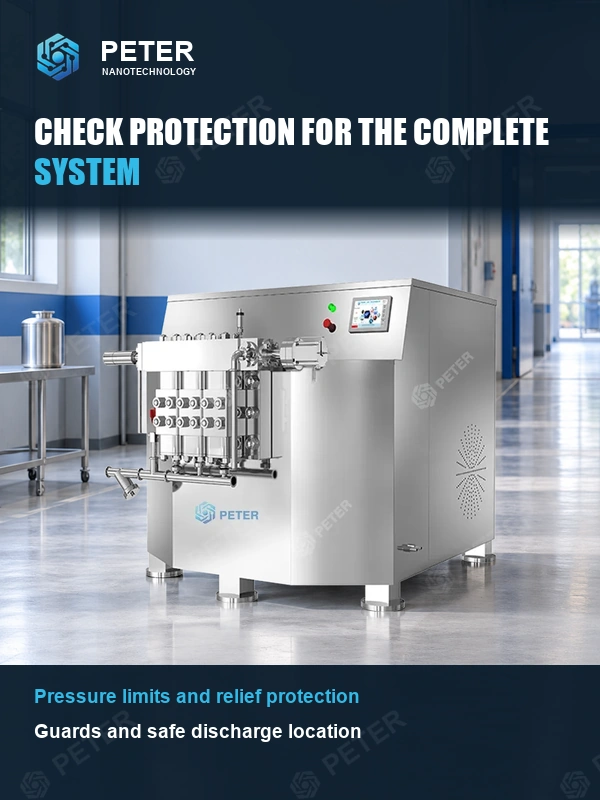
Check protection for the complete system
Pressure protection must consider the machine and anything connected to it. A component’s allowable pressure and temperature, the possibility of a blocked flow path, and the destination of any discharge all matter. The Tetra Pak handbook explicitly discusses the need for a protective device when flow downstream of a positive-displacement high-pressure pump can be stopped.
A homogenizer pressure relief valve must be selected and set through the approved design process. Depending on the system, another suitable protective device may be specified. Do not adjust a setting to stop nuisance trips without investigating the cause and obtaining authorized engineering review. The lowest-rated relevant component can matter more than the machine’s headline pressure rating.
When assessing a production high-pressure homogenizer, request the scope of supply for pressure protection and connected pipework. Clarify which safeguards are on the machine and which remain the installer’s responsibility.
| Protection function | What the acceptance review should establish | Common misunderstanding |
|---|---|---|
| Overpressure protection | Device suitability, settings, capacity and safe discharge arrangement | The normal pressure controller covers every failure |
| Guarding and access control | Hazardous areas, access conditions and protection against foreseeable contact | A removable cover is always an interlocked guard |
| Emergency stop and restart control | Defined stopping behavior and deliberate safe restart | An emergency stop removes all stored energy |
| Pressure indication and alarms | Relevant measurement locations and documented response | One displayed zero proves every section is depressurized |
| Energy isolation | Identified isolating points and verified control of residual energy | A screen button is an energy-isolating device |
Specify what each interlock is meant to prevent
The useful question is not “How many interlocks are fitted?” but “Which hazardous event does each one prevent, and how is that function checked?” Depending on the assessment, the design may include access-related functions or monitoring of feed, cooling, lubrication or other required conditions. These are examples for review, not a statement that every CAS PETER model has those functions.
For each homogenizer safety interlock, request the triggering condition, resulting machine response, reset conditions, test method and responsible person. Avoid casually calling every process alarm a safety function. Where a safety-related control system is required, its required performance and validation belong to the competent design assessment.
Acceptance checks should use the supplier’s approved test procedure. Do not defeat a guard or create a hazardous blockage simply to see whether a trip works. Keep evidence of the approved checks and retain the settings under change control.
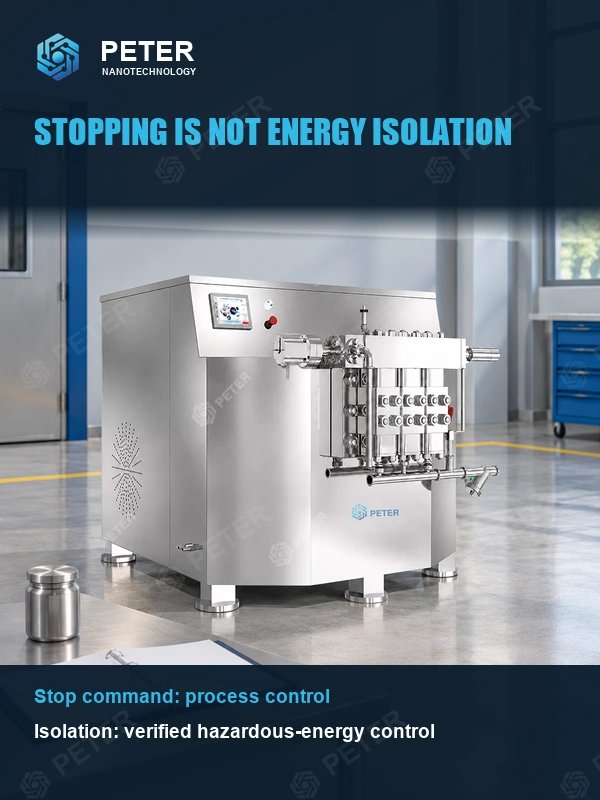
Stopping is not energy isolation
A normal stop or emergency stop may leave stored pressure, electrical energy or another hazard in the system. Maintenance needs the machine-specific hazardous-energy procedure, not an improvised instruction to switch off power and loosen a fitting. US 29 CFR 1910.147 addresses hazardous-energy control during servicing and maintenance where it applies; push buttons and similar control devices are not energy-isolating devices.
The authorized procedure should identify isolation points, control residual energy and define how a safe condition is verified before work. Trapped sections and possible reaccumulation need consideration. Depressurization must use the designed route; opening a union or cracking a fitting is not a substitute for that procedure.
For a production homogenizer system, request a clear isolation-point description and the operating and maintenance manuals as part of the technical package. The equipment listing is a starting point for procurement, not a safe-work instruction.
Pipework and discharge arrangements deserve their own review
A well-protected pump does not make unsuitable piping acceptable. Verify the specified pressure and temperature envelope, connections, support, inspection requirements and any required shielding. The assessment should account for the fluid released during a fault, including its temperature and chemical hazards, as well as the stored energy.
The HSE pressure-systems guidance highlights failure of pressure-containing equipment, released fluid and poor installation or maintenance as sources of harm. It also calls for suitable protective devices and safe operating limits. Determine which legal requirements apply to the actual fluid and installation; not every liquid-only system falls under the same statutory examination regime.
The site’s utilities and installation guide provides related procurement questions. Keep access for inspection and maintenance in the layout instead of leaving it to be solved after equipment arrives.
| Document or record | Why it matters at handover |
|---|---|
| Safe operating limits and component scope | Defines the permitted conditions for the complete supplied system |
| Protection and interlock description | Shows the function, response and checking requirements |
| Approved isolation and depressurization procedure | Supports safe servicing without improvised pressure release |
| Inspection and maintenance schedule | Keeps protective functions effective after commissioning |
| Site-specific risk and installation review | Addresses hazards introduced by the formulation and surrounding process |
Flammable and aseptic duties are different specifications
Flammable formulations may require a hazardous-area assessment and equipment appropriate to that environment. Aseptic processing instead raises contamination-control and validation questions. Neither requirement can be inferred from the other, and neither is established by a clean-looking stainless-steel enclosure.
Send the intended formulation, operating conditions and installation information before requesting options. Have the supplier state what is included, what is conditional and what must be provided elsewhere in the system. A written boundary of responsibility is more useful than an unexplained “safe” or “explosion-proof” label.
Frequently Asked Questions
What safety devices should a high-pressure homogenizer include?
Specify protection functions for overpressure, hazardous access, safe stopping, restart and energy isolation, then verify the actual design. The required devices and interlocks depend on the machine, connected process and jurisdiction.
Why is a pressure-relief valve required?
A suitable overpressure-protection arrangement protects against conditions such as a blocked discharge that normal control may not safely manage. The approved design determines the appropriate device, setting and discharge route; do not change these informally.
What interlocks should be checked before operation?
Check the functions identified in the risk assessment and supplier documentation, using the approved test procedure. Record the intended trigger and response rather than assuming every alarm is a safety interlock.
How should operators depressurize the system safely?
Operators must follow the machine-specific procedure and use the designed depressurization route. Maintenance may require hazardous-energy isolation and verification by authorized personnel; never loosen fittings to release pressure.
What safeguards are needed around high-pressure piping?
Review ratings, connections, support, access protection, inspection and the consequences of a fluid release. The connected installation must be suitable for the actual pressure, temperature and formulation.
Should explosion-proof or aseptic options be considered for some products?
Yes, where the formulation and process require them, but they address different risks. Confirm the applicable hazardous-area or aseptic requirements and obtain evidence for the supplied configuration rather than relying on a generic product description.
References
- Tetra Pak Dairy Processing Handbook: Homogenizers
- HSE: Pressure systems
- 29 CFR 1910.147: Control of hazardous energy
Conclusion
Specify homogenizer safety as a set of documented protection functions for the complete installation. Begin with the process hazards and safe limits, then review overpressure protection, access, stopping behavior and the means of controlling stored energy. Confirm how each function is tested and maintained, and make the boundary between supplier and installer responsibilities explicit. A relief valve, an interlock and an emergency stop each serve a purpose, but none replaces a safe maintenance procedure. For a CAS PETER equipment proposal, request the configuration-specific documentation and have competent personnel review it against the formulation and site conditions. Acceptance should be based on that evidence, not on the number of buttons or covers visible in a photograph.