

Chitosan Nanoparticle Homogenization: Separate Ionic Gelation from Pressure Processing
Chitosan nanoparticle homogenization requires two separate decisions: how the particles form during ionic gelation, and whether an additional pressure-processing step improves the finished dispersion. A smaller measured size after treatment does not establish better polymer recovery, payload retention, or stability in the intended medium. First identify the mixing equipment used in the reference method, then compare untreated and processed material with the same formulation and analytical preparation. For a high-pressure trial, confirm feed suitability with the equipment supplier before introducing a crosslinked suspension. This guide explains how to evaluate method transfer without treating every use of the word “homogenization” as the same process.
Identify the equipment behind the published method
The term homogenization describes several different mechanical operations. A rotor-driven handheld mixer, a valve homogenizer, and a microfluidizer introduce energy through different flow environments. Rotational speed belongs to a particular motor and mixing head; it cannot be converted directly into a pressure setting. Residence time, batch circulation, cooling, and local reagent concentration also differ. A method described only by its mixing speed is therefore insufficient to define a pressure-processing recipe.
In a chitosan synthesis study using ionic gelation, the researchers used a handheld homogenizer during preparation and then filtered the suspension. That work supports the importance of formulation and purification history. It does not demonstrate an equivalent result from a CAS PETER pressure homogenizer. Treat its equipment description as a boundary on method transfer, rather than presenting the reported particle size as a performance promise for another machine.
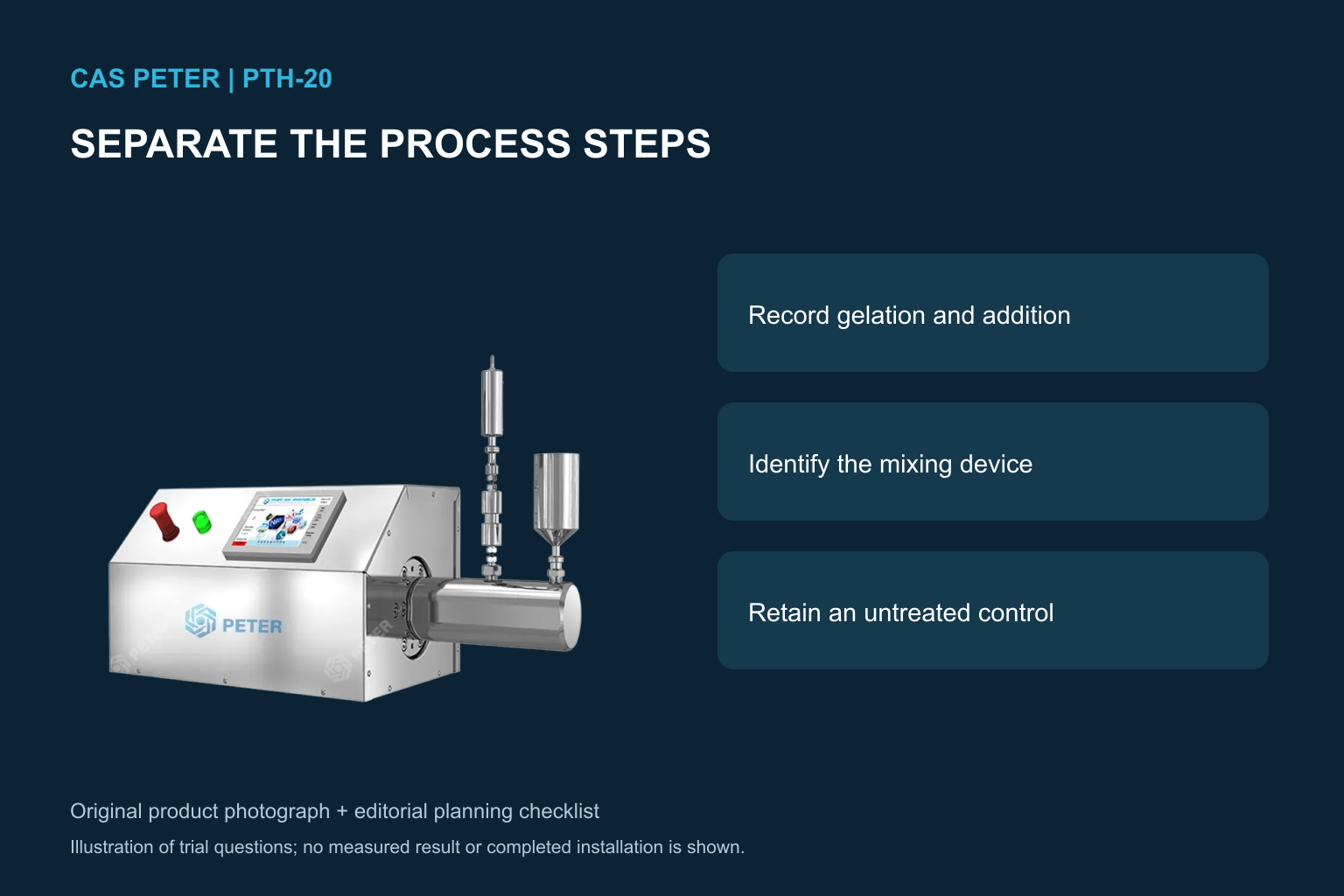
For a laboratory discussion, the CAS PETER PTH-20 product page identifies a real equipment option to review. Its inclusion here illustrates the machine category under consideration; it does not establish that a particular chitosan formulation is compatible or that a specified size is achievable. Confirm the feed condition, wetted materials, cleaning approach, minimum batch requirement, and configuration against current supplier documentation before proposing a trial.
Separate gelation from downstream size adjustment
Ionic gelation commonly brings chitosan together with an oppositely charged crosslinking component such as tripolyphosphate. The material develops while these streams mix. The point of addition, addition sequence, solution concentrations, and waiting time can therefore affect what reaches a later homogenization step. If those variables drift between batches, a pressure comparison may actually compare different starting particles.
A separate experimental ionic-gelation protocol uses controlled dropwise addition under stirring. Its relevance is that particle formation can be organized through reagent delivery and mixing, without assuming that subsequent high-pressure treatment is essential. Neither paper supplies a universal manufacturing recipe. Together, they justify documenting the formation stage before deciding whether additional equipment has a useful role.
Define the proposed process location explicitly. Processing a chitosan solution before crosslinker addition asks a different question from processing a freshly formed suspension. Treating a matured, loaded particle system asks another question again. Keep these as separate experimental routes, with separate controls and acceptance criteria. Do not pool their results under one label such as “homogenized chitosan.”
Establish a starting-material record
For each chitosan lot, retain the supplier identity, grade, available molecular-weight information, degree of deacetylation, preparation solvent, and concentration basis. Distinguish a nominal powder addition from the amount actually dissolved. Record visible insoluble material and the handling used to remove it. A filter or clarification step can change the starting population before the intended trial has begun.
Document crosslinker preparation just as carefully. Record reagent identity, concentration, pH adjustment, temperature, addition rate, and time elapsed before sampling. If pH or conductivity changes during preparation, measure the final suspension as well as the separate starting solutions. These observations help distinguish a formulation change from a mechanical-processing effect without requiring unsupported assumptions about the mechanism.
Use one parent batch split into matched portions when practical. Retain an untreated portion over the same elapsed time and temperature history. If independent preparations are necessary, include independent repeats rather than treating repeated measurements from one vial as proof of batch reproducibility. State which type of repeat each result represents.
Build a trial around a defined question
Start with a question that can change a process decision. Examples include whether pressure treatment reduces persistent aggregates without lowering usable recovery, or whether a dispersion remains reproducible after transfer into its intended test medium. Avoid an unrestricted objective such as making the smallest possible particles. That objective leaves no clear stopping point and ignores whether the particle system still performs its intended role.
The table below is an editorial trial-planning framework based on the process distinctions above. It gives qualitative checks, not validated operating limits or published equipment settings.
| Trial question | Hold constant | Measure alongside particle size | Decision consequence |
|---|---|---|---|
| Does processing alter an already formed suspension? | One parent batch, maturation time, sampling delay | Recovered polymer, visible solids, temperature history | Continue only if the usable fraction meets the stated requirement |
| Is the change caused by filtration? | Filter material, handling, sampled volume | Feed and filtrate size, retained material, mass recovery | Report filtration and pressure effects separately |
| Does the final medium destabilize the particles? | Dilution ratio, medium composition, mixing order | Time-dependent size, turbidity, sediment, payload retention | Reconsider formulation or handling before adding more passes |
| Is the result reproducible? | Ingredient lots and documented preparation | Independent-batch variation and analytical repeatability | Set the next trial around the dominant source of variation |
Agree on the evaluation sequence before running equipment. Take a feed sample, a sample after the proposed mechanical step, and samples before and after any purification. Use consistent labels that include batch, process position, and time. This preserves the ability to identify the stage responsible for a change instead of attributing every downstream difference to pressure.
Measure size without hiding the sampled population
Dynamic light scattering can help compare dispersions, but it measures the material that reaches the measurement cell under its stated preparation conditions. Dilution, pH adjustment, removal of visible aggregates, and waiting time may change that material. Record these steps explicitly. Do not filter a treated sample while measuring its untreated control without the same preparation, unless filtration itself is the question being studied.
Keep the reported size basis and distribution information. A single average can conceal a second population or a small amount of large material. Inspect the instrument quality indicators and repeat preparation when the signal is unsuitable. Compare the result with another relevant observation, such as microscopy, turbidity, sediment inspection, or a validated particle-counting method, where available. The DLS and laser-diffraction guide explains why results from different measurement principles should not be treated as interchangeable.
State whether the analyzed material represents the whole batch or a selected fraction. When a purification step produces a cleaner distribution, retain the corresponding recovery result. Otherwise, a highly uniform final sample could simply reflect removal of a substantial part of the original preparation. A useful process must deliver the required material quantity as well as a favorable analytical trace.
Track polymer and payload through purification
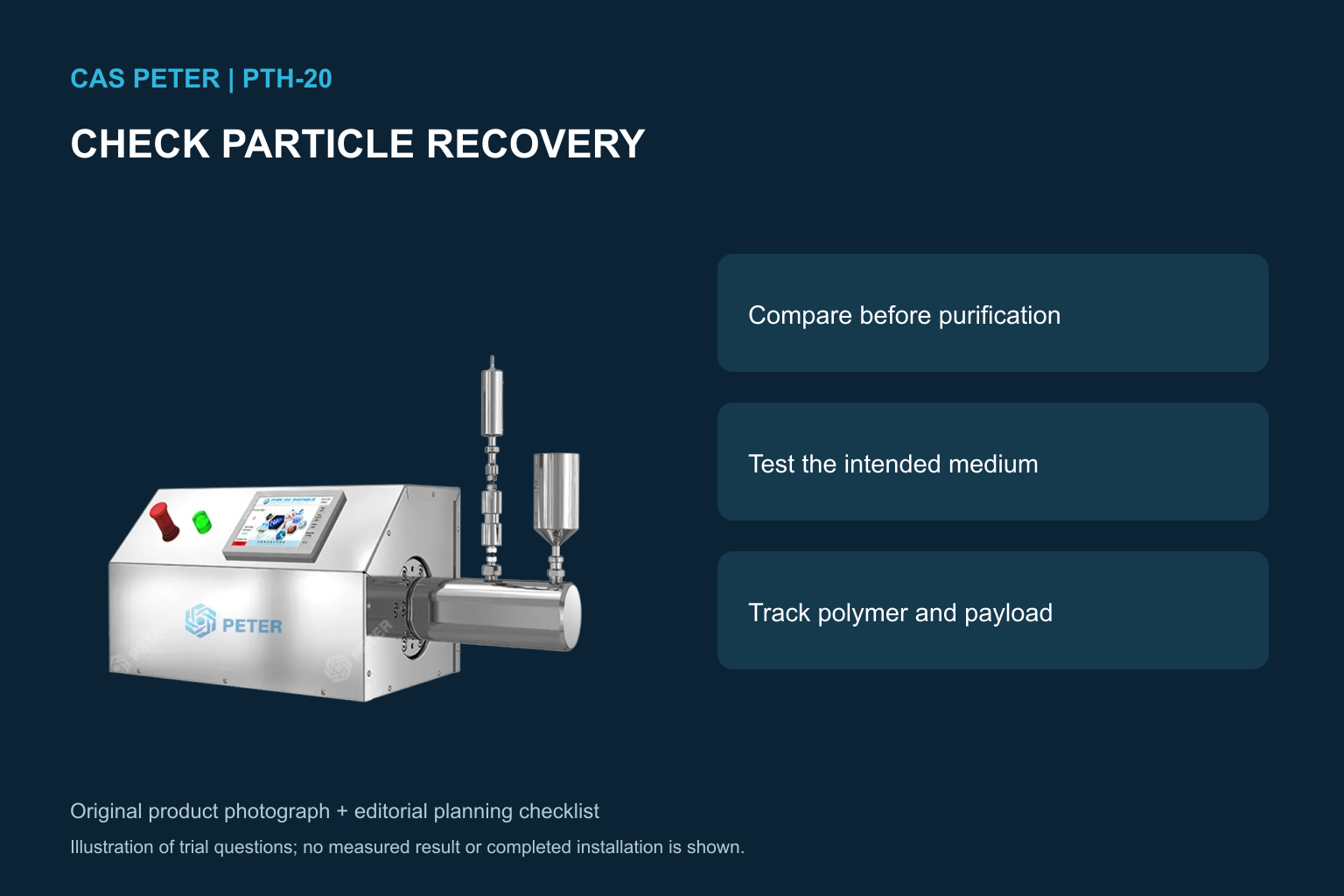
If the particles carry an active compound, assay intact compound in addition to particle size. Distinguish free material, particle-associated material, and total recovered material using an analytical separation demonstrated to work for that formulation. Check whether filters, membranes, or collection vessels retain the compound on their own. An apparent loss from the liquid phase does not automatically establish successful incorporation into particles.
Likewise, account for sample volume and dilution during washing or collection. Concentration can rise after volume reduction even when the recovered amount falls. Define recovery on an amount basis and identify the reference point, such as the initial batch or the material entering purification. Keep the denominator consistent across comparisons. This makes it possible to separate improved particle selection from improved synthesis yield.
For an unloaded system, define what polymer-related measurement is appropriate and feasible before drawing a mass-balance conclusion. If a validated quantitative assay is unavailable, report that limitation and retain the qualitative observations. Do not turn an unverified estimate into an encapsulation or recovery claim merely because the size measurement looks satisfactory.
Challenge the intended medium before scaling
A dispersion measured immediately after preparation may behave differently after dilution into a buffer, food matrix, coating formulation, or biological assay medium. Test the actual intended medium whenever possible. Keep order of addition, concentration, temperature, and observation times consistent. These are formulation-specific challenge tests, not a general declaration that chitosan nanoparticles are stable in all environments.
Include observations after the planned hold time and transport conditions. Record settling, visible changes, redispersibility under a defined handling method, and the relevant payload measurement. For a broader explanation of measurement context, see the zeta-potential interpretation guide. A favorable charge measurement in the preparation medium cannot replace a storage or compatibility test in the final medium.
Use the retained untreated portion to decide whether extra processing adds value. If both portions change similarly during the medium challenge, the next useful investigation may be formulation or storage conditions. Increasing pressure or adding passes without that comparison can consume material while leaving the actual cause unresolved.
Put the equipment discussion after the evidence
A supplier discussion should include the starting-liquid description, visible solids, expected batch quantity, processing stage, temperature restrictions, and cleaning constraints. Share the trial objective and the analytical acceptance criteria. Ask for confirmation that the proposed feed and configuration are suitable; do not extrapolate from a published result produced with a handheld mixer.
The dispersion methods overview provides the wider process context. For this application, the purchasing decision should follow a documented comparison: the selected operation must improve a meaningful product attribute at acceptable recovery and handling cost. A high-pressure machine is a candidate process tool, and the trial determines whether that tool belongs in the particular formulation workflow.
Further learning: physical gels and self-assembly
The NPTEL lecture below explains general gel properties and self-assembly. It provides conceptual background for discussing networks and particle interactions. It is not a chitosan manufacturing protocol, a pressure-processing demonstration, or validation of a CAS PETER machine.

Educational source: NPTEL-NOC IITM. Watch the lesson on YouTube.
Frequently asked questions
Can a handheld homogenizer result be converted into a pressure setting?
No direct conversion is justified. Mixing-head geometry, reagent delivery, exposure time, and flow history differ from pressure homogenization. Use the published method to define controls, then validate the proposed operation separately.
Does a smaller chitosan particle size prove higher yield?
No. Filtration or purification can remove larger material and change the measured population. Report size together with recovered quantity, sample preparation, and the fraction actually analyzed.
Should every chitosan nanoparticle process include high-pressure homogenization?
That decision requires formulation-specific evidence. Establish the gelation process first, confirm feed suitability, and retain the additional step only when matched trials show a useful improvement without unacceptable losses.