

Pectin Molecular Weight After Homogenization: Verify Thickening and Gel Function
Pectin molecular weight after homogenization should be evaluated together with solution flow and the performance of the finished recipe. A lower molecular weight does not, by itself, demonstrate better thickening or a weaker gel. Compare the same pectin lot at matched concentration, hydration, pH and measuring temperature, then test the actual function you want to preserve. For an ingredient supplier, the useful result is a reproducible processing window that meets a texture specification, rather than the largest change in a molecular measurement.
This guide focuses on a hydrated pectin ingredient stream. It does not treat juice cloud stability as a substitute for ingredient qualification, and it does not assume that a commercial powder will respond like pectin extracted from a treated fruit juice.
Define what the pectin must do before choosing a treatment
Start with the customer’s use: pourable thickener, gelled filling or colloidal stabilizer. Those uses need different acceptance tests. Write a short specification describing the base recipe, ingredient addition sequence, pH adjustment, heating and cooling, and the time between preparation and measurement. Keep the untreated ingredient in every comparison. Without that reference, normal preparation variation can look like a homogenization effect.
For a thickener, select a flow measurement that represents the use, such as handling during filling or flow after resting. For a gelled product, specify setting conditions, sample geometry and the property to be measured. A solution viscosity result answers a different question from a gel texture result. Avoid using one measurement as permission to omit the other.
Connect the ingredient trial to the broader food homogenization workflow, while keeping its decision separate from an orange juice cloud stability investigation. In juice, particles, soluble material and enzymes can all influence the observation. In a prepared pectin solution, the trial can isolate the ingredient more directly.
What the available research supports
A pilot study of apple and citrus pectin functionalisation reported source-dependent changes in molecular characteristics and lower apparent viscosity after treatment. Under its tested gel preparation conditions, the researchers did not find a statistically significant change in gel strength. That finding supports measuring flow and gel behavior separately; it does not establish that all commercial pectins retain their gel performance.
A study of pectin extracted from homogenized orange juice found lower molecular weight after treatment and investigated changes in pectin structure. Its material was a juice-derived fraction, so the findings should not be converted directly into a processing recipe for a different isolated ingredient. Taken together, the studies justify a material-specific comparison rather than a universal relationship between pressure, molecular weight and texture.
The checklist below is a proposed development framework. It contains no equipment performance guarantees, recipe limits or claimed results from CAS PETER machinery.
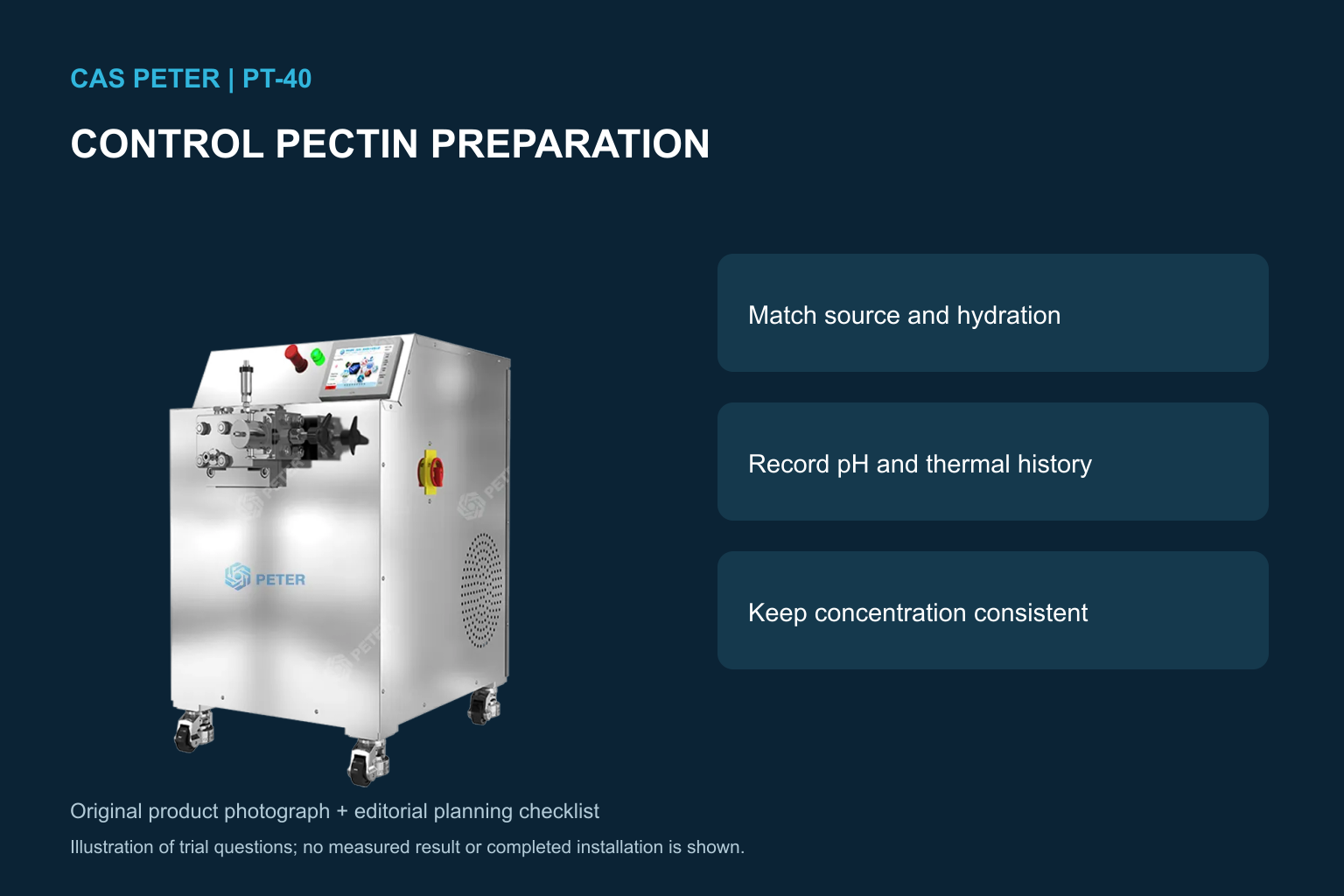
Control hydration before the homogenizer
Record the commercial grade, botanical source where known, lot identification, moisture information and any standardizing ingredients supplied with the powder. Two bags described simply as pectin may not be interchangeable. Ask the supplier for the product specification and the intended formulation conditions instead of inferring functionality from the generic ingredient name.
Use one preparation procedure for all trial arms. Specify water composition, powder addition method, mixing duration, temperature and the waiting time before processing. Inspect for incompletely hydrated material. If visible lumps remain, investigate preparation before increasing homogenization severity. A change in lump dispersion should not automatically be described as molecular degradation.
Prepare sufficient homogeneous feed for the comparison, or demonstrate that separately prepared batches have equivalent starting properties. Retain a feed sample immediately before each treatment. If the feed is stored during a long trial, record its changing temperature and elapsed time. Also retain an untreated sample exposed to the same holding period so that storage effects can be distinguished from processing effects.
Build a trial that separates pressure from history
Ask the equipment supplier to confirm an allowable operating envelope for the complete feed. Include concentration, viscosity across the expected temperature range, pH, dissolved salts, feed particle condition and the planned cleaning chemistry. A pressure reported in a paper is not evidence that a particular installed machine, seal set or cooling arrangement is suitable for that formulation.
Begin with an untreated reference and a limited number of supplier-approved treatment conditions. Record actual pressure, flow, pass history, inlet temperature and temperature after treatment. Identify where the temperature sensors are installed. A cooled collection sample does not describe the entire thermal history experienced inside the processing system.
When comparing passes, document whether material is collected into separate vessels or returned to a common tank. Tank recirculation creates a different history from a defined full transfer. Keep the trial description precise enough that another operator could reproduce the treatment. Do not describe both arrangements simply as multiple passes without explaining the routing.
For a pilot discussion, the CAS PETER PT-40 product page provides the actual equipment reference used in this article’s illustrations. Model selection remains subject to feed review, pressure and temperature compatibility, cooling requirements and a representative material trial. The photograph does not establish an approved pectin recipe or a guaranteed production rate.
Use three complementary levels of measurement
First, document the composition and preparation of each sample. Compare concentration on a consistent basis and account for water introduced during adjustments. Evaporation, dilution and sample transfer losses can change the apparent response. A laboratory result is difficult to interpret if its sample contains a different amount of pectin from the control.
Second, measure molecular characteristics with a method appropriate to the ingredient and laboratory. Ask the laboratory what molecular average and distribution are reported, what preparation is required and whether the procedure removes an insoluble fraction. Keep the procedure the same across samples. Filtering or dissolving samples differently can change which material reaches the instrument.
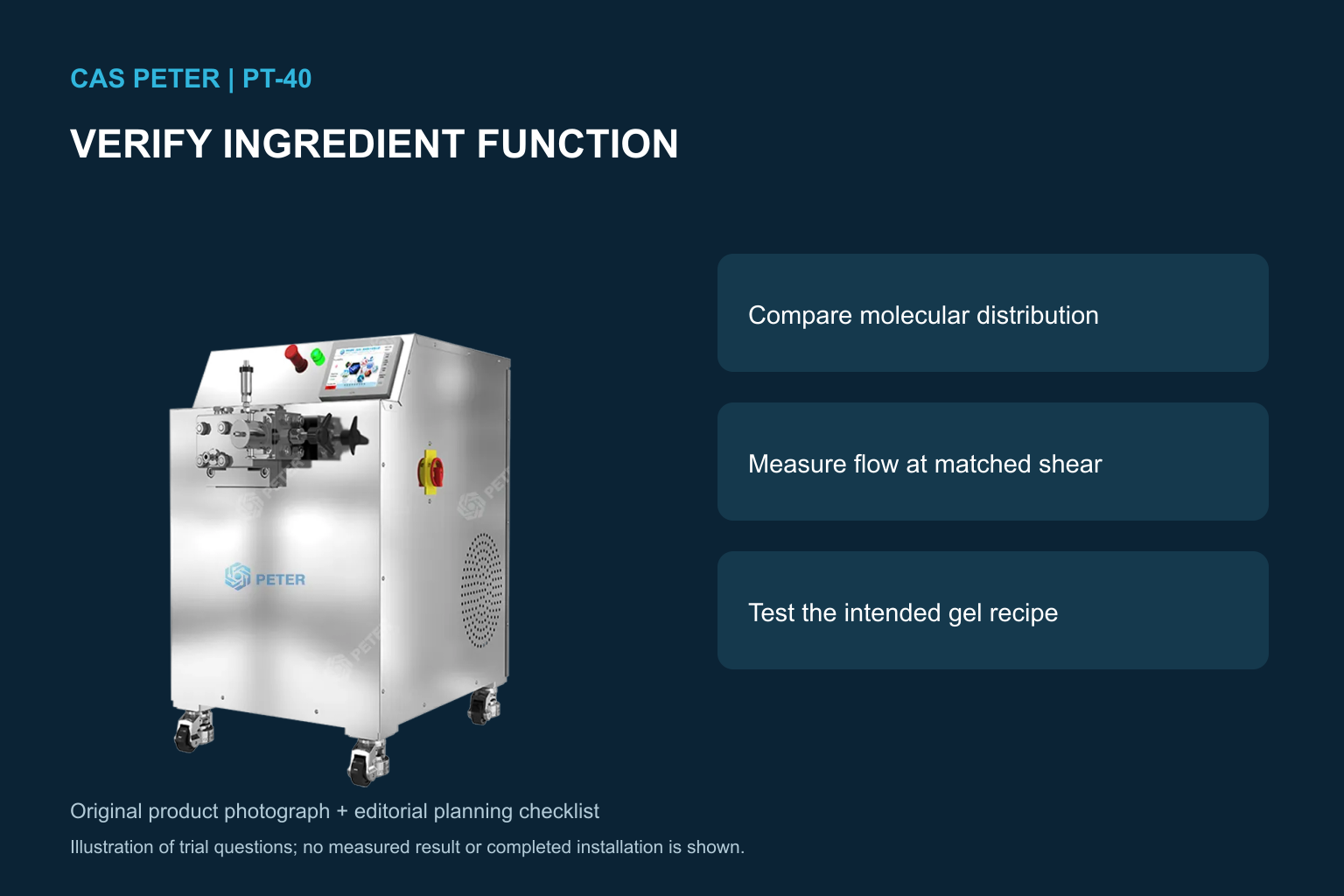
Third, test the relevant macroscopic function. For a flow curve, report measurement temperature, geometry, shear procedure and rest history. For gel texture, hold the recipe, setting history and test geometry constant. Report replicates and variability. A single force reading or viscosity number can be a useful screening observation, but it should not become an unexplained release specification.
A decision table for the development team
| Observation | Question to resolve | Useful next comparison | Decision boundary |
|---|---|---|---|
| Lower molecular average with little change in flow | Did the distribution change without changing the relevant use behavior? | Repeat flow and recipe tests using matched preparation | Do not reject solely on a molecular average unless the specification requires it |
| Lower solution viscosity with similar gel texture | Are the two tests measuring different functions? | Confirm both methods and repeat the intended recipe | Preserve the distinction between solution handling and finished gel performance |
| A gel becomes softer while solution flow seems acceptable | Did setting chemistry or preparation vary? | Repeat the gel recipe with matched pH, solids and cooling | Do not approve from the flow test alone |
| Results vary between preparations | Is hydration or feed history insufficiently controlled? | Repeat independently prepared controls | Resolve preparation variation before optimizing pressure |
| More treatment gives no useful application improvement | Is extra processing only increasing time and cooling demand? | Compare the least severe acceptable condition | Select against the product specification, not maximum treatment |
This qualitative table is an original trial-planning aid informed by the separate structural and functional endpoints in the two cited studies. It does not supply universal acceptance thresholds.
Test the actual recipe, including downstream handling
Use the treated ingredient at the planned addition level in a representative formulation. Keep the order of addition and subsequent heat treatment fixed. If the commercial process includes pumping, blending or a warm hold, include an appropriate development simulation rather than approving the ingredient directly from a beaker test. Document which parts of the production process were reproduced and which remain untested.
For a gelled filling, agree on the time at which texture matters: after setting, after storage or after handling. Examine water release and visible defects alongside the selected texture measurement. For a pourable product, compare the flow behavior at the relevant use temperature and after the relevant rest period. Specify those conditions before seeing the results to reduce selective interpretation.
An ingredient may pass one application and fail another. Keep the approved use attached to the trial result. For perspective on another plant-derived texturizing ingredient, see the starch homogenization trial guide; its material response should not be assumed to describe pectin.
Handle ambiguous findings without overclaiming
If molecular weight changes but product function does not, report both findings plainly. There is no requirement for every analytical change to produce a commercially meaningful benefit. Conversely, if texture changes without a clear molecular explanation, preserve the result and investigate preparation and formulation before attributing it to a particular mechanism.
Repeat promising conditions using independent feed preparations. Where the intended use involves more than one ingredient lot, include a lot comparison before approval. A reproducible result on one carefully selected lot is useful development evidence, but it is not evidence of robustness across all supplier variation. State the scope of the tested materials in the final report.
Prepare a useful inquiry and acceptance record
Send the supplier the ingredient specification, prepared-feed concentration, pH, viscosity information, temperature restrictions, batch quantity, intended operating mode and cleaning requirements. Explain whether the priority is easier handling, retained gel strength or another measurable product function. Request a trial plan tied to those priorities rather than a promise that smaller molecules automatically improve quality.
Agree in advance on sample collection, laboratory responsibility and the decision rule for proceeding. Retain the untreated reference, processing log, molecular data, flow curves and application results together. Record unsuccessful conditions as well as the preferred one. This prevents a later scale-up discussion from relying only on the most favorable chart.
Educational video: understanding food flow
The following NPTEL IIT Kharagpur lesson introduces food rheology. It supports the distinction between flow behavior and other quality measurements; it is not a pectin processing protocol or evidence for a specific machine setting.

Educational source: NPTEL IIT Kharagpur. Watch the lesson on YouTube.
Frequently asked questions
Does a lower pectin molecular weight always mean a weaker gel?
No. Molecular characteristics, solution flow and gel texture are different measurements. Compare gel performance using the intended recipe and matched preparation conditions rather than predicting it from one molecular average.
Can a juice homogenization study set the conditions for isolated pectin?
Not directly. Juice contains other components and the extracted pectin fraction may differ from a commercial ingredient. Use the study to identify questions, then qualify the actual feed and recipe on approved equipment.
What should a pectin trial report include?
Include ingredient identity, hydration and composition, operating and temperature history, molecular measurement details, flow results, application tests, replicates and the tested use boundary. Retain the untreated reference and explain any unresolved variation.