

Cellulose Nanofibril Redispersion After Drying: Verify Functional Recovery
Cellulose nanofibril redispersion after drying should be evaluated against a never-dried reference and the intended application, rather than judged by whether a powder disappears into water. Drying can leave persistent bundles and change the recovered suspension’s behavior. Rewet the material consistently, confirm that the prepared feed is suitable for the equipment, and measure residual aggregates, flow and functional performance separately. Additional homogenization may help a particular feed, but it cannot be assumed to reverse every drying-related change. The useful result is reproducible recovery of the properties the customer actually needs.
Distinguish redispersion from initial fibrillation
Initial fibrillation starts with a defined cellulose feed and aims to develop a finer fibrillar structure. Redispersion starts with material that has already been processed and subsequently dried. The drying route, surface chemistry and additives become part of the starting specification. A method that produces nanofibrils from wet pulp does not automatically restore a dried powder to the same state.
Also distinguish cellulose nanofibrils from cellulose nanocrystals. Product names sometimes group both under nanocellulose, but their shape, preparation and suspension behavior are different. Obtain the material identity and supplier documentation before choosing a test method. A spherical-equivalent particle size cannot by itself establish fibril length or individualization.
The dispersion methods guide covers the broader processing context. For preparation from a wet cellulose feed, see the separate cellulose nanofibril homogenization trial guide. The question here is what can be recovered after a drying and rewetting cycle.
What drying and redispersion studies can tell you
An experimental comparison of salts during spray drying and redispersion showed that pretreatment affected the recovered cellulose structures. Its fibrils were originally made using mechanical processing, but the dried samples were redispersed with a rotor-stator mixer. The paper therefore supports attention to drying history and additives; it does not validate a high-pressure redispersion recipe for another feed.
A separate study of dried cellulose nanofibers for lubricating oleogels used carboxymethylated material and a hydrogel preparation followed by solvent exchange. Its results show why a particular surface chemistry and downstream application matter. An oleogel route is not the same as restoring an aqueous coating suspension, and its solvent process should not be transferred into a homogenizer without an independent compatibility assessment.
Drying-related loss of recoverable structure is commonly discussed as hornification. For practical process selection, avoid reducing that term to a promise that enough pressure will undo a single bond type. The application needs measured evidence of recovery, regardless of which molecular explanation is proposed for a particular material.
Specify the powder and its complete history
Record cellulose source, surface treatment, counterion form where relevant, declared solids and any drying aids. Request the drying method and storage conditions. An additive that improves handling may also alter the final product, so include its amount in the formulation record rather than describing the sample as cellulose only.
Determine the dry-matter basis used in the trial. A powder containing residual water or added salts does not contain the same cellulose amount as an equal mass of a different powder. Report whether concentration refers to total dry solids or cellulose content. This distinction becomes important when comparing rheology or material consumption.
Retain a never-dried sample from the same material where possible. A different commercial wet grade can provide a practical benchmark, but label it as such. Differences in surface treatment or fibril preparation would otherwise be misinterpreted as changes caused only by drying.
Control rewetting before testing mechanical treatment
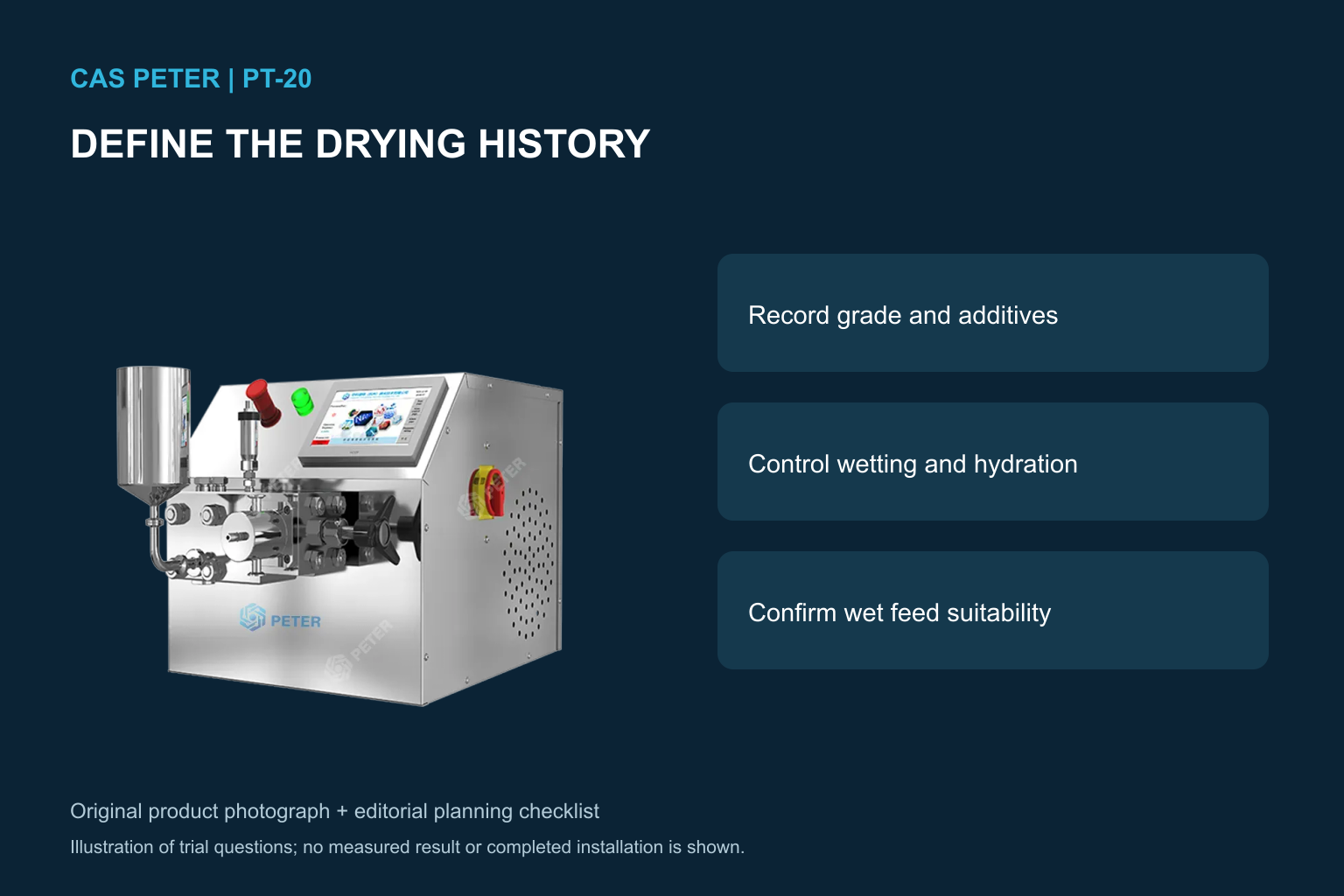
Use a documented addition order, water quality, temperature and hydration interval. Compare samples prepared with the same mixing equipment and vessel geometry. Floating powder, dry cores and visible lumps are reasons to improve the wetting procedure before judging the downstream machine.
Start with a wetting-only comparison so that the contribution of hydration can be separated from further mechanical processing. Record how much material remains on vessel walls or mixing tools. Unmeasured material loss can make the recovered suspension appear less viscous simply because it contains less cellulose.
Where pH or salt adjustments are being investigated, treat them as formulation variables. Use matched controls and document the resulting conductivity and pH. Do not adopt a salt addition or alkaline condition from a paper as a universal redispersion aid. Its suitability depends on the cellulose grade, final application and equipment materials.
Keep air incorporation under control and record any degassing step. A foamy sample can create difficulties in feed delivery and rheological measurement. Confirm an appropriate procedure rather than applying vacuum or additives without considering their influence on the material being compared.
Confirm that the suspension can enter the equipment
A dried powder is not a direct feed for a liquid high-pressure homogenizer. Prepare a representative wet suspension and have the supplier review its viscosity, solids, residual particle or bundle size and chemical composition. The fact that the original wet cellulose passed through a machine does not establish that the rewetted powder is suitable.
Inspect the complete sample before deciding that it is safe to process. Removing the largest lumps by screening may make a test possible, but it also changes the material. Weigh and characterize the rejected fraction. Otherwise the reported outcome could describe only the easy-to-disperse portion while ignoring commercially significant losses.
Start a supplier-approved trial with a defined baseline and a limited number of processing changes. Record pressure, passes, temperature and collected mass. If processing changes the flow behavior substantially, revisit the feed and cooling assessment before increasing exposure. Do not infer an operating limit from the model name or a research publication.
Measure both remaining bundles and recovered function
Use imaging to assess large residual structures and a suitable higher-resolution method when claims about individual fibrils are needed. Document sample preparation and field selection. A few attractive images cannot establish that the entire batch is uniformly dispersed, especially when sediment or visible bundles remain elsewhere in the vessel.
Use the DLS and laser diffraction comparison to understand what particle-size methods can and cannot establish. A fibrillar suspension is not a collection of uniform spheres. Report the method and its limitations, and do not convert an equivalent diameter into a verified fibril width or length.
Rheology provides a functional comparison when performed at matched cellulose content and temperature with the same loading, preshear and rest procedure. Record the flow curve or relevant viscoelastic measurements rather than a single undocumented viscosity. Follow recovery after rest if the end use depends on rebuilding structure after mixing.
The following qualitative table connects the scope of the two cited studies with proposed application-focused checks. It does not provide a universal pass criterion for dried nanocellulose.
| Comparison | Evidence to collect | Main control | Decision it can support |
|---|---|---|---|
| Never-dried and rewetted material | Images, dry-matter basis and matched flow measurements | Same grade and surface chemistry where available | Whether drying changed properties relevant to use |
| Short and extended hydration | Residual lumps and recovered suspension behavior | Water, concentration and mixing procedure | Whether wetting time is a limiting step |
| Wetting-only and mechanically treated feed | Bundle observations, temperatures and collected mass | Same prepared suspension | Whether added processing provides a useful improvement |
| Different drying aids or salts | Composition, conductivity and final-product performance | Cellulose content and application method | Whether an aid is compatible with the target product |
| Recovered suspension and finished application | Coating, film or rheology results under a fixed method | Formulation, drying and test conditions | Whether suspension recovery translates into useful function |
Verify the application instead of declaring complete recovery
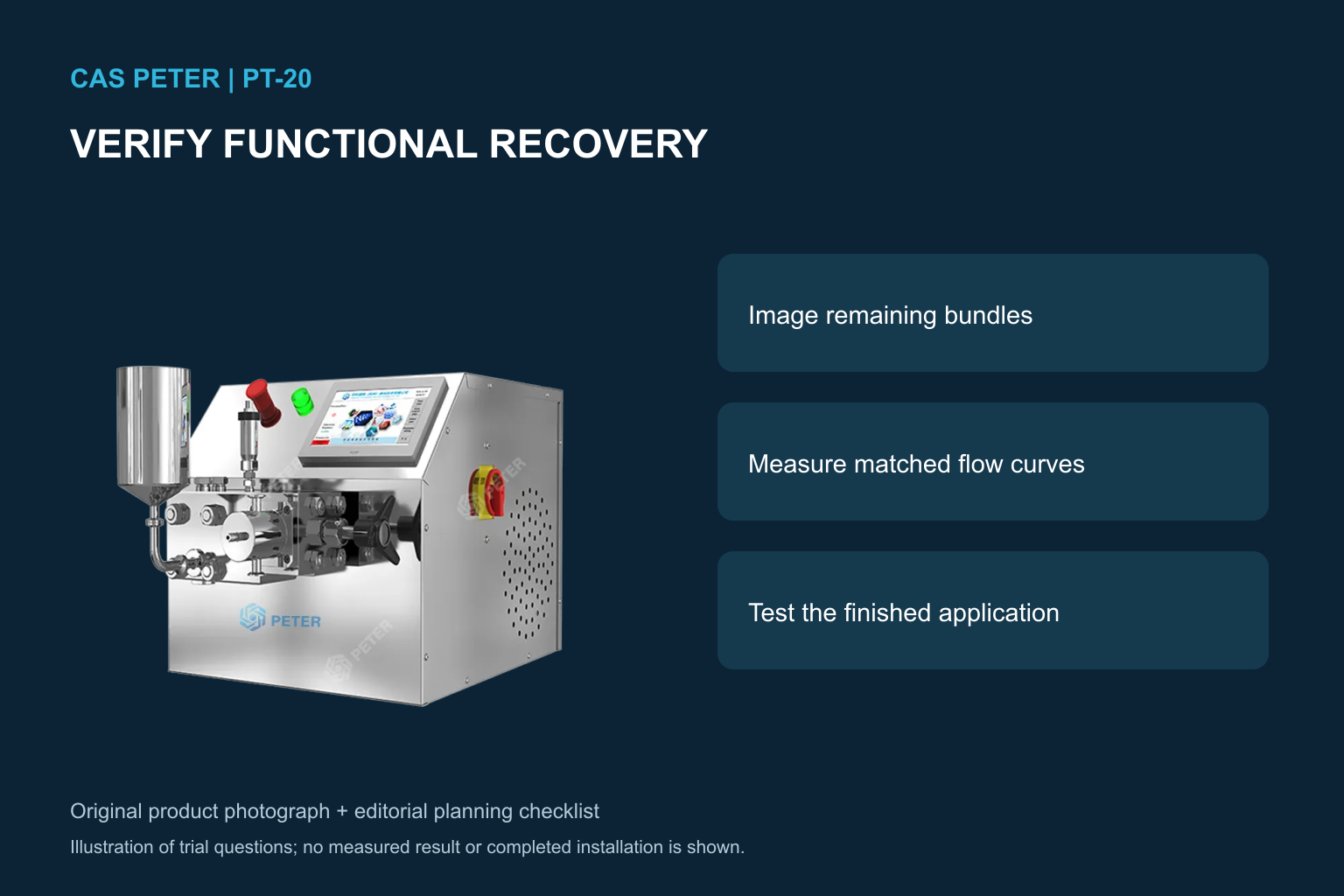
For a coating application, prepare matched formulations and evaluate the relevant coating behavior and dried surface. For a rheology modifier, compare the final formulation rather than only the cellulose suspension. For a reinforcing additive, use the actual matrix preparation and testing procedure. Each application defines a different useful recovery target.
A suspension may recover one property while retaining visible differences in another. For example, a usable flow response does not prove that the original fibril population has been restored. Report these outcomes separately. If the application tolerates residual aggregates, document that tolerance through performance evidence rather than claiming that aggregates are absent.
Include storage and redispersion of the prepared liquid if the customer will hold it before use. A successful measurement immediately after processing may not represent the material after transport or a production delay. Specify whether settling is reversible under the customer’s normal handling procedure and what mixing is needed before use.
Compare the complete material route
Evaluate dry transport and local redispersion against supplying a wet concentrate. Include preparation water, operator time, energy, cleaning, rejects and additives. A lower shipping mass is only one part of the decision. If redispersion requires an incompatible additive or removes a large fraction of the material, the complete route may be less attractive.
Keep the comparison grounded in measured quantities from the trial. Record collected usable suspension, excluded material and the time required for each step. Avoid presenting an equipment nameplate capacity as the actual output for a viscous cellulose feed. Confirm the practical rate and product result together during scale-up.
Repeat the selected route using an independent powder lot before committing to production. Supplier changes in drying conditions or surface treatment can matter even when the commercial grade name remains unchanged. Include those variables in the incoming material specification and change-control discussion.
Prepare a representative equipment enquiry
The CAS PETER PT-20 product page offers a starting model reference for an experimental setup. Ask the supplier to confirm suitability for the actual wet cellulose feed, including materials, flow behavior, residual bundles, cooling and cleaning. The image shows the product, not a documented redispersion installation or a guarantee of functional recovery.
Send powder and suspension specifications, the full preparation procedure, the desired application and the measurement plan. If solvent exchange is part of the downstream route, identify exactly where it occurs. Research involving solvents does not establish that a proposed machine is suitable for that mixture or operating environment.
Agree on a sample collection plan and acceptance criteria before the trial. A useful report should show what entered the machine, what was recovered, what changed and how the finished application performed. That evidence supports a defensible choice between changing the material, changing preparation or adding mechanical processing.
Further learning: colloidal stability
The following NPTEL lesson introduces colloidal stability concepts. It helps frame interactions in suspensions but is not a redispersion protocol for a particular cellulose grade.
Educational source: NPTEL-NOC IITM. Watch the lesson on YouTube.
Frequently asked questions
Can high-pressure homogenization always reverse cellulose hornification?
No. Drying can leave persistent structural changes. Test the actual prepared suspension against an appropriate reference and verify the properties required for its intended use.
Should dry cellulose nanofibril powder be fed directly into the machine?
No. Prepare a suitable wet suspension and obtain a supplier assessment of its viscosity, residual bundles, solids and chemical composition before a liquid high-pressure homogenization trial.
Does matching the original viscosity prove complete redispersion?
No. Viscosity is one functional measurement. Also evaluate residual structures, concentration and the final application before claiming that the original material state has been restored.