

Alumina Slurry Dispersion: Verify Rheology and Reflocculation After Processing
Alumina slurry dispersion should be evaluated through rheology, agglomerate observations and the tendency to reflocculate after processing. A lower average particle size alone does not establish that a slurry will remain pumpable or form a consistent green body. Compare samples at the same solids content, chemistry, temperature and shear history, and include a defined resting period before repeat measurements. This guide outlines a comparative development workflow for an aqueous ceramic slurry. It treats high-pressure processing as a candidate operation that requires a material compatibility review, rather than assuming every abrasive alumina feed is suitable for a standard homogenizer configuration.
Define the downstream failure first
Identify where the present slurry stops working. Is transfer difficult immediately after preparation, does viscosity rise during a production hold, or does the forming step become inconsistent? These problems may look similar when an operator describes the material as thick, but they lead to different experiments. Write an acceptance statement tied to the actual holding, transfer or shaping sequence before deciding which particle-size result would be useful.
Record the existing preparation method and preserve a reference from the same powder batch. A slurry that flows easily straight after strong mixing may behave differently after rest. Conversely, a material that appears thick at rest may become workable under the relevant shear. The development report should describe that sequence instead of labeling one sample good and another bad from a single viscosity reading.
The wider dispersion methods guide explains how processing options fit into a trial. This article focuses on time-dependent slurry behavior and representative measurements. It does not provide a universal dispersant dose, pH target or pressure setting for all alumina grades.
What the published evidence says
An AIST-authored wet-jet milling study compared ball-milled alumina slurry with slurry receiving an additional wet-jet treatment. Its abstract reports comparable particle-size distributions alongside differences in viscosity evolution and reflocculation behavior. This is a useful warning: matching a size distribution does not establish matching slurry performance. The research used its own powder, chemistry and processing system, so its result cannot be transferred directly to a CAS PETER machine.
A separate primary study, Investigating the dispersion state of alumina suspensions, examines complementary characterization including cryogenic microscopy. Its reported examples show why similar viscosity or zeta-potential values can be insufficient to discriminate dispersion states. That supports combining methods rather than accepting a single favorable measurement. It does not establish that every development project needs that exact microscopy technique.
The workflow below is a proposed comparison plan. It uses those studies to define useful questions while leaving the operating conditions and acceptance limits to the actual material, equipment review and downstream requirement. No experimental performance or completed alumina installation is represented by the product illustrations.
Characterize the powder and liquid chemistry
Record the alumina grade, phase where known, supplier, batch, nominal size information and relevant surface treatment. Include the source and quality of the water, dispersant identity, addition order, solids basis and pH. State whether solids are expressed as mass fraction or volume fraction. If a conversion is needed, use appropriate measured or supplier-supported densities and document the assumptions instead of treating the two percentages as interchangeable.
Prepare sufficient slurry to divide across the reference and processing conditions. Keep wetting, premixing and waiting times consistent. Document coarse material, persistent lumps or visible sediment before processing. Screening may be required for feed compatibility, but record the retained material and apply comparable preparation to the control. Otherwise, an apparent processing improvement could partly reflect removal of difficult material before the trial.
Avoid changing pH and dispersant concentration at the same time as treatment intensity in an initial process comparison. Those changes may be worthwhile, but they need a design that separates chemistry from mechanical processing. If the purpose is to compare complete preparation routes, say so and report each route fully rather than attributing every difference to one machine.
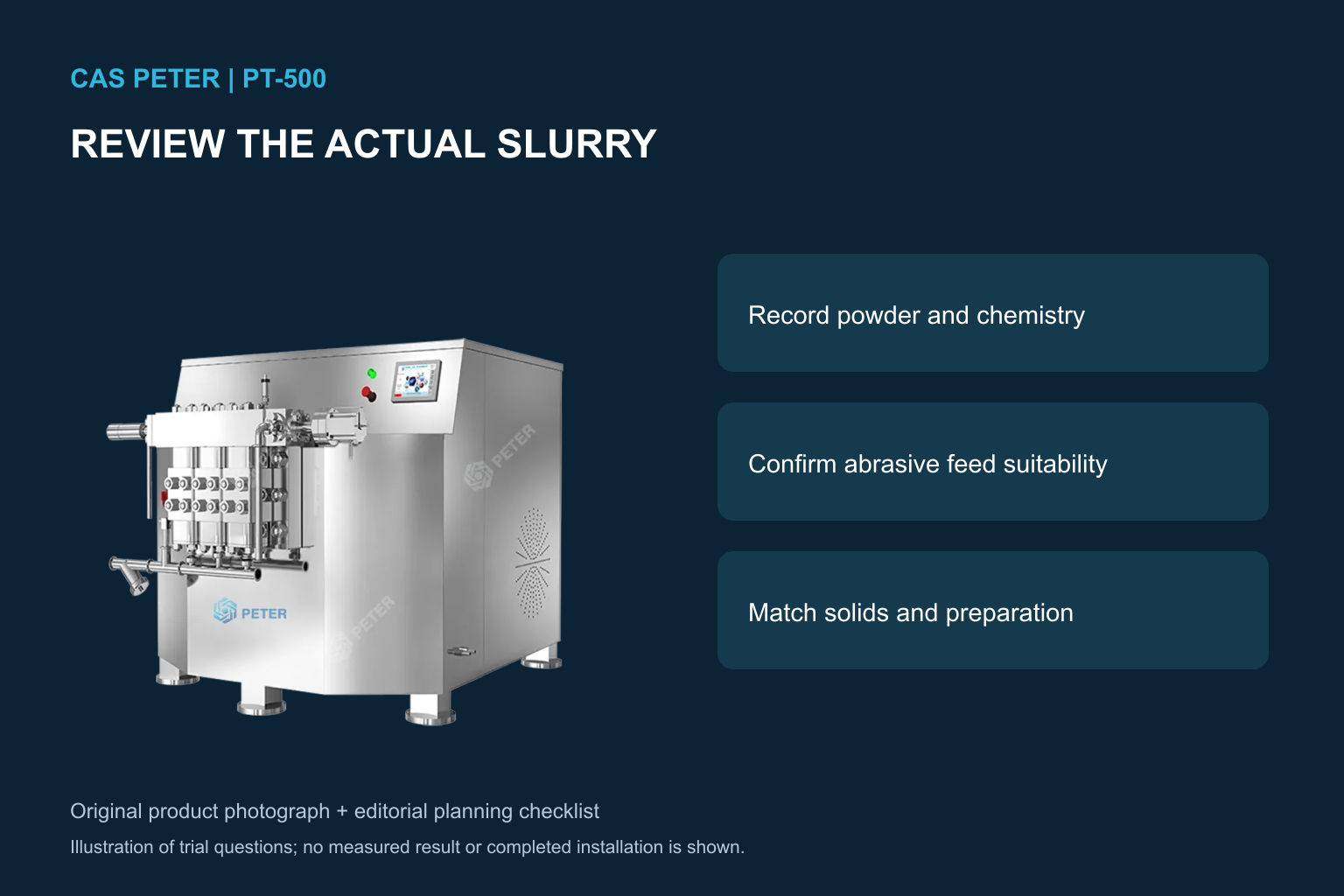
Review abrasion and feed suitability before a trial
Alumina-containing feed requires a review of abrasive wear, coarse agglomerates, solids loading, viscosity and chemical compatibility. Ask the supplier to assess the actual sample and proposed configuration. Do not assume that a machine pictured beside an alumina article is approved for any concentration or particle distribution. A laboratory result from wet-jet milling also does not prove equivalence between that collision geometry and a different pressure-processing design.
For a possible production discussion, the CAS PETER PT-500 product page identifies a real equipment model. Send the supplier measured feed properties and a description of the existing preparation route. Request confirmation of feed limits, suitable wetted components, wear monitoring, cleaning requirements, cooling and the planned trial arrangement. The appropriate outcome of that review may be a revised preparation method or another configuration.
Retain samples from the feed and each processing condition. Record actual operating conditions, collection times, temperatures, recirculation or discrete-pass history and any signs of unstable feed delivery. If equipment behavior changes during the run, stop and investigate according to the supplier’s procedure. Do not continue merely to reach a research pressure or complete a predetermined number of passes.
Compare rheology under a defined history
A viscosity value needs its temperature, instrument configuration and measurement condition. Establish a repeatable loading, conditioning and rest procedure with the laboratory. Where useful for the application, measure a flow curve across a relevant range rather than comparing values collected at different shear rates. Keep the direction and timing of the measurement sequence consistent across samples.
The handling history before measurement matters. Record whether the sample was stirred, shaken, transferred or allowed to stand, and for how long. Do not vigorously remix only the reference while gently transferring the treated sample. Choose procedures that make the comparison fair and relate to the intended operation. If the real process includes a long hold, include that hold as a separate test rather than relying on an immediate post-processing measurement.
Use independent preparations to check repeatability. Multiple instrument readings from the same cup describe measurement variability, but do not show whether the preparation route is reproducible. Keep unusual observations in the record, including settling during sampling, bubbles introduced during loading and visible differences between the top and bottom of the container.
Build a complementary measurement set
The following qualitative table is a trial planning aid, not a specification. Establish numerical limits from the relevant transfer and shaping requirements. The cited studies motivate the use of complementary measurements; the laboratory should choose methods it can perform reliably for the actual slurry.
| Check | Record before comparing | Useful question | Limit of the result |
|---|---|---|---|
| Particle distribution | Sampling location, dilution and dispersing preparation | Did the measurable agglomerate population change? | Aggressive analytical preparation may alter weak flocs |
| Flow behavior | Solids, temperature, shear sequence and rest history | Can the slurry flow under relevant conditions? | One viscosity value does not establish the whole dispersion state |
| Rest and remeasurement | Container, holding time and remixing procedure | Does flow behavior drift after processing? | An immediate result cannot represent a production hold |
| Microscopy or another structural method | Representative sampling and preparation artifacts | Are clusters or heterogeneous regions still present? | A selected image cannot quantify the entire batch |
| Forming and drying | Matched casting or shaping conditions | Does the processed slurry improve the intended operation? | Slurry behavior alone does not establish final ceramic performance |
Review the particle measurement methods guide before choosing dilution and dispersion procedures. A measurement designed to reveal primary particles may intentionally disrupt weak structures. That can be useful, but it answers a different question from whether the stored production slurry remains flocculated. Label the analytical preparation clearly so the two results are not confused.
Test reflocculation through a controlled rest sequence
Define a realistic observation schedule based on the actual time between slurry preparation and use. Divide samples into containers that provide enough material for the planned tests. Avoid repeatedly disturbing the same vessel if the purpose is to observe undisturbed holding. Record both visible separation and the repeat rheology result, because a visually uniform slurry can still change its flow response.
When flow deteriorates after rest, first confirm solids, evaporation control, sample temperature and handling consistency. If those remain controlled, investigate chemistry and structure with the available complementary methods. Do not assume the only remedy is more pressure. A formulation problem or a processing route that changes material behavior may require another development direction.
A related silica dispersion trial guide addresses another abrasive inorganic system. Its discussion is useful for planning questions, but alumina and silica should not share an assumed pH target or dispersant dose. Preserve the material-specific evidence instead of transferring a convenient recipe across powders.
Carry the result into the forming step
Test promising samples in the intended shaping operation under matched conditions. Record the slurry age, handling before use and relevant forming observations. For casting, compare the chosen casting procedure and green-body evaluation. For another application, define a corresponding functional test. The point is to check whether the measured slurry difference survives the next operation.
Keep drying and thermal processing comparisons controlled where they form part of the project. An improved slurry result is an intermediate finding, not proof of a stronger or denser finished ceramic. Report downstream measurements only when they were actually performed. If no final-part test was included, state that the trial established slurry behavior and leave ceramic performance as an open question.
Consider process practicality alongside analytical performance. Track preparation time, recoverable quantity, cleaning effort and signs of wear that require follow-up. A condition that gives a marginally better particle result while making handling unreliable may not suit production. Agree on the tradeoff criteria before selecting the preferred route.
Write a decision report that can be repeated
Keep a single sample identifier across preparation, processing, particle analysis, rheology, rest testing and forming. Attach the raw conditions and identify the reference. Report the observed differences with their variability and the limitations of the methods. A traceable negative result is useful because it prevents repeating an unsuitable route without understanding what changed.
For an equipment inquiry, include the actual powder specification, slurry chemistry, solids basis, viscosity conditions, coarse-particle observations, required throughput and target application. Ask for a material review and a documented trial before requesting a performance guarantee. The appropriate equipment choice should follow the verified feed and process outcome, rather than being inferred from the appearance or model name of the machine.
Further learning: colloidal stability
The following neutral university lesson introduces colloidal stability. It provides background for interpreting suspension behavior; it is not an alumina operating procedure or a substitute for a material compatibility assessment.

Educational source: NPTEL-NOC IITM. Watch the lesson on YouTube.
Frequently asked questions
Can two alumina slurries have similar particle sizes but different viscosity?
Yes. The cited wet-jet study reports comparable particle-size distributions alongside differences in viscosity evolution. Match chemistry, concentration and measurement history, and use additional observations before selecting the preferred slurry.
Does lower viscosity prove that all agglomerates are removed?
No. Viscosity describes flow under particular conditions. Combine it with appropriate particle or structural observations and relevant downstream tests, while documenting how sampling and analytical preparation may affect the slurry.
Is every PT-500 configuration suitable for abrasive alumina?
Suitability must be confirmed for the actual feed and configuration. Provide the powder, solids content, viscosity, chemistry and coarse-particle information, and request a supplier review of wetted parts, wear, feed limits and the proposed trial before processing.