

Alginate Homogenization: Separate Viscosity Recovery from Gel Performance
Alginate homogenization should be evaluated by measuring viscosity after controlled cooling and rest, followed by a separate gel test under matched calcium conditions. A thinner outlet sample does not establish polymer degradation, and a smooth solution does not establish acceptable gel strength. Temperature, hydration, shear history and dissolved ions can all change the reading. For a manufacturing trial, define whether the objective is easier pumping, more uniform hydration or a particular finished gel before choosing the processing window. Use the same alginate lot and preparation history for the untreated reference and every processed sample.
Define the material before interpreting the change
Sodium alginate solution, seaweed extraction slurry and partially crosslinked calcium alginate are different feeds. A result obtained while disrupting seaweed cannot be transferred directly to a purchased, already hydrated polymer. Likewise, breaking a calcium-containing gel into fragments is different from changing the molecular size of a soluble alginate. Record which system enters the machine and which physical form the application requires afterward.
For purchased alginate, retain the grade, lot, supplier viscosity method and moisture information. A supplier viscosity designation describes a test under stated conditions; it is not the viscosity of every formulation containing that grade. If two lots are compared at different effective polymer concentrations, the apparent processing effect may actually be a raw-material difference. Prepare a common stock where practical and divide it only after hydration is complete.
The FAO technical chapter on alginates describes how molecular weight, concentration, temperature, pH and calcium affect flow. It also explains that preparation and stirring history influence final viscosity. These relationships make matched preparation essential. The chapter is background guidance, not a modern recipe for every food, cosmetic or pharmaceutical application; ingredient suitability and product requirements still need separate review.
Separate hydration from pressure treatment
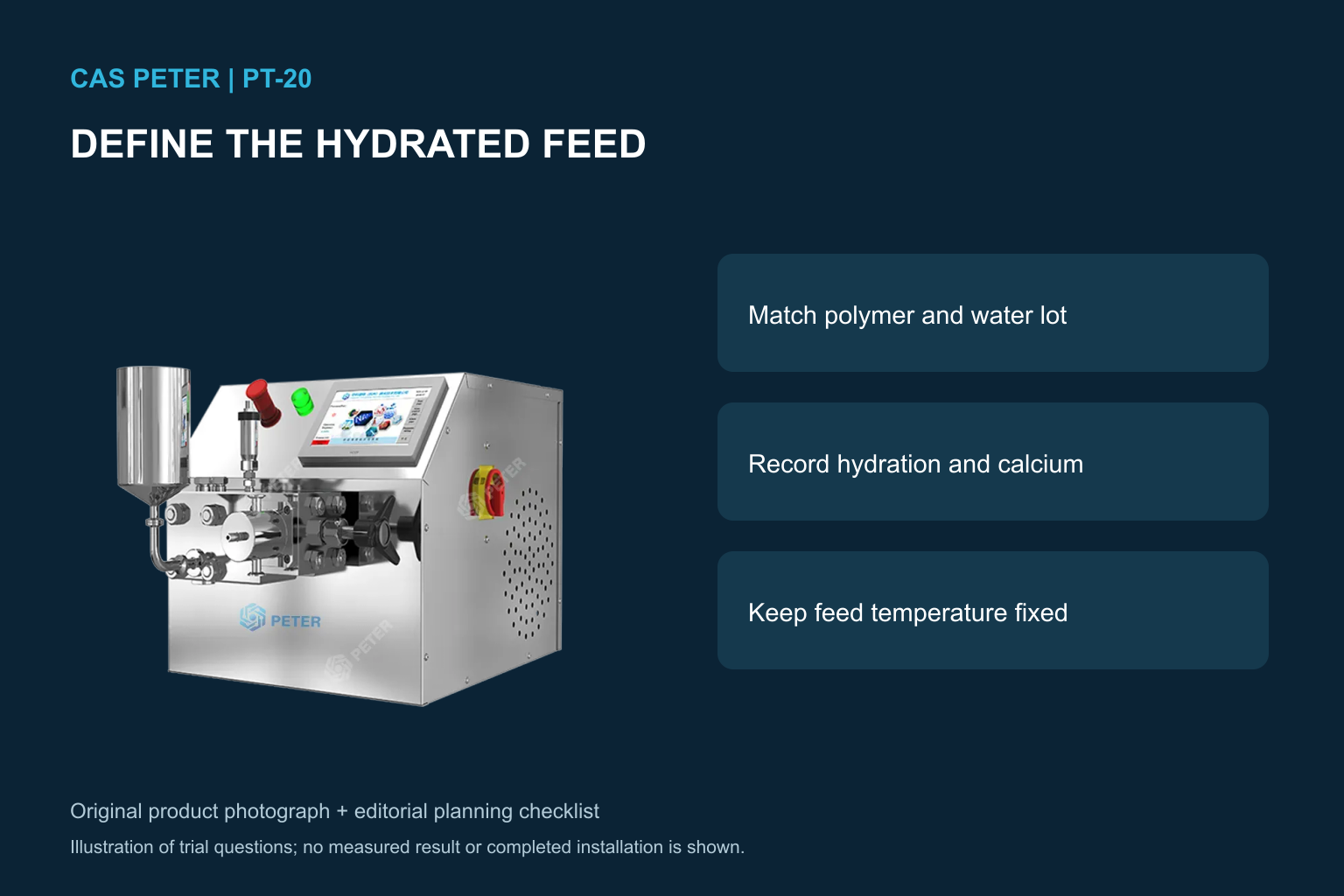
Start with a documented powder addition and wetting procedure. Record water quality, mixing sequence, hydration time and the presence of undissolved material. Inspect the feed using an appropriate method rather than assuming that the absence of visible lumps proves complete dissolution. A partially hydrated sample may thicken during the waiting period after processing and create a misleading impression of viscosity recovery.
Make the untreated control experience the same holding time and comparable handling. If the processed sample waits overnight while the control is tested immediately, hydration and aging are confounded with the pressure step. Use sealed containers, control evaporation and identify the moment from which elapsed storage time is counted. Any dilution used for measurement should follow the same order of addition and equilibration period.
Calcium deserves its own record. Water hardness, other ingredients and residual calcium in the commercial polymer can alter flow and crosslinking. Do not add a chelating agent solely to make a difficult sample easier to measure unless that change is part of the intended formulation. It changes the system being evaluated and may hide the behavior that matters in the finished product.
Compare viscosity at matched temperature and history
Collect inlet and outlet temperatures for each pass, together with cooling conditions and actual recovered mass. Test samples at a common measurement temperature after a defined rest. Warm material often flows more easily; a lower immediate reading can therefore disappear after cooling. Conversely, a persistent change may remain after temperature is normalized. These are different observations and should be reported separately.
Use an instrument and geometry appropriate to the sample. State the spindle or geometry, shear rate or speed, equilibration time and loading procedure. For a shear-dependent solution, one unspecified viscosity value is difficult to interpret. A flow curve can show whether the relevant pumping or application range has changed, provided all samples follow the same measurement sequence.
Include a recovery experiment when reversible structure is plausible. Apply a defined shear sequence, then record the return of viscosity or modulus after rest. Keep the timing identical. If the instrument itself changes the sample, a second run on the same aliquot cannot be treated as an independent repeat. Fresh aliquots help separate sample variability from measurement history.
Use molecular testing only to answer a defined question
A persistent viscosity reduction can justify further analysis, but viscosity alone does not prove chain scission. Concentration error, ionic differences, incomplete hydration and changes in intermolecular structure must first be considered. When molecular degradation is a critical concern, use a suitable molecular-weight distribution method with a validated sample preparation and compare untreated and processed material from the same batch.
State the limits of that analysis. A size-exclusion method can be affected by sample dissolution, filtration, calibration and polymer interactions with the system. Filtering away a difficult fraction may improve the chromatogram while changing the material being measured. Document recovery and explain whether the method describes the whole formulation or only the soluble fraction that reached the detector.
A study of high-pressure pretreatment during alginate extraction examined seaweed disruption and the properties of subsequently extracted alginate. It supports keeping extraction history visible when qualifying the polymer. Its seaweed pretreatment and extraction sequence should not be presented as a pressure prescription for a commercial alginate solution, nor as proof that every change in solution flow represents the same structural mechanism.
Build a decision table around the intended function
The following table is a proposed trial framework, not a set of reported machine results. The controls follow the preparation and flow dependencies discussed in the FAO reference. Select acceptance limits from the actual product specification and measurement capability before examining the processing results.
| Trial observation | Check before assigning a cause | Useful next comparison | Decision supported |
|---|---|---|---|
| Outlet sample is thinner | Temperature and effective polymer concentration | Cooled samples at equal rest time | Whether thinning persists beyond heating |
| Flow returns during storage | Hydration completeness and measurement history | Matched control held for the same interval | Whether recovery is process-related |
| Viscosity falls after repeated passes | Water loss, ions and cumulative thermal exposure | Independent batches and molecular analysis if needed | Whether further processing harms the function |
| Solution passes flow limits but gel is weak | Calcium delivery, pH and gel maturation | Identical gel recipes from each trial sample | Whether the processed polymer meets the final use |
| Gel differs across production lots | Alginate grade, residual calcium and mixing sequence | Multiple qualified raw-material lots | Whether the chosen window is robust |
Test the gel separately from the solution
Prepare gels with a fixed polymer concentration, calcium source, addition sequence and maturation schedule. Match the sample dimensions and test temperature. Calcium transport and local mixing can create gradients, so a specimen taken from the surface may not represent the center. State where the sample was collected and how replicate gels were made.
Choose the gel measurements according to use. A molded ingredient may require compression resistance and water retention, while a coating may need continuity and handling strength. A single peak force does not describe every application. Where appropriate, pair mechanical testing with visible defects, released water and performance after the planned storage or handling step. Keep the test relevant to the product rather than collecting unrelated measurements.
If the application uses a partially crosslinked feed, assess both the dispersed fragments and the continuous phase. A lower apparent viscosity can coexist with a changed particle population. Calling that result polymer depolymerization without evidence would collapse two different mechanisms. Describe what was measured: flow of the whole dispersion, mechanical behavior of the gel or molecular characteristics of a separated fraction.
Plan the equipment trial around feed compatibility
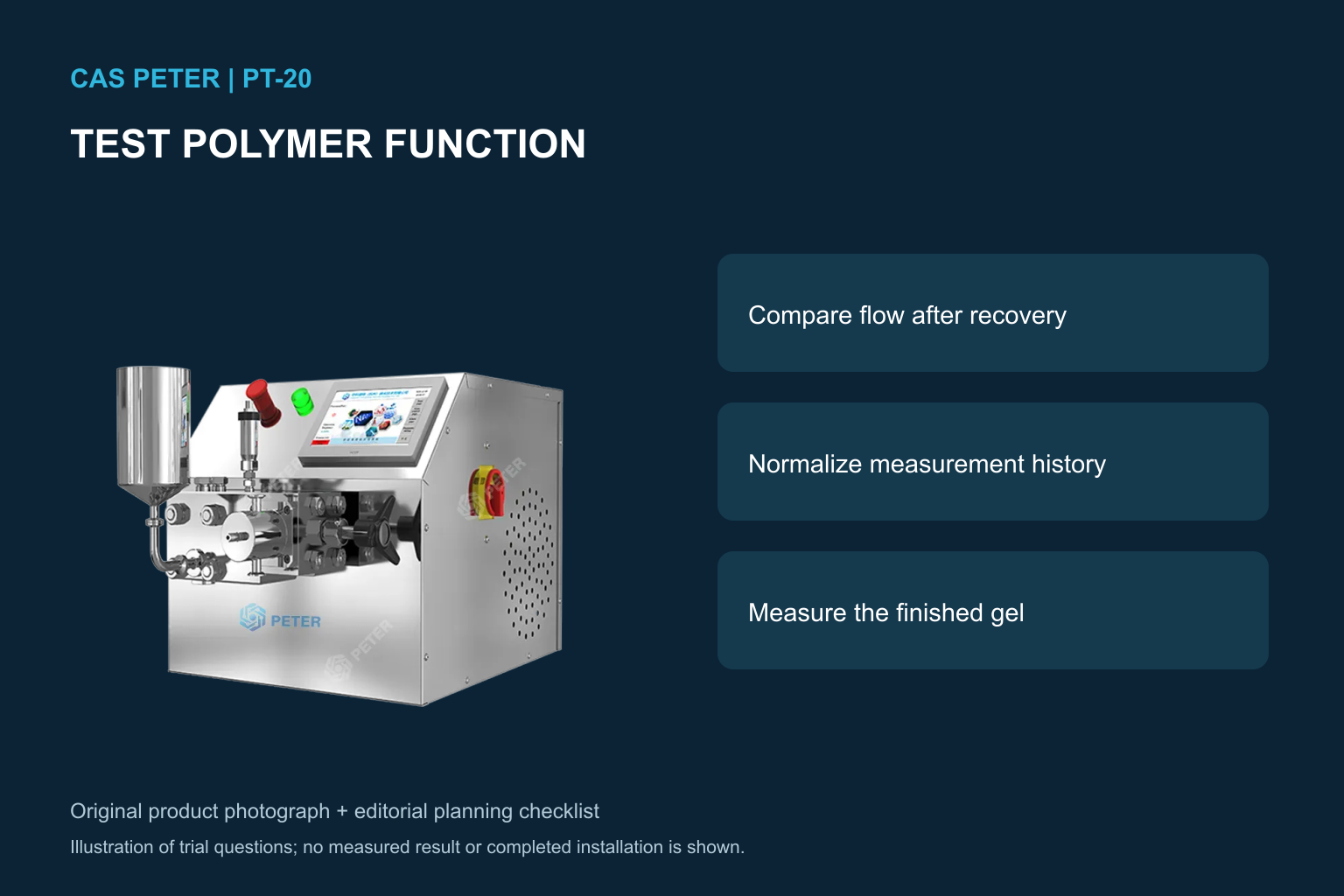
The CAS PETER PT-20 product page is a starting point for discussing an experimental homogenizer configuration. Confirm suitability using the actual feed, viscosity range, particle or gel content, wetted materials and cooling requirements. The product photograph identifies the model; it does not establish that an arbitrary alginate formulation is approved for that machine.
Define a conservative, supplier-reviewed starting trial and a stopping rule. Record actual pressure, pass count, flow, temperatures and sample recovery rather than relying only on a nominal setpoint. If flow becomes erratic, pressure unstable or the feed develops an unexpected gel fraction, stop and investigate compatibility. More passes should answer a specific unresolved question, not substitute for a defined test objective.
For broader process planning, see the dispersion methods guide. The articles on pectin molecular weight and retained function and oat beta-glucan viscosity provide complementary examples of separating polymer processing from application behavior. Their material-specific conclusions are not alginate acceptance limits.
Qualify a repeatable operating window
Repeat the most promising condition on independently prepared feed. Include a realistic range of raw-material variation where the application needs it. Compare performance after the actual holding period between processing and use, because a formulation that works immediately may change before it reaches filling or gel formation. Record any remixing allowed before the final test.
Report a balanced result: processing conditions, flow behavior, viscosity after normalization, gel performance and unresolved analytical limits. If easier pumping accompanies unacceptable gel loss, the condition has not met the complete objective. If viscosity changes but gel performance remains within the defined requirement, document that outcome without claiming that the polymer is unchanged at every structural level.
An equipment inquiry becomes more useful when it includes the alginate grade, concentration, water quality, hydration procedure, presence of calcium, desired throughput and target function. Add representative feed and finished-product test methods. This allows a trial to be designed around measurable requirements rather than a request for maximum pressure or the smallest possible material size.
Educational video: interpreting flow behavior
This neutral NPTEL food-rheology lesson provides background on material flow and measurement. It is included to support interpretation of viscosity data, not to supply an alginate processing recipe or certify an equipment configuration.

Educational source: NPTEL IIT Kharagpur. Watch the lesson on YouTube.
Frequently asked questions
Does a viscosity decrease prove that homogenization broke alginate chains?
No. Temperature, polymer concentration, hydration, calcium and shear history can change viscosity. Compare matched, cooled samples first. If molecular degradation matters to the product, use an appropriate molecular-weight distribution method with documented sample recovery instead of inferring chain scission from one flow reading.
Can a seaweed extraction study determine settings for an alginate solution?
No. Seaweed pretreatment acts on a cellular raw material before extraction. A purchased alginate solution has a different starting structure and processing objective. Use the study to understand its stated system and qualify commercial solution processing separately with representative feed and equipment review.
Should a gel be accepted if the solution meets its viscosity target?
Only after the gel itself meets the application requirement. Match calcium addition, polymer concentration, maturation, dimensions and test temperature. Solution viscosity can help control preparation, but it cannot replace a relevant mechanical, water-retention or finished-product test.