

Kaolin Slurry Homogenization Trials: Control Water Chemistry Before Pressure
Kaolin slurry homogenization trials should control water chemistry, dispersant and solids before assigning a change in flow or settling to pressure. Compare the same mineral lot in matched water, measure the rested slurry as well as the freshly processed sample, and confirm that the proposed feed is compatible with the equipment. A lower viscosity alone does not prove particle delamination or lasting dispersion. This guide describes a controlled screening approach; the cited kaolin studies establish formulation effects, not a validated high-pressure homogenization recipe or guaranteed machine performance.
Define which kaolin material is entering the process
Record the mineral grade, supplier lot, moisture basis and any previous treatment. Natural kaolin, a purified kaolinite material and a calcined grade should not share an unqualified material label. Keep the available composition and particle-size documentation with the trial record. A change in the raw material can otherwise be mistaken for a change caused by processing.
Describe the product target in practical terms. A coating, ceramic feed or other mineral formulation may require different flow, settling and application behavior. Identify the problem that is actually limiting the process: difficult transfer, rapid separation, poor redispersion, inconsistent application or an unacceptable coarse fraction. Avoid choosing pressure simply because it is a visible machine setting.
The dispersion methods guide introduces the broader process context. This article focuses on preventing water chemistry and formulation history from becoming hidden variables in a kaolin screening trial.
What the kaolin research can and cannot tell you
The publisher abstract of the DYNA study of fine material in kaolin suspensions describes research that investigated how the fine fraction relates to suspension rheology. Its relevance is that a mineral-size distribution belongs in the interpretation of a flow measurement. It does not demonstrate the outcome of pressure processing on a CAS PETER machine.
The University of Manchester’s research record on kaolinite and sodium chloride provides the original study abstract. It reports that pH and electrolyte concentration affected flocculation, settling and viscoelastic behavior in the investigated dispersions. Only that abstract is used here; the full paper is not claimed as a reviewed operating protocol.
These findings justify controlling mineral composition and water chemistry when comparing mechanical treatment. They do not establish a universal dispersant dosage, pH target or pressure. In particular, evidence of changed flocculation is not automatically evidence that mineral layers have separated. A delamination claim needs an appropriate structural investigation of the material actually processed.
Match solids on a clear dry basis
Define the slurry concentration calculation and use the same basis for every batch. If the purchased mineral contains moisture, account for it consistently. Record water introduced with dispersant solutions and other additions. A small unreported dilution can make a slurry easier to move without demonstrating an improvement in dispersion.
Prepare the initial comparison from one representative mineral lot. Mix the parent feed sufficiently for representative sampling using an appropriate written method. Record preparation order, wetting time, mixing time and holding time. Keep a retained sample that experiences the defined handling history without the pressure treatment being investigated.
Do not use the laboratory sampling method to remove an inconvenient coarse fraction from only one condition. If screening is necessary for equipment compatibility, apply and record the same preparation step in the relevant controls. Keep the removed mass visible in the report so that the tested stream is clearly identified.
Establish a water-chemistry record
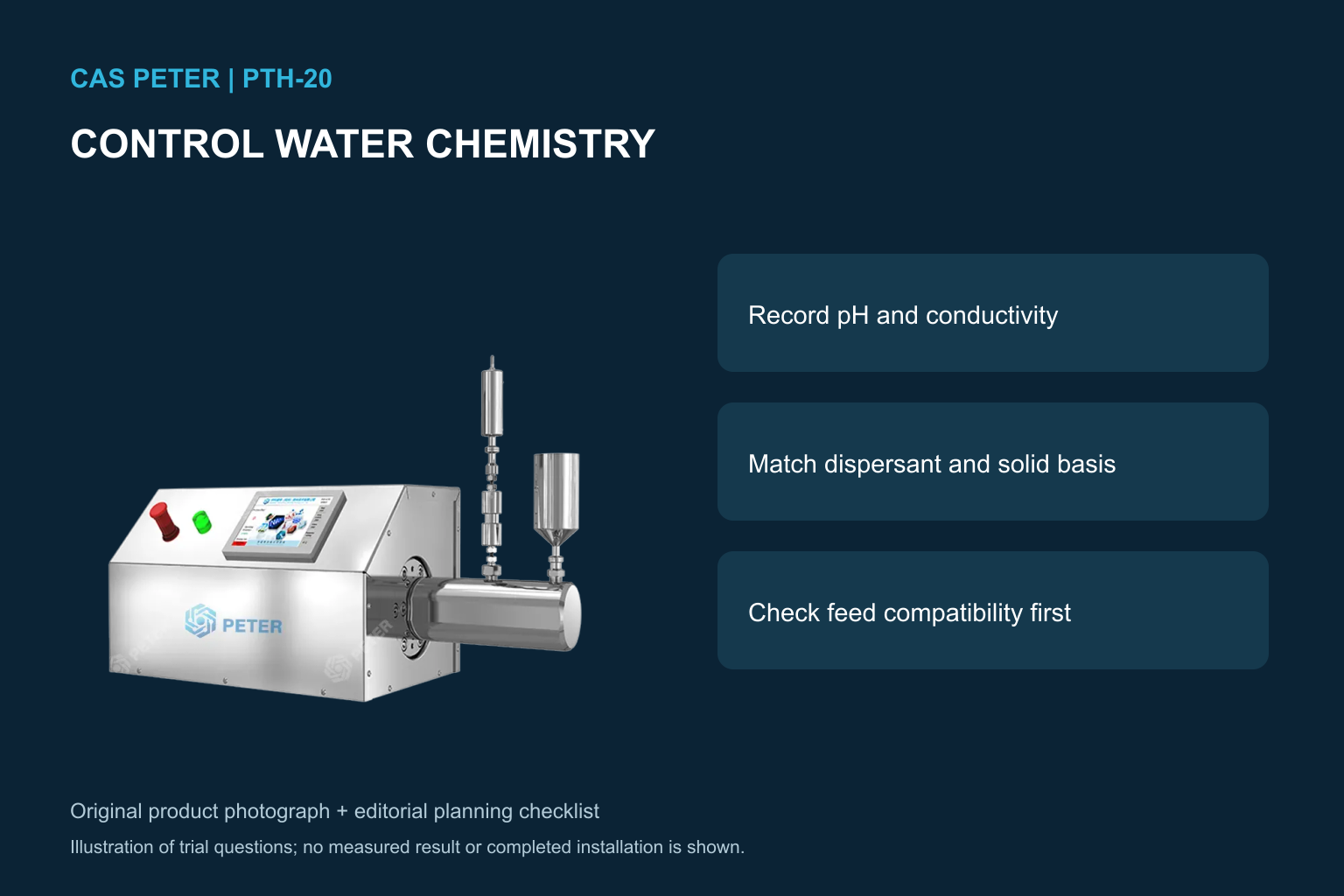
Identify the water source and record measured pH and conductivity at a defined stage and temperature. Conductivity is a useful batch-comparison indicator, but it does not identify every dissolved species. If water variation is suspected, arrange the relevant water analysis rather than interpreting one conductivity reading as a complete chemical description.
Keep the order and quantity of acid, alkali, salts and dispersant additions in the preparation sheet. If pH adjustment is part of the trial, document the agent used and any added liquid. Recheck the slurry after a defined mixing and equilibration period instead of treating the first reading as its permanent condition.
Include the final-use water in confirmation trials. A dispersion prepared in laboratory water may behave differently when blended into a process stream. Where dilution is part of the application, compare dilution in the intended water with an appropriate laboratory control. Clearly distinguish the formulation experiment from the pressure experiment.
The zeta-potential interpretation guide explains why an electrokinetic reading should be interpreted in its actual medium. It should complement flow, settling and application evidence rather than replace them with a single universal stability threshold.
Separate dispersant screening from pressure screening
Record dispersant identity, active-solids content and dosage basis. A commercial solution and its active ingredient are different mass quantities. Keep that distinction clear when comparing products or preparing a batch. Do not copy a dosage from a different mineral, water or end-use requirement and call it optimal.
A practical first screen compares formulations at the same mineral loading and preparation history. Once an acceptable feed is established, hold it constant while comparing approved mechanical-treatment conditions. If both chemistry and pressure must change together, label the work as a combined process comparison and avoid attributing the result to either factor alone.
Look for an acceptable operating region, not merely the lowest immediate viscosity. Include compatibility with downstream binders or other ingredients. A formulation that flows well in the feed vessel but fails after final blending has not solved the application problem. Keep chemical additions subject to the requirements of the intended product.
Confirm that the feed can be processed
Before a pressure trial, provide representative feed information to the equipment supplier. Ask for an assessment of solids loading, particle distribution, viscosity, abrasiveness, pH, additives and the proposed operating conditions. The presence of a model in a catalogue does not establish that every mineral suspension is suitable for its configuration.
The wetted-material and seal selection guide identifies questions that belong in that compatibility discussion. Agree on feed preparation and any restrictions before introducing material into the equipment. Trial planning should also account for cooling, sampling and the handling of retained or rejected material.
For the approved experiment, record pressure, actual flow, pass history, inlet and outlet temperature, and elapsed time to sampling. Preserve the untreated comparison under matched handling conditions. Where independent batches are available, repeat a promising result rather than relying entirely on repeat measurements from the same run.
Measure fresh and rested behavior consistently
Choose a flow method that addresses the application and document its shear history. State any preconditioning, rest interval, measurement direction and temperature. A single viscosity reading without that context is difficult to compare with another laboratory or another day.
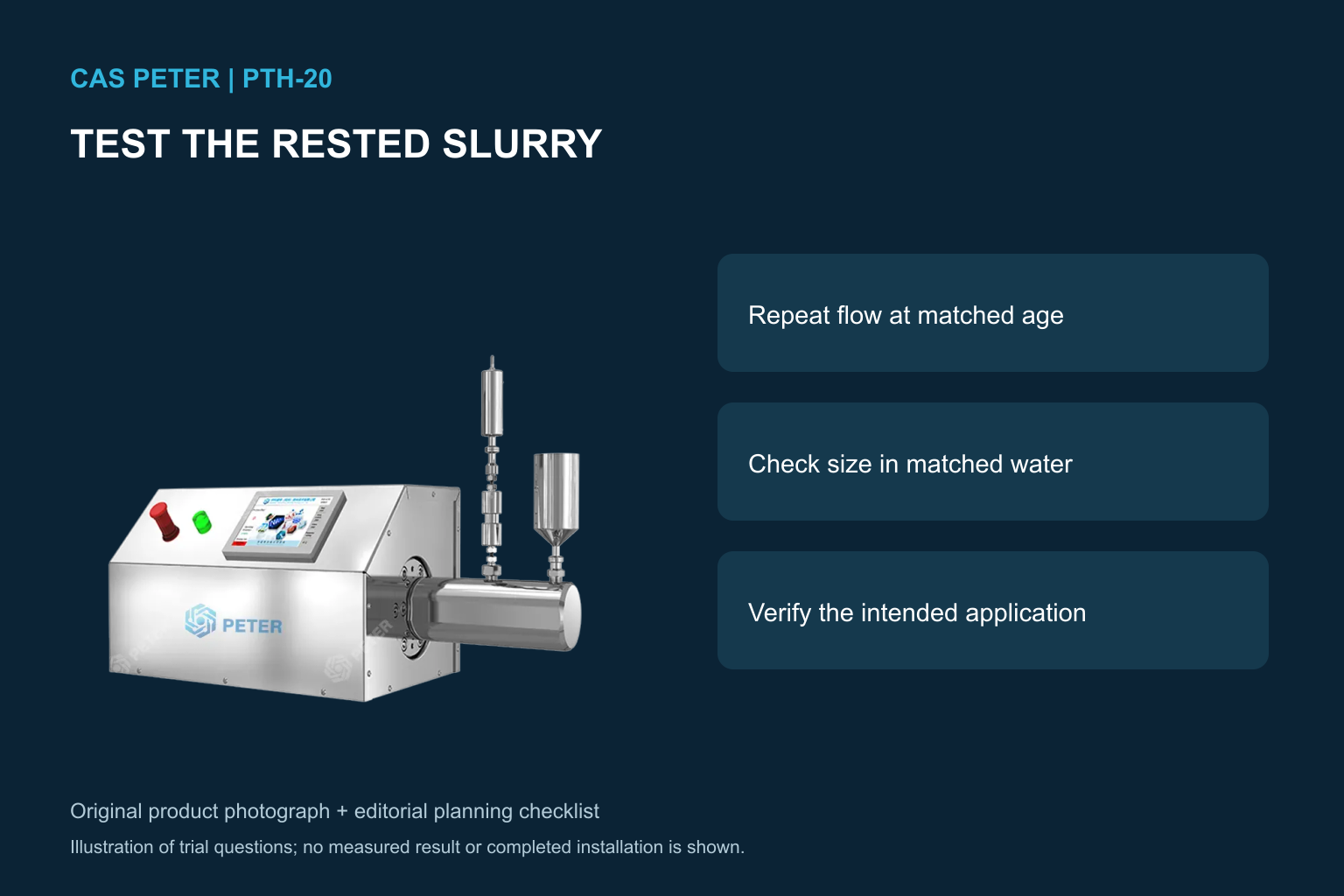
Measure the rested slurry after a defined storage or holding period. If low immediate viscosity rebounds during the expected transfer interval, that matters to the process decision. Report the time dependence rather than selecting only the most favorable reading. Keep the container and mixing method consistent when testing redispersion.
Use particle-size methods appropriate to the mineral suspension and the question being asked. State the preparation medium and any dispersing treatment used by the measurement instrument. Aggressive preparation during analysis may change what is being measured. Where delamination is claimed, seek appropriate morphology or structural evidence in addition to the size distribution.
Interpret the observations with explicit controls
The table below is a proposed decision framework, not published operating data or a specification for kaolin products. Set acceptance values from the actual application and measurement capability.
| Observed result | Alternative explanation to check | Useful follow-up |
|---|---|---|
| Viscosity decreases immediately after processing | Temperature or sample history differs | Repeat at matched temperature and defined rest time |
| Settling changes between trial batches | Water chemistry or solids basis changed | Compare preparation records and repeat matched controls |
| Particle size appears smaller | Analysis preparation changed the dispersion | Repeat using the same medium and sample treatment |
| A processed sample thickens after final blending | The application changes chemical conditions | Test the complete formulation at realistic dilution and age |
| Structural improvement is claimed from flow alone | Flocculation changed without proven delamination | Add a suitable structural measurement before making that claim |
Do not define success as the absence of visible sediment for an arbitrary short interval. Record the relevant holding period and whether any settled material can be returned to a usable state by the intended handling method. Assess the final application, such as the actual coating or formed material, when that is the commercial target.
Connect the trial to equipment selection
The CAS PETER PTH-20 product page provides a real catalogue reference for a configuration discussion. The accompanying photograph identifies that model only. It does not represent a documented kaolin installation, establish abrasive-slurry approval or demonstrate mineral delamination. Proceed only after the actual feed and proposed configuration have been reviewed.
Prepare an inquiry with the mineral grade, dry-solids basis, size-distribution record, water analysis where relevant, dispersant details, viscosity method, desired throughput and application acceptance criteria. Include the intended cleaning and sampling sequence. Request a trial plan that produces enough representative material for both immediate and rested measurements.
This NPTEL colloid-stability lesson supplies neutral background for understanding interactions in dispersions. It is not a kaolin operating protocol and does not prescribe homogenizer conditions.

Educational source: NPTEL-NOC IITM. Watch the lesson on YouTube.
Frequently asked questions
Does lower kaolin slurry viscosity prove delamination?
No. Flow can change with formulation, temperature, shear history and flocculation. Use an appropriate structural investigation before claiming that the mineral layers have separated.
Should water chemistry remain constant during a pressure comparison?
Yes. Match the water, pH-adjustment history, dispersant and solids basis across the relevant conditions. If chemistry is intentionally changed, identify it as a separate trial variable.
Is every kaolin slurry suitable for a high-pressure machine?
No. Confirm the actual feed and configuration with the supplier, including particle distribution, abrasiveness, solids, viscosity and additives. A catalogue photograph alone does not establish compatibility or an approved operating procedure.