

Sesame Milk Homogenization: Compare Whole-Seed and Filtered Beverage Stability
Sesame milk homogenization should be evaluated against the beverage you intend to sell: a filtered extract and a whole-seed drink carry different suspended solids, oil and protein into the process. A smaller average particle size does not establish that both products will resist creaming, sedimentation and separation after heat treatment. Start with a documented seed preparation and solids balance, then compare pressure treatments within each formulation. Judge the finished packaged drink using separate physical, sensory and microbiological checks. This approach makes equipment trials useful without treating a published pressure or storage result as a universal sesame milk recipe.
Define what remains in the beverage
A filtered sesame beverage loses material during extraction and filtration. A whole-seed beverage deliberately retains more of the original solids. Calling both samples “sesame milk” does not make them equivalent feeds. Before testing, record the seed lot, peeling or roasting history, soaking conditions, extraction water and any separation step. Collect the removed fraction so the team can explain where the material went.
Measure total solids and, where relevant to the product specification, fat and protein in the actual homogenizer feed. Starting with the same seed-to-water ratio is insufficient if one preparation retains sediment and another removes it. A difference in stability could arise from composition rather than from the pressure treatment. Report product recovery alongside appearance so filtration is not mistakenly credited as a homogenization improvement.
Use two questions when comparing the routes. First, which route produces the desired ingredient composition and mouthfeel? Second, within that route, does homogenization improve the finished drink? Keeping these questions separate prevents a smoother but lower-recovery extract from winning a trial intended to develop a whole-seed product.
What the sesame studies establish
The 2015 sesame milk stability study examined formulation and processing together. Its measured responses included several stability indices, particle size, viscosity and color. The useful lesson is that formulation and heat history belong in the experimental design; a pressure setting alone does not explain every quality response. Its results concern the tested system and should not be transferred to another seed preparation without checking comparability.
The 2009 sesame beverage development study examined seed pretreatment, milk yield, dispersion stability and sensory acceptance. Its preparation included removal of coarse material and readjustment with water, and used laboratory homogenization rather than establishing a pressure-processing recipe. This makes recovery and actual composition essential context when interpreting a filtered beverage. It does not validate an unfiltered whole-seed route. Here, the whole-seed comparison is a proposed development framework that must be tested, rather than an outcome attributed to that study.
These studies also illustrate why searching for one “best pressure” is unhelpful. Different feeds and process sequences create different starting points. Use published work to decide what to measure and which factors to control, then develop an approved operating window for your own beverage and equipment.
Separate creaming from sedimentation
Creaming describes upward separation of an oil-rich fraction, while sedimentation concerns material collecting toward the bottom. A drink can show both. Photograph identical transparent containers at fixed intervals and record the position and appearance of each layer. A single overall stability score can conceal whether treatment helped the oil phase but left a compact bottom deposit.
For a whole-seed drink, examine whether the bottom fraction redistributes with the intended consumer handling. A loose sediment that disperses after gentle inversion differs from a hard deposit that remains attached to the package. State the mixing procedure used in the test; “redispersible” has little value if one operator shakes vigorously and another turns the container once.
Use a fresh, well-mixed sample for composition measurements and a separate undisturbed sample for separation observations. Repeatedly opening and remixing the same container can erase the very instability being measured. Retain enough packages for destructive sampling at the planned storage intervals.
Build a controlled comparison before increasing pressure
Prepare filtered and whole-seed routes from the same seed lot when the purpose is to compare processing choices. Within each route, divide a representative batch into an untreated control and the proposed treatments. Keep stabilizer addition, hydration time and starting temperature consistent. Record processing order, because feed that waits for hours is not equivalent to freshly prepared material.
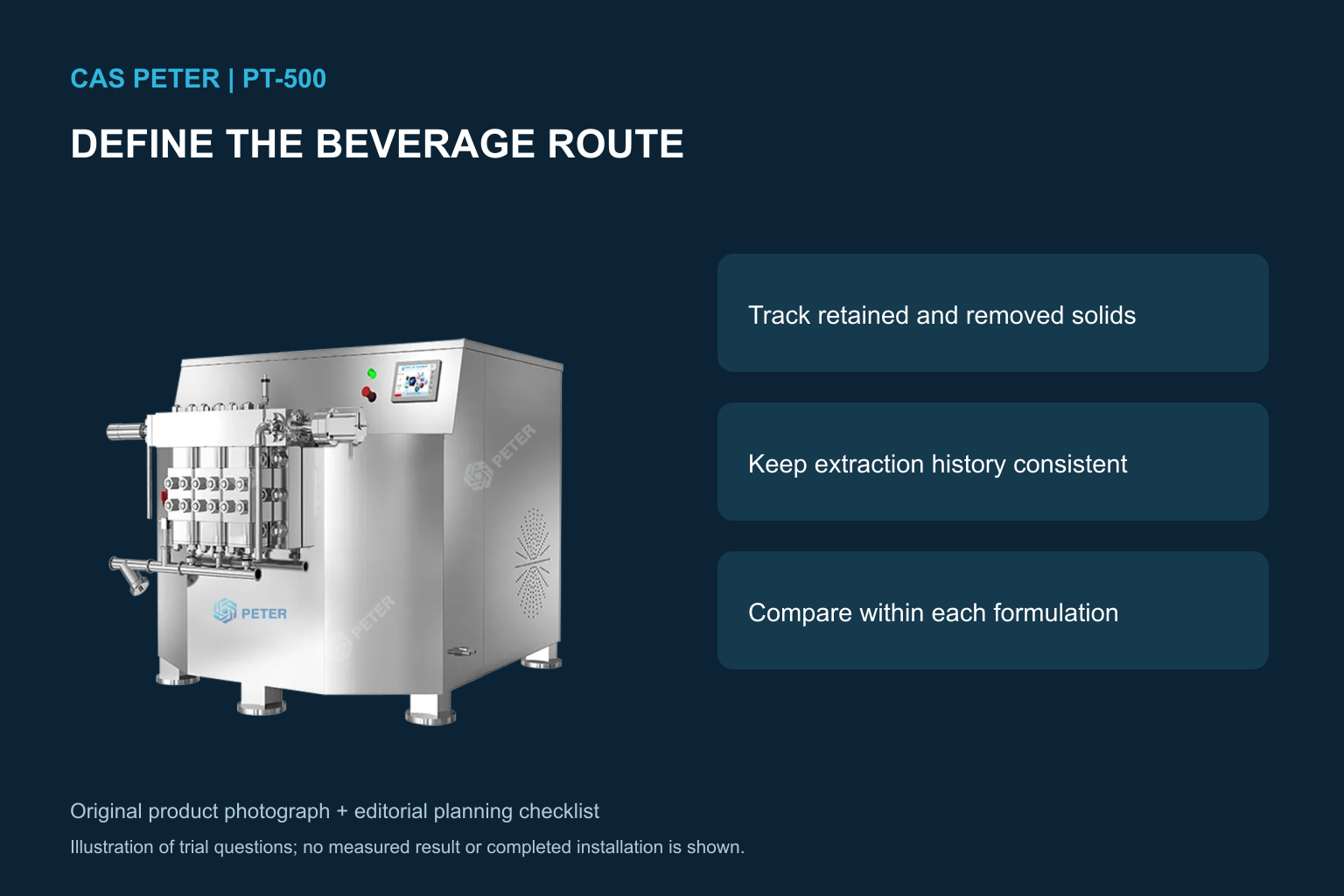
The table below is an editorial trial framework, informed by the two sesame studies. It contains no recommended pressure, preservative dose or shelf-life limit. Set acceptance criteria from the intended product specification and an appropriate food-safety assessment.
| Trial question | Keep consistent | Measure separately | What the result can establish |
|---|---|---|---|
| Whole-seed versus filtered route | Seed lot and documented extraction basis | Solids recovery, actual feed composition, removed material | Whether the routes produce comparable or deliberately different beverages |
| Pressure treatment within one route | Recipe, hydration and inlet temperature | Particle distribution, creaming and bottom sediment | Whether the mechanical treatment improves that particular feed |
| Stabilizer contribution | Processing sequence and ingredient preparation | Flow, layer formation and redispersion | Whether formulation improves the intended stability response |
| Final heat treatment | Matched beverage and packaging procedure | Post-heat aggregation, color and sensory quality | Whether a promising homogenized feed survives the final thermal step |
| Storage in the intended package | Filling method and defined storage conditions | Physical separation, oxidation indicators and microbiological results | Whether the complete process meets its validated specification |
Do not expand immediately to a large factorial experiment. First confirm that the team can reproduce the control beverage and collect representative samples. An unstable control preparation makes small differences between pressure treatments difficult to interpret. Repeat promising conditions using independently prepared batches rather than relying only on repeated readings from one sample.
Read the particle result as a mixed dispersion
Sesame beverages contain more than a population of identical oil droplets. Solid fragments, protein-rich aggregates and oil droplets can all influence measurements. State the measurement method, sample preparation, dilution liquid and reporting basis. An intensity-weighted light-scattering result and a volume-weighted distribution should not be compared as if they were the same number.
Inspect a complementary image or coarse-particle measurement when the sample contains visible fragments. If the analytical instrument requires dilution, determine whether that dilution changes aggregation or releases trapped material. A clean result from a heavily diluted aliquot may not represent the drink in the package. Keep the concentrated beverage observations alongside laboratory sizing data.
Track the broad distribution and the large-particle fraction, not just the mean. A small shift in the average may coexist with a troublesome coarse fraction. Conversely, a larger reported mean in a whole-seed beverage may reflect intentionally retained solids rather than a failed oil-droplet treatment. Interpretation must follow the product definition.
Check heat history and storage without combining endpoints
Test samples after the final heat step, not only directly at the homogenizer outlet. Describe whether homogenization occurs before or after heating and whether the process includes cooling, holding and aseptic filling. Those operations influence what reaches the consumer. An attractive intermediate sample is a development result, not acceptance of the packaged product.
Store test packages under documented conditions that represent the intended distribution route. Physical separation, flavor deterioration and microbial growth are different failure mechanisms. Homogenization should not be assumed to replace a validated preservation process. A beverage with no visible layers may still fail another part of its specification.
If accelerated observations are used for development, preserve their purpose and limitations. They can help rank candidates under the chosen stress, but they do not automatically establish the declared shelf life. Confirm the final product with the appropriate real-time and safety validation program, including the actual package and filling operation.
Include texture, flavor and practical recovery
A physically uniform sesame drink may be too thick, gritty, bitter or otherwise unsuitable for the target product. Evaluate sensory properties through an appropriate controlled procedure and connect the observations to instrumental measurements. For example, record whether increased body accompanies more retained solids or a formulation adjustment before attributing it to pressure alone.
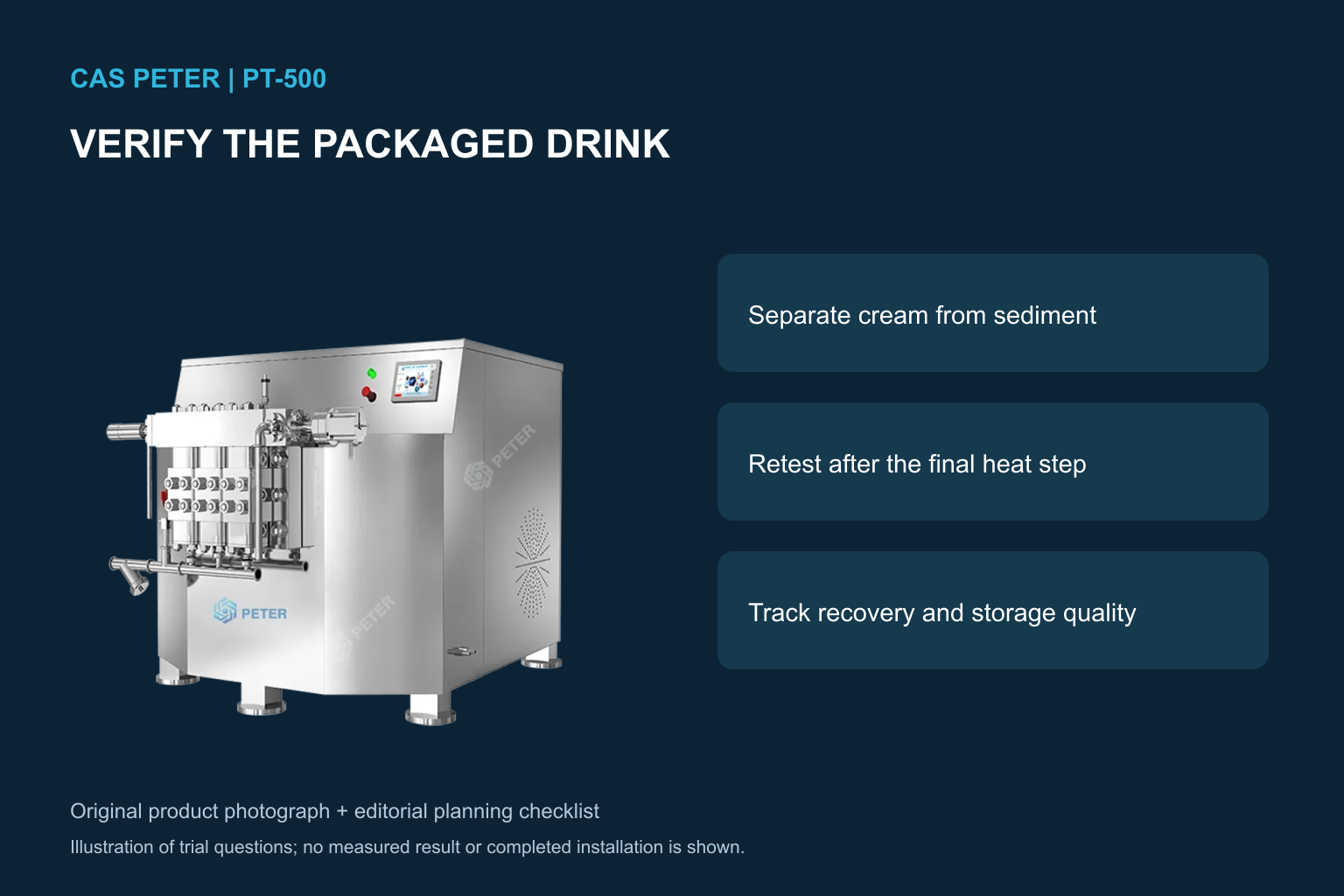
Document product retained in the feed vessel, pipework and collection system. With small development batches, uncollected material can be a meaningful part of the mass balance. Compare recovered beverage quantity and composition, not merely the appearance of the easiest sample to collect. A process that creates a desirable laboratory aliquot but poor overall recovery needs further development.
The supporting almond beverage stability guide discusses separate creaming and sediment questions, while the orange juice cloud stability guide covers another mixed plant dispersion. Use these as complementary trial-design references; neither supplies sesame-specific acceptance limits or an interchangeable recipe.
Prepare an equipment inquiry around the real feed
The CAS PETER PT-500 product page is a starting point for discussing production equipment. A photograph or model name does not demonstrate suitability for a particular whole-seed beverage. Provide actual solids, coarse-particle information, flow behavior, target batch size, temperature limits and the required cleaning arrangement. Ask the supplier to confirm the applicable configuration against those details.
Include a process sketch showing grinding, any filtration, stabilizer preparation, heating, homogenization and filling. If the route changes, update the inquiry. Whole-seed material may require different feed preparation from a filtered extract, and the acceptable feed must be established before it enters a pressure-processing system. Avoid assuming that a machine replaces upstream milling.
For broader planning, the dairy and food homogenization guide connects equipment questions to product-quality objectives. A useful acceptance trial should produce a traceable batch record, recovered product balance, agreed measurements and a clear explanation of the remaining uncertainty. That gives the buyer evidence for a decision rather than an isolated pressure-and-size demonstration.
Educational background on emulsion formation
The NPTEL lesson below explains general emulsion technology. It helps distinguish dispersed oil droplets from the other suspended components in sesame milk. It is background education, not a sesame beverage formulation, a preservation validation or a demonstration of the illustrated CAS PETER machine.
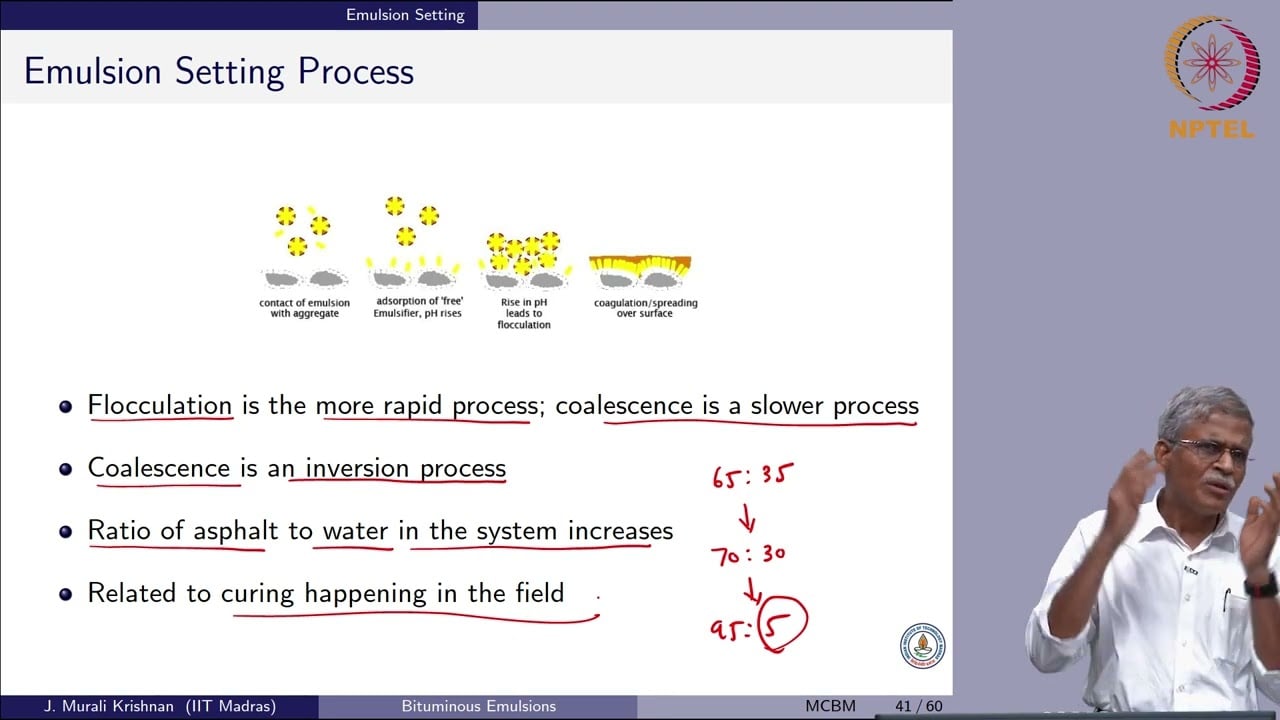
Educational source: NPTEL-NOC IITM. Watch the lesson on YouTube.
Frequently asked questions
Should whole-seed and filtered sesame milk use the same homogenization pressure?
Not automatically. First document actual solids, oil, protein and coarse material in each feed. Compare treatments within each route, then assess the finished beverages against their intended compositions and quality specifications.
Does a smaller particle measurement prove that sesame milk will not separate?
No. Identify what the instrument measured and inspect creaming, bottom sediment and redispersion separately. Confirm the result after final heating and during storage in the intended package.
Can a sesame milk shelf life be assigned after homogenization alone?
No. The cited studies do not validate an arbitrary whole-seed beverage after pressure processing alone. Establish the preservation method, packaging process and storage conditions for the actual finished product before assigning a shelf life.