

High Pressure Milk Homogenizer for Food Product Stability
When a food-process engineer in Rotterdam encountered phase separation and texture drift in a chilled dairy-food beverage, she stopped a line trial after a smooth commissioning sample formed a thin cream band and lost body during refrigerated holding. The first assumption was that the new homogenizer was underperforming. A review of powder hydration, pre-emulsion quality, inlet temperature, pressure profile, and real production duty revealed the reversal: the issue was not a bad machine, but a process window that had been selected by nominal flow instead of validated against the finished product.
Summary: A stable dairy-food product comes from a matched pressure–temperature–formulation window, not from choosing the highest available pressure. Tetra Pak describes ice-cream mix homogenization in a 50–200 bar range and notes that the setting should reflect fat type and level; that is a useful starting distinction, not a universal beverage recipe. Define the separation, texture, and shelf-life outcome first; then validate representative mix at the intended duty point and select the lowest condition that consistently meets it. ISO 13320 can support a particle-size measurement plan, but it is a test method, not a homogenizer certification.
High-pressure homogenization forces a prepared liquid through a controlled high-energy valve zone. In milk-based foods, it can reduce and redistribute the fat phase, improve uniformity, and support a consistent mouthfeel. It does not replace correct hydration, heat treatment, emulsifier selection, or hygienic control. Those upstream and downstream decisions determine whether the dispersion remains acceptable after filling, throughout refrigerated distribution, and at the end of the claimed shelf life. Teams comparing a milk line with a broader food application can also review milk homogenizer versus food homogenizer differences before transferring an existing process basis.
Where high-pressure homogenization adds value in dairy-food production
The most useful applications are fluid products in which a dispersed fat phase, proteins, sugars, hydrocolloids, or other ingredients must remain acceptably uniform. Examples include flavored milk, high-protein dairy drinks, cultured dairy bases before the relevant downstream step, ice-cream mix, coffee creamers, and dairy-food beverages with controlled added solids. The objective is product-specific: cream-line control may lead one project, while viscosity consistency, freeze-thaw behavior, sediment control, or a clean drinking texture leads another.
Ice-cream processing provides a useful reference point because its process chain is explicit. The Dairy Processing Handbook places homogenization after heating the mix to above 75°C and before pasteurization above 80°C for more than 25 seconds in its stated continuous example. Those figures are not a universal recipe for every beverage; they show why pressure cannot be specified separately from thermal history. A chilled dairy-food drink may use a different heat treatment, ingredient system, and legal process requirement, so its own validated combination governs.
Stability is a finished-product result
Pressure can alter fat-globule distribution, but the finished result also depends on fat percentage, protein state, mineral balance, viscosity, aeration, packaging, and storage temperature. A practical trial therefore records inlet temperature, actual flow, pressure stability, outlet temperature, and at least one agreed quality measure. Laser diffraction may be appropriate for some dispersed systems; ISO 13320 defines the laser-diffraction method, while the processor still needs product-specific sampling, dispersion handling, and acceptance criteria.
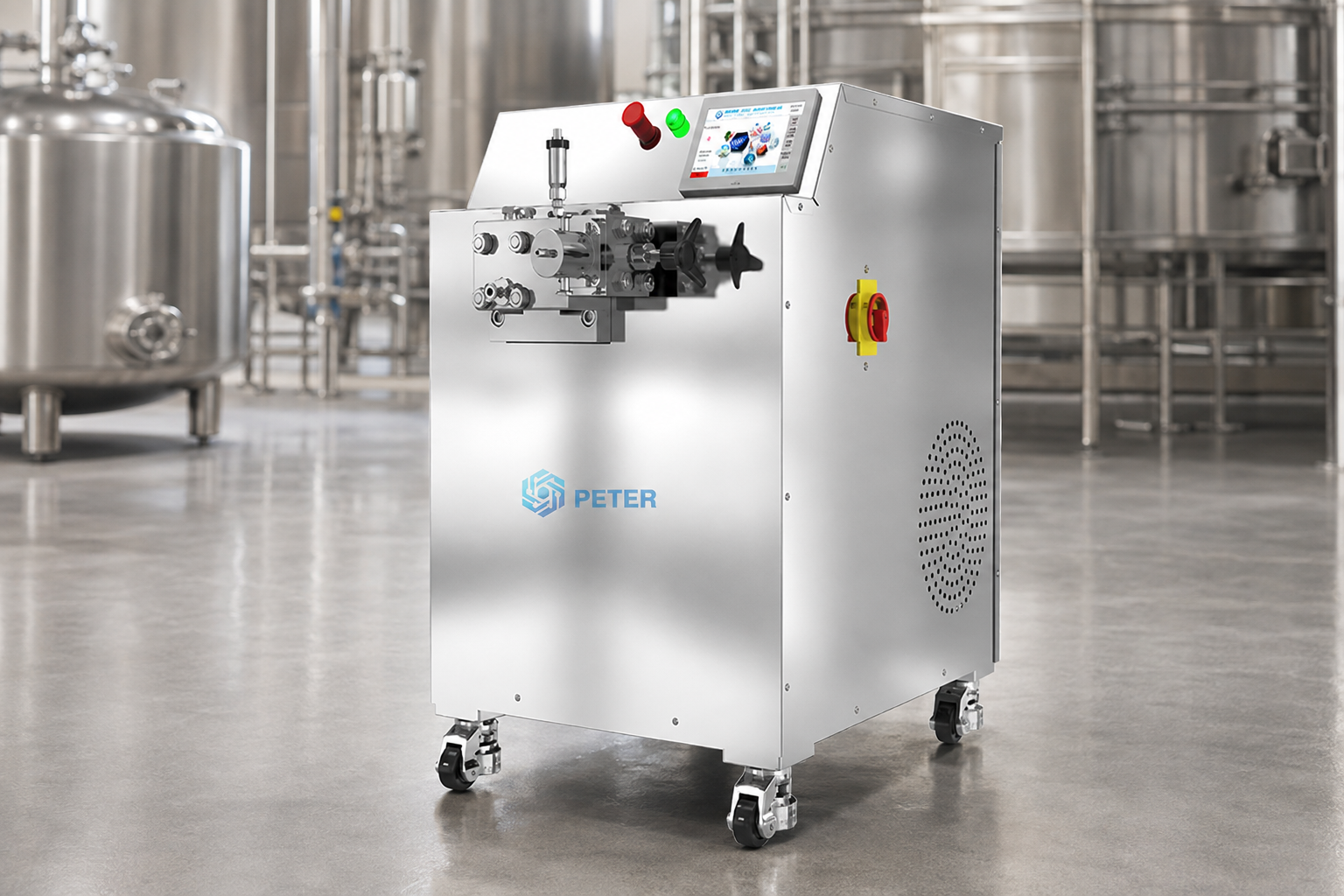
Critical settings: pressure is only one control variable
A high setting can make a formulation look improved during a short run while increasing outlet temperature, valve wear, and sensitivity to small changes in feed condition. Conversely, a lower setting may meet the stability target with less energy input. The technically responsible choice is the lowest validated setting that achieves the defined result over the intended campaign length. For a two-stage arrangement, assess the stage split as part of the trial rather than importing it from a different formulation. For a concise explanation of the valve action and process logic, see how high-pressure homogenizers work.
Start with a feed specification: minimum and maximum fat, total solids, viscosity at a stated temperature, pH, particle limits, emulsifiers or stabilizers, batch size, and expected run duration. Check the premix before the homogenizer. Undissolved powders, incomplete hydration, poor oil-in-water pre-emulsion, air entrainment, or a changing feed temperature can create symptoms that a pressure adjustment cannot reliably correct. Solids and viscosity also determine the pressure loss, pump load, and attainable flow; sizing against water-like conditions is a common route to disappointing line capacity. The documented setpoint is useful only when upstream conditions are controlled tightly enough to repeat it.
| Decision dimension | What to validate | Effect on product and total cost |
|---|---|---|
| Dispersion and stability | Particle or fat-globule trend, separation observation, sensory result | Reduces the risk of rework, rejected fills, and late shelf-life failures |
| Pressure and flow | Actual operating range at qualified viscosity and inlet temperature | Avoids sizing against water-like conditions that cannot be sustained in production |
| Thermal load | Inlet/outlet temperature and cooling margin through a full run | Protects the intended texture and reduces unplanned process interruptions |
| Cleaning and changeover | CIP sequence, chemical compatibility, drainage, verification steps | Shapes availability, water and chemical use, and cross-contact control |
| Wear and service | Valve, seal, and spare-part plan at the intended duty | Turns purchase comparison into a more realistic lifecycle-cost comparison |
DIY trials versus an industrial food homogenizer
A small development device may help a product developer explore whether mechanical treatment changes visible separation in a sample. It is not evidence that a commercial line will reproduce the same pressure profile, thermal history, cleanability, or throughput. Small trial equipment may not represent industrial valve geometry, feed behavior, or hygienic design, and it should not be used to infer market compliance or shelf-life performance.
That distinction matters during scale-up. A robust development program carries forward the variables that control the result: formula preparation, inlet temperature, pressure profile, pass count where relevant, outlet temperature, and analytical method. It then repeats the preferred condition on representative pilot material before approving production capacity. A useful retained-sample plan follows the actual shelf-life claim and includes a time-zero control plus planned in-life and end-of-life checks; the schedule is product- and market-specific. The comparison below keeps the question commercial as well as technical.
| Application stage | Primary question | Evidence before moving forward |
|---|---|---|
| Bench or DIY exploration | Does the formula show a potentially useful response to controlled treatment? | Screening observations; not a production or compliance conclusion |
| Experimental development | Which pressure-temperature window meets the defined texture and separation target? | Replicated samples, documented feed conditions, and agreed analytical checks |
| Pilot transfer | Can the result be repeated at longer run time and representative flow? | Temperature, pressure, yield, cleaning, and retained-sample data |
| Production dairy-food line | Will net output remain stable through normal sanitation and raw-material variation? | Qualified duty point, preventive-maintenance plan, and batch-record controls |
Standards and food-safety scope
Standards and regulations answer different questions. ISO 13320 concerns particle-size analysis by laser diffraction; it does not approve a machine or establish that a food is stable. The Codex General Principles of Food Hygiene set out a HACCP-based food-hygiene framework; they support a processor’s hazard analysis but do not substitute for local law or plant validation. In the United States, 21 CFR Part 117 addresses current good manufacturing practice and preventive controls for human food, while product standards and destination-market rules may add separate obligations.
Procurement documents should state the destination market, intended product, cleaning chemicals, food-contact expectations, documentation needs, and tests that define acceptance. Cleaning is not a post-purchase detail: CIP chemistry, circulation conditions, drainability, gasket compatibility, product recovery, and allergen or flavor changeover controls affect both availability and cross-contact risk. Claims such as “food safe,” “compliant,” or “validated” require a defined scope and supporting evidence. Unsupported claims can slow customer approval, confuse responsibilities between equipment supplier and processor, and expose a distributor or manufacturer to avoidable commercial risk.
How to select a system for dairy and food scale-up
- Write a user requirement specification covering the product envelope, target quality result, validated flow range, utilities, thermal controls, cleaning routine, and campaign length.
- Agree trial acceptance criteria before running samples—such as a stated separation observation, viscosity method, retained-sample protocol, and a suitable particle-size method.
- Match the feed system to ingredient behavior. Confirm powder wet-out and hydration time, pre-emulsion uniformity, shear sensitivity, and the allowable solids/viscosity range before setting capacity.
- Compare net capacity after startup, cleaning, product recovery, and normal changeovers; a nameplate maximum is not saleable output.
- Review wetted materials, valve and seal access, CIP compatibility, service plan, and the documentation needed for the plant’s quality system; then confirm the pilot-to-production scale-up basis with the actual formulation.
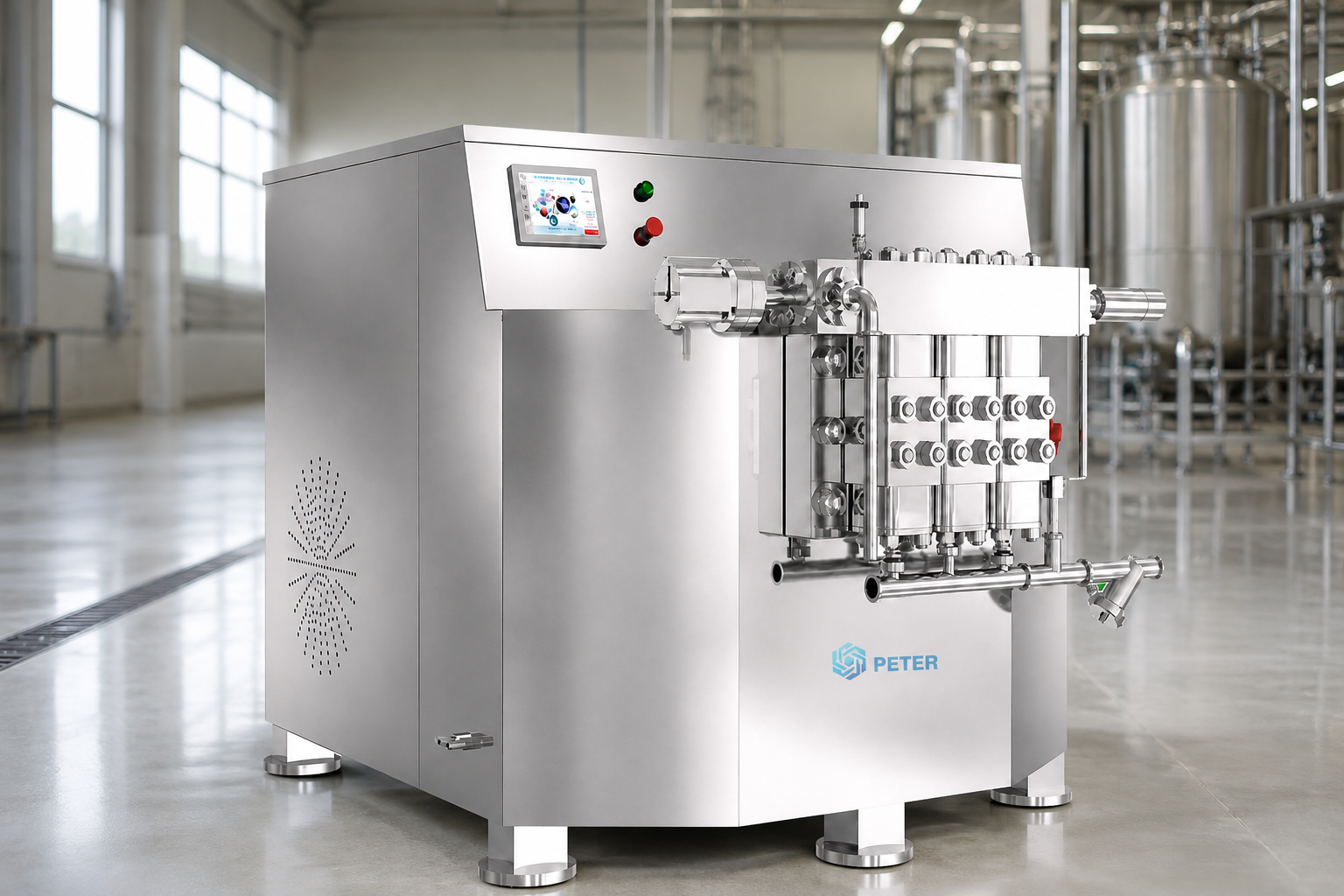
CAS PETER can be considered when buyers need a configurable, China-supplied high-pressure homogenization option and a technical discussion around representative trial conditions. For development work, the PT-20 provides a starting point to discuss a high pressure milk homogenizer configuration. Production teams can review the PT-500 as a food homogenizer machine option against validated flow, viscosity, sanitation, and changeover needs. In either case, request like-for-like duty-point data rather than a price quotation based only on maximum pressure.
Frequently asked questions
What does a milk homogenizer do to milk?
It applies controlled mechanical energy to reduce and redistribute the fat phase, which can support a more uniform appearance and help limit visible cream separation. The effect depends on milk composition, pre-emulsion quality, temperature, pressure profile, and downstream heat treatment. Confirm the outcome using agreed product-stability and sensory checks rather than a pressure value alone.
What pressure is used for milk homogenizer processing?
There is no responsible universal setting. Tetra Pak describes a 50–200 bar range for ice-cream mix and advises adjustment for the mix fat type and level; other dairy-food products need their own qualified range. Establish the lowest condition that achieves the stated target with representative feed, flow, temperature, and holding tests.
How does diy milk homogenizer affect product stability?
A small development device can indicate whether a formulation responds to mechanical treatment, but it cannot establish commercial product stability by itself. Its pressure control, heating, flow pattern, materials, and cleaning method may differ substantially from a process line. Use it only as an early screen, then confirm the result through controlled pilot trials and retained-sample testing through the intended shelf life.
What should processors check before selecting a milk homogenizer?
Check the full formula range, actual production duty, target quality tests, temperature control, upstream premixing, cleaning chemistry, wetted materials, utilities, maintenance access, and local compliance obligations. Ask for a representative trial with acceptance criteria agreed in advance, followed by holding and shelf-life checks appropriate to the product. This creates a clearer scale-up decision than comparing maximum pressure or nominal capacity alone.
References and next step
- Tetra Pak Dairy Processing Handbook: Ice cream
- ISO 13320: Particle size analysis — Laser diffraction methods
- Codex Alimentarius: General Principles of Food Hygiene (CXC 1-1969)
- eCFR: 21 CFR Part 117 — Current Good Manufacturing Practice and Preventive Controls for Human Food
In dairy-food processing, a stable product is not created by a pressure number; it is created by a repeatable dairy homogenization process that survives normal ingredients, sanitation cycles, and shelf-life conditions.
When the product, duty point, and validation plan are ready to review, contact CAS PETER to discuss a suitable high-pressure homogenizer configuration.