

High Shear Lab Mixer vs Homogenizer: Which One to Choose?
When a formulation scientist in Boston encountered a fast-creaming emulsion during a representative lab trial, she raised the rotor-stator speed and extended the mixing time. A visible cream layer still returned within minutes. The reversal came when the team stopped treating the result as a faulty mixer: the rotor-stator had made a sound premix, but the target droplet distribution required a different finishing mechanism. This illustrative scenario captures a common selection error—specifying “more shear” without defining where and how that energy must reach the sample.
Summary: Choose a rotor-stator high-shear mixer when the first job is wetting powder, breaking soft agglomerates, dissolving ingredients, or building a uniform pre-emulsion—especially when the starting particles are relatively large or the batch is not yet pumpable. Choose high-pressure homogenization only after the feed can move reliably through the pump and valve and the goal justifies pressure-based refinement. Neither mechanism carries a universal final-particle-size guarantee. Pressure processing can raise outlet temperature by roughly 2.5°C per 10 MPa in some fluid-food systems, so compare matched samples, log temperature and entrained air, and use the same ISO 13320, ISO 22412:2025, or other justified method.
How Should the Required Process Outcome Determine the Equipment Choice?
“Homogenizer” describes an outcome more often than one universal mechanism. A laboratory rotor-stator may be sold as a mixer or homogenizer, while a high-pressure unit is also a homogenizer. The useful distinction is physical: a rotor spinning inside a close stator creates localized shear and circulation in a vessel or inline head; a high-pressure pump drives a prepared fluid through a narrow valve or interaction zone, where rapid acceleration, pressure drop, turbulence, impact, and cavitation may act together.
The analytical target should govern the specification. ISO 13320:2020 covers laser-diffraction measurements from approximately 0.1 µm to 3 mm under its assumptions. ISO 22412:2025 addresses average hydrodynamic size and distributions mainly for submicrometre particles, emulsions, or fine bubbles in liquid. Neither method declares one machine “better”; both require controlled preparation and fit-for-purpose interpretation.
Write the requirement as a change in a measured quality attribute: for example, “reduce the volume fraction above a defined size while keeping product below a justified temperature,” “incorporate powder with no visible fisheyes within a defined time,” or “produce top, middle, and bottom samples that meet the same distribution criterion.” Starting-particle size, viscosity at the processing temperature, ability to feed a pump without voids, and sensitivity to air may eliminate an option before nominal speed or pressure enters the discussion.
How Do Rotor-Stator Mixers and High-Pressure Homogenizers Treat the Feed Differently?
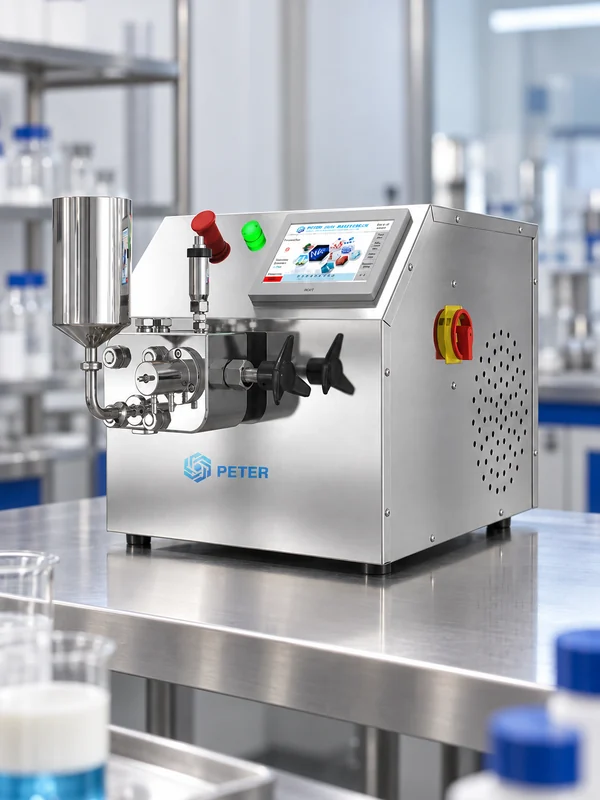
How Does a Rotor-Stator Mixer Wet Powders and Break Down Coarse Feed?
In a batch rotor-stator, the rotating element draws material into the head and expels it through stator openings. Performance depends on rotor diameter, rotational speed, stator geometry, head position, vessel shape, fill volume, viscosity, and treatment time. Tip speed can be calculated as π × rotor diameter × rotational speed, but matching tip speed alone does not preserve circulation, residence-time distribution, or power per unit volume during scale-up.
This mechanism suits powder incorporation, breakup of soft agglomerates, dispersion, and coarse-to-intermediate emulsification. The recirculating batch can accept a coarser starting dispersion than a narrow high-pressure flow path, provided the largest particles, fibers, and hardness remain compatible with the head. That does not mean every solid is safe: hard oversized particles can block screens, and abrasive solids can accelerate wear.
A rotor-stator is usually a batch operation in the lab, although inline systems exist. Powder added too quickly may form externally wetted lumps with dry cores; lowering the addition rate, improving surface turnover, or staging the liquid can matter more than adding rpm. Vortexing, air entrainment, wall bypass, and an under-covered head can make results operator- and geometry-dependent.
How Does a High-Pressure Homogenizer Refine a Pumpable Pre-Dispersion?
A high-pressure homogenizer first requires a pumpable, sufficiently pre-dispersed feed. The pump raises pressure, and the fluid passes through the homogenizing valve or interaction zone. A review indexed by PubMed describes pressure drop, shear, turbulence, impingement, cavitation, shock waves, and temperature rise as contributing mechanisms; their balance depends on valve design and the formulation.
“Pumpable” must be demonstrated at the intended feed temperature and solids condition; a viscosity value measured at one spindle speed or one shear rate may not predict inlet behavior for a shear-thinning or thixotropic material. Coarse lumps, fibers, settled solids, or air pockets can cause unstable flow, pressure fluctuation, blockage, or poor repeatability. A uniform premix is therefore a feed-quality control, not an optional convenience.
Processing is continuous through the machine, even when a finite laboratory batch is collected and returned for a second or third pass. Pressure, flow, valve geometry, number of passes, inlet condition, and temperature history are therefore more informative than an rpm value. The same review reports an outlet rise of about 2.5°C per 10 MPa for some fluids, a useful engineering warning rather than a universal correction factor. Measure the actual formulation at the actual pressure, and do not infer a final droplet or particle size from pressure alone.
How Can You Diagnose Common High-Shear Mixer Failures Before Changing Equipment?
If increasing rpm does not improve dispersion, stop changing one visible setting and audit the whole flow pattern. Confirm that the head is fully covered, the batch reaches the rotor inlet, the vessel does not trap an unmixed annulus, and the product is not pulling air. Inspect rotor-stator clearance and screen openings for wear or blockage. Highly viscous material may circulate poorly even though the material inside the head experiences intense shear.
- Persistent powder lumps: check addition rate, addition point, liquid surface renewal, powder density, and whether an outer gelled layer is shielding a dry core.
- Foam or density loss: reduce the free-surface vortex, correct head immersion, inspect suction leaks, and compare a mass-per-known-volume check before and after mixing. Do not degas only one trial arm unless degassing is part of the proposed process.
- Top-to-bottom variation: verify bulk turnover with samples from defined locations; local fineness near the head does not prove that the whole batch is uniform.
- Rapid temperature rise: separate the effect of heat from the effect of shear. A falling viscosity may improve circulation while simultaneously changing droplet breakup, solubility, or stability.
- Noise, vibration, or declining throughput: stop the trial and inspect for dry running, contact, blockage, wear, or an unsuitable solid rather than treating the symptom with a longer run.
When droplet size falls during mixing but rebounds after the mixer stops, the limitation may be coalescence rather than energy input. Check emulsifier type, concentration, order of addition, phase temperature, pH, ionic strength, and the time between processing and measurement. A longer run can worsen an unstable formulation by adding heat and air. Take samples from the same location and at the same elapsed time.
For a diagnostic study, prepare one master batch and split it into at least three matched aliquots per condition. Hold formulation, vessel, fill level, head depth, and sampling time constant; vary one process factor at a time. Use ISO 13320 where its optical model and range suit the sample, but also record viscosity, temperature, appearance, and separation over a defined interval. A narrow instrument result is not enough if the sample visibly creams or sediments.
If the rotor-stator consistently produces a stable premix yet cannot reach the required final distribution, the honest conclusion may be that it has completed its proper task. Sending a controlled premix to high-pressure processing is a process sequence, not evidence that the first mixer failed.
Which Feed Properties Can Rule a Mixer or Homogenizer In or Out?
How Do Viscosity and Pumpability Create a Practical Process Boundary?
Viscosity is not one timeless number. Record the measurement temperature, instrument geometry, shear rate or speed, conditioning time, and whether the material is shear-thinning or time-dependent; ISO 3219-2:2021 provides general principles for rotational and oscillatory rheological measurements. A high-viscosity batch may still be workable in a rotor-stator if it circulates and does not overload the drive, while a pressure system needs consistent pump filling and flow through its inlet and valve. Conversely, a very viscous batch that only spins as a plug around the head is not receiving uniform treatment.
Test pumpability with the actual formulation or a justified surrogate at the intended feed temperature. Record inlet behavior, flow or batch processing time, pressure stability, recovery, and any settling during the run. Never thin a sample merely to make a trial possible without treating the dilution as a formulation change; it may alter viscosity, interfacial chemistry, particle collisions, and the reported distribution.
How Should Starting Particles, Powders, Fibers, and Entrained Air Be Managed?
Compatibility begins with physical limits. Large or hard particles can obstruct a stator screen or high-pressure valve; abrasive minerals can accelerate wear; fibrous material may wrap around a rotor or bridge an inlet. High-shear mixing is often the more useful first step for relatively large starting particles, dry-powder wetting, and feeds that are not yet pumpable, but equipment-specific inlet, screen, and material limits still control. Screen the feed when justified, and document the screen because it changes the sample presented to the process.
Air is both a process variable and a measurement confounder. A vortex can change apparent density, foam stability, oxidation exposure, pump filling, and optical measurements; some formulations also retain microbubbles that a quick visual check misses. Record foam height or density at a defined temperature, keep vessel geometry and head depth fixed, and apply the same deaeration rule before analysis to every comparison sample.
Chemical compatibility is equally important. List wetted metals, ceramics, elastomers, and polymers, then check them against solvents, surfactants, pH, cleaning agents, and temperature. Grade, surface finish, seal geometry, and exposure time affect risk. For biological samples, also consider adsorption, foaming, loss of activity, and containment.
How Should Cooling and Cleaning Be Built into the Trial Rather Than Added Later?
Heat histories differ. A rotor-stator warms a batch progressively as mechanical energy dissipates; an ice bath or jacket can remove heat, but it may also change viscosity. A high-pressure unit produces a rapid outlet temperature rise that may repeat with each pass. Set a justified maximum product temperature, record inlet and outlet values on every pass, and cool between passes when the quality attribute is heat-sensitive.
Cleaning burden follows the flow path. Rotor-stator heads can often be removed for visual inspection, but shafts, slots, and seals may retain residue. High-pressure systems add tubing, check valves, pressure valves, and hold-up volume; a documented flush sequence and recovery study are therefore essential. Run a blank after cleaning and use a suitable assay—gravimetry, conductivity, total organic carbon, microscopy, or a product-specific marker—rather than relying on clear rinse water alone.
How Can You Compare Mixer and Homogenizer Trials with the Same Evidence?
Which Inputs Must Stay Identical for a Fair Side-by-Side Trial?
Start with one well-characterized master batch, record its initial particle or droplet distribution, viscosity at a stated temperature, density or foam condition, and stability before processing, then split it into matched aliquots. Use the same raw-material lots, formulation, sample mass, conditioning time, and temperature window. If a rotor-stator premix is required before the pressure trial, identify that premix as the high-pressure baseline; comparing a raw powder slurry on one side with an already uniform feed on the other would answer the wrong question.
Do not attempt to equate rpm with pressure. Instead, predefine the endpoint and compare each route at practically relevant settings: rotor and stator geometry, tip speed, head position, batch time, and cooling for the mixer; feed condition, pressure, flow, valve configuration, pass count, and cooling for the homogenizer. If the formulation changes with time, randomize or alternate run order so that aging does not consistently favor one route.
How Should Samples Be Collected to Reveal Batch and Run Uniformity?
A single sample near the rotor head can hide an unmixed wall zone. After a defined circulation or rest period, collect batch samples from documented top, middle, and bottom locations—or justify a validated composite—and keep sample volume small enough not to disturb later sampling. For high-pressure processing, define whether the sample represents the first, middle, or final outlet fraction, or a mixed collection vessel; also document hold-up and any material discarded during pressure stabilization. The representative-sampling principle in 21 CFR 211.110 is relevant to applicable drug manufacturing, but it does not prescribe a universal sampling pattern for every laboratory trial.
Analyze every arm with the same method, instrument settings, dispersion medium, dilution sequence, optical properties or viscosity input, analysis delay, and reporting basis. Use ISO 22412:2025 DLS for mainly submicrometre dispersed systems when its concentration and scattering assumptions are controlled; use ISO 13320:2020 laser diffraction when its size range and optical model fit. Add microscopy when shape, flocs, bubbles, or rare oversized material could be hidden by an average. For cell disruption, assay desired release and unwanted debris or activity loss rather than using particle size as a proxy.
Which Combination of Results Should Determine the Winner?
Judge the predefined quality attribute together with distribution width, top-to-bottom or first-to-last consistency, temperature history, entrained air, stability after a fixed interval, recovered yield, cleaning result, and operator time. Assess repeatability with at least three independent preparations where material allows, then challenge another day or operator. Three replicates are a useful study-design starting point, not a regulatory acceptance number; limits must come from intended use and measurement capability.
Scale-up evidence should preserve the variables that drive the mechanism. For rotor-stator systems, compare tip speed, power density, head geometry, batch turnover, and time—not rpm alone. For high-pressure systems, compare feed condition, pressure, valve geometry, pass count, flow, and thermal history. A successful beaker trial is not a scale-up claim until the larger process reproduces the defined quality attributes with the same or demonstrably comparable analytical method.
Which Technology Delivers Better Process Value for the Intended Job?
| Decision dimension | Rotor-stator / high-shear mixer | High-pressure homogenizer |
|---|---|---|
| Primary task | Powder wetting, dissolution, deagglomeration, pre-emulsion | Fine emulsification, dispersion refinement, pressure-based cell disruption |
| Operating mode | Usually batch in the lab; inline designs also available | Continuous flow through the valve; finite batches may be recirculated |
| Temperature pattern | Progressive batch warming, affected by time and cooling | Rapid rise across the restriction, repeated on multiple passes |
| Feed tolerance | Often better for initial incorporation; limited by head and circulation | Requires pumpable, pre-dispersed feed within valve limits |
| Starting particles and powders | Useful for wetting powders and reducing soft, relatively coarse agglomerates; hard-particle limits still apply | Best fed with a uniform pre-dispersion that meets inlet and valve limits |
| Viscosity and pumpability | Can handle some higher-viscosity or non-pumpable batches if bulk circulation remains adequate | Needs reliable pump filling and stable flow at the actual feed temperature |
| Final-size tendency | Often sufficient for coarse-to-intermediate emulsification or dispersion | Can pursue finer or tighter distributions in suitable feeds; no universal size guarantee |
| Air and uniformity risk | Free-surface vortex and poor batch turnover can introduce air or leave dead zones | Air can disrupt feed and pressure stability; outlet fractions and collection mixing must be defined |
| Cleaning | Accessible head, but shafts and screens require inspection | Longer closed flow path; flushing and recovery must be verified |
| Scale-up evidence | Tip speed plus power, circulation, geometry, and batch-time data | Pressure, valve, flow, pass, feed, and thermal-history data |
| TCO tendency | Lower process complexity; operator time can dominate | More valve, seal, cooling, and cleaning burden; stronger hydraulic transfer data |
Total cost should include premixing, labor, cooling, sample loss, cleaning validation, wear parts, downtime, and reruns. Build an illustrative annual model from planned batches, local quotations, and observed trial data; do not substitute a generic payback promise.
When Should You Use a Mixer, a Homogenizer, or a Two-Step Process?
| Application condition | Best starting route | Evidence to request |
|---|---|---|
| Dry powder must first enter a liquid without lumps | Rotor-stator | Wetting time, undispersed fraction, temperature |
| Stable premix exists, but final droplets remain too broad | High-pressure trial | Size distribution by pass, temperature, stability |
| Powder feed must become a fine, tight distribution | Rotor-stator premix, then high-pressure finishing if the premix is pumpable | Premix uniformity, inlet limit, results by pass, yield |
| Viscous formulation circulates poorly and is not reliably pumpable | Condition or reformulate before claiming either route works | Viscosity versus temperature and shear, torque, feed behavior |
| Foaming or oxidation is a critical risk | Trial submerged mixing and controlled surface turnover before pressure processing | Density, foam height, dissolved oxygen or product-specific oxidation marker |
| Abrasive, hard, or oversized solids are present | Pre-screen and supplier material review | Maximum inlet size, wear materials, recovery |
| Production will use high-pressure continuous flow | Premix plus laboratory high-pressure finishing | Matched lab/pilot pressure, valve, pass, and quality data |
When Is a High-Shear Premix Followed by High-Pressure Finishing the Better Route?
A two-step process is more rational than forcing a binary choice when dry ingredients or coarse agglomerates must first be wetted and distributed, but the final quality target still requires pressure-based refinement. The rotor-stator creates a uniform, pumpable feed and reduces the risk that large lumps or concentration gradients reach the valve; the high-pressure stage then applies a controlled number of passes to pursue the final distribution. This sequence is also useful when the intended production line already contains both unit operations.
Set a handoff specification between the steps: maximum tolerated coarse fraction, viscosity and temperature window, density or air limit, and top-to-bottom uniformity. Measure the premix before the first high-pressure pass, not only the final sample, so a poor result can be traced to feed preparation or finishing. If the premix already meets the stability and size requirement, the extra pressure step adds heat, yield loss, cleaning, and wear without demonstrated value.
A homogenized lab mixer result is not a recognized equipment class; it usually describes a sample produced by one of several mechanisms. Procurement documents should name the mechanism, feed condition, working volume, temperature limit, analytical endpoint, and intended production route.
Which Standards Support the Measurements, and Which Claims Still Need Evidence?
- ISO 13320:2020 guides laser-diffraction instrument qualification and particle-size distribution measurement. It is a test-method standard, not a mixer or homogenizer certification.
- ISO 22412:2025 specifies DLS application for hydrodynamic particle size and distributions mainly in submicrometre dispersed systems. Concentration, dilution, viscosity input, and multiple scattering can change interpretation.
- ISO 3219-2:2021 gives general principles for rotational and oscillatory rheological measurement. It helps define how viscosity data were obtained; it does not establish that a material is pumpable through a particular machine.
- 21 CFR 211.110 addresses in-process controls, representative sampling, and testing for applicable finished pharmaceuticals. It is not a universal laboratory mixer test and does not certify equipment.
Claims such as sterile, sanitary, GMP-compliant, food-contact suitable, or validated require defined scope and objective evidence. A wetted-material list does not by itself establish cleanability, and a particle-size test does not establish microbiological safety. Unsupported compliance language can delay supplier approval, force retesting, or create misleading product claims. Ask which configuration, document, and destination-market requirement each claim covers.
What Should R&D and Procurement Verify Before Selecting Laboratory Equipment?
- Define the endpoint. State the starting distribution, target range, stability interval, acceptable temperature, and required analytical method.
- Characterize the feed. Report viscosity versus temperature and shear condition, pumpability, solids and largest particle, abrasiveness, pH, solvent and surfactant content, density or entrained air, biological sensitivity, and available sample volume.
- Run a staged trial. Establish a controlled rotor-stator premix, then test high-pressure passes only when the endpoint or production route justifies them. CAS PETER’s homogenizer lab product page can serve as a discussion entry point; verify all limits for the actual configuration and material.
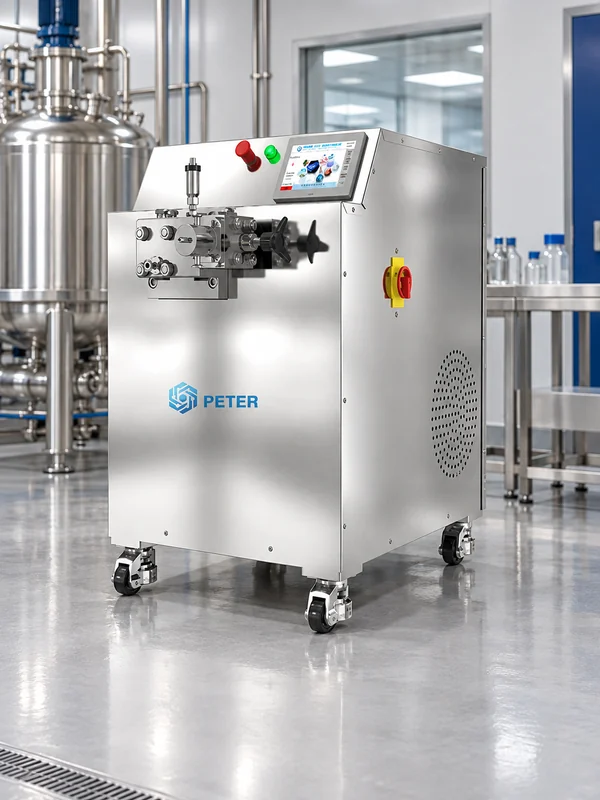
- Inspect transfer evidence. Compare matched analytical results and temperature histories across laboratory and pilot equipment. The public PT-40 pilot homogenizer page is a relevant next-stage reference, not proof that any laboratory recipe will scale automatically.
- Score ownership burden. Include premixing, cooling, yield loss, cleaning assay, consumables, preventive maintenance, operator training, and documentation. For more context, use the handheld versus lab-scale comparison and the benchtop R&D selection guide.
CAS PETER should enter the decision at this evidence stage: share a representative material description, target result, sample volume, and intended scale, then request a documented trial plan. This is more useful than selecting from pressure or rpm alone, especially when comparing high shear lab mixers with pressure-based systems.
What Do Laboratories Most Often Ask About Mixers and Homogenizers?
What is a laboratory homogenizer used for?
It is used to make a sample more uniform by reducing droplets or soft agglomerates, dispersing phases, or disrupting certain cells. The task determines the mechanism: rotor-stator mixing is often best for incorporation, powder wetting, and premixing, while high-pressure homogenization is often selected for controlled fine processing of a pumpable feed. Final size still depends on the material, formulation, valve or head, process settings, temperature, and analytical method.
How does a laboratory homogenizer work?
A rotor-stator laboratory homogenizer circulates material through a fast-moving rotor and close stator openings. A high-pressure laboratory homogenizer pumps a pre-dispersed material through a restricted valve or interaction zone, where pressure drop, turbulence, impact, shear, and cavitation may contribute. Record feed condition, pressure, pass count, flow, inlet and outlet temperature, and air behavior.
What role does homogenizer lab play in a laboratory homogenizer system?
The phrase “homogenizer lab” is a search term, not a separate component. In practice, the laboratory system establishes controlled feed preparation, process settings, sampling, cleaning, and analytical evidence before pilot or production transfer; the equipment is only one part of that method.
Which process limits should you check for a laboratory homogenizer?
Check minimum and maximum working volume, flow, pressure or speed range, inlet particle size, viscosity, permitted solids, wetted-material compatibility, maximum product temperature, cooling capacity, and cleaning access. Also confirm sample recovery, pass strategy, utilities, containment, and the conditions behind any supplier performance claim.
Which Evidence Should Pass the Final Equipment Selection Gate?
- ISO 13320:2020, Particle size analysis — Laser diffraction methods.
- ISO 22412:2025, Particle size analysis — Dynamic light scattering (DLS).
- ISO 3219-2:2021, Rheology — Part 2: General principles of rotational and oscillatory rheometry.
- Electronic Code of Federal Regulations, 21 CFR 211.110, Sampling and testing of in-process materials and drug products.
- Håkansson, Emulsion Formation by Homogenization: Current Understanding and Future Perspectives.
The memorable rule is simple: use the mixer to build the right feed, and use the homogenizer only when the target and transfer path require its mechanism. To discuss a material-specific trial, review the CAS PETER benchtop high pressure homogenizer page and contact the team with your feed properties, target distribution, temperature limit, and planned production scale.